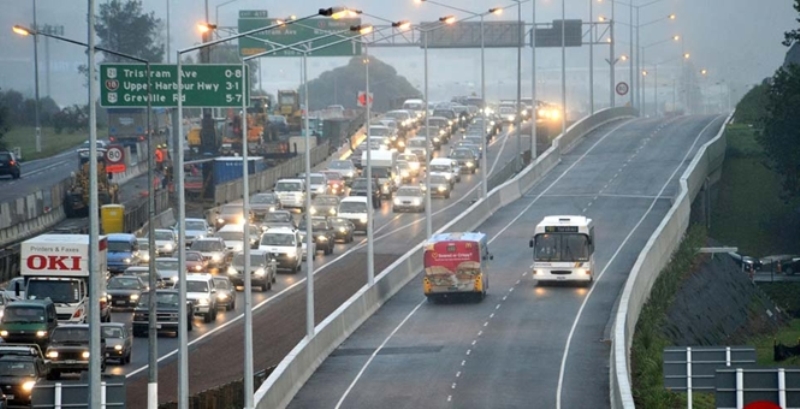
Driving Goes Down, So Tax Goes Up?
I was always taught when things got a little bit tough and demand had slid you either do one of two things: drop the price of your product to kick-start demand again, or invest in an alternative product to bring in an alternative source of revenue to bolster the bottom line.
Well someone forgot to give the Economics 101 memo to our apparent business-like minded National Government currently in power because I’ll tell you what; if a business did the opposite to the above which is what the government is doing, that would be the fastest way to bankruptcy that I have ever seen (apart from burning money).
But yet this is what our Government is exactly doing; demand on roads has basically fallen out and will continue to do so for some time to come. So what does it do, it goes and basically cranks up petrol and road user charges in order to fund this folly called Roads of National (Party) Significance which then the costs are passed along to the end person – the consumer (that is you and me). So what will happen? Well price went up so our demand goes essentially down. We travel less which means government gets even less revenue into its coffers from roads. And so the government will move the petrol tax and road user charges up again to account for the new shortfall and the cycle becomes a death spiral downwards. Now coupled with failed actual and meaningful investment into an alternative product – which in this case would be public transport/mass transit/active transit. This means the Government is not truly diversifying out its investments and not doing the actual hard yards in securing an alternative source or catalyst to revenue to bolster its bottom line.
Yes folks investment in mass transit (which I will interchange with public transport) and active transit (so cycling and walking) does actually bring in increased revenue to the government’s bottom line – just not in as obvious places such as a crude road tax. Okay there is one place obvious where government would get revenue from in mass transit – and that is the fares but for everything else it is not so obvious but it there. Providing mass and active transit is deemed viable AND affordable (which it is currently not in both cases) the extra revenue from government comes from these places (apart from fare box):
- Increased consumer discretionary spending – so via the GST take
- Lower producer costs gained from economic efficiencies in the transit system (so I am looking at mitigating congestion). Lower producer costs mean: either better wages can happen and/or again better consumer discretionary spending power (so the consumer spends more on producer goods and services), or lower producer costs (and this can be coupled with increased consumer spending as well) meaning businesses are willing to invest more causing actual economic growth (rather than the government causing it – or ruining it)
- Better quality of life for citizens. Now that means less spent on healthcare due to the environmental effects caused by congestion. So spend there means public money going else where within the state or back into the consumer and producers pockets
- Jobs. Investing into both mass transit or active transit means more jobs. People are employed as public transport services need to be expanded, and people are also employed to help maintain the physical infrastructure whether it be for buses, trains or even the walker (pounding that pavement does need upkeep). More jobs means economic growth and prosperity for citizens – which means more tax take for the government.
Now in saying all this, it does not mean I support gutting the entire road expenditure program as that would be just as backwards as what the Government is doing now with its tax and spend grab. Roads and highways still need to be maintained and that section of State Highway One north of the Puhoi tunnel needs safety improvements (and no that does not mean the Holiday Highway either). What I do mean is that a more balanced approach to spending our dwindling supply of cold hard cash needs to be done in transport investment – to roads, mass and active transit. That also means smart investment into transport that actually have benefits for the amount of money being sunk in (and yes before someone crows I know the CRL has a BCR of 0.9 but add in the other three lines that spawn off the CRL and I bet the BCR would be over 2.0) rather than being piddled on duds (most of these RoNS projects have a Benefit Cost Ratio that are less than (and this is combined too) the CRL)
And to kick (oh look even WordPress and Google recognise the term Holiday Highway) along what the MSM have to say about this tax and spend grab, lets take a look and some articles and even a cartoon :O
All from the NZ Herald
Editorial: Sacred cows fair game as Govt clings to surplus
Cartoon: Roads of national significance
So my question is: Can This Government actually Lead and Manage (I’ll leave that as an open question to interpretation)
My answer though is this:
From a Share in Twitter (original statement came from Kerre Woodham)
Ben Ross shared Kerre Woodham‘s status.
Squeezing money out of people already doing it tough just so he can meet a random arbitrary surplus figure is pure thievery.
Bill English is raising petrol tax because he wants to keep his promise of delivering a surplus. He’s blaming the fact that growth has slowed right down, mainly due to rising unemployment. It just doesn’t seem fair that he’s punishing taxpayers because he can’t do his job. Creating an environment where manufacturers thrive and can employ more Kiwis is English’s job. Making it easier for business people to do what they do is English’s job. Squeezing money out of people already doing it tough just so he can meet a random arbitrary surplus figure is pure thievery.
And from me in Twitter
@sudhvir We need NEW LEADERS, NEW MANAGERS and NEW LEADERSHIP #smartandintelligenttransport #CRL #OURFUTURE
Oh and we can not forget this “letter” to the National Government either:
A Message to the New Zealand National Government
To the Right Honourable Prime Minister John Key
Head of Government
Leader of the New Zealand National Party14 December 2012
Please have Minister of Finance – the Honourable Bill English sign the cheque for the Auckland City Rail Link – covering no more that 40% of the total project cost (so $1,440,000,000 (after inflation)) in time for Budget 2013 with the release of money being 2014 or 2015. The cheque is to be handed over to the City of Auckland for the City Rail Link mega project. Can you please have the Minister of Finance sign another cheque for $100,000,000 for the Auckland Rail and Bus Efficiency Program (again in time for Budget 2013 and the money being released August 2013) to help facilitate extra redundancy capacity in the bus and rail networks prior to the City Rail Link being open for business around 2025.
The City of Auckland with its population of 1,500,000 people will take care of the rest of details for the planning, execution and delivery of the City Rail Link plus all efficiency programs. I need not need to remind the Prime Minister that this is for the sake of the NATIONAL economy and that DOING NOTHING is not an option. All other funding provisions (the 60%) will be taken care by Budget 2013 per further works built on from this post HERE.
If one needs a hard report to back the case of the City Rail Link and efficiency programs I turn your attention to the recently completed and publicly released City Centre Future Access Report which you can read in the embeds below to save on your bandwidth (as we are still in recessionary time as the Minister of Finance keeps telling us).
With Kind Regards
Ben Ross
Card-Carrying National Party Member since 2003
We seriously folks do need: We need NEW LEADERS, NEW MANAGERS and NEW LEADERSHIP – TODAY!

 Talking Southern Auckland