
First General Overview starting with The Centres, Terraced Housing and Apartment Zone, and Mixed Housing Urban Zone
Coming back to one of the more if not the most critical issues facing Auckland – The Unitary Plan (not berms). I am going to lay down an outline in what I would like to see in the Unitary Plan when it becomes operative (eventually). Because at the moment I would rate the version that is out for notification an “F;” the same as both the Long Term Plan and Integrated Transport Plan (The Auckland Plan got a C-).
I am going to come at a more generalist approach in covering what I would like to see in the Unitary Plan before I set down into the nity gritty stuff that will end up in my formal submission. Be aware that from now until February 28th when the submission period closes I could chop and change a bit as new research and material comes to hand. It is not flip-flopping but being rather pragmatic as that new material comes to light.
Before I start with a general overview of what I would like to see in the operative Unitary Plan starting with the Centres and Residential Zones, let’s get some historic context first from my earlier feedback to the Unitary Plan.
You can find my previous feedback to the Unitary Plan here. The four particular sections that I will be drawing on are the following:
-
My Housing Mix in Auckland (general overview)
-
The Clunker and Business Zones (looks at the Centres)
-
The Clunker and Residential Zoning (looks at residential zones)
-
It is all about Height! (Looks at the issue of height across the zones and centres)
In the My Housing Mix in Auckland post I had used the Council Housing Simulator as a basic to work out the housing allocation across Auckland. From there the alternatives to the zoning and centres in comparison to what was provided in the Unitary Plan March Draft can be seen.
This is what I came up with:
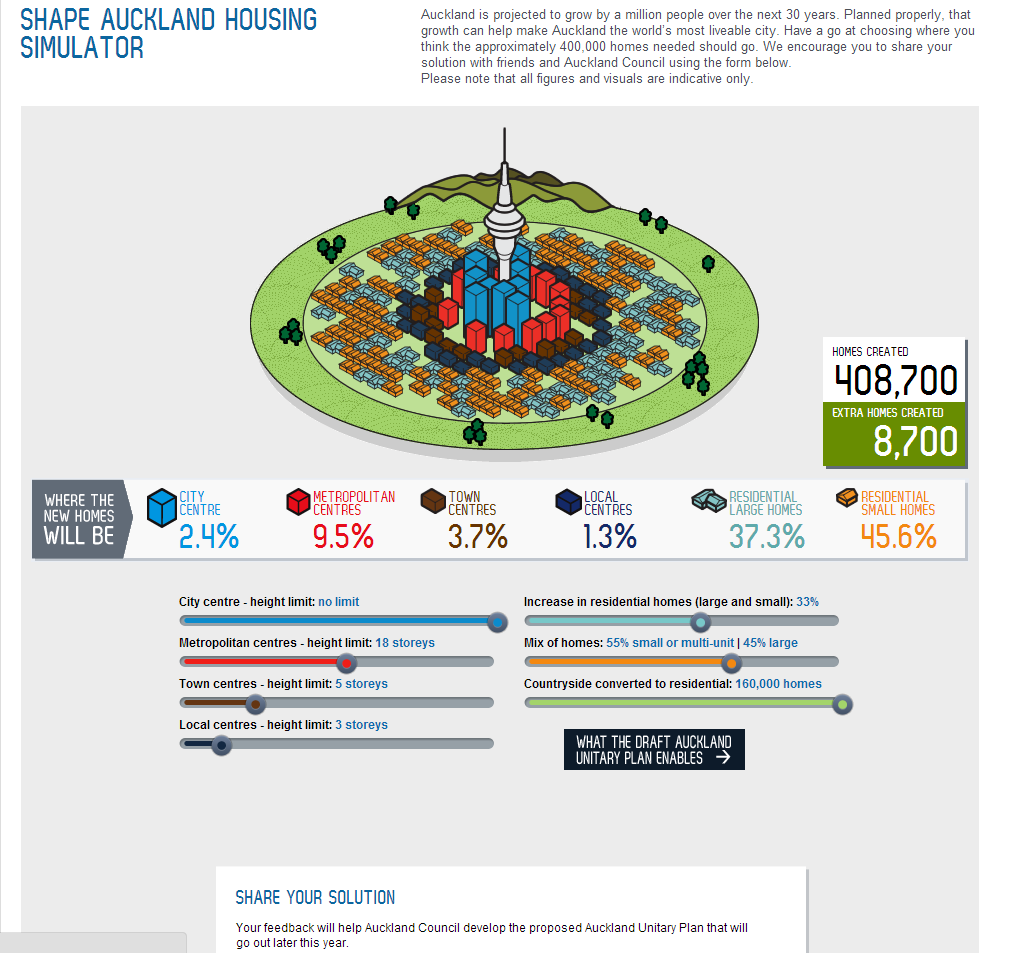
Of course that is a generalised viewpoint as I had altered around some of the heights in the Metropolitan Centres such as Papakura and Manukau City Centre. The catch though is that I used trade off’s such as dropping Papakura to 12 storeys (now 10 in the notified version of the Unitary Plan) but allowing Manukau to go unlimited in height. The trade off’s effectively allowed to balance out some changes and still stick to the allocation in the above graphic.
More detailed breakdowns of the zone and centre provisions can be found in the respective bullet points above which contain hyperlinks to the respective posts.
However, since the feedback there has been a large-scale drop out of intensification across Auckland (apart from West Auckland). This drop out will caused increased pressure for Greenfield development thus Auckland will sprawl further than planned, wanted and intended to – not good.
So here I go again trying to get the intensification back up again via my submission starting first with the Centres.
The Centres
What I had in my “The Clunker and Business Zones” section of the initial feedback stays the same (although Papakura stays at 10 storeys and Albany joins Manukau in having unlimited height). As for the zoning of the respective centres I would make some small alterations to a few like Manukau. In the Manukau Metropolitan Centre case I would extend the Metropolitan Centre zone all the way to the Southern Motorway in the east This basically includes the General Business and Mixed Use Zones where the old theatres are (now a Church) as well as Lambie Drive in the west.
The Centres would also act as central focus points for decided where the Terraced Housing and Apartment Zone, and Mixed Housing Urban Zone will also go.
Terraced Housing and Apartment Zone
This particular zone got gutted in most areas of Auckland. The main exception being West Auckland who are holding up their end of the deal for progressing a 21st Century rather than a 1950’s version of Auckland. Shame on the representatives for the rest of Auckland.
An example of the Terrace Housing and Apartment Zone being gutted was south of Manukau as shown here (between the South Western Motorway and Kerrs Road:
What the heck the Manurewa Local Board were thinking I would be bedevilled to know. That area went from Terraced Housing and Apartments down to Mixed Housing Suburban (meaning it says as is). With Manukau up for large scale growth and South Auckland also undergoing significant growth and investment (as noted here: “South Auckland – The Rising Jewel in Auckland’s Crown” hard choices will need to be made on where people are going to be housed?
There are three basic choices here:
- A flanking Terraced Housing and Apartment Zone next to the Metropolitan Zone so people can live close to a major employment centre
- Pressure on Weymouth to intensify beyond what would have otherwise have occurred
- Sprawl out even further
Weymouth was used as an example here.
I would go with Option One and have a decent enough supply of Terrace Housing Zone and Apartment next to a Metropolitan and Town Centre Zones through out Auckland.
Why?
So again people can live close to their place of work as well as allowing for a transition between a Centre and wider suburbia (often demarcated by Mixed Housing Urban/Suburban and Single House Zones.
As a rule of general thumb and where viable I would zone with 400 metres of Metropolitan Zone, 200 metres of a Large Town Centre (Papakura) and 100 metres of a Town Centre (Manurewa and Otahuhu).
However just because for example the Manurewa Town Centre might get say 5-8 storeys in the Centre Zone does not mean it will get Terraced Housing and Apartments at the same height. Using my “Refined Definitions of Alternative Zonings for the Unitary Plan table (in my UP submission) the Terraced Housing and Apartment Zone within 100 metres of the Manurewa Town Centre would be set at Medium Class Density Zone
With a Metropolitan Centre like Manukau the following Terrace Housing and Apartment Zone methodology would apply using my alternatives (as an example):
- Within 100 metres of the Metropolitan Centre Boundary: Medium Intensive Density Zone
- Between 100-250 metres from the Metropolitan Centre Boundary: Medium Standard Density Zone
- Between 250-400 metres from the Metropolitan Centre Boundary: Medium Classic Density Zone. This allows a phase down into Mixed Housing Urban Zone
The Medium Density Zone definitions being:
| Medium Classic Density Zone | Ranging from single homes through to Walk-Up Apartments and Terrace Housing
Minimum size lot for single house is 300m2 |
Up to three storeys as permitted activity. Four Storeys is a Restricted Discretionary Activity. Above four storeys is non-complying |
| Medium Standard Density Zone | Ranging from Walk-Up Apartments and Terrace Housing to 6 storey apartments | 3-6 storeys permitted. Above 6 storeys and below 3 storeys on any new development is noncomplying |
| Medium Intensive Density Zone | Ranging from Walk-Up Apartments and Terrace Housing to 8 storey apartments | 3-8 storeys permitted. Above 8 storeys and below 3 storeys on any new development is noncomplying |
Note that with Manukau it would only be the southern flanks of the Manukau Metropolitan Centre owing to industry zoning in the west and flight path rules restricting intensive development in the north. The east on the other side of the Motorway owing to bottlenecking with the road links would be restricted to Mixed Housing Urban.
I will go into specifics with the zoning later when I start playing around with the maps. But for now a general overview on how I would apply the Terrace Housing and Apartment Zone.
Mixed Housing Urban Zone
A major let down with this as a lot of this got scaled back by NIMBY’s before the notified version of the Unitary Plan went out. As a result of this pull back we are looking at the issue of either a housing capacity shortage or more Greenfield sprawl to compensate.
If I were a Planner I would apply the Mixed Housing Urban Zone in three set places on the Auckland Map:
- The entire Auckland Isthmus that is covered by Mixed Housing Suburban or already Mixed Housing Urban (the Isthmus being the old Auckland City Council area)
- Within two kilometres of a Metropolitan Centre, 1.6 kilometres for a Town Centre and 800 metres of a Local Centre for those centres outside the Isthmus area
- Set transport corridor areas such as between Homai and Manurewa using the rail line to the west, Kerrs Road to the north, Great South Road to the east and Weymouth Road to the South
The range of residential building in an Mixed Housing Urban Zone according to my alternative definitions would be:
| Low Standard Density Zone | Mostly single family homes to be built. Some infill allowed
Minimum Lot Size 450m2 |
Two Storeys Maximum permitted, Three Storeys a Restricted Discretionary Activity |
| Low-Intensive Density Zone | Mostly single family homes to be built. More intensive infill allowed
Minimum Lot Size 300m2 |
Two Storeys Maximum permitted, Three Storeys is a Restricted Discretionary Activity
Apartments and Terraced Housing are non-complying |
| Medium Classic Density Zone | Ranging from single homes through to Walk-Up Apartments and Terrace Housing
Minimum size lot for single house is 300m2 |
Up to three storeys as permitted activity. Four Storeys is a Restricted Discretionary Activity. Above four storeys is non-complying |
Note that in this case four storeys in the Medium Classic Density Zone would be a Discretionary Activity (more hoops to jump through rather than Restricted Discretionary.
Now people will get uppity about the wider expansion of Mixed Housing Urban either from pure NIMBYism to which I don’t really care – live with it, or lack of understanding – something I hope to clean up.
First of all most of the Isthmus and parts outside the Isthmus under the old legacy plans before the Super City had zoning that is effectively the same as the new Mixed Housing Urban Zone today. I kid you not. The Unitary Plan if it becomes operative as is, is more restricted to residential development via the downgrading of the zoning than the legacy plans. Most people forget that what the MHU proposes can already happen so why the fuss? If anything the MHU has stricter controls for development in place than the legacy plans so that crap building (as Bernard Orsman put is) is minimised.
With the Auckland Design Manual also now in effect the standard of residential urban development for the Mixed Housing Urban zone should improve over time. Again allaying fears of crap building.
Next you actually got have the market willing to provide the full range of housing under a Mixed Housing Urban Zone. The piece from Bob Dey explains:
Unitary plan notified Monday – and Fontein says new restrictions increase housing shortfall to 150,000
…
Market realities
It was fine for the council to tell developers where it would like them to build – enabling infrastructure efficiency, growing in convenient stages – but Mr Fontein said the reality was that intending occupiers wanted amenity, accessibility & proximity to jobs or leisure, and there was no guarantee the 2 aims would coincide.
Among the acronyms such as nimby (not in my back yard), Mr Fontein said ‘nimey’ was highly relevant to the unitary plan: it stands for ‘not in my election year’. But even if the region’s politicians hadn’t picked up on the surge of opposition to extreme intensification, statistics show the intensification target is working against history.
 Credit: StudioD4/Jasmax Housing Capacity Report
“At the peak in 2003 we were doing a ratio of 25:75 (apartments: standalone houses). Now we’re talking about spinning that around to 70:40 (more than 100%, allowing for slippage) through the cycle.”
For examples of why that wouldn’t happen, Mr Fontein pointed to cross-leases, which make it hard to aggregate sites, and a developer’s experience in looking at 500 cbd-fringe properties but finding only 140 could be developed. Owners had many reasons for not wanting to sell for development, not least of which was that they liked things the way they were.
…
Also you have the following rules from the Unitary Plan applying to a Mixed Housing Urban Zone (in fact all the residential zones’ development controls are here):
So would say at optimum levels only 40-50% of the Mixed Housing Urban Zone would be developed to its maximum potential. If it is higher than I’d say we are heading for 3 million people folks rather fast.
So it is not all doom and gloom with the Mixed Housing Urban zone. The zone offers some of the best chance of sprawl not racing away like a runaway reactor while still giving housing choice to the population.
Again I will get to specifics with the MHU once I start playing around with the maps.
Mixed Housing Suburban and Single House Zones
They if not rezoned by the above stay as is where is for now.
That caps off my first overview of what I would like to see in the operative Unitary Plan. Over time as I write my submission I will be getting down into real nity gritty stuff including playing around with the maps.
Remember folks it is the Unitary Plan we should be focusing on, not berms!
TALKING AUCKLAND
Talking Auckland: Blog of TotaRim Consultancy Limited
TotaRim Consultancy
Bringing Well Managed Progress to Auckland and The Unitary Plan
Auckland: 2013 – YOUR CITY, YOUR CALL

 Talking Southern Auckland