Busy-Busy Writing

Source: pic.twitter.com/3H0PJbMZBQ @SprawlRepairMnl
At the moment I am knuckling down busy writing my formal submission to the Unitary Plan in order to get it in by the February deadline. While straight forward in putting pen to paper (well pixels to screen) on what you would like to see in the Unitary Plan (thus Auckland over the next thirty years), the time-consuming part is the referencing back to those specific provisions in the Unitary Plan (or the maps) you are writing about. Luckily Auckland Council have left Unitary Plan submission help documents to assist – which you can find in my “Unitary Plan Submission Guide” post.
The entire Unitary Plan is too long to write on in the submission. Heck Section Three where the zones are (and I am focusing on) is 2247-odd pages and that was enough to make the eyes water let alone the rest of the Unitary Plan.
So I will be focusing on three sections of my submission to the Unitary Plan, they being:
- Parking Minimums (I also discovered parking minimum and end-of-use facilities for cycling as well which was interesting to read)
- Residential Zones and Provisions
- Business Zones and Provisions
Parking Minimums
As I believe in more liberalised planning methods with urban development, parking minimums are being mentioned to be removed or scaled back in the final Unitary Plan document. My “Free Parking is NOT Free Parking” and “Parking Free Residential Buildings” will provide the context and why I believe we should be operating in a freer market mode when it comes to parking provisions. In the end this cost-inhibitive and inefficient land use from parking by our parking minimum regulations has to stop. That said our infrastructure including mass transit needs to be also up to speed as well.
Residential Zones and Provisions
This is getting straight out opposition from me in my submission to what is in the Unitary Plan that covers both the Residential Zone provisions (the rules) as well as the maps (wrong zoning). For the provisions they are too complex, too hindering, and too broad in what can be provided in most of the residential zones (for example the Terrace House and Apartment Zone is a blanket zone that needs to be broken into sub-zones to recognise the difference between low, mid and high rise blocks – all which have different applications). Thus as a result you get unintended extra costs added when trying to provide residential supply for a growing Auckland. We have the Auckland Design Manual which guides good urban design practice when developing so the over-prescriptive rules (often development controls) in the Unitary Plan for residential zones can be liberalised and scaled back. Do that and you should have some affordability returned back to the housing market. And before someone mentions the rabbit hutch apartments in the CBD, they were caused by over-prescriptive rules from the Banks and Hubbard regimes – NOT from liberalised planning regimes.
As for the maps I have the Isthmus and Southern Auckland in my sites for mapping changes. For the Isthmus I am pondering whether the entire old Auckland City Council area have the minimum zoning of Mixed Housing Urban (which would bring it just about into line with the existing legacy District Plans) and widen the Terrace Housing Apartment Zoning in some areas. Before I get people jumping on me about it please remember we have the Overlays and Precincts which can add protection measures for areas such as historical areas. However, at the end of the day cities grow and evolve and nothing stays constant on this Earth. No point bottling the natural progression of suburbs as new people move in, old people move out, and requirements change as Auckland continues to evolve. Yes I do get cranky with those who outright resist change as the City is not a museum piece in a snow globe. As for South Auckland I am looking at some minor changes mainly south of Manukau and west of Wiri.
Business Zones and Provisions
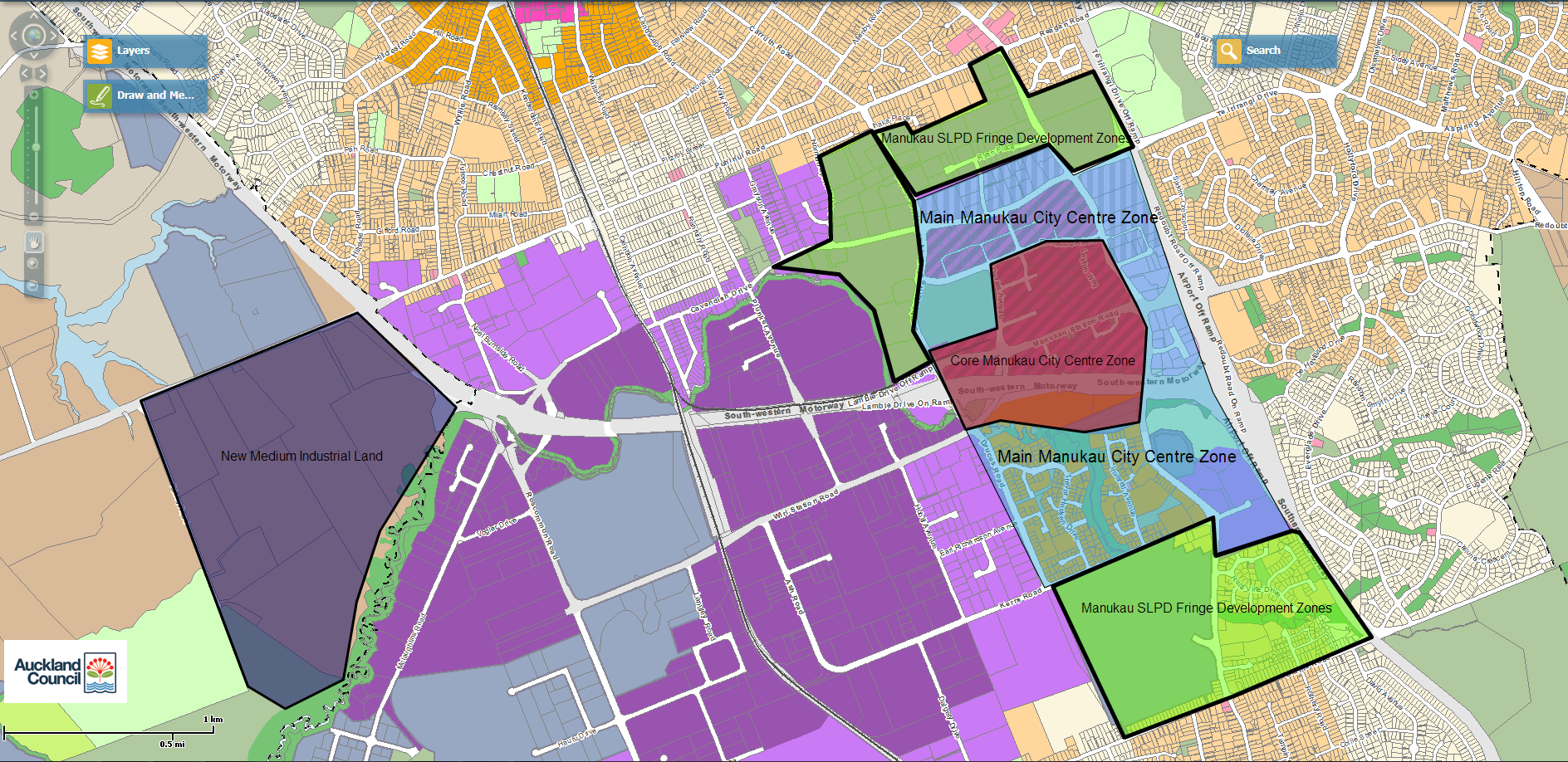
Nothing too big here with just two changes being sort after for the final Unitary Plan document. The first is taking Sylvia Park out of the Metropolitan Centre class and placing it to either Mixed Use or even General Business use. Sylvia Park is nothing but retail and has a very long way to go before it evolves into a true Metropolitan Centre like Manukau and New Lynn. The next is inserting of the Super Metropolitan Centre Definition into the Unitary Plan to recognise our two second tier centres in Auckland (they being Manukau City Centre and Albany). At the same time I will be requesting the Manukau (Super) Metropolitan Centre Zone be widened and height restrictions removed from it.
The definition of Super Metropolitan Centre that I would like inserted into the final version of the Unitary Plan will be pasted further down the post.
This part of the submission though is drawing on comparisons made by Auckland Council Property Limited and their 2011 “Auckland Council Property Limited Outline” while also drawing on previous commentary I have written up like my “21st Century Auckland Booklet” material.
So while only covering those particular three sections of the Unitary Plan it is still enough to write on for one’s submission. My final version of my Unitary Plan submission will be posted to the blog on March 1 after the submission period closes.
Super Metropolitan Centre Definition
The Super Metropolitan Centre is the second highest in the centres hierarchy after the City Centre zone. While the City Centre zone recognises the pivotal role in Auckland’s present and future successes, the Super Metropolitan Centre can also play such a future pivotal role.
More intensive than a Metropolitan Centre in development and catchment but less so than the City Centre Zone, the Super Metropolitan Centre will act as smaller scale complementary regional hub and international centre (based around the Pasifika concept) in: business, learning, innovation, industry, entertainment, retail and hospitality, culture and urban living.
Like the City Centre; to improve the vibe of the Super Metropolitan Centre environment, the zone permits a wide range of activities to establish in most parts of the SMC. The zone also manages activities that have the potential to adversely affect the amenity of the Super Metropolitan Centre. The Unitary Plan enables the greatest level of development in terms of height and floor area to occur in the Super Metropolitan Centre as well as the City Centre. Within the Super Metropolitan Centre itself, development potential is concentrated in the core central business district. Development potential reduces towards the ridgeline (Redoubt Hill) and transitions to lower heights towards its northern flanks (bordering Papatoetoe), southern flanks (Manurewa/Browns Road) and western flanks (Wiri industry and Auckland International Airport).
Again like the City Centre; the Super Metropolitan Centre zone manages the scale of development in order to protect important, sunlight admission to parks and public spaces, and significant views to the volcanic cones and other landmarks. The significant height and scale of buildings in SMC increases their visibility from many places, affecting the quality of both public and private views at local and citywide scales. In addition to managing the scale of development, the zone manages the quality of building design to ensure new buildings successfully integrate with the SMC’s existing built form and public realm to create an attractive and recognisable skyline.
The Super Metropolitan Centre makes an important contribution to our sense of identity whether it is international, national, regional or sub-regional in sense identity construction.
A Super Metropolitan Centre does have comparisons also with the lower order Metropolitan Centres in acting as hubs for a wide range of activities including commercial, leisure, high density residential, tourist, cultural, community and civic services – just on a more intense level than an existing Metropolitan Centre but not as intense as a City Centre Zone as mentioned above.
In further reinforcement to the urban-scape of the Super Metropolitan Centre while still recognising its higher order hierarchy, the SMC again must have some street frontages within the zone are subject to a Key Retail Frontage or General Commercial Frontage overlay. Key retail streets are the focal point of pedestrian activity within the centre. General commercial streets play a supporting role. Development fronting these streets is expected to reinforce this function. Rules for the overlay are incorporated in the zone rules. New development within the zone requires resource consent in order to ensure that it is designed to a high standard which enhances the quality of the centre’s public realm. This recognises that the Super Metropolitan Centre is a blend of the higher order City Centre zone owing to sense of identity and greater intensity of development, production and catchment; as well as the lower order Metropolitan Centre zone in the fact an SMC still will act as the “sub regional community” (as well as wider regional) “place” as well.
In saying that a Super Metropolitan Centre could be viewed as a complementary City Centre area in-lieu of the existing City Centre Zone by some as part of their sense of identity attached to the SMC.
Click for full resolution
Source: https://voakl.net/2013/07/17/what-do-you-want-to-see-in-your-super-metropolitan-centre/
Reference Material
Auckland Council Property Limited Outline
21st Century Auckland Booklet
The Draft Auckland Unitary Plan Feedback Submission

 Talking Southern Auckland