Submissions and How they ‘Influence” Council Policy
In the “Civics 101” post I outlined some first steps for those who wish to interact more with Auckland Council.
Interacting with the Council as seen in Civics 101 is one way to be kept abreast of Council policy as well as influence. But there is another way – a more formal way of “influencing” Council policy and that is through the submission process that occur on a regular basis. And in this post we will be looking at the submission process otherwise known as Civics 201
Civics 201
From time to time Council and the Council Controlled Organisations (usually Auckland Transport) will seek written feedback and/or submissions on plans and policy directions.
To provide clarification:
- Feedback: all other correspondence being sort after by Council or a CCO via various means in an “informal” matter. This can range from surveys at the most basic to the Draft Unitary Plan feedback round including Civic Forums early last year.
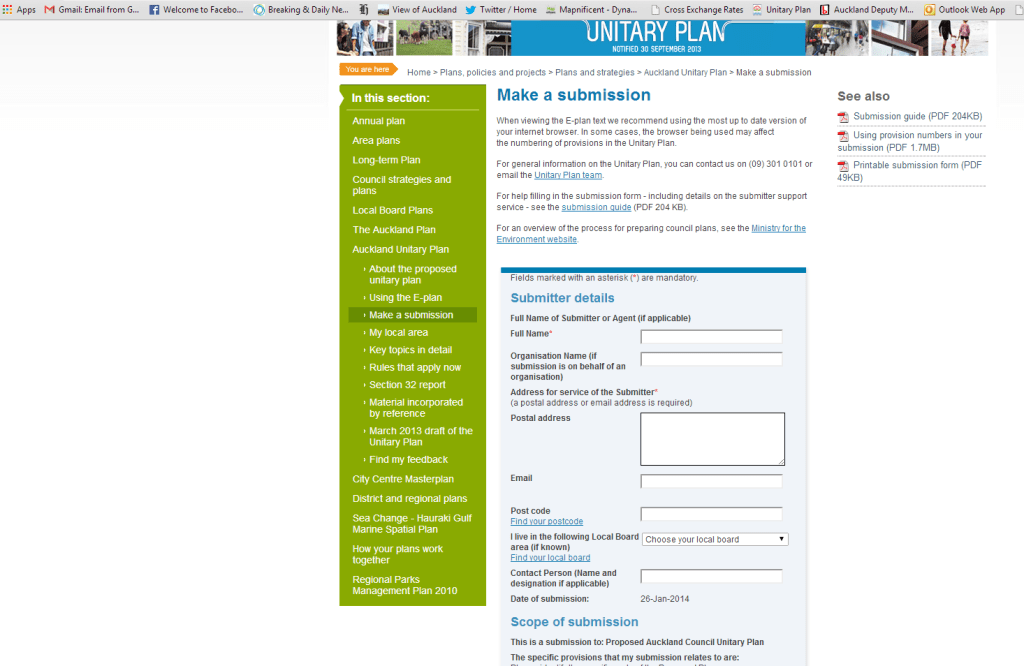
- Submissions: formal documents sent from us (residents, businesses, associations, the CCO’s, and even Local Boards and the Governing Body) back to the Council (or CCO’s) in dealing with formal policy issues. These include the current Unitary Plan, submissions being called for, submissions for the Annual Plan, and later this year the Integrated Transport Plan as well as the Long Term Plan. Submissions are governed by the respective legislation to which they are being written on. For example the Unitary Plan submission process is governed by the Resource Management Act 1991 and subsequent amendments. The Annual and Long Term Plans are dealt with by the Local Government Act 2002 and 2009 (for Auckland), the Integrated Transport Plan falls under the Land Transport Management Act and subsequent amendments. By governed I mean the set processes that must be followed in writing a submission, what can be written, the hearings process, and the deliberation process by the Council or the CCO. Submissions are treated in much the same way submissions to Central Government are treated. An example of the governing process of a submission is the current Unitary Plan notification process. My Unitary Plan Submission Guide has outlines from Council on the Unitary Plan submission process.
Feedback (unless it was something as extensive as the Unitary Plan last year) I won’t be covering as they are usually straight forward. What I am more interested in is the submissions and longer forms of feedback (like the Unitary Plan) and how to get best bang for your ‘buck’ out of them – if you are serious on wanting to be a part of how governing Auckland works through the submission process. While I will not dictate what you actually write in your submissions as your views are different to my own, I will offer some guidelines outside of the Council ones to assist in writing a robust submission to the Council and CCO’s. These guidelines I offer work for both the “online” submission where you fill in the boxes on the Council website (see below) or a “full” submission where you write it from scratch (my Auckland Plan submission being one, and Draft Unitary Feedback Plan being the other). One form of “submission” I will never endorse to the point of condemning it is the Pro-Forma method of feedback.
Pro Forma’s are a standardised form created by someone with pre defined questions that lead into often predefined answers (usually in favour of the person or the group). A certain group of people from a particular area of the lower North Shore did this as a method of feedback to the Unitary Plan last year rather than encouraging individual and individualised submissions. They were warned about pro-forma and the chilling effect it can have. Individualised submissions are treated as that – individual submissions, pro-forma’s are treated as just one submission. Meaning as the lower North Shore found out (the hard way) they had a few hundred if not maybe a couple of thousand pro-forma forms filled out but the Council only treated it as one collective submission rather than individual submissions. For me personally I treat pro-forma’s with disdain compared to individualised submissions (whether full or from the online section) owing to time and effort put into them compared to tick the box. However, I’ll leave it at that and move on to some guidelines.

Guidelines to filling in an effective submission form
First of all read what the Council has put as guidelines for the respective submissions for the respective plans calling for those submissions. The Draft Unitary Plan and the Annual Plan 2014/2015 each have their guidelines. Again for example with the Unitary Plan:
What is involved in making a submission:
• ask yourself how the Unitary Plan will affect you and the things you want to do on your property or in your business. Alternatively, think about what it means for your neighbourhood or Auckland as a whole.
• use your submission to provide information that you wish to be considered during the decision-making process
• your submission needs to identify the impact the unitary plan will have and say why you support or oppose it.
• if you are seeking specific changes to provisions it is important you clearly state what you want the provision to be amended to. Council cannot make assumptions or ‘read between the lines’
• be clear about the actual provision number in the Unitary Plan that you wish to submit on. Use the table of contents to provide the complete reference number, for example:
– for an objective – Part 2 Chapter D,1.1.4 objective 2
– for a rule – Part 3 Chapter K, 5.11.4.3.
• if you want to cover a series of issues, use bullet points
• it is better to cover all the issues you want to raise in one submission so that your consolidated comments can be reviewed as a whole
• get your submission in well before the closing date and time, which is 5pm, Friday 28 February 2014
• say whether you want to speak at a hearing
• please ensure your submission only relates to the Proposed Auckland Unitary Plan and does not contain comments relating to the other council submission processes that may be happening at the same time, for example the annual
plan or bylaws.
You don’t have to be an expert to submit on the Unitary Plan, but you do have to make your submission relevant to
the proposed provisions and clearly state which provision you are addressing.Source: http://www.scribd.com/doc/200806302/Unitary-Plan-Submission-Guide
As it said you do not have to be an expert like a Planning consultant but your submission does have to be relevant to what is being proposed. And this is where people get caught out especially in later hearings. Basically if in doubt ask your Local Board, Councillor or the contact links provided by the Council. Something that can also help the creative juices flowing is talking about it with your friends and family (if they are up for it) in casual or serious conversations. It is a good way to bounce and contest ideas before putting pen to paper or pixels to screens. Often (as I discovered) something is brought up that you might have not thought of but is a good idea. If that is the case and is relevant to the submission then put it down. That said working together on your submissions does help and if you are nervous about presenting in a hearing then grouping up together to present (if your submissions are similar) I would recommend.
Hearings
Note: I refer to hearings held by the Council itself and NOT the hearings before the Commissioners for the Unitary Plan
If you tick the “yes” box for hearings the Council (or Auckland Transport) will arrange a time for you to present your submission to a hearings panel. By that I do not mean the ones where you sit around the table with eight other members of the public, a Councillor if you are lucky, and a couple of officers and have a chat about what you wrote in your submission to whatever plan. Those kinds of “forums” (as they are called) do honestly and deeply annoy me to a great extent. Call me selfish but after taking the time and effort write an individualised submission I expect my 10 minutes to present my case to the Councillors SOLO! If I want to have a forum type of discussion I would do so as a stand-alone rather than as an extension of the submission I wrote. The Civic Forums before the Unitary Plan feedback session kicked off was a good one to formulate ideas with other citizens before finally putting pen to paper.
Back to the hearing where it is you before (if it is the Council rather than Auckland Transport) eight to twelve Councillors.
Now this sounds daunting but in all honesty it really isn’t – trust me on this 🙂 . The hearing is effectively you giving the summary of key points of your submission to the Councillors (or members if Auckland Transport). This is your moment in the spotlight to put your key points to the Councillors. Thus to be effective remember these pointers:
- Note the time frame given to you to present by the Committee Chair. This time frame is also given to you in your confirmation email sent prior to when you are due to present. DO NOT GO OVER IT UNDER ANY CIRCUMSTANCES! Sorry for the caps but if you want to make your presentation effective then abide by the time given. Otherwise you will have no time for questions to be asked by the Councillors back to you – thus entering a dialogue with them over your submission. So if you are given 10 minutes presentation time you will usually have 5-6 minutes outlining your main points with the remainder of the time for questions – not 10 minutes giving your presentation and no time for questions (and don’t get cranky with me if you waste your 10 minutes presenting then get dismissed with no questions asked as you did not manage your time properly (something I see all too often at the hearings)
- When giving your presentation to the hearing panel the main purpose is to emphasis your main point made in your written submission (all written submissions should have a main point to which all other points and research come off it, if not then you need to rewrite or alter your submission style). The Hearing Panel members have your written submission in from of them and often highlighted with your points of interest so no point rehashing it like I have again seen so many do. Tip: to make sure you stay within your 5-6 minute time slot so that you can get questions your main point emphasis should be: What the main point was, and why it is a main point. Usually when you focus on that you will cover whether you support or oppose something, why so and what alternatives you would like to have in place.
- Forget Power Point presentations in hearings as they are cumbersome and distract the panel members. Instead run your supplementary material (as it will often have your prompt notes) on paper which can be handed around (usually) to the panel if your forwarded it a couple of days in advance. With that supplementary material remember some basic golden rule of thumbs:
- Text is bad, white space and pictures/graphics are good
- At the absolute maximum you should run on the page: 1/3 text, 1/3 white space, 1/3 pictures! Anything more and it is cluttered and too hard to understand. My Manukau presentation is a classic example – although this was set for a full deputation at the Auckland Development Committee
- You have a maximum of six minutes so no more than six pages of paper (supplementary material) – effectively one page a minute. Keep it simple otherwise you both run the risk of going overtime and confusing the hearing panel
- In a hearings panel there is no point running a supplementary booklet such as the one I ran with my Manukau presentation last November to the Auckland Development Committee (see the upcoming Civics 301 post). All your information should have been in the original submission
- Do not belittle nor insult the hearing panel not matter how angry you might be with the Council for whatever reason. Being direct is fine when required but insulting and belittling is a no-no. Put it this way how would you feel if the roles were reversed and you the Councillor being insulted or belittled. Probably the same way that person is feeling who you just did insult or belittle. No progress is either made that way either so effectively you are wasting time
- Play the ball not the man. This is an extension of the last bullet point if you are critiquing policy or Council actions. If you are going to critique then I would highly recommend when presenting to give a solid alternative and researched reason why rather than trying just the NIMBY approach. I can speak from experience with this bullet point after I heavy critiqued the Southern Initiative and the Mayor late last year after a question from Councillor Chris Darby on engagement. I did get pulled in by the Deputy Mayor while laying down the fire/critique however, when I was laying down that critique to the Mayor who was present when I did it I was playing the ball (that is critiquing the lack of communication and interaction methods of the Southern Initiative) rather than the man (the Mayor himself and saying something like him being inept (note to Council I did not say that at any time – this is an example of what not to do)).
After the Submission Writing and Hearings Phase
Once you have made your submission and attended a hearing panel two or three more things will occur. The first being you get a thank you letter and sometimes an outline of information presented at the hearings. Second is the relevant Committee (if Council) will meet at a later date to deliberate the submissions and material from the hearings. This is where the main contesting of ideas between the Councillors, the Mayor and the Local Board will occur with the final outcome being a set of recommendations. Those recommendations are subsequently passed up to the Governing Body where by the final vote are set as policy thus in stone. Once that is done another letter might be sent out outlining the final decisions and what is being implemented as Council policy (this also applies to Auckland Transport).
The above is by no way an exhaustive list on how to deliver a successful submission and/or hearing panel presentation. But it should give some pointers to prevent some failures I see all to commonly especially in hearings and presentations. Remembering submissions and the subsequent hearing panels are the more formal way of trying to “influence” Council policy.
Also please do remember from my Civics 101 post that while Council is obliged to listen – they are not obliged to “listen” (that is action what you have said or submitted) per-se. Remember at most given times our Local Government democracy will operate in contesting ideas before settling on a final one and running with it. That said one thing to watch for is when there is as tendency to fixate on one idea and the Councillors run with it without any other due consideration – i.e they are rubber stamping. Also sometimes it can take a great deal of time to get ideas up on to the main stage and the Council as a whole starting to run with it. It took Manukau three years to get onto the plate and rolling – so patience is something you might need in large quantities if you want a good cause to go through the motions.

 Talking Southern Auckland