Month: March 2014

AT HOP Roll Out Complete

Congratulations are in order
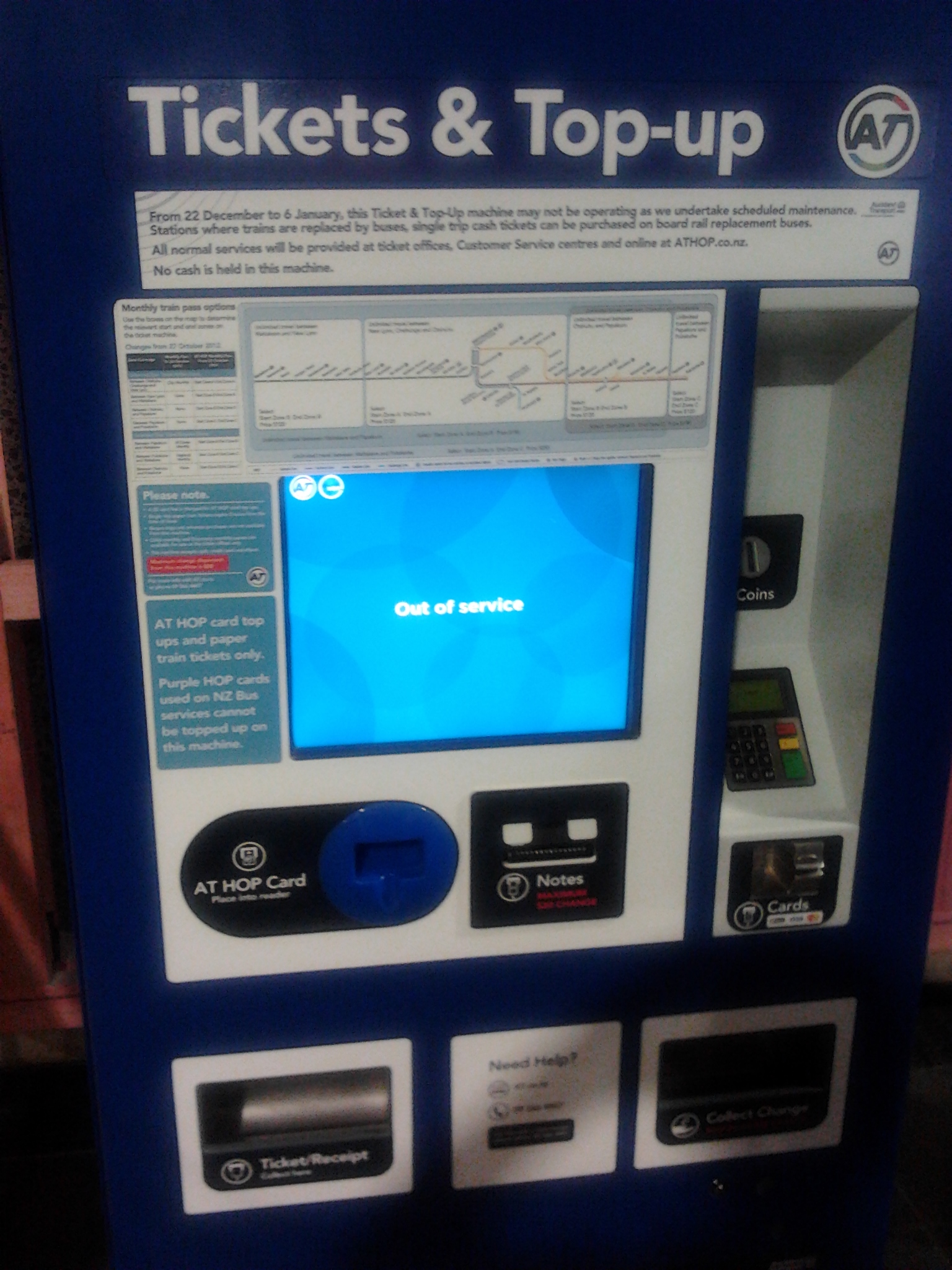
 

Yes the sole machine was out of order, however tech support had been notified 10mins earlier


Like Transport Blog (Celebration time, HOP Rollout Complete) congratulate and note the completion of the AT HOP roll out that is now completed. The journey has been very bumpy with all sorts of set backs and stories running around all over the place. In a sense of irony Talking Auckland (through its first inception View of Auckland) was partially founded in reaction to the AT-HOP and Snapper disasters at the time back in 2011. But today a moment to reflect, note, congratulate and celebrate that this roll out of this “universal” Public Transport smart card is complete.

From Voxy

Auckland Transport completes AT HOP rollout

Auckland Transport has completed the rollout of AT HOP, its reusable pre-pay smart card for travel on trains, ferries and buses.

There are currently more than 250,000 AT HOP cards being regularly used by customers around the region.

AT HOP allows customers to use one travel card on different modes of transport and public transport operators.

The card was first introduced on the region’s rail network in October 2012 and has been progressively rolled out since then.

Auckland Transport chairman, Dr Lester Levy, says it is significant for further developing public transport in New Zealand’s largest city. He says the rate at which public transport users have taken to the new system so far bodes well for on-going patronage growth.

“Other transformational projects such as the fleet of new electric trains, improved reliability of all services and a major focus on customer needs and satisfaction levels are other vital elements in delivering a world class public transport system,” he says.

Auckland mayor Len Brown is a regular user of public transport and also acknowledges what a significant milestone completion of the AT HOP rollout is. “The transformation of Auckland’s public transport system is well and truly underway, and the completion of the AT HOP rollout is a critical part of that,” he says.

“I want to congratulate Auckland Transport for delivering this project in such an effective and timely way.”

The project has been delivered in partnership with the New Zealand Transport Agency (NZTA).

Dave Brash, the New Zealand Transport Agency’s group manager of Planning and Investment, congratulates the Auckland Transport-led team on the successful introduction of integrated ticketing into Auckland.

“Making public transport easier and more attractive for people is a key priority for NZTA. So, after seven years of development, and a $73 million investment from the national land transport fund, we’re pleased with the resulting sophisticated platform, underpinned by a national ticketing standard that could support integrated ticketing systems across the country.”

—-ends—-

Source: http://www.voxy.co.nz/national/auckland-transport-completes-hop-rollout/5/185637

I use my HOP card when ever I travel on the train, bus or ferry and I personally enjoy using it with little issue. I detest carrying cash in the 21st Century so AT HOP just makes my life that much more easier when using the public transport system. Integrated Fares are on the way as Auckland Transport works through that and the service tenders (Rail starts next month) will no doubt have Integrated Fare provisions included for our public transport operators. If AT extends the HOP card to their parking buildings as a form of payment as well as one day maybe their Park-n-Rides that would be an extra one up for me (I know they can not start with using AT-HOP for parking yet until the IRD changes its treatment with HOP post June 2015, but we might as well get the ball rolling now in planning).  Further more we also have the roll out of the new South Auckland Bus Network starting next year in which all-in-all makes public transport just that much more attractive.


We still have a long way to go with things like the City Rail Link, the Manukau South Link, Pukekohe Electrification, more bus-ways, ridding us of paper tickets for something more robust like Sydney’s card tickets and so on. But lets put that to one side today, this week and take a moment, a reflection of the fact Auckland now has a universal public transport smart card.


I tip my hat and give congratulations to Dr Lester Levy and Auckland Transport with AT-HOP as an integrated ticketing scheme now fully complete.



Resilience in our Transport Network

The Need for a Resilient Network


When you see this (and similar Tweets) all to often you wonder how resilient is our entire transport network is:

There is an article in the Herald about accident that happened last night which is still having effects NOW can be seen here: Fatal crash in Auckland closes major route to airport

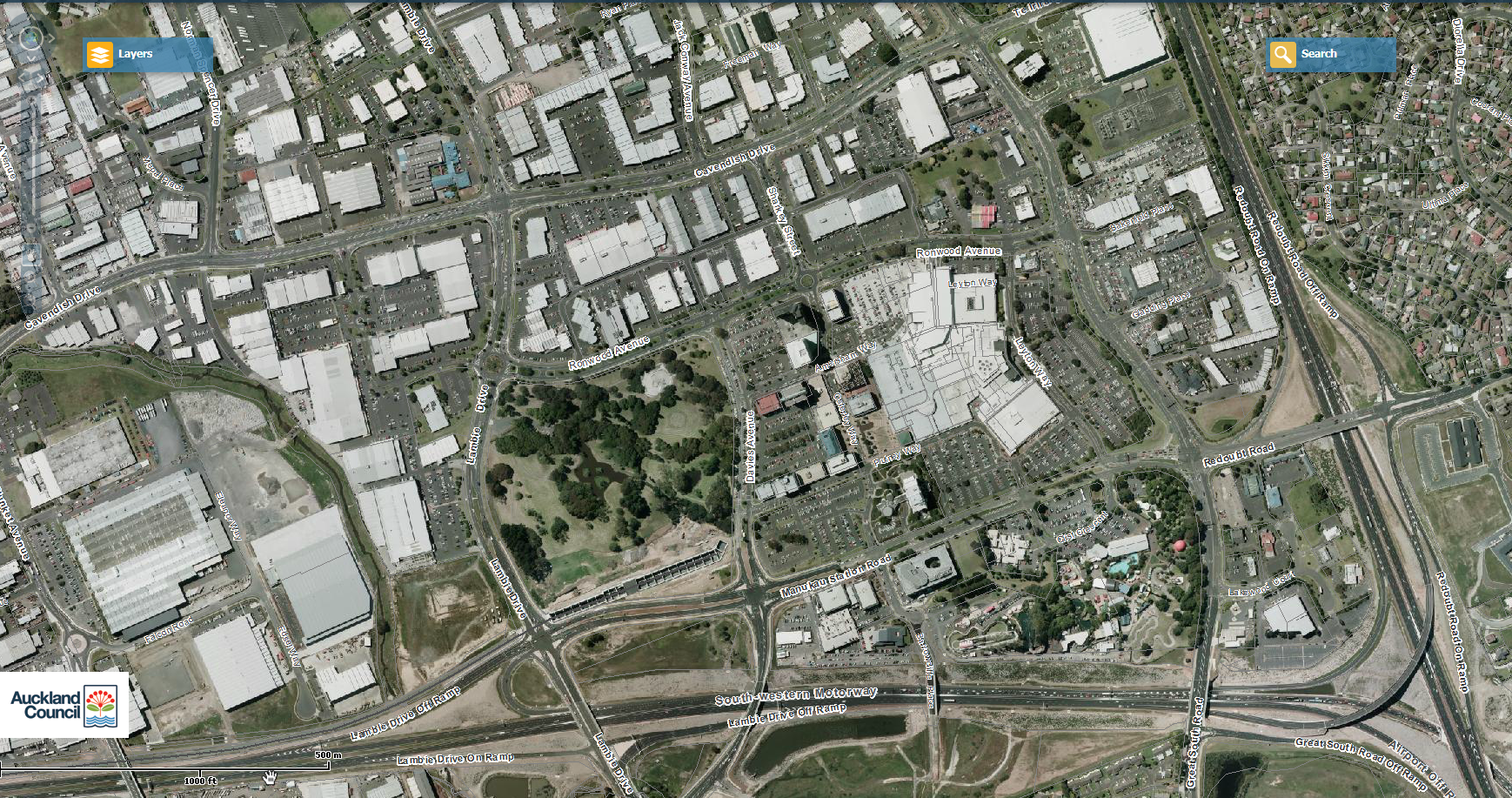
Manukau City Centre Area

The accident happened on I believe the from north to west link of the State Highway One/Twenty interchange that is known for speeding traffic and useless merging


Having a major route to the airport closed is not particular good. Then again neither is accidents anywhere on the motorway network nor blockages on the rail network and the trains not being able to “run around.” So the question is how do we get the transport network to be more resilient for both freight and people.


Leave your comments below of inclined email me for a guest post spot.

I shall answer the question myself this weekend.


Have a good Friday everyone


Dodgy Poll

Not all what to seems


[Please note I am not taking aim at Digi-Poll in any shape or form and I do respect their credibility as a polling company highly. I do however, take aim at the NZ Herald for their “reporting” and not laying out the fall statistical facts about the poll clearly in their article]


I did notice the Herald Digi-Poll out this morning citing a poll about Mayor Len Brown. You can read the article here: Thumbs down for Len Brown – poll

What the online piece did not show was the actual graphs which can be seen below from Twitter earlier today:

The Herald Digi-poll subsequently brought a stinging rebuke from Stats Chat which said:

Beyond the margin of error

Now, the Herald-Digipoll is supposed to be a real survey, with samples that are more or less representative after weighting. There isn’t a margin of error reported, but the standard maximum margin of error would be  a little over 6%.

There are two aspects of the data that make it not look representative. Thr first is that only 31.3%, or 37% of those claiming to have voted, said they voted for Len Brown last time. He got 47.8% of the vote. That discrepancy is a bit larger than you’d expect just from bad luck; it’s the sort of thing you’d expect to see about 1 or 2 times in 1000 by chance.

More impressively, 85% of respondents claimed to have voted. Only 36% of those eligible in Auckland actually voted.

,.,,,

So, how could the poll be so badly wrong? It’s unlikely to just be due to bad sampling — you could do better with a random poll of half a dozen people. There’s got to be a fairly significant contribution from people whose recall of the 2013 election is not entirely accurate, or to put it more bluntly, some of the respondents were telling porkies.  Unfortunately, that makes it hard to tell if results for any of the other questions bear even the slightest relationship to the truth.

——–

You can read the full Stats Chat piece here: http://www.statschat.org.nz/2014/03/20/beyond-the-margin-of-error/


The bits in bold is what gives suspicion the poll was slanted to produce a “story” that was not truly there. Then again check this:

Thumbs down for Len Brown – poll

By Bernard Orsman 5:30 AM Thursday Mar 20, 2014

The journalist running the story is not known to be “objective” from time to time and has been pulled up before for either slanting or giving a misrepresentation (that is his opinion rather than a claimed fact).

So I would be very careful in trotting out this poll which has misrepresentations and a bad case of slanting as proof of fact against the Mayor. Using such a poll in that method will not do your credibility any good – although two of the oppositional five Councillors had (although expected).


Back to City Building we go as there is nothing to see from that Orsman piece.


Economy Continues to Improve

When doing so – how do you make it better


News of the continuing to improve economy and the manufacturing sector will usually do well for an incumbent Government and be of a nightmare for an opposition party trying to seek Government. The question is for the opposition is how to get into Government while people are in a good mood (that reflects back as Government support).

Standard macro-economics will teach you that then a nation’s economy improves to the point it starts hitting the boom phase (we are not in a boom yet) then the State should be scaling back “state-sponsored building initiatives” to avoid overheating the economy. When the country is in a recession or depression then you start the state-sponsored building programs to give the economy a prod along. Typically this is done through infrastructure building to lay the foundations down for when the economy takes off again as it is for New Zealand. It is unwise for a Government to embark on a massive state sponsored building program when the nation is in a full recovery or boom phase as flooding the economy with money is like fuelling a fire that will go out of control. An out of control fire will cause large-scale damage to an economy in the end as Japan and the USA have found out over time.

And so where does this leave Labour. Well it does not leave them a lot of room at the moment. However, it does not mean that they give up. It means you have to be smart at how you develop and pitch policies that will not cause the economy to overheat leading to interest rates hitting 10%.

From the NBR on the Economy Growing

NZ economic growth keeps rate hike track intact

Paul McBeth | Thursday March 20, 2014

New Zealand’s pace of growth in the final three months of the year, underpinned by a booming manufacturing sector, won’t derail the Reserve Bank’s path to higher interest rates this year.

Gross domestic product grew 0.9 percent to a seasonally adjusted $38.3 billion in the three months ended Dec. 31, from a revised pace of 1.2 percent in the September quarter, according to Statistics New Zealand. That was in line with market expectations and slightly ahead of the Reserve Bank’s forecast of 0.8 percent growth in the quarter. Annual growth was 2.7 percent, and GDP was 3.1 percent higher than the same quarter a year earlier. (See graph below)

The pace of growth underpins signs the local economy is gathering momentum, which Reserve Bank governor Graeme Wheeler says is creating inflationary pressures that require a monetary policy response. He kicked off a tightening cycle this month, lifting the official cash rate a quarter-point to 2.75 percent and anticipates raising the OCR another 2 percentage points over the next two years.

The rest of the article gives a break down in further figures of the economy growing.


Back to the question where does that leave Labour.

I would go down the Social Liberal path and be very careful managers on our economy is growing. For the most part it would mean the following:’

  • stay well out if the way in trying to “intervene” in the growth phase. This usually means wind back some regulation not put on more…
  • There will be inequality that is a given. The question is how best to address it without impinging greatly on the rest of the economy. So maybe expanded apprenticeship and mentoring schemes for the unemployed and under-employed. Maybe better flexible working arrangements especially parents. And better funding towards our tertiary systems especially and ironically around the Arts Faculties (I’ll do a post on that sometime in the future).
  • Wind back any state sponsored building programs – this is the wrong time to do it unless you want to overheat the economy. You can still get away with expanding the rail network, boosting our coast shipping and maybe some new power generation north of Huntly but I would be reluctant on ‘Think Big” stuff including 100,000 homes outside of Christchurch.
  • Make sure Councils are not spending willy nilly as interest rates rise and too much money from them flooding the economy can also cause overheating. This means it can put the CRL in an interesting position if we enter a boom phase and we try to leverage debt when interest rates are particularly high at the time.
  • And for heaven’s sake do not hike taxes unless you plan to do a massive overhaul (which should be down when in a recession any how).


Labour though seem to be doing the opposite to a number of bullet points above. To which in my own evaluation will in the medium and long-term have potential to cause more harm. I saw this piece (which I will post en-mass) from Leader of the Opposition David Cunliffe a few moments ago

Millions invested due to Labour’s forestry plan

DAVID CUNLIFFE | 20 MAR 2014

Red Stag Timber has today announced it will invest $120 million in upgrading its plant on the basis of Labour’s Forestry and Wood Products Economic Upgrade, says Labour Leader David Cunliffe.

Red Stag General Manager Tim Rigter said. “We are confirming today that if we can get a Pro Wood policy with a future government, we would proceed with a $120 million capital investment in upgrading our plant and facility. We want to be able to process another 500,000 tonnes of logs.”

“This is great news for the Rotorua region that suffered through the closure of the Tachikawa sawmill and the loss of 120 jobs,” says David Cunliffe.

“A new world-class mill fitted with the latest technology will future proof jobs in a region hard hit by the National Government’s hands-off approach. I am delighted that our policies can secure jobs in a region that desperately needs them.

“It is a terrific endorsement for Labour’s Economic Upgrade for Forestry and Wood Products that I announced yesterday.

“Our upgrade is supported by the sector. Our focus on investment, innovation and industry is part of the upgrade that will create better jobs that pay higher wages where they are needed.

“To encourage investment we will provide tax deferrals in the form of accelerated depreciation to encourage industry to invest in new technology and plant.

“To boost innovation we will work with the industry and public science bodies to develop new products and technologies.

“To support industry development we will introduce measures including a Pro-Wood policy for government buildings, loans for new forest planting and forestry taskforces for long-term unemployed.

“Labour’s economic upgrade will lead to better jobs and higher wages for all New Zealanders,” David Cunliffe says.

———-


The question that comes to me now is why can’t Red Stag do this investment NOW? What is actually holding it up? I am quite curious to see the mechanics of the waiting. For the rest of the “Pro-Wood” policy it looks like something the Soviet Union would try to pull. That is the State leading and essentially dictating who does what with their resources. Not the most efficient way of moving the economy along that I have seen to date and especially as we are not in a recession that requires state intervention.


Now what would be interesting to see is what is the total demand of processed wood in New Zealand and will Christchurch and Auckland make any “contributions” to that demand. Furthermore I am keen to see what export potential in the free market is for our processed timber. I am also keen to see if a wider infrastructure roll out across New Zealand might kick off increased demand for wood as industry and cities expand while satellite centres begin to establish themselves.

In the end though Labour’s “Pro Wood” policy just does not do it for me (in wanting to vote for them) both at the individual and collective level.


Right then I wonder what narrative will come along the way this time for tomorrow. Hopefully something from National.