Most Likely
The Property Council recently commissioned a research project looking at the availability of commercial and industrial land under the Proposed Auckland Unitary Plan. As somewhat was expected (as this has been signalled for a while now regardless) we have an apparent shortage of both industrial and (in this case) commercial land.
From Voxy
Not enough land for business in Auckland – research
Monday, 28 April, 2014 – 17:04
Research commissioned by Property Council shows that the Proposed Auckland Unitary Plan risks considerably underproviding land for commercial development. This could be exacerbated by residential building activity encouraged on land where business activities should logically have been allowed to grow to support the demand generated by residential growth – resulting in suboptimal outcomes.
Property Council supports the PAUP’s promotion of business activity around the airport and the theoretical capacity for business development in the CBD, metropolitan centres and town centres.
However in practice, taking into account development realities, there will probably be a shortage of sufficiently available business land in the medium to long term across Auckland.
The latest Capacity for Growth Study (CfG) undertaken by the Auckland Council reports 1,875 hectares of vacant business land and vacant potential land. However, Research by Colliers International suggests that this may be overstated. There is less than 800 hectares of land currently available for industrial development. The inclusion of vacant land zoned for office or retail development, of which very little exists, would make only a small difference. Industrial zoned land accounts for 70 per cent of business land, according to the CfG study.
If annual long term absorption rates settle at 50 hectares per year, Auckland would require around 950 hectares of land between 2012-2031, in this respect. With the market heating, absorption rates could be significantly higher. Between 1996 and 2006, annual business land absorption rates reached 113 hectares.
There is currently insufficient vacant industrial land to cater for this demand. Auckland Council must prioritise making greenfield and vacant potential structure-planned/special-zoned available. Even more so if absorption rates start to drift higher.
Property Council chief executive Connal Townsend says there needs to be a clear signalling and timely decisions by Auckland Council, so that the development industry has certainty on this matter.
“Given the fluctuation in absorption rates within cycles, the timing of release of land will need to be carefully monitored,” Mr Townsend said.
…
The Property Council supports the Unitary Plan around (as they say) the promotion of business activity next to the airport and within our Centres (the CBD, Metropolitan Centres and Town Centres). However, the Property Council has pointed out there could be a potential shortage in that business land that Auckland would need through the life of the Unitary Plan. A concern at this point and time I also share.
The Property Council also pointed out in regards to the commercial and industrial situation in Auckland:
– Structure planned/special zones and vacant potential business land accounts for almost 80 per cent of total business land capacity, while vacant business land accounts for just 20 per cent (including both urban and rural).
– 60 per cent of vacant business parcels in the urban area are less than 1,000 square metres in size with limited vacant business parcels over one hectare. A lack of large vacant sites and a shortfall of vacant greenfield land for business use in the region limits options for firms looking to locate large scale land extensive activities.
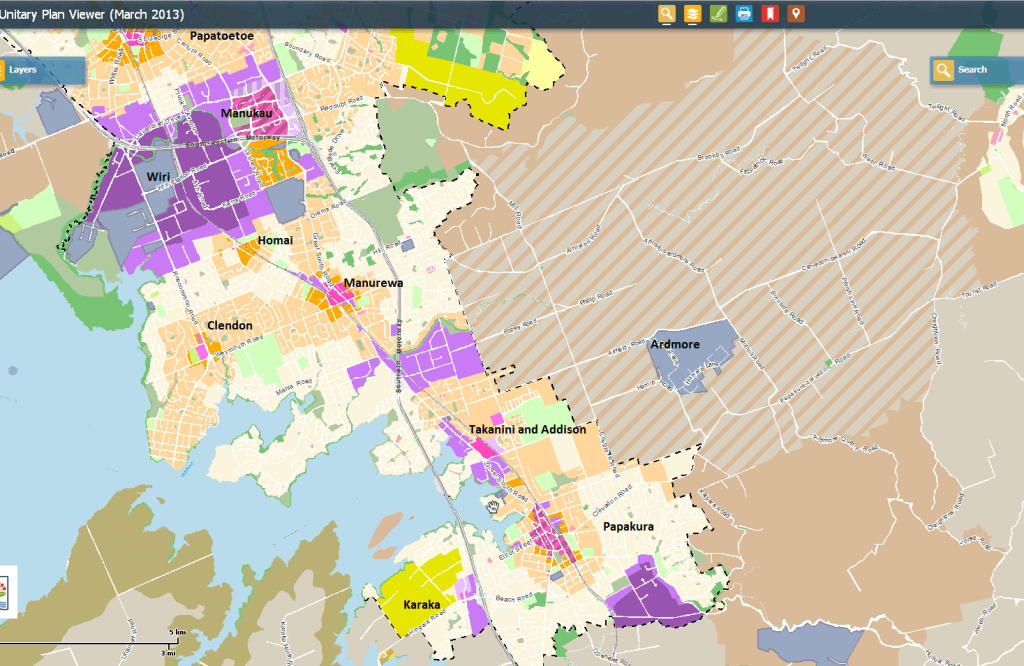
– Most land available for industrial development is in the south. This could lead to a shift in employment clusters, and absorption rates are likely to be therefore higher in this area – both of which should be properly accounted for by the Council.
These issues highlight the importance of undertaking robust and timely assessments to meet future business requirements, and for the Council to ensure it is not overly reliant on theoretical modelling and predictions that are not undertaken on a regular basis. Market realities and practical considerations are key and must be accounted for in this respect.
Property Council urges Auckland Council to continue carefully assessing the location and type of activities in business zoned land, to avoid adverse impacts on the vitality of the existing city centre, metropolitan, town and local centres. This is a vital issue, with significant ramifications for Auckland’s future employment, business and economic growth.
——
Again all concerns that I am both aware of and again also share with the Property Council. The point in dark red about our industrial development being primarily in the South (so Wiri, East Tamaki, Takanini and Drury South) is one I have pointed out many times before in this blog (Auckland Development). The consequences of both such concentrated industrial development in the south, and the of industry in the Onehuga-Southdown industrial complex migrating also south are both acute enough to cause Auckland grief, and again have been pointed out in this blog (Slow News Day. We Have the Bigger Picture to Focus On & Lobbyists Continue to Push for East-West Link).
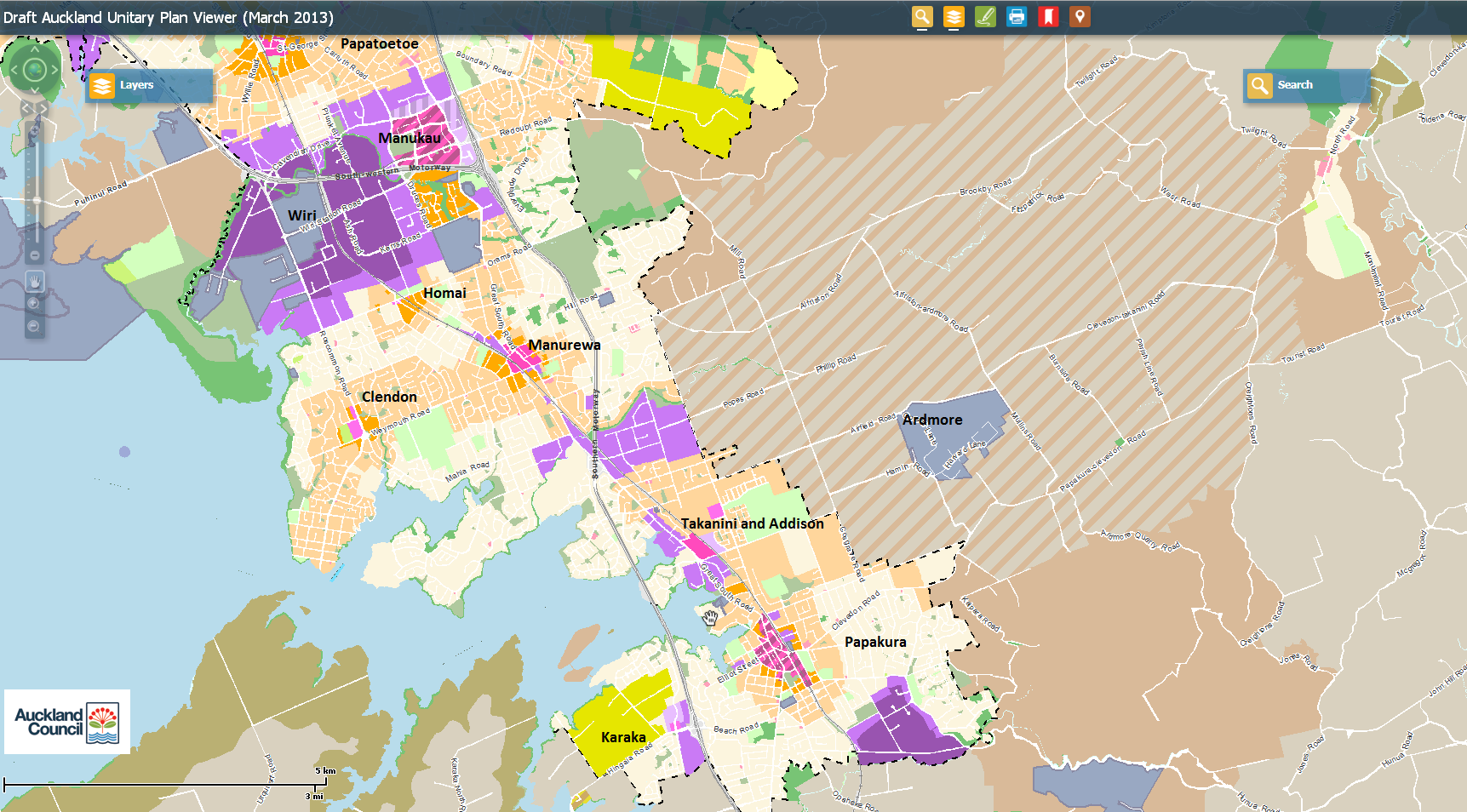


If successful the land would be converted from rural to industry
Coordination and in this instance some speed will be needed to make sure commercial and industrial land is fully ready to go for up coming development under the Unitary Plan (so all the ducks lined up by 2016 when the Unitary Plan is due to become operational). Not doing so (or rather failing to do so) would risk having our residents (and employers) unable to have access to quality employment centres (including the industrial complexes) as the City grows.
.

 Talking Southern Auckland