To mitigate against this
Before I start the post I highly recommend reading the Stuff article first so you can get the context of this post. The Stuff article can be found here: http://www.stuff.co.nz/national/10052616/Food-barns-eating-up-Auckland-land
The opening paragraph from the article
Food barns eating up Auckland land
LAURA WALTERS Last updated 05:00 18/05/2014
Residents are powerless to stop supermarkets moving into growing areas of Auckland where they see profit to be made.Former Pohutukawa Coast Community Association (PCCA) chairman Cameron Butler gave four years of his life and thousands of dollars – which he is still paying off – to fight a losing battle against supermarket giant Progressive Enterprises and its plans to build a Countdown supermarket in Beachlands despite residents’ $90,000 Environment Court fight.
In 2009 the PCCA door-knocked 1800 residents in Beachlands and Maraetai. Butler said about 70 per cent of respondents were opposed to the supermarket.
“People moved out here for the lifestyle, away from the big city, away from the supermarkets and away from the subdivisions.”
A supermarket would take business away from existing retailers causing a “tumbleweed” effect on the current town centre, he said.
“We were very disappointed, we were gutted . . . my heart told me at least I tried.”
….
As the article further mentions we will be seeing more of these “remote” supermarkets springing up across Auckland as the City grows (remote means stand alone premises rather than incorporated into a Town Centre or shopping mall)
The concluding comment from the article also spells out the context of the expansion of our supermarket chains:
Progressive Enterprises had less market share than its competitor so was constantly looking for opportunities to open new stores where it was not represented, to offer that community a choice, Walker said.
Supermarkets were also a catalyst for other retail growth and helped to build services for communities in the long-term.
Planning for cities, towns and regional centres was constant and Countdown worked together with geographers and planners to identify opportunities for new stores, refurbishments and expansions, he said.
—–
“Supermarkets were also a catalyst for other retail growth and helped to build services for communities in the long-term.”
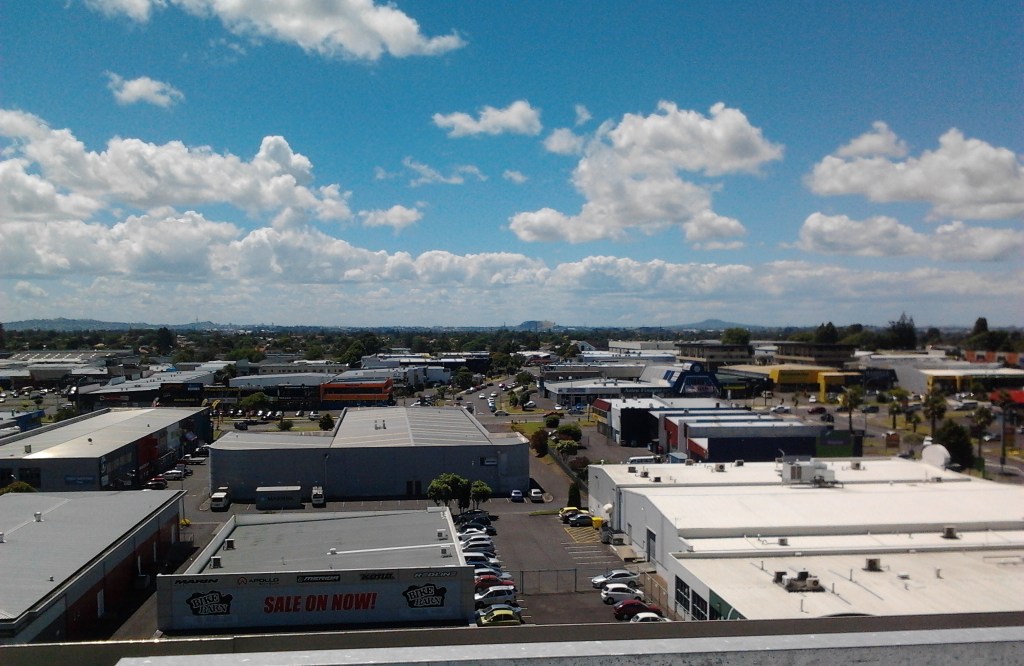
Yes and no on that line from Progressives. A supermarket integrated with the wider area especially a Town Centre or Metropolitan Centre will act as a catalyst for that future growth as supermarkets are often act as anchor points (hence why malls have them). A supermarket on its own in a light industrial area or pretty much the middle of no where, and/or has a stinking large car park between it and the main road will not act as a catalyst to growth apart from cars, congestion and ugliness to the surrounding urban fabric. If you want an example of that check the Countdown and Pak n Save at the Lincoln Road/Universal Drive intersection out west.

Not very inviting if you try any other transport mode than the car is it? Also not very integrating to the rest of the urban fabric around the two supermarkets as well.
So I can understand why people have concerns about these supermarkets springing up everywhere (or being consented) before the Unitary Plan becomes operative in late 2016. Our legacy planning rules are just not really urban nor people friendly.
Our American cousins developed a walking scale for how many citizens within a given city were within 5-minutes of a grocery store. The link to the commentary about the scale can be found here: The 5 Cities Where It’s Easiest — and Hardest — to Walk to the Grocery Store
I would not like to apply such a scale to Auckland, not when the trend for our supermarket planning is like the Lincoln Road situation above.
However, we have hope to try (if we follow the Americans (and that is not a bad thing)) and make our supermarkets more friendly post 2016 – when the Unitary Plan comes to operative.
This is an extract from the Proposed Auckland Unitary Plan (pre-second submission round) in regards to our Metropolitan Centres which includes a piece on supermarkets
PART 2 – REGIONAL AND DISTRICT OBJECTIVES AND POLICIES» Chapter D: Zone objectives and policies» 3 Business zones» 3.3 Metropolitan Centre zone
Some street frontages within the zone are subject to a Key Retail Frontage or General Commercial Frontageoverlay. Key retail streets are the focal point of pedestrian activity within the centre. General commercial streetsplay a supporting role. Development fronting these streets is expected to reinforce this function. Rules for the overlay are incorporated in the zone rules.
Buildings within the zone require resource consent to ensure that they are designed to a high standard, which enhance the quality of the centre’s streets and public open spaces.
a.the positive contribution these activities make to centre viability and function, and
b.designs that positively contribute to the streetscape and character of their surroundings, having regard to the functional requirements of these activities.
…
So yes the planners via the Unitary Plan do recognise as Progressive Enterprises did in the Stuff article that supermarkets do have (the potential for) positive contributions to the given centre. However, as I have pointed out and the Unitary Plan points out in 9.b (above) the supermarkets need to be integrated into the urban fabric around it which includes being both people friendly and very accessible by either walking or public transport.
How new supermarkets consented post 2016 under the operative Unitary Plan will be interesting. This is why I said on Councillor Cathy Casey’s wall in commenting on the Stuff article the following:
Getting submitting on the Unitary Plan especially around the General Business Zone, the Mixed Use Zone AND especially the Metropolitan Centres.
This will be your only chance to “control” the outcomes of the above concerns with our villages.
That said I would be reluctant in “slagging off” our Metro Centres in trying to preserve our Town and Local Centres. Metropolitan Centres are not your enemy but your friends as an anchor point and hub which do have positive effects on near by smaller centres.
Cathy the Unitary Plan Committee meets again on Tuesday afternoon. Might be a good time to question the planners and get some clarification on concerns raised in the Stuff article
….
Essentially the idea is to get supermarkets built within the Town and Metropolitan Centres with the Mixed Use Zone an absolute last resort. What we do not want owing to the nature and location of this zone is Supermarkets being built in the General Business Zone. To do might run the risk of a supermarket in the General Business Zone detracting from the nearby centre. Furthermore the controls in the GBZ might not be as strict as the centres so you might run a repeat of what we get with our current supermarkets (the disconnect).
So concerned about your village or centre from Supermarkets? Did you submit to the Unitary Plan earlier this year and if eligible will you do so again when the second submission round opens in mid June. The future is pretty much in YOUR hands.


 Talking Southern Auckland