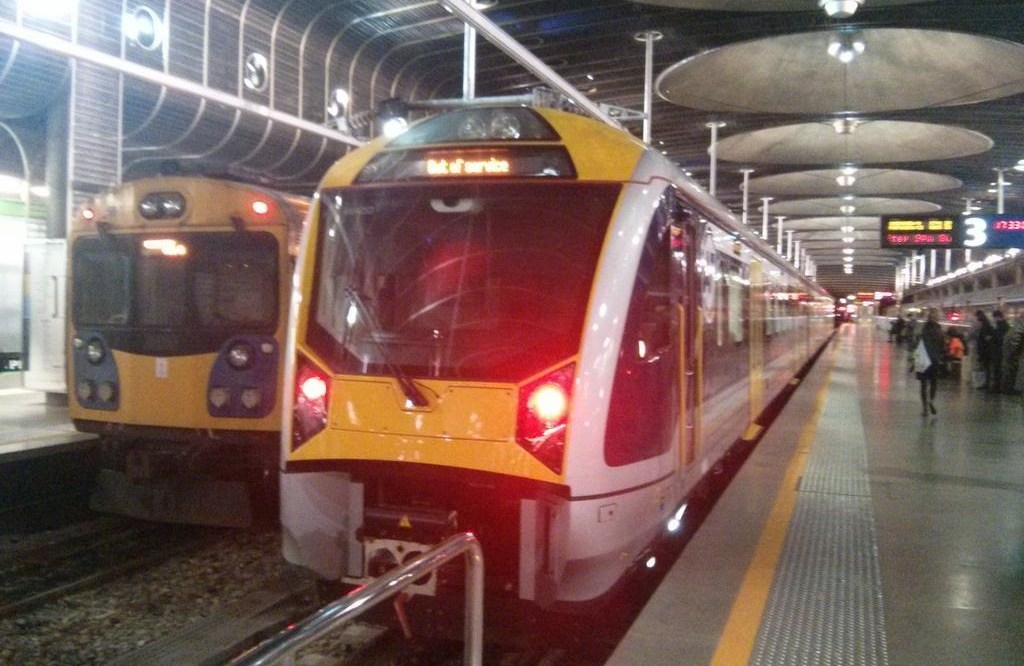
Auckland Transport: “Acknowledged the problem had yet to be fully diagnosed – let alone fixed.”
Continued coverage of our Electric Train and Rail System Fault that caused a 10 day grounding of the EMU (Electric Train) fleet to be grounded will continue until confidence is restored and a proper fix is in place

Source: pic.twitter.com/IUHNR2DboJ
In light of the updates as of yesterday on the Electric Train fault, fault-finding and fixing (see: Latest Updates on the Electric Train Grounding Saga) we are slowly getting more information out on the situation.
From the NZ Herald
Trains back but fault not yet sorted
By Mathew Dearnaley 5:00 AM Saturday Aug 2, 2014
Auckland’s new electric trains are back running between Onehunga and Britomart, despite a continuing mystery over a power failure which knocked them out of action last week.
The “intermittent” failure, which knocked out four trains in one hit on one day and then struck again the next, prompted Auckland Transport to replace them with old diesel units during a frantic search for the cause.
A spokesman said yesterday they had been returned to service on Thursday but, when questioned by the Weekend Herald, acknowledged the problem had yet to be fully diagnosed – let alone fixed.
“The fault is a high-frequency voltage spike … and appears to be associated with interaction between the trains and the power supply system,” he said. “Auckland Transport is working with KiwiRail on testing the EMUs [electric multiple unit trains] with alternated sections of the network livened.”
The spokesman said on Tuesday that the council body still hoped to extend electric train passenger services to the Manukau-Britomart run via Panmure and Glen Innes on the eastern line on August 17.
“ [Auckland Transport] acknowledged the problem had yet to be fully diagnosed – let alone fixed.“
Not exactly confidence inspiring when such a fault should have been prevented if the tests prior to the Onehunga Line going “live” in late April were conducted properly and more to the point THOROUGHLY! Also with the problem not fixed we still have the elevated risk of the EMU (Electric Multiple Unit) of running into the same issues caused by that “intermittent failure” that lead to the 10 day grounding last week.
Now remember from yesterday’s Stuff article that Mayor Len Brown said: “If it’s about power delivery then that is systemic and we’ve got a problem.”
Well looking at this: “The fault is a high-frequency voltage spike … and appears to be associated with interaction between the trains and the power supply system…” it seems we have that problem.
As for “The fault is a high-frequency voltage spike?“
If we are seriously looking at a high-frequency voltage spike (so over-voltage) then it seems the theory on Dirty Power could be looking pretty solid into becoming “actual.”
A recap on Dirty Power
From Day 10 and the Electric Train Fleet is Still Grounded
First harmonics:
Harmonics (electrical power)
From Wikipedia, the free encyclopedia
Harmonics voltages and currents in an electric power system are a result of non-linear electric loads. Harmonic frequencies in the power grid are a frequent cause of power quality problems. Harmonics in power systems result in increased heating in the equipment and conductors, misfiring in variable speed drives, and torque pulsations in motors. Reduction of harmonics is considered desirable.
…
Effects
One of the major effects of power system harmonics is to increase the current in the system. This is particularly the case for the third harmonic, which causes a sharp increase in the zero sequence current, and therefore increases the current in the neutral conductor. This effect can require special consideration in the design of an electric system to serve non-linear loads.[2]
In addition to the increased line current, different pieces of electrical equipment can suffer effects from harmonics on the power system.
Motors
Electric motors experience losses due to hysteresis and losses due to eddy currents set up in the iron core of the motor. These are proportional to the frequency of the current. Since the harmonics are at higher frequencies, they produce higher core losses in a motor than the power frequency would. This results in increased heating of the motor core, which (if excessive) can shorten the life of the motor. The 5th harmonic causes a CEMF (counter electromotive force) in large motors which acts in the opposite direction of rotation. The CEMF is not large enough to counteract the rotation, however it does play a small role in the resulting rotating speed of the motor.
—–
Source: http://en.wikipedia.org/wiki/Harmonics_(electrical_power)
As for Dirty Power
Power quality
From Wikipedia, the free encyclopedia
Power quality determines the fitness of electrical power to consumer devices. Synchronization of the voltage frequency and phase allows electrical systems to function in their intended manner without significant loss of performance or life. The term is used to describe electric power that drives an electrical load and the load’s ability to function properly. Without the proper power, an electrical device (or load) may malfunction, fail prematurely or not operate at all. There are many ways in which electric power can be of poor quality and many more causes of such poor quality power.
The electric power industry comprises electricity generation (AC power), electric power transmission and ultimately electricity distribution to an electricity meter located at the premises of the end user of the electric power. The electricity then moves through the wiring system of the end user until it reaches the load. The complexity of the system to move electric energy from the point of production to the point of consumption combined with variations in weather, generation, demand and other factors provide many opportunities for the quality of supply to be compromised.
While “power quality” is a convenient term for many, it is the quality of the voltage—rather than power orelectric current—that is actually described by the term. Power is simply the flow of energy and the current demanded by a load is largely uncontrollable.
———–
[Main Source and full run-down: Theory: Why Our Electric Trains are Grounded and Will Face Future Issues]
……..——————………
A brief definition of ‘over-voltage’ and Power Conditioning (a method to clean Dirty Power up and provide the required Clean Power)
From Wikipedia
When the voltage in a circuit or part of it is raised above its upper design limit, this is known as overvoltage. The conditions may be hazardous. Depending on its duration, the overvoltage event can be transient—avoltage spike—or permanent, leading to a power surge.
Explanation
Electronic and electrical devices are designed to operate at a certain maximum supply voltage, and considerable damage can be caused by voltage that is higher than that for which the devices are rated.For example an electric light bulb has a wire in it that at the given rated voltage will carry a current just large enough for the wire to get very hot (giving off light and heat), but not hot enough for it to melt. The amount of current in a circuit depends on the voltage supplied: if the voltage is too high, then the wire may melt and the light bulb would have “burned out”. Similarly other electrical devices may stop working, or may even burst into flames if an overvoltage is delivered to the circuit.
Sources
….
Man made
Man-made sources of spikes are usually caused by electromagnetic induction when switching on or off inductive loads (such as electric motors or electromagnets), or by switching heavy resistive AC loads when zero-crossing circuitry is not used – anywhere a large change of current takes place. One of the purposes of electromagnetic compatibility compliance is to eliminate such sources.
…
Filters are used to prevent spikes entering or leaving the equipment through wires, and the devices coupled electromagnetically to space (such as radio-frequency pick-up coils in MRI scanners) are protected by shielding.
….
Source: http://en.wikipedia.org/wiki/Overvoltage
Filters or Power Conditioners being:
Power conditioning
Power conditioning is modifying the power to improve its quality.
An uninterruptible power supply can be used to switch off of mains power if there is a transient (temporary) condition on the line. However, cheaper UPS units create poor-quality power themselves, akin to imposing a higher-frequency and lower-amplitude square wave atop the sine wave. High-quality UPS units utilize a double conversion topology which breaks down incoming AC power into DC, charges the batteries, then remanufactures an AC sine wave. This remanufactured sine wave is of higher quality than the original AC power feed.[2]
A surge protector or simple capacitor or varistor can protect against most overvoltage conditions, while a lightning arrestor protects against severe spikes.
Electronic filters can remove harmonics.
Smart grids and power quality
Modern systems use sensors called phasor measurement units (PMU) distributed throughout their network to monitor power quality and in some cases respond automatically to them. Using such smart gridsfeatures of rapid sensing and automated self healing of anomalies in the network promises to bring higher quality power and less downtime while simultaneously supporting power from intermittent power sourcesand distributed generation, which would if unchecked degrade power quality.
[Click here: Power conditioning for more on power conditioning]
…..
Source: http://en.wikipedia.org/wiki/Power_quality
…..——……
You will have to forgive me if I do not have a lot of confidence with Auckland Transport right now when it comes to the fault plaguing the Electric Trains and wider electrified rail system.
Will the Manukau Line see the Electric Trains running in mid-August? Most likely unless we get another “intermittent failure” that causes the fleet to be grounded before then. However, the power issues will not be doing the shelf life of our new Electric Trains nor the maintenance budget any good in the duration.
I would also like to take time to acknowledge those people who I have talked to via various mediums around the fault plaguing the fleet. Your discussion points, hints, pointers, insights, knowledge and even perseverance over this saga has been wonderful and enlightening. I do hold the faint hope we will see accountability at the top over the fault and the subsequent 10 day grounding as faint as that hope currently is.

 Talking Southern Auckland