Research Paper in Auckland’s Commute Patterns and Differences is Out

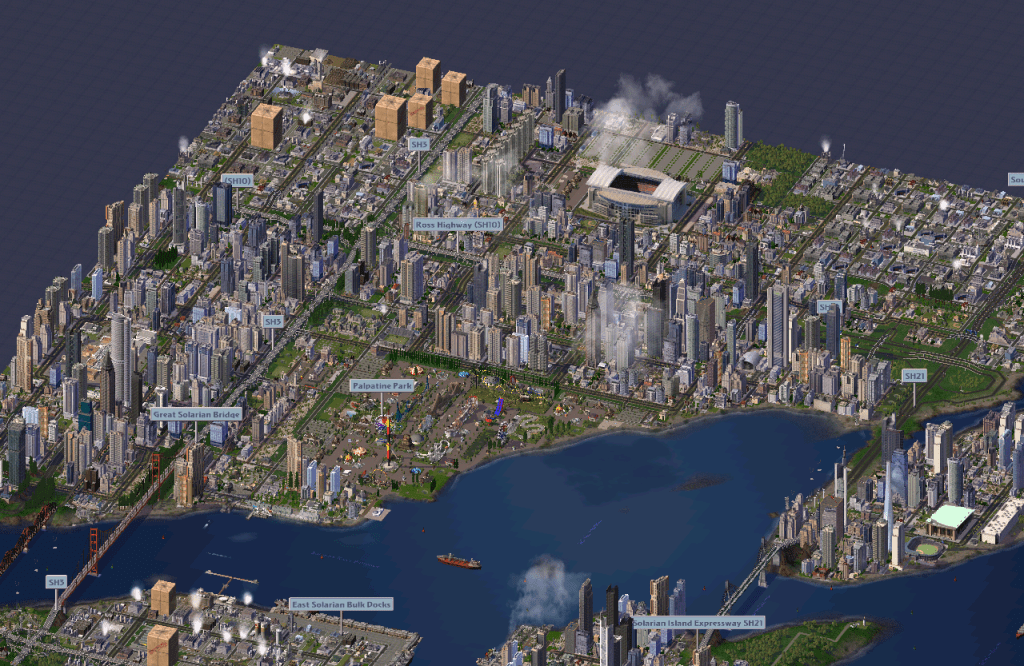
Note: Simulation Only. Not depicting Auckland
The Ministry of Transport has released a paper into Auckland’s commute patterns as captured by the 2001, 2006 and 2013 Censuses.
From the Ministry of Transport
Research on Auckland
Last updated on: 12/08/2014
Auckland’s size, growth and resulting congestion mean addressing the city’s transport issues is a key focus for the government.
From time to time, the Ministry commissions research to better understand Auckland’s transport issues.
Journey to Work Patterns in the Auckland Region
The results from the 2013 Census provide an opportunity to better understand Auckland’s journey to work patterns, and in particular, see what changes have occurred since the 2006 Census.
The Ministry of Transport commissioned Richard Paling Consulting Ltd to undertake an analysis of the journey to work data from the 2013 Census. The work covers:
- commuting patterns in Auckland from 2001 to 2013
- comparisons with commuting patterns of Australian cities
- journey to work patterns by sub-regional areas, local board areas, and census area units (CAU)
- commuting movements to selected key employment centres and from selected residential areas
- changes associated with investment in the rail corridor and Northern Busway
- commuting movements across the Waitemata Harbour
- impact of transport investment on land use.
The report, entitled Journey to Work Patterns in the Auckland Region, can be found below.
- Executive Summary [PDF, 4 MB]
- Journey to Work Patterns in the Auckland Region – main report [PDF, 8.2 MB]
Big city life? Challenges and trade-offs for Auckland city
In May 2014, NZIER released the report Big city life? Challenges and trade-offs for Auckland city(external link). The report aims to help inform debate on Auckland’s urban structure. It examines the impact of the city’s constrained geography and uses a simple economic model to show the effect on housing costs of improving transport infrastructure, lifting house construction productivity, and extending the urban limit.
Big city life? was funded by the Reserve Bank, the Treasury, the Ministry of Transport and NZIER’s public good programme, which supports research into areas of general interest to New Zealanders. You can read more on NZIER’s website(external link).
———————————————-
Source: http://www.transport.govt.nz/research/othertransportresearch/research-on-auckland/
I have the two documents below as embeds to save on your bandwidth 🙂
Richard Paling Report Transport Patterns in the Auckland Region Executive Summary
Richard Paling Report Transport Patterns in the Auckland Region
I have read the Executive Summary but am around halfway though the main report. I have noticed an interesting situation in regards to the City Centre and Southern Auckland A trends that will (if these trends do continue) influence planning provisions for some years to come (and enough to give light to a review of the Auckland Plan very soon).
Once I have finished reading the main report I will post the commentary up on it. In the meantime if you have a few moments, take a read (at least the Executive Summary) and see what you notice.

 Talking Southern Auckland
look forward to post – interesting that the walking/jogging is 4 times cycle, and backs up my observations on Dominion rd. AT have an issue as they often sacrifice pedestrians to cycle ways. Which is what they did on Ian McKinnon Dr. And where walkers still out number cyclists 10:1 from what I see. And if they want to support healthier outcomes then they should back walking more.
Work from home trend is as expected – and will grow much more. Will impact CBD, due to most large businesses I come across are doing much more hot desking, and people doing 1-2 days at home. Feedback seems to support that they’re much more productive at home. Again supports a reduced employment/commute into CBD
Evening Mark
Hopefully tomorrow I should have a basic summary up on the report.
But the following things stood out to me thus far
Public Transport as mode share is increasing at the expense of private transport mode share for the most (but not all) parts
The City Centre draws its workers from itself, the Lower North Shore, inner Isthmus and those close to the Western Rail Line
South Auckland is something of an enigma with the bulk of its commutes within itself or to Penrose-Onehunga. It was noted increased commuting concentrations to the Heavy Industrial complexes in the south, the Airport and Manukau City Centre.
Note: Students were not measured so we do have skewering
While the workforce is increasing in the City Centre so is our population. Thus relative to proportions the percentage numbers and where they are coming from in their commute to the CBD does not change that much.
Thus I have concluded the Auckland Plan needs a review especially with assumptions made about the City Centre and South Auckland. Simply put South Auckland throws a nice big fat spanner into the Auckland Plan’s ideals and the Plan needs reworking around this. Why? Even by 2042 when the Auckland Plan expires South Auckland will still be primarily commuting within itself