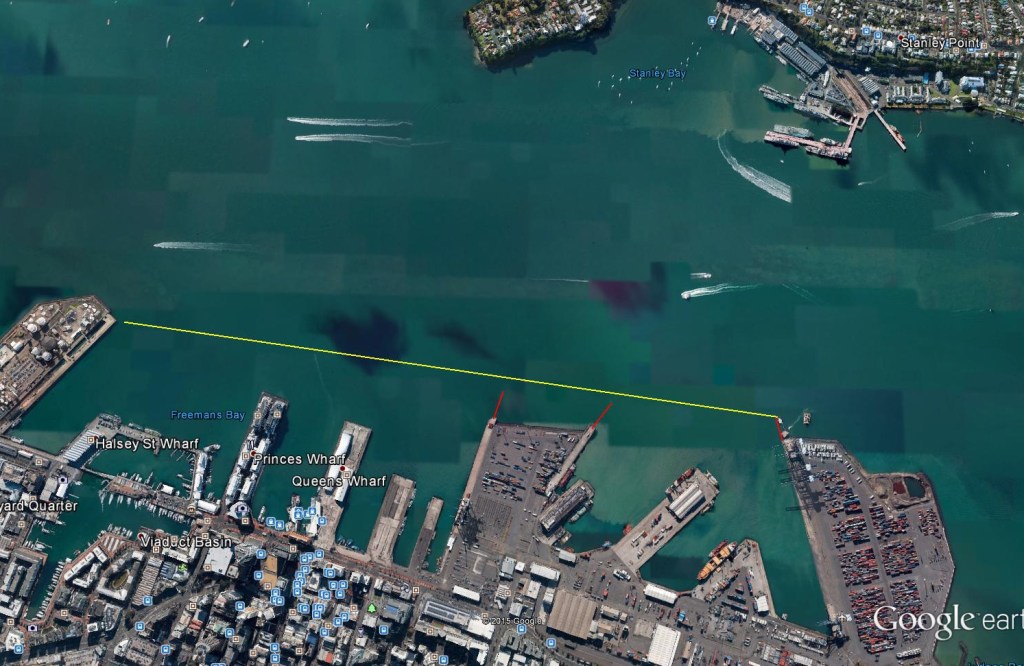
However, will the engagement with stakeholders and the community be that – engagement?
Tomorrow the Auckland Development Committee chaired by Deputy Mayor Penny Hulse will set in motion the Port Future Study Part Two that was not meant to start until next year.
The Addendum Agenda for that Committee spells out what will be looked at in both setting up the study as well as engagement with the City:
Future of Ports of Auckland Study
File No.: CP2015/05041
Purpose
- To approve the bringing forward of the expected timing of what has been referred to as the “Ports Stage II Study”.
- The report also outlines the broad objectives of the study.
Executive Summary
- Given renewed interest and concerns about the effects of port expansion on the Waitemata Harbour, the Auckland Development Committee is requested to bring forward the commencement of the Port Stage II Study from its current timeframe post the Unitary Plan.
- The Committee is requested to direct the Chief Executive to initially focus on the study design and draft study scope, to be approved by the Committee before the actual study commences.
- For the purpose of this report, “study design” relates to processes for stakeholder involvement, engagement and governance structures and their terms of reference, resourcing, timing etc. The term “scope” refers specifically to the study – which will be technical in nature and undertaken by experts – and what is to be included in the study.
| Recommendation/sThat the Auckland Development Committee:
a) pursuant to standing order 3.10.17, revoke resolution APC/2013/45: h) agree that early scoping work on a study of the economic, environmental and cultural impacts and opportunities for Maori be reported back to the Auckland Plan Committee in August 2013, and if required, any future Stage 2 work relating to wider issues of port location and distribution in the Upper North Island is to be undertaken at a later time, post the Unitary Plan. and replace it with: h) commence the Port Stage II Study, with the broad objective of scoping the economic, environmental and cultural impacts, of the port and its associated freight movements through Auckland, the opportunities for Maori, the wider issue of port location and freight distribution in the Upper North Island, the relationship between the port and Auckland’s urban form and the benefits and costs, including opportunity costs, of options considered. b) direct the Chief Executive to commence the design of the study and its associated processes. c) note that the study should include collaborative stakeholder input at each critical stage, including the study’s scope, and that the council will make decisions on any matters arising from the study. d) request that the study design, including resourcing requirements and a draft study scope be reported back to the Committee for its approval as soon as possible, prior to the actual study commencing. |
So all looking solid right? Well check this in the ‘Comments’ department further down:
16) Because stakeholders should be involved in all critical stages of the study, this report deliberately does not set out any detail, as the process itself and the scope of the study need to be developed in collaboration with others. In this sense, the study design is expected to have similarities to the approach used by the Consensus Building Group on alternative funding for transport. It should be noted that, at the completion of the study, it will be the council that makes decision on any matters arising from the study.
And this is where the supposed Community Empowerment that Council is meant to be embracing more falls over. The Consensus Building Group was nothing but the Mayor’s hobby horse for Len to get through his most two preferred options via the Long Term Plan (fuel taxes, rates, or tolls) rather than canvassing all options and say putting five forward to the City – as genuine choice. So in effect the CBG was tokenism at its best.
If the Council is true to its word about Community Empowerment and with the Port of Auckland causing community emotions to run high I would not even go anywhere near the “approaches” used by that flawed Consensus Building Group. All options must be considered, all options must be spelled out in costs and benefits (monetary, economic, social, physical environmental).
I will not be at the Committee tomorrow but I will keep tabs via the live stream and report anything of significance that comes out of it.

 Talking Southern Auckland