Close vote
This afternoon the Auckland Council Governing Body resolved in a draw vote (thus needing the Mayor’s casting vote to pass it) to allow a compromise on the Port of Auckland wharf extensions as noted here: (Ports of Auckland bows to council pressure over wharf extension).
The voting split was this:

Source: NewsTalk ZB and Auckland Council
It is of note that the vote would have passed still 11-9 if Councillors Krum, Webster, Walker, Walker and Quax were present for the vote. Councillor Krum I have not placed down as I am not sure which way she would have voted.
It is also to note and this became apparent in the debate that the voting line is clearly split between the Southern and Western Auckland Councillors in favour, and the Isthmus and North Shore Councillors against (Webster is Rodney and would have been in support). Furthermore on a Geography split that four of the five heavy industrial complexes of Auckland are in the Council Wards that voted in favour of the Port compromise today (Councillor Krum has the other complex).
From Auckland Council:
Auckland Council supports Ports of Auckland’s compromise on wharf extensions
Auckland Council’s Governing Body has today voted to accept a proposal from Ports of Auckland Ltd (POAL) aimed at addressing community concerns about the construction of two extensions to Bledisloe Wharf.
The proposal follows extensive discussions with Auckland Council, the owner of POAL, over the past fortnight. The proposal is for POAL to:
· Proceed with one of the two wharf extensions only – the B2 wharf, and commit to removing it should the forthcoming Port Future Study find that it is not required, and
· Not proceed with the B3 wharf extension until the outcome of the Port Future Study is known
Mayor Len Brown said: “This proposal aims to respond to the legitimate concerns of Aucklanders, without compromising the ability of the Ports to respond big increases in freight volume projected over the next decade.
“One of the lessons for the Ports is that Aucklanders are expecting them to consult more fully with them on their wharf development plans in future, especially when it impacts on the environment they treasure.
“The community has been clear that they want a careful and constrained approach to any growth of the Port footprint. We have to balance community concerns with the need for the Port to reflect Auckland’s continuing strong economic growth.
“The Port study we are undertaking will help drive the work we need to do to strike that balance. I am pleased that the Ports has listened to the community. That needs to translate into greater community engagement from here on.”
The draft scope and terms of reference of the Port Future Study will be reported to the Auckland Development Committee on 14 May 2015. The Governing Body noted that the proposal addresses a number of community concerns, especially around the impact on sight lines from Queens Wharf, while providing POAL with sufficient additional capacity to respond to increased freight demand.
The Chief Executive of Auckland Council, in consultation with the Chief Executive of ACIL, will write to POAL confirming that the proposal has been accepted by Auckland Council.
Background
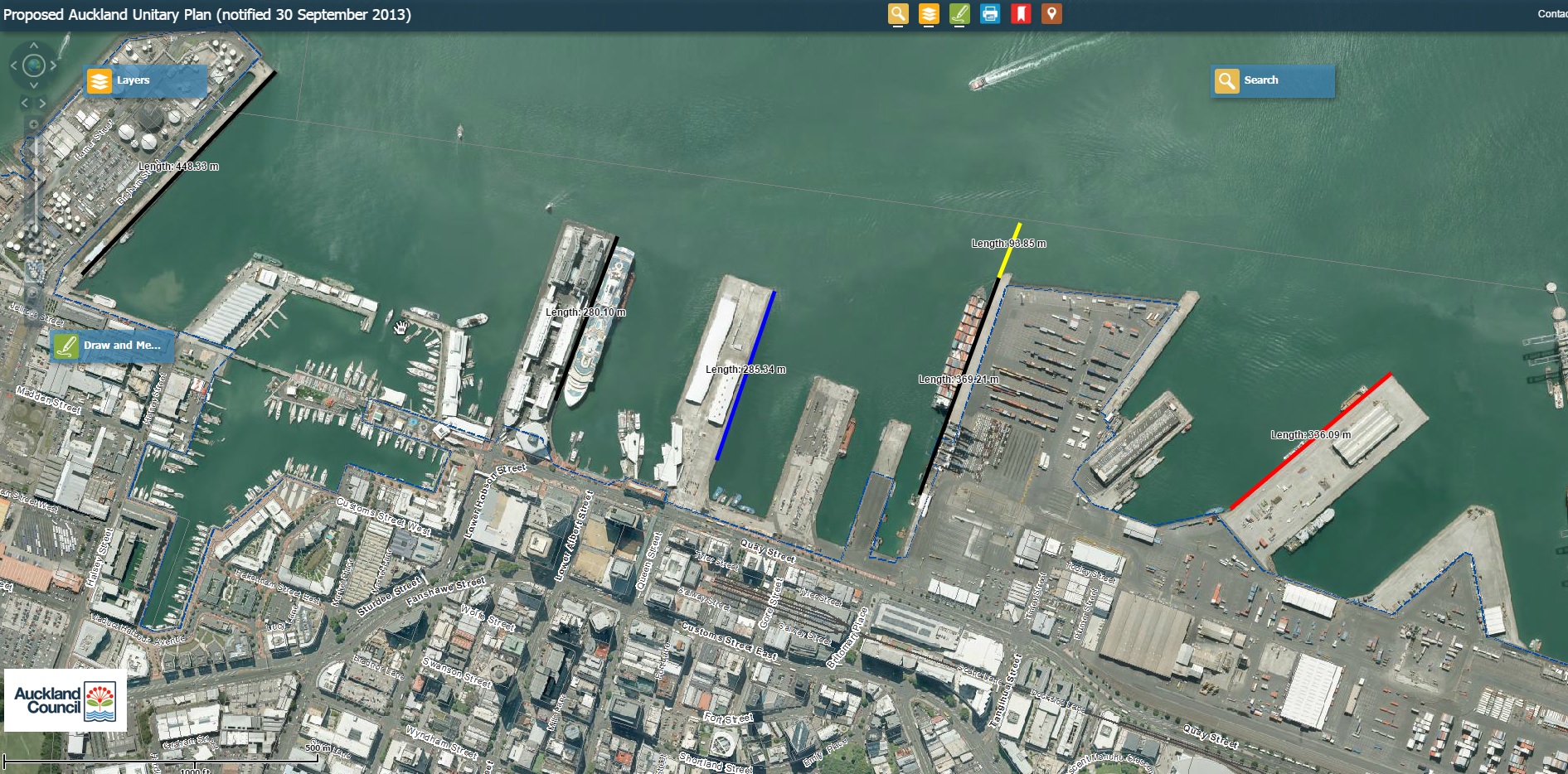
· In October 2014 and December 2014 POAL was granted resource consents by Auckland Council to construct two extensions to Bledisloe Wharf, which is part of POAL’s multi-cargo operation at the western end of the port precinct. The two extensions, when completed, would be 98 metres (B2) and 92 metres (B3) long and would provide berthage for multi cargo and vehicle vessels and new, longer cruise ships
· On 1 April 2015, the Auckland Development Committee requested that the Auckland Council Chief Executive and ACIL engage with the port to delay the planned works until the conclusion of the Port Future Study. Following this request, ACIL wrote to POAL seeking further dialogue on the issue.
· In the past three weeks a series of meetings has been convened between the council, ACIL and POAL. Auckland Council staff met with POAL management to explore options to amend the planned physical works programme for the multi-cargo, vehicle and cruise ship business and test alternative options. Engagement between the parties occurred on basis of a non-binding discussion to help inform parties of respective positions and to test alternatives.
· After considering a wide range of alternatives, five options were outlined to councillors by council staff in a briefing on 28 April 2015. They are:
Option 1: construction continues as per resource consents and POAL expands cruise and general cargo/vehicle volumes through additional berthage space. This would enable larger cruise ship visits from 2017 and meet multi cargo and vehicle carrier berthage capacity needs for several years.
Option 2: B2 constructed to full length, but B3 shortened to 40 metres. Under this scenario POAL could manage general cargo/vehicle volumes through additional berthage space, but could not accommodate longer cruise ships until alternative facilities are available.
Option 3: B2 to be fully constructed, B3 to be delayed until the outcome of the Port Future Study, provided that is available within twelve months. This would mean that POAL has limited expansion of berthage space. In addition it would not be able to accommodate longer cruise ships until alternative facilities are available. Future works would be subject to outcome of the Port Future Study and the final Unitary Plan rules.
Option 4: Port ceases work voluntarily until the outcome of the Port Future Study. POAL operations constrained to current facilities, with consequential impact on business certainty and the ability to process growth in freight volumes and accommodate larger cruise ships.
Option 5: Council discusses potential interventions with ACIL in order to achieve a delay in construction. This would have the same impact as option 4, plus the consequences of any intervention e.g. changes in directors.
· A formal response from POAL was received by the Chief Executives of Auckland Council and ACIL on 29 April 2015. The response indicates that POAL is prepared to delay the development of the B3 wharf until the findings of the Port Future Study has been considered by the council, provided that council completes this work within 12 months (i.e. June 2016). POAL has also committed to removing the B2 extension, if it is contrary to the Port Future Study conclusions and subsequent decisions.
· Council staff advised Councillors that they consider that the POAL proposal balances the need for increased port berthage capacity, while addressing a number of community concerns, specifically those around sight lines from the end of Queens Wharf and a view that the extensions are a precursor for further reclamation. While the proposal doesn’t stop of all construction, it does confirm that, should it be shown that the extension is not necessary to deal with current and near future freight demand, that it will be removed. The proposal also provides POAL with sufficient additional berthage to manage demand in the short to medium term.
· The development of the draft scope and terms of reference of the Port Future Study is underway and will be reported to the Auckland Development Committee on 14 May 2015. The final scope and terms of reference will be agreed in conjunction with a broad based group of relevant stakeholders.
—ends—-
The next one to watch is the Auckland Development Committee on May 14 to which I will be present at.

 Talking Southern Auckland