Future Port Study Draft Scope also up
The agenda for the May Auckland Development Committee is now up and can be read below:
The attachments and extra attachments can be found here: http://infocouncil.aucklandcouncil.govt.nz/
The main issue that will be discussed at the Committee will be the scope of the Future Port Study.
Below is the introductory remarks to the outline of the Future Port Study:
Port Future Study: Design Proposals
Purpose
- This report outlines the proposed stakeholder engagement process and draft scope of the Port Future Study as directed by the Auckland Development Committee on 3 April 2015.
Executive Summary
| Recommendation/s
That the Auckland Development Committee: a) endorse the collaborative Māori and stakeholder process, the establishment of the Stakeholder Reference Group and Consensus Working group, the role and tasks allocated to these groups, and the resources required to support them, as set out in the agenda report. b) endorse the list (Attachment A of the agenda report) of identified stakeholders to be invited to participate in the collaborative process, and delegate to the Chief Executive of Auckland Council the authority to extend this list as additional stakeholders are identified. c) endorse the draft study scope as set out in the agenda report, for referral to the Consensus Working Group. d) note that the project will be funded from the Mayoral Office budget, over the 2014/15 and 2015/16 financial years. |
Comments
- On 1 April 2015 the Auckland Development Committee resolved to commence the Port Future Study (Resolution No. AUC/2015/61), and directed the Chief Executive to report back on the study design as soon as possible. The committee noted that the study should include collaborative stakeholder input at each critical stage, including the study’s scope.
- This report gives effect to the committee’s resolutions by proposing the following:
- i) a collaborative stakeholder process and groups to be established as part of this process;
- ii) a draft study scope and process by which it is finalised and procured. Note that, once finalised, the study scope will be formatted into an appropriate Request for Proposal (RFP) for procurement purposes;
iii) the resources required to support the project and its processes;
- iv) a broad expected timeline for the project.
Collaborative Stakeholder Process
- The 1 April 2015 Auckland Development Committee resolution states that the project must be based on collaborative stakeholder input. It is helpful to reflect on the following principles of collaboration when considering collaborative processes for this project.
- Participation – participation of stakeholders from all perspectives need to be included. This will require developing strategies to work with individuals who don’t act collaboratively.
- Collective – collaboration may require broadening participant’s perspectives so that they are able to understand and respect the range of views within the group. The group needs to reach a consensus and then take action collectively on the decisions they make.
- Transparency – feedback and trust are essential elements of collaboration. Being transparent with information is crucial if that is to be achieved.
- Independence – collaboration requires independent thought, not group-thinking. An environment where people can think for themselves needs to be maintained.
- Emergence – the point of collaboration is to achieve great results. Focus must be on the end goal rather than worrying about how that is achieved. The collaborative group needs to set their own goals and objectives.
- Persistence – these principles need to be applied persistently throughout the process.
- Given these principles, the proposal is that the project essentially be ‘handed-over’ to stakeholders; that they work through and understand the study findings; and that they make recommendations to the council on the best way forward from their consensus viewpoint. Council will then make decisions on matters arising from the Port Future Study with these recommendations in mind.
- It is proposed that two groups be established – a larger Stakeholder Reference Group (SRG) and a smaller Consensus Working Group (CWG). There are essentially two drivers for this:
- i) there is wide interest in the study and many stakeholders that need to be accommodated – hence the larger SRG,
- ii) it is generally accepted that a collaborative group, or any working group for that matter, becomes dysfunctional once it is larger than around 12 to 15 people – hence the smaller CWG. The CWG is to be self-selected from the SRG.
Stakeholder Reference Group
- The SRG is made up of a number of ‘sectors’ under which stakeholders are grouped. The proposed sectors are:
- i) Māori
- ii) Business associated with the port – both direct and indirect
iii) community groups e.g. residents, heritage
- iv) environmental groups
- v) recreational marine users
- vi) specialist interest groups
vii) specialist professional groups
viii) specialist commercial groups.
- Attachment A contains a list of organisations under each sector that will be invited to participate. It is noted that many of the specialist groups also represent general community views. This list needs to be as inclusive as possible and is not exhaustive at this stage. Delegation is sought for the Chief Executive to expand this list over the next two weeks.
- Each sector would have a number of representatives, who together constitute the SRG. The representatives are identified through a facilitated self-selection process. The SRG would ideally have between around 40 to 50 representatives (feasibly around 5 per sector). POAL would be represented on the SRG, though with fewer representatives than the various sectors.
- The role of the SRG is to:
- i) represent stakeholders and communicate back to organisations within the sector
- ii) engage with and provide feedback / input to the CWG as needed
iii) undertake work requested by CWG as needed
- iv) receive updates and report-backs from the CWG.
Consensus Working Group
- The CWG will be a smaller group of around 15 people. This group will not be sector based, but selected through a facilitated self-selection process from within the SRG. The two exceptions are Maori and POAL (one representative) who have automatic representation on the group. The CWG will be chaired by an Independent Chair.
- The role of the CWG is to:
- i) finalise and agree the study scope
- ii) receive progress updates during the study
iii) provide direction / decisions as required
- iv) identify and request additional critical information / work to be undertaken
- v) receive the final study report
- vi) make recommendations to the Auckland Council on the way forward
vii) engage with the SRG during the process.
- The CWG is where the bulk of the work will be done. It is considered appropriate that members be remunerated.
Independent Chair
- The CWG needs to be expertly chaired to ensure the principles of collaboration are applied and the group works towards consensus building and recommendations to the council. The role of the Independent Chair is to:
- i) chair the CWG
- ii) engage with the SRG
iii) engage with consultants and technical experts\
- iv) liaise with the project manager
- v) stakeholder management and communication
- vi) be a spokesperson for the project.
- There are three feasible options by which the Independent Chair can be selected:
- i) selected and appointed by the council
- ii) selected by the SRG
iii) selected by the CWG – either from within or outside the CWG.
- It is recommended that the council selects and appoints an appropriate chair. Proposals in this regard are captured in a report, titled “Port Future Study: Appointment of Independent Chair”, under separate cover.
- Chairing the CWG would be time demanding. It is therefore appropriate that the chair be remunerated.
- Figure 1 illustrates the broad proposed process for establishing the SRG and CWG.
————————————-
You can read the rest of the material in the agenda.
However, there are a couple of points to keep an eye on the Study set up:
-
The proposal does not include any general community consultation during the study. This is because:
- it would be unreasonable to expect the community to keep up to date and informed on what is likely to be a highly technical study
- it would be more reasonable to engage the community on specific proposals that the council may wish to put forward once the study is completed.
-
Based on this, there is no immediate need for a decision on general community consultation. This is something the council can consider once it has a better understanding of potential proposals itself.
As for what the study is going to look at:
Study Scope
- The objective of the Port Future Study is to provide Auckland Council, as the port company’s owner, with recommendations about a long-term strategy for the provision of facilities to accommodate sea-based imports and exports (and the cruise industry) flowing to and from Auckland. In doing this, the study will consider the economic, social, environmental and cultural costs and benefits, and the feasibility, of a range of options that will include:
- i) relocating part or all of the port, or the port’s functions, within the Auckland region
- ii) closing Auckland’s ports, thus requiring imports and exports to and from Auckland to arrive by sea at other ports and be freighted to Auckland by land
iii) constraining the port to its current footprint, while planning for future development of additional facilities at another location(s)
- iv) enabling limited growth within the existing port precinct, while planning for future development of additional facilities at another location(s).
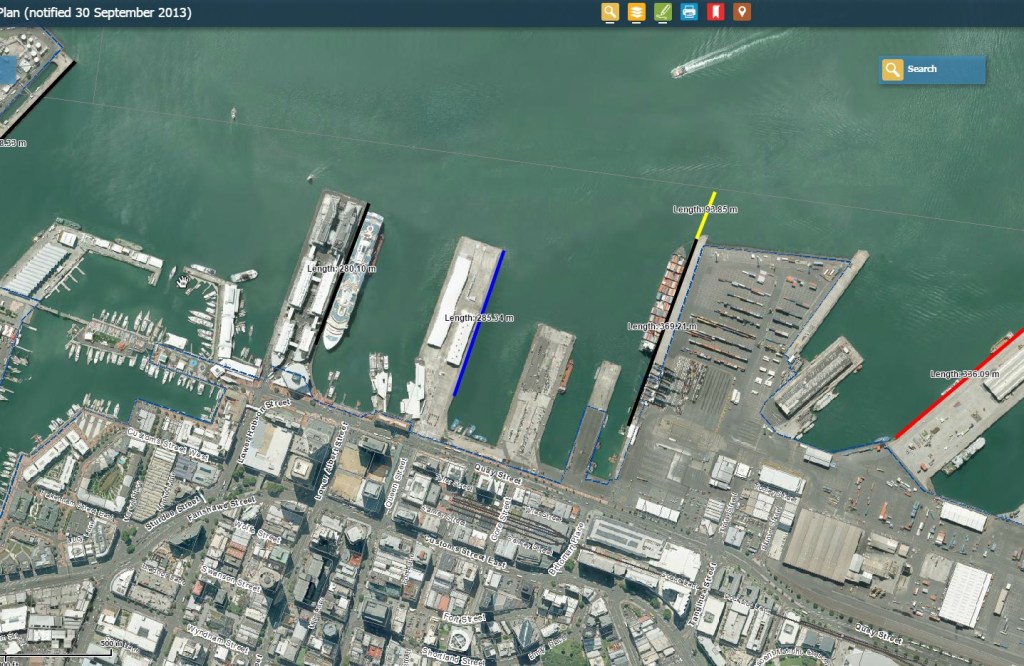
- For clarity purposes, all options need to consider how port activities could be reconfigured (both current and future), and therefore also consider the wider impacts on and requirements of the waterfront and its surrounds, for example the central wharfs and cruise ship requirements. The study is therefore not restricted to the current ‘port precinct’.
- In considering the costs and benefits of the various options, consideration will be given to the full spectrum of costs and benefits, such as:
| Economic | · Investment needed for option: | for POAL
for others e.g. government, other local authorities, other port companies cost of supporting infrastructure cost of reconfiguration options |
| · Opportunity costs: | of land with the port in its current location
of rail-line utilisation of other transport infrastructure |
|
| · Market impacts on road / rail / motorways / waterways | investment choices
value of travel time |
|
| · Cost impacts: | to supply chain
to customers |
|
| · Economic benefits & impacts for Auckland: | GDP
import / export sector cruise industry tourism industry |
|
| · Economic benefits & impacts for NZ: | GDP
import / export sector capacity of other Upper North Island ports freight distribution and movements |
|
| · POAL | business profitability
size of dividend POAL ownership (in context of North Island port operations and freight distribution) |
|
| · Maori: | impact of Te Ao Maori | |
| Environmental | · Marine ecology: | marine mammals
fish and benthic organisms |
| · Hydrodynamic: | tidal flows
channel depths / dredging sediment loads sea level rise harbour capacity |
|
| · Natural values: | water
coastal access |
|
| · Carbon footprint: | land based
sea based |
|
| · Pollution: | air quality
land based sea based |
|
| · Impacts other: | visual
noise light |
|
| Social | · Employment: | port core – job gains, losses and relocation
wider e.g. supply chain – job gains, losses and relocation access to employment (equity) employment opportunities for future generations including employment opportunities for Maori |
| · Public access: | to and from the harbour and the gulf | |
| · Recreational use: | of the harbour and gulf
of the waterfront |
|
| Cultural | · Maori: | historical grievances
cultural values |
| · Heritage: | port or maritime history related
city related |
|
| · Urban form & amenity: | waterfront as gateway to the city
how the port and city integrates how a growing & denser city and port relate / exist side-by-side transport impacts |
……………………….
A bit long winded there but essentially the Future Port Study is going to be doing a full Geographic (Physical and Human) analysis of the Port in its current location as well as relocation options. Once the non viable options fall away then most likely two strong options will come up to which the Council will consider and send out to a full consultation round with the wider community afterwards.
So we will see where this goes on Thursday. I will be at the Committee in the morning Live Tweeting the proceedings before heading to my first Unitary Plan mediation on all things transport (parking).

 Talking Southern Auckland