
Public invited to watch as well
From Auckland Zoo and its partners:
Rare takahē to be released on Rotoroa
Two of New Zealand’s critically endangered takahē will be released onto Rotoroa Island this Saturday 23 May – a free event open to the public.
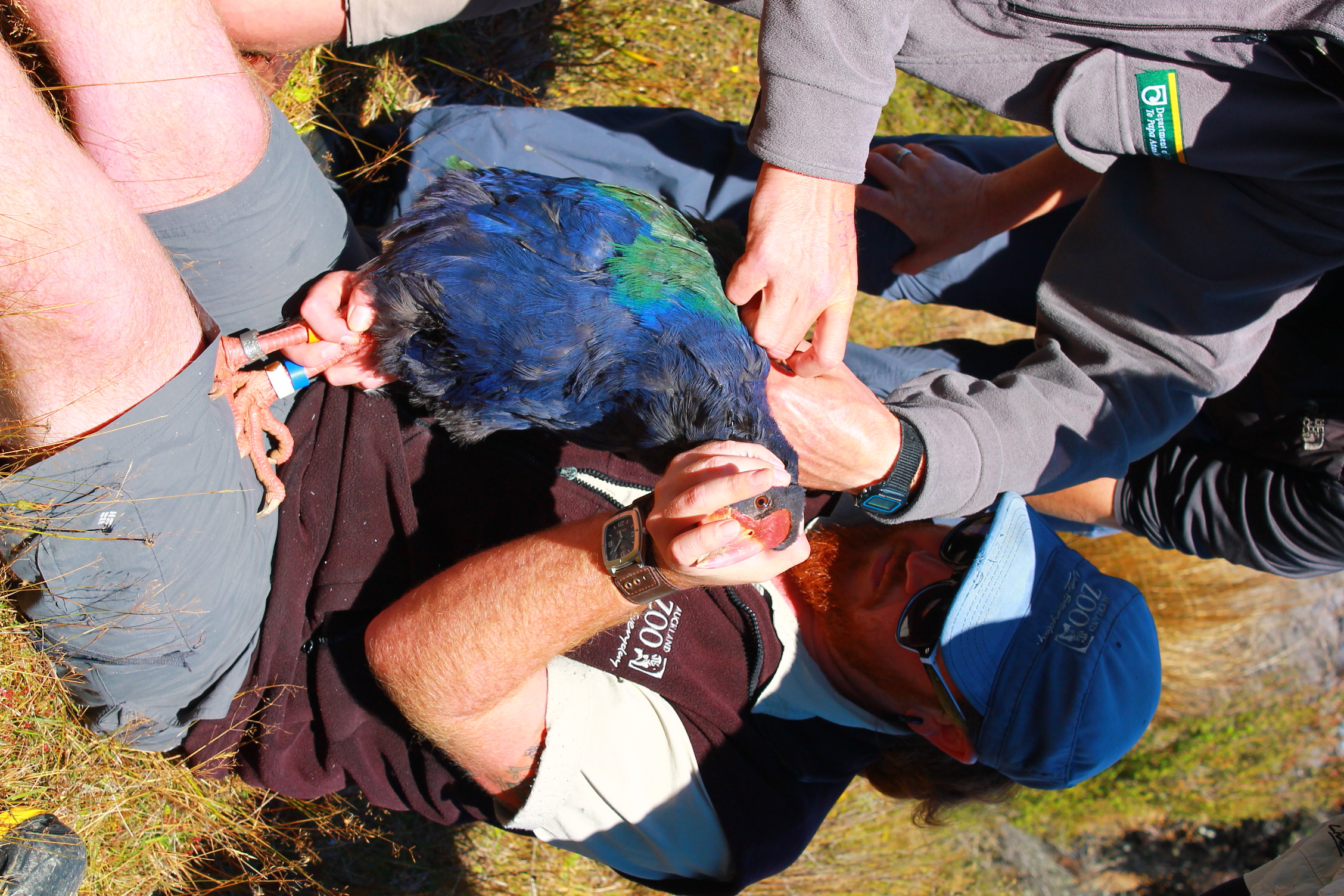
Seventeen-month-old takahē Teichelman (male) and Silberhorn (female) are the first of up to five breeding pairs bound for the Hauraki Gulf isle where Auckland Zoo and the Rotoroa Island Trust (RIT) have partnered to create a unique wildlife reserve.
The two birds hatched at the Department of Conservation’s (DOC) Burwood Bush Takahē Rearing Unit near Te Anau as part of its successful Mitre 10-supported Takahē Recovery Programme, and are expected to breed within the next two years.
Auckland Zoo has been working in partnership with the international Conservation Breeding Specialist Group* (CBSG) and DOC to help develop the population management plan for takahē, which has been partially funded through the Auckland Zoo Conservation Fund.
“There are currently just 270 takahē in the world. While we know there’s no single New Zealand site large enough to recover this iconic species on its own, collectively, lots of smaller sites, including islands like Rotoroa, can work together to ensure their future,” says Auckland Zoo director, Jonathan Wilcken.
Rotoroa Island Trust (RIT) chair Barrie Brown says Rotoroa is delighted to be welcoming and assisting takahē.
“It’s wonderful that Rotoroa can provide a haven for these takahē to grow, breed and produce chicks to then help populate other selected safe North Island sites. Takahē will be the sixth wildlife species we’ve introduced to the island in the past twelve months,” says Mr Brown.
“Many of these species are being sustained through intensive conservation management. This is something the Rotoroa-Zoo partnership is demonstrating to a new generation of young New Zealanders through our dynamic schools programme. The addition of takahē provides us with more great opportunities to engage these future conservationists.”
The takahē are being released onto Rotoroa with the blessing of their kaitiaki (guardians) Ngai Tahu, and will be received by representatives of Ngai Tai ki Tamaki on behalf of the iwi of Rotoroa. The pair are being fitted with transmitters and will be monitored closely by Zoo and Rotoroa Island staff.
Public invitation: Public are welcome to attend this 23 May takahē release by catching the ‘360 Discovery ferry from downtown Auckland (Pier 3, Quay St) at 8.45am. For ferry bookings and ticket prices, visit360discovery.co.nz.
*The Conservation Breeding Specialist Group is part of the International Union for the Conservation of Nature’s (IUCN) Species Survival Commission. It provides species conservation planning expertise to governments and wildlife organisations. More details can be found at http://www.cbsg.org/
Takahē Fast Facts
- The South Island takahē (Porphyrio hochstetteri), endemic to New Zealand, is flightless – though has wings, can weigh up to 3kg, and is uniquely adapted to eating grasses. It is the world’s largest living rail and is Critically Endangered (IUCN Red List).
- Takahē pairs mate for life. Females lay 1 – 3 eggs in October, of which around 80% hatch. The 30-day incubation is shared by both parents who also feed their chicks for 3 months.
- Working in partnership with Mitre 10, the DOC Takahē Recovery Programme has not only grown the takahē population, but has also developed the capacity to support breeding takahē to new sites such as Rotoroa Island.
- There were only four recorded sightings of takahē between 1800-1900, then none were seen until 1948 when they were rediscovered by Dr Geoffrey Orbell in the Murchison Mountains in Fiordland National Park
Rotoroa Island Wildlife Reserve
- The Rotoroa Island Trust (RIT) and Auckland Zoo formed a partnership in 2012 to create a wildlife reserve on Rotoroa, funded by the Hutton Wilson Charitable Trust ($4m over five years)
- For 100 years, Rotoroa was run by the Salvation Army as a drug and alcohol rehabilitation centre, and was closed to the public, a role that ceased in 2005. www.rotoroa.org.nz
- Following extensive planting, monitoring and pest eradication, six wildlife species have now been introduced to the island – saddleback, whitehead, kiwi, moko and shore skinks, and now takahē. The RIT-Auckland Zoo partnership plans to introduce up to 20 species to Rotoroa Island by 2018

Source: Auckland Zoo
Source: Auckland Zone

 Talking Southern Auckland