
Choice and savings
Yesterday talks occurred between Government Ministers, Mayor Len Brown and Deputy Penny Hulse over the Transport Accord in Wellington. There have been no pressers from yesterday’s meeting but this will be a long game so plenty more meetings to go.
But it pays to remember as Budget 2015 and the term poverty gets bantered I bring this graphic back up again:
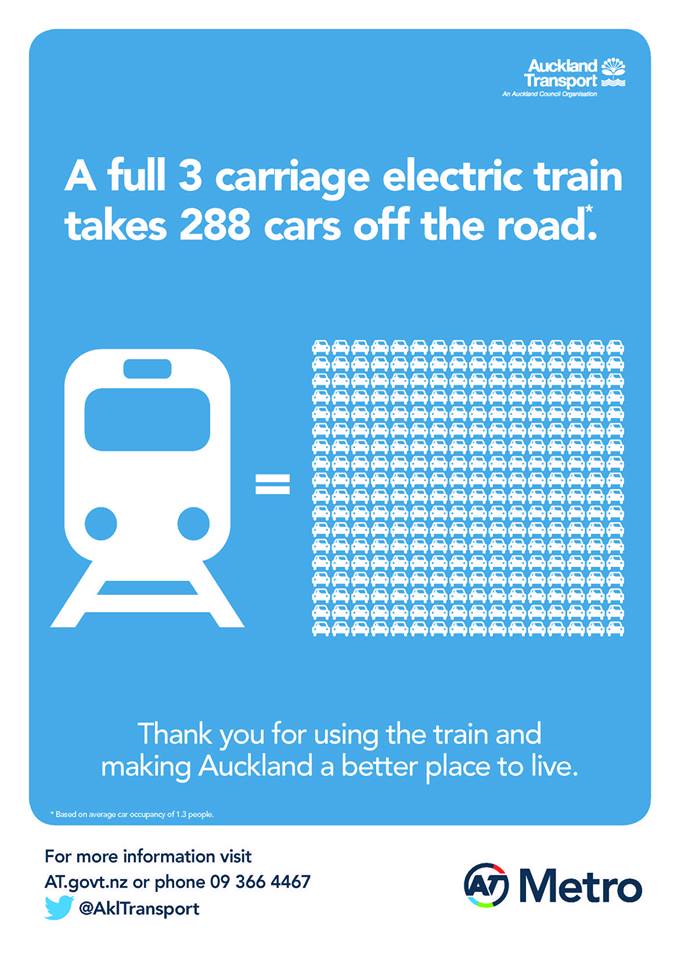
The above graphic (and one translated for buses and light rail) works when the system is in place that is a given. And so the two questions of whether both the Government is willing to pay the Iron Price (actually invest in rail) and whether we are willing to chip in via the Transport Levy (preferably the one Councillor Clow with my addition for rural properties added) to get our transport system on track.
22,000 submissions with most calling for more investment in public and active transport would send a loud enough signal to the Government at least that more needs to be done now.
This leads to the situation and question of whether we have “transport poverty.” That is owing to a public and active transport system that is currently not accessible nor efficient to a large majority to the urban population that population are “enslaved” to the relatively expensive car.
Thus the way to alleviate this transport poverty is to have a working, accessible and efficient public and active transport system so people are able to make a genuine choice on their transport mode. If you wish to have a car that costs you round about $7,800/year in running costs feel free. But at the same time if I want to save that $7,800/year from a car and either pay $2,280/year in public transport or even $0/year using active transport to get around urban Auckland then I should be able to.
Because right now I can not make that choice to use public transport more and subsequently ditch one of our two cars and make those large savings that could be used else where. For me that would be paying off the mortgage. For others in South Auckland those savings from ditching the car could mean better quality food, better quality clothing, and even a genuine increase sense of happiness and quality of life.
But again to enjoy such “savings” we need our public transport system to be efficient and accessible to all urban residents and to all urban jobs commercial AND ESPECIALLY industrial!
Until then we live in Transport Poverty.
*Costs
- Car figure of $7,800/year is derived from fuel, registration, WoF, servicing and other general maintenance (see AA PDF below)
- Public Transport Figure of $2,280/year is 12 months of A-B Zone AT-HOP Monthly Passes that allow unlimited travel per month. For a single zone Monthly is $1,680/year

 Talking Southern Auckland
Agreed. Can’t help but think a lot of our current transport plans are being framed in a very middle class way – lots of talk about how people are going to get to the CBD or the associated railway stations on the lines quicker, but not a lot of discussion about how frequent transport is going to help someone get to East Tamaki from the other side of Auckland without expecting them to spend two hours at the beginning and end of each working day transiting.
Will reply to this hopefully in the afternoon or tomorrow as quite a bit came out of Committee regarding your comment.
Not sure if this earlier post helps give light on what you were referring to in your comment: https://voakl.net/2015/04/07/missing-bus-links-those-industry-links/
Note: the situation that arose from this post is often the main point of contention between myself and Generation Zero.