The American Mall Comeback – Reintegrating them back into the Urban Fabric
Yesterday while I was in the Unitary Plan Mediation on the Metropolitan Centre Zone the Council Planners earned my ire around their stance on malls and their role within the Metropolitan Centres. I can not comment on the other submitters unless they wish to do so themselves until the Hearings start in September. Council Planners if they attract my attention differ and if I want to comment on my interactions with the Planners will then draw my comment unless commercial sensitivity applied to a site specific area.
Yesterday there was a hung up (again) over the role of the shopping mall and their place in a Metropolitan Centre. We have ten Metropolitan Centres in Auckland of which only two don’t have malls in them (Papakura and Westgate). As I know malls do act as central anchor points in the other eight Metropolitan Centres and will do so for a very long time. More to the point unlike overseas I do not see our malls in those eight Metropolitan Centres suffering the same rate of decline seen in the USA (unless the Mall over really doesn’t invest in its mall). Malls in Auckland especially when invested in are still big draw cards and in the weekends Manukau and Sylvia Park (to name two) draw a brisk trade.
I will cover separately why Council Planners earned my ire yesterday around malls and the Metropolitan Centres.
But in this and which will form part of my evidence for September I am going to look at the mall in the USA.
The Rebirth of the American Mall and the American Mall Seeking to Reintegrate with the Urban Fabric
From CNBC
Doubling down on the rebirth of the American shopping mall
For the first 100 years of its existence, the tiny town of Williston, North Dakota, was known for little more than ranching, farming and its proximity to where the Yellowstone and Missouri rivers meet. It was a true frontier town, with a small downtown district and the closest shopping mall some 125 miles away. Blink and you could miss it.
Today Williston—which sits atop the oil-rich Bakken shale formation—is enjoying a second life as a key player in the state’s booming economy. Following several years of record population growth and real estate development, the town will soon boast one more draw: a $500 million retail mecca complete with shopping, a hotel and indoor water park. Not bad for a town of just 32,000 people.
Williston is one of five major projects across the U.S. that highlight the many challenges facing the modern-day shopping mall—from the rise of online buying to Americans’ flight to the cities. But they also identify some possible solutions, whether it’s incorporating elements of what makes that town unique, or weaving in other forms of entertainment.
……..
Source: http://www.cnbc.com/id/102710913
The article then goes on the rise and then the fall of the mall due to over expansion, the Global Financial Crisis, and individual retailers not adapting to changing “tastes” of the ever digital-connected consumer. All points I can easily agree to.
But why have the malls in our Metropolitan Centres (and of course St Lukes) survived to the point of facing increasing demand from us the Auckland consumer. Increasing demand despite more returning to the City Centre and this apparent trend of “main stream shopping” if I were to take Transport Blog and Generation Zero’s comments at full value.
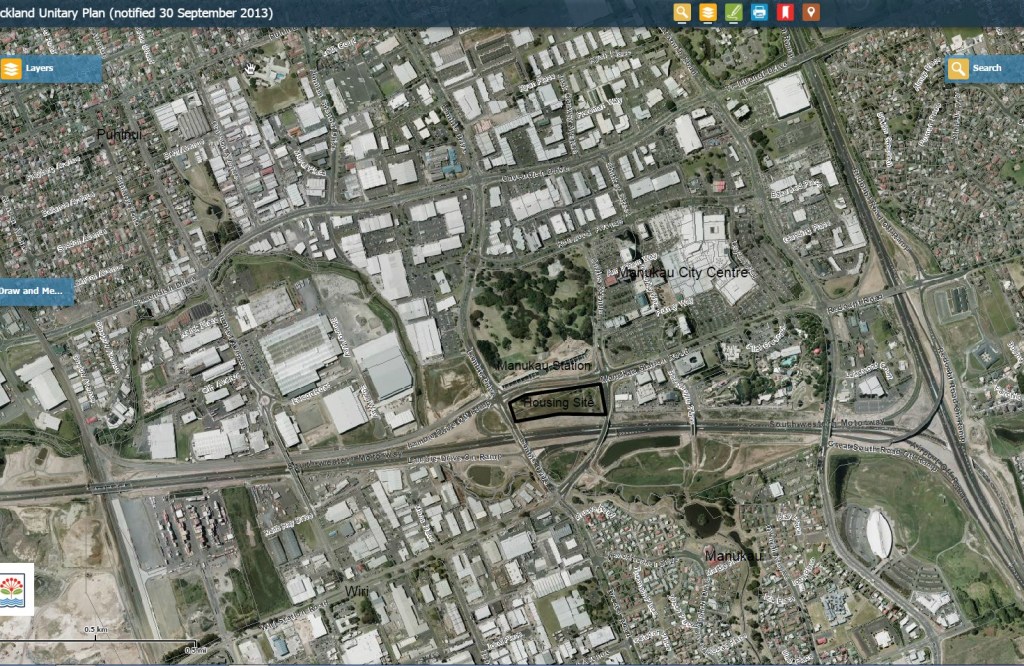
I look at Manukau Mall (to which I will focus on here) which still does a brisk trade in the weekends and most late night Thursdays. I also look at other malls and their owners committing some serious capital in both upgrading them AND integrating them back into the wider urban fabric (the main point of the USA article). So in my opinion the mall is not dead here in Auckland but rather evolving as best it can to the fickle tastes of the citizen consumer.
Continuing from CNBC
But balance is being restored in the sector. The amount of new retail space hasn’t topped 40 million feet a year since 2009, according to CBRE, a real estate brokerage firm. This comes after many years with more than 150 million square feet added to the market annually. And now some of the country’s biggest developers are making huge bets that the shopping mall—long a symbol of the American suburbs—still has a bright future; albeit with a major makeover.
…..
Investment also must be made to rejuvenate existing malls, and big money is being ponied up to make these properties succeed. Simon Property Group, the world’s largest real estate company, has redevelopment and expansion projects underway at 24 shopping properties in the U.S. and Asia. In addition to a major overhaul at its World Trade Center location in Lower Manhattan, Westfield’s projects include makeovers for its properties in Los Angeles and San Jose, California. And General Growth Properties, whose strategy is to “acquire assets with significant unrealized growth potential” in U.S. cities, is overhauling its Ala Moana Center in Hawaii, to the tune of $660 million.
….
As I said earlier investment back into our malls is happening.
“The U.S. isn’t overretailed, it’s under-idea-ed. If you have a great idea it doesn’t matter how much competition there is.”
….
Yeah our Council and its planners seem to be very resistant to “great” ideas that are outside their narrow mind frame and ideology as I found out yesterday.
A sense of place
A Brooklyn native, Castellani said dining halls at other retail properties around the city felt too formal, and left consumers angry about how much they’d spent on a sandwich. So when her team got to work and designed City Point’s dining area, they told each of the vendors to bring its own personality to their space. Arepa Lady, for example, got its start making cornmeal flatbreads that are popular in Colombia and selling them out of food truck in Queens. It will continue to sell out of a food cart at City Point. “It can’t feel like it’s anywhere but in Brooklyn,” Castellani said. But it also has to feel effortless, because Brooklynites “can smell it if you’re trying too hard,” she said. “They can smell a rat.”
The fusion of shopping, living, office and entertainment space all at one site marks a major shift in retail. In fact, such projects were once considered taboo, as developers doubted consumers would want visit to a grocery store or gym while they shopped for apparel. Today, these mixed-use properties resonate with time-crunched shoppers looking to combine trips—a key tactic driving the Brooklyn project and the $20 billion Hudson Yards megadevelopment.
When completed in 2019, Hudson Yards—the legacy of a failed 2012 Olympic bid—will include condominiums, a public school, restaurants and more than 100 shops, including Manhattan’s first Neiman Marcus. Also, buzzworthy: fitness center operator Equinox’s first foray into the luxury hotel business. “We’ve curated this to make sure when you come in here it’s everything you’d want to have,” said Ken Himmel, president and CEO of Related Cos.
……..
Again our mall owners and their investors are looking (and doing) at upgrading their malls into full integrated centres (Lynnmall and Sylvia Park to name two) . Something that would give the Metropolitan Centre flesh on their naked bones at the moment. And it is something Council should encourage if it wants “intensification” within our Metropolitan Centres as the City continues to grow. However, our Council Planners seem to have this “Anti-Mall” aversion full stop which is not going to help ANYONE including the private citizen come consumer.
The rest of the article goes on about specific examples in the USA including those Millennials shopping at Malls specifically well designed fully integrated malls.
In short the mall is not dead in Auckland and is making its revival in the USA. As seen in the USA the malls here in Auckland are evolving to become fully integrated developments that will include residential, office, non retail services, recreation, and anchor points to public transport hubs (which our Council pushes).
However, as I will cover in a separate post the Auckland Council is its own worst enemy and is fast becoming an enemy of the private citizen. Council is there to enable for the demands of the citizen, not enforce some social engineering ideology up on us. And the way the Planners earned my ire yesterday Council is not going to do itself any favours especially if it becomes an #Auckland2016 issue!
As a final remark I shop on both Main Streets and Malls depending on my “wants” on my lesiure trip.
Reference Link to CBNC Article:
Doubling down on the rebirth of the American shopping mall

 Talking Southern Auckland