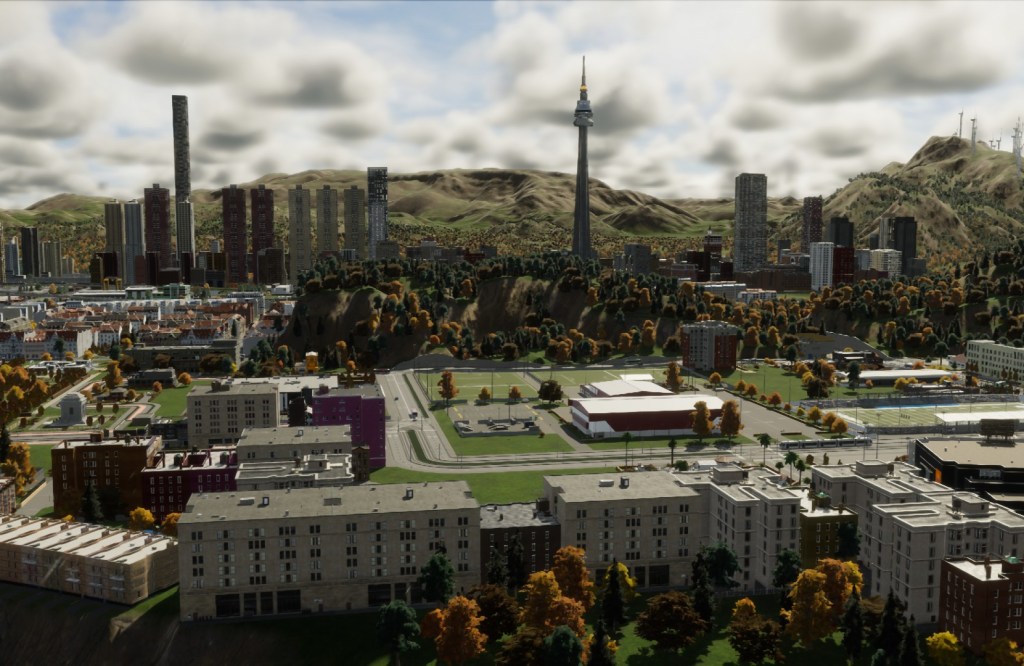
The consequences of those deliberate choices made earlier on
In developing Manukau City Centre in Cities Skylines 2 through my 3.x series, I pondered about how much complexity goes on in getting an urban area ready for residents and businesses to move in, and for visitors to part with their coin. In the end I came up with:
The definition of Planning Complexity or rather the efforts it takes to produce an output which becomes that successful it causes a new set of complexities.
Complexity One – the amount of preparation 👇
How much goes on to get to the point of residents and businesses moving in, and for visitors to part with their coin?
It takes around 12 hours in real time in preparation and planning to produce a single 51-minute video of the urban simulator letting rip (aka off pause) and watch all the urban interactions take place. Those interactions leading to the city – Manukau Ranges going from 28,000 population to 68,000 in the space of that 51-minute video…
You can see the 3.x series here: From 28,000 to 68,000 population (in 51 minutes). The Planning and Preparation of the City!
The results you will notice is the population increasing rapidly and people making use of the transit and amenities. This brings about a new set of complexities:
Complexity Two – Succeeding in your goal on giving a people and businesses a reason to come to your City 👇
Foxy’s Dive doing the mahi here
A gallery of those four pictures with the streams of pedestrians going to and from Foxy’s Dive cocktail bar:


So I have hospitality and entertainment covered. Well what about transport?
Transport is covered in the third complexity 👇
Complexity Three – Actually designing and more to the point FULLY FUNDING YOUR TRANSIT SYSTEM that well it is not only a success but success is measured by; I NEED A BIGGER BUS, TRAM, AND TRAIN:
In Cities Skylines 2 I can open the Transit Line Manager to see the individual Line’s percentage rates. Meaning their average utilisation verses nominal capacity for each Line (passenger or cargo). Anything above 33% (remember it factors a full 24 hour day not just peak time) means the Line is being used well. Above 50% we are getting crowded as there will be periods in the day the rolling stock is full. Above 75% will be symptomatic of overcrowding becoming regular. 90%+ means you are going to need something bigger!
Not every single Line will be hitting those figures and if it did I be worried. On the flipside while we can see the central station with its masses of pedestrians, cars are still around and the city still gets congestion pinch points. The other end of the City Centre is facing this as it is close to a major motorway interchange, and I had not yet extended the bus services to this area. But with some addition of some bus lanes, some new bus stops, and some new bus routes the congestion is lessening and I am some very happy city centre residents.
Going back to Manukau Ranges 3.0 – Overview and Development of the City Centre
To get where we are in 3.3, and the upcoming 3.4 video (in production as of this post) it all comes back to deliberate decisions taken way back in 3.0 and even 1.0.
Outlined in 3.0:
The City Centre might be under development but deliberate choices were made regarding the transport network around the central station, an accompanying metro station, and the tram/bus mall! What we plan has consequences to the Spatial Form, and accompanying behaviours! It also has consequences…
In 3.0 I give an overview following:
- Development of the City Centre that was done off-screen
- What I am trying to achieve with the City Centre in terms of 24/7 economy in terms of infrastructure
- Who I am trying to attract and why
- How to attract those residents, businesses and tourists using the Signature Buildings, and Leisure venues
- Miscellaneous tidbits in preparation of 3.1
The 3.0 video:
And of course 3.3 where we see it all in action:
In the end what 3.x has illustrated is the definition of Planning Complexity, as a consequences of some very deliberate choices made. Deliberate choices not only made at the beginning but as the Ctiy continues to grow and evolve.

 Talking Southern Auckland
One thought on “The Very Definition of Planning Complexity”
Comments are closed.