The Great Parking Delusion Harms Us
Parking, one of the greatest lightning rods if not lightning rod when it comes to Urban and Transport Planning, not matter what country you are in. This gets exacerbated even more so when it comes to free verse paid parking. And consequently this impacts how parking shapes our world including hidden high costs. But is there a way out of it. The Part 9.x mini series will look at this starting with a general redux,
How Parking Shapes our World
The High Cost of Free Parking: Why Your Car Pays Cheaper Rent Than You Do
1. Introduction: The Great Urban Delusion
If you look at an aerial map of the Manukau City Centre from 2010, you will notice a startling, almost dystopian truth: there is more land dedicated to the storage of stationary cars than to the humans who live, work, and study there. We have all been there circling the block for twenty minutes, gripped by the frustration of “parking scarcity” while trying to attend a match or grab dinner. To the average driver, our cities are suffering from a desperate shortage of pavement.
But step back from the steering wheel and the delusion evaporates. What we perceive as a “parking crisis” is a management failure. Our metropolitan centres are not running out of space; they are drowning in “concrete wastelands” designed for cars that are not even there 90% of the time. This obsession with “free” parking is an invisible tax on housing and a parasite on urban design. By prioritizing the storage of private metal boxes over the needs of people, we have built a world where cars enjoy cheaper “rent” than the human beings who own them.
2. Your Rent is Subsidizing a Ghost
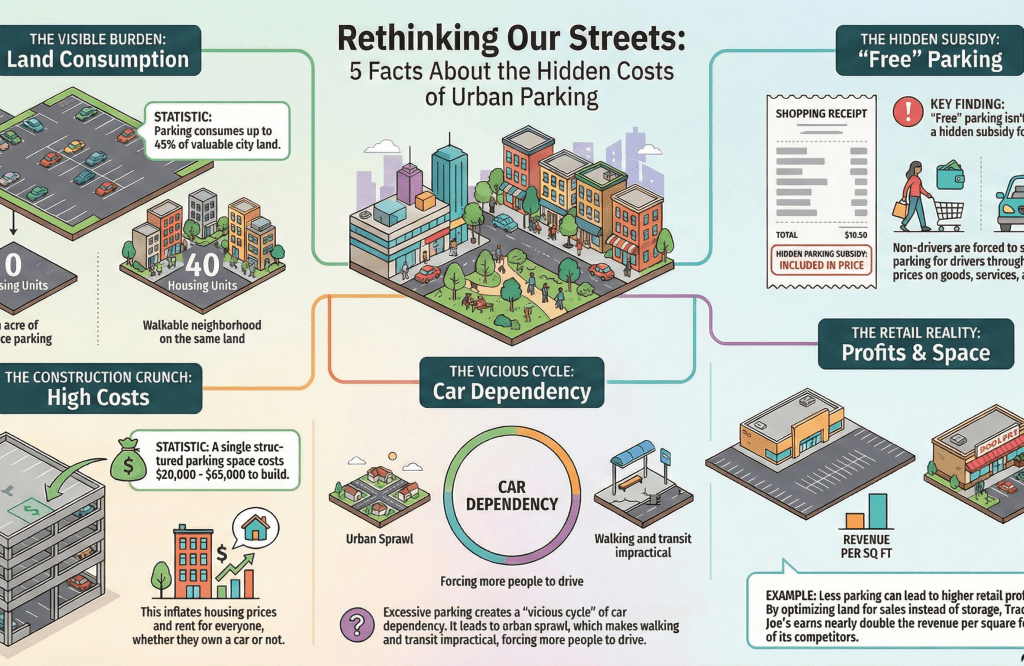
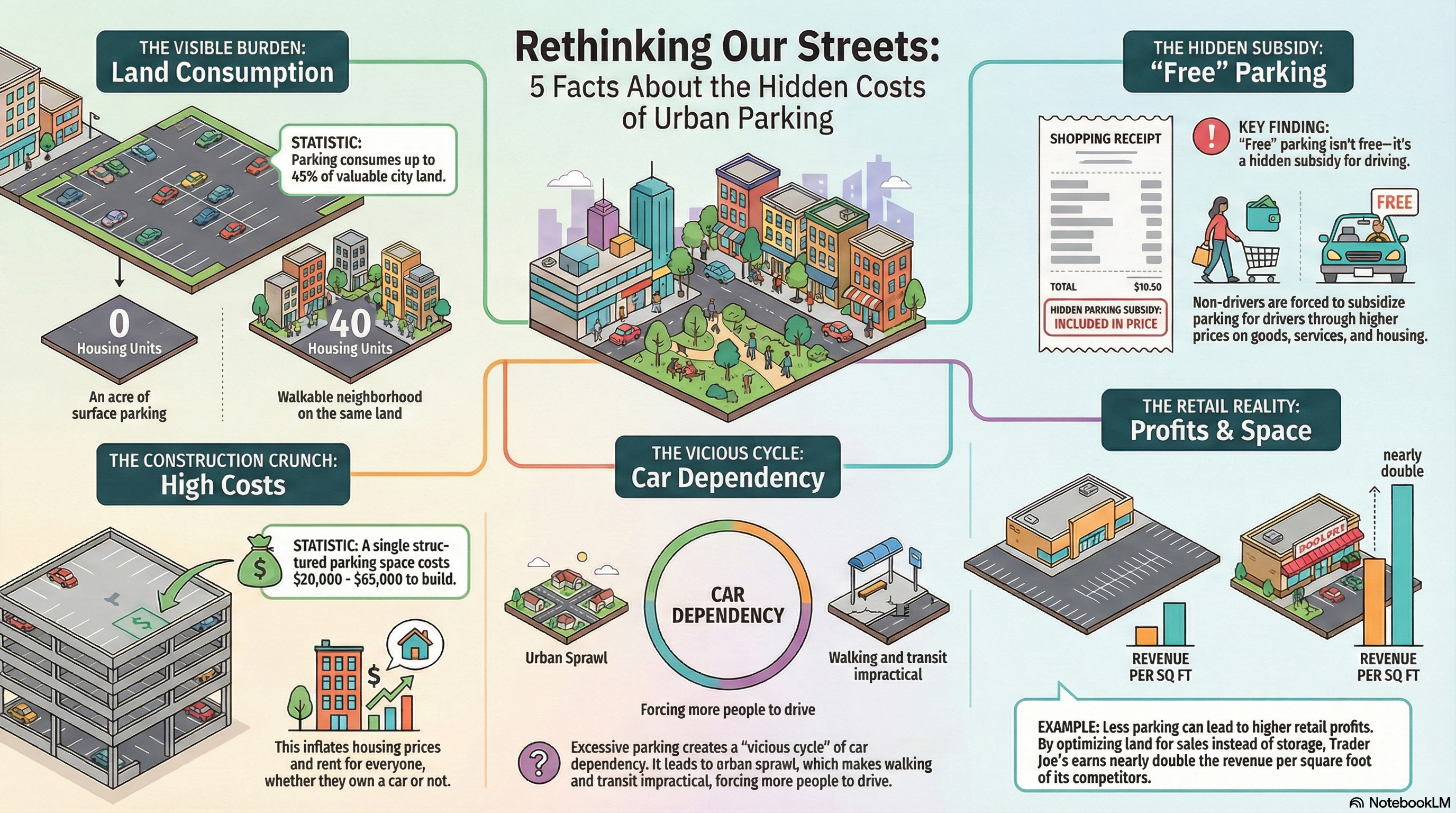
The most damaging impact of mandatory parking minimums—government rules requiring a set number of stalls for every new building—is hidden in your monthly mortgage or rent. Data from the “Market-Led Paradigm” and City Observatory reveals a staggering economic irony: parking requirements add 10% to housing prices.
In a modern parking garage, a single stall can cost up to $37,000 to build. Even a simple surface space can cost $4,200, requiring land that could otherwise be used for additional housing units. This is not just an efficiency problem; it is a social justice issue. These mandates frequently “kill” affordable housing projects because developers cannot balance the books when forced to spend tens of thousands of dollars on empty stalls.
The result is a profound social inequity. Low-income residents, the elderly, and people with disabilities—groups significantly less likely to own cars—are forced to effectively pay for the construction and maintenance of parking for those who do.
“Each stall in a parking garage can cost up to $37,000 to build… forcing every tenant to effectively pay for the construction and maintenance of off-street parking requires people who don’t own cars—who are disproportionately low-income, the elderly, and people with disabilities—to subsidize those who do.” — City Observatory
3. The Genius of the “Small” Parking Lot
We often assume that a business with a full, tight parking lot is failing to provide “sufficient” space. The reality is that the “notoriously small” lot is often a weapon of competitive brilliance. Consider the Trader Joe’s model. While shoppers frequently vent on social media about their tiny, frantic lots, the economics tell a story of unmatched efficiency.
Trader Joe’s achieves sales of approximately $1,734 per square foot, nearly doubling the $930 per square foot generated by rivals like Whole Foods. By “right-sizing” their developments—prioritizing revenue-generating floor space over massive car storage—they lower their overhead and gain a massive competitive advantage. They can locate in dense, high-value urban areas where their sprawling competitors simply cannot fit. A “sufficient” lot is one that stays full; an “empty” lot is just an expensive, unproductive asset sitting on the balance sheet.
Why cars pay cheaper rent than you
4. The Secret to Tokyo’s “Inviting” Streets
Why do international cities like Tokyo feel fundamentally more pleasant to walk in than our own? The secret is not simply better transit; it is the “Proof of Parking” law. In Japan, you cannot purchase a vehicle until you can prove you own or rent a private, off-street space to store it.
There is no cultural or legal assumption that a motorist has a right to store their private property on public streets for free. The aesthetic result is transformative. Without rows of parked vehicles lining every kerb, streets become open, safe, and visually quiet. They become places for people to walk, talk, and exist, rather than mere corridors for stationary machinery.
“Every time I see a picture of a Tokyo street scene I think ‘why does this look so inviting?!’ and then I realise it’s because there’s no on street parking.” — Ben Ross
5. The “Black Friday” Fallacy
While Japan embraces individual responsibility, Western cities are trapped in a model of “mandated excess.” We typically design our cities for the “Black Friday” or “Boxing Day” peak—the absolute busiest shopping day of the year. This ensures that for the other 360 days, those massive lots sit half-empty, hollowing out the vibrancy of our neighbourhoods.
The alternative is a “Market-Led” supply where developers build for actual context. Look at recent developments near the Northern Busway in Takapuna. By being close to high-quality transit, developers were allowed to provide fewer parking spaces than apartments. This shift allowed them to pass direct savings to buyers who chose to live car-free.
This leads to the essential concept of “unbundling”—separating the cost of parking from the base rent or the price of groceries. When you “unbundle” parking, you stop hiding the cost of car storage in the price of bread or a one-bedroom flat. It allows the market to price the space for what it is worth, giving residents the choice to save money by opting out of a space they do not need.
6. Reclaiming the Kerb for “People Places”
To fix our cities, we must stop viewing the kerb as a permanent car park and start seeing it as a valuable public asset. The Auckland Transport Parking Strategy provides a clear-eyed hierarchy for how we should allocate this limited space:
- Safety
- Property Access
- Movement of People (Buses, cycles, walking)
- Public Space Improvements (Seating, plantings)
- Mobility Parking
- Specialty Parking (Loading zones, car share)
- General Vehicle Parking
Notice that “General vehicle parking” sits at the bottom. The logic is one of sheer math: if you want to transport 8,000 people per hour, you will need four traffic lanes—or just one single bus lane.
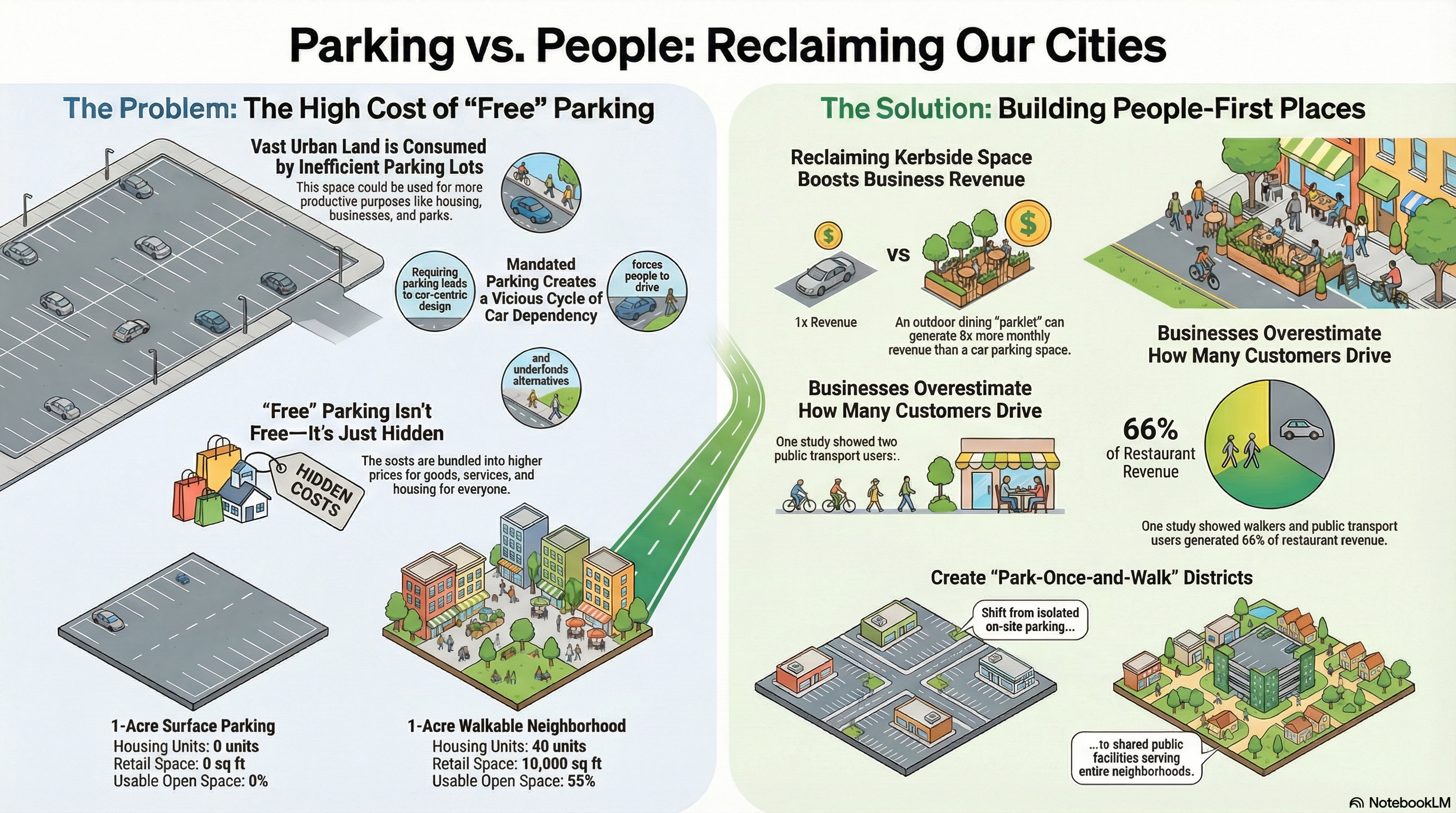
When we stop subsidizing stationary cars, we can repurpose that space for “parklets,” outdoor dining, and green spaces. We can turn a dull asphalt strip into a vibrant social hub, like the colourful outdoor dining areas now appearing in Auckland’s urban centres. These “people places” generate more local economic activity and social cohesion than a parked SUV ever could.
7. Conclusion: Success Without Excess
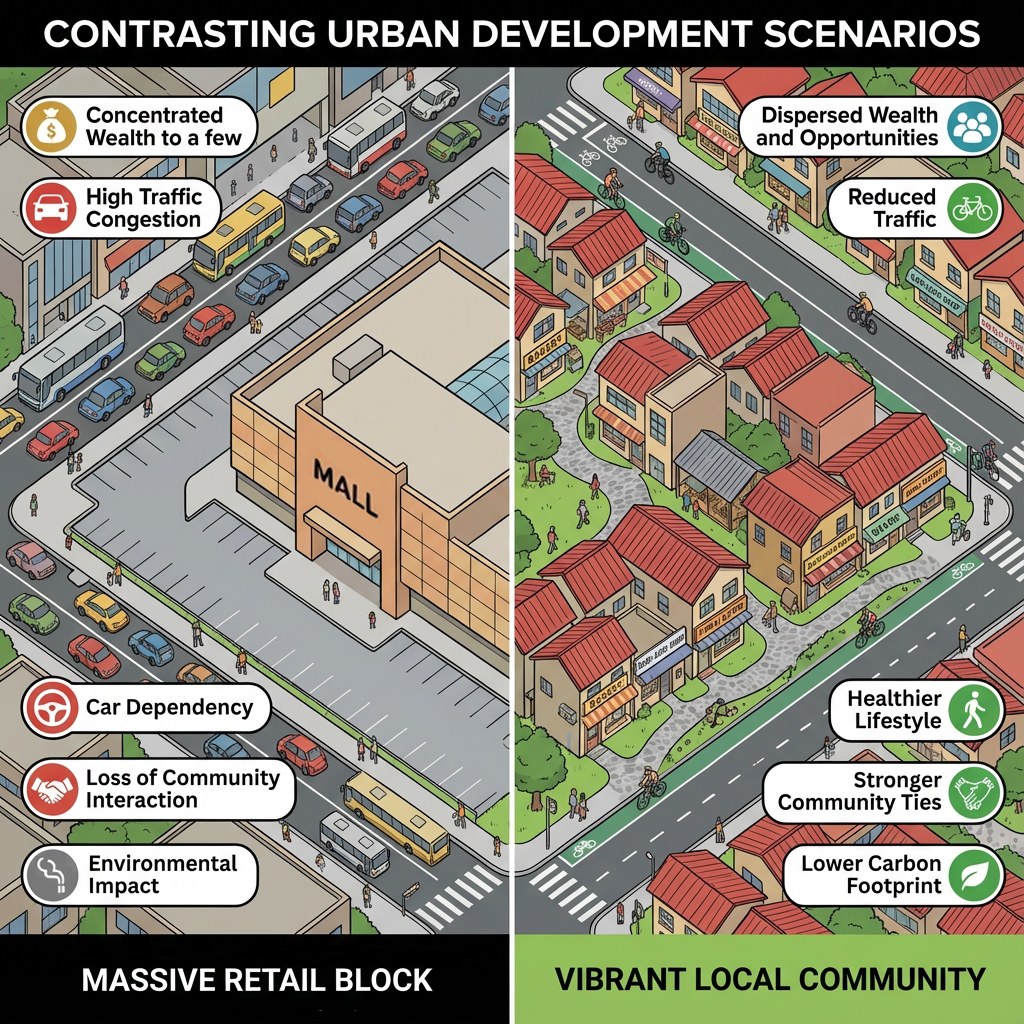
The shift toward “management-focused” urbanism is not “anti-car”; it is “pro-city.” As our populations grow, we can no longer afford to prioritize “parking success” as defined by an oversupply of empty stalls. We need “success without excess”—using tools like the 85% occupancy threshold to adjust prices and manage demand effectively. If a lot is 95% full, the price is too low; if it is 50% full, we have wasted precious land.
The era of the “free” parking mandate is a failed experiment. It has made our housing more expensive, killed affordable development, and made our streets hostile to human life. If we stopped treating the storage of private property as a public right, what vibrant, affordable city could we build in the space that remains?

 Talking Southern Auckland