Auckland in attempting to manage its parking (and where it might go if implemented)
Auckland Transport often (and rightfully) cops criticism with its policy creation and implementation. Parking Management is not one of those but rather a stroke of genius. So much so I have used AT’s Tiered Parking Management System in training materials abroad, and policy advocacy domestically if your parking can gone amok. Auckland Transport knows parking has gone amok in Auckland and is trying to manage it effectively despite it being a lightning rod issue. Let’s take a look at it and how it might work elsewhere (as well as supporting AT to fully implement it).
Auckland’s Planning Choice
1. Introduction: The Hidden Logic of the Curb
In the discipline of urban systems, the curb is far more than a site for vehicle storage; it is a critical interface that dictates the efficiency, safety, and vibrancy of the city. Modern urban management operationalizes the Tiered Parking Management System to align the use of the street with broader transport and environmental goals. This framework serves as a metric for a community’s maturity, charting the transition from restrictive car-dependence toward “transit-freedom.”
The logic of this system is rooted in the realization that space dedicated to stationary vehicles represents a missed opportunity for the movement of people and the creation of public value.
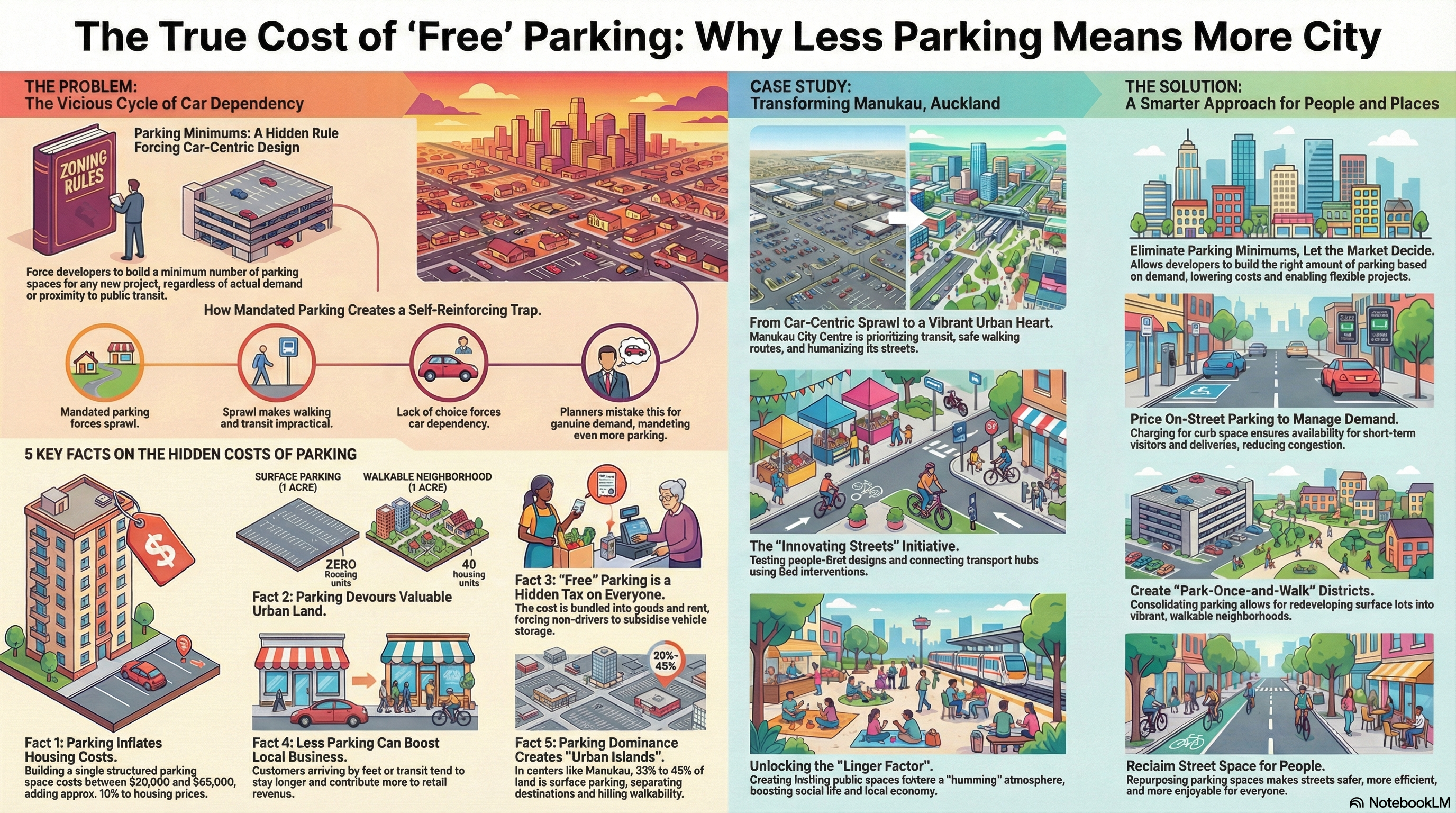
The provision of “free” parking is an economic fallacy that obscures immense hidden costs. Constructing a single stall in a parking garage can cost up to $37,000**, while a surface spot costs approximately $4,200**. These capital expenditures have not vanished; they are recovered through higher housing prices (adding up to 10% to development costs) and public “opportunity costs.” When land is dedicated to empty vehicles, it cannot be used for housing, parks, or commerce. Effectively, those who do not own cars—often the elderly, low-income residents, and people with disabilities—are forced to subsidize the storage of private property for those who do.
The transition between these management approaches is triggered by a specific metric of urban maturity: Readiness for Change.
**US Dollars. For New Zealand that is towards $65,000 for a parking garage space, and $10,000 for a surface parking lot space (on average)
2. Defining ‘Readiness for Change’
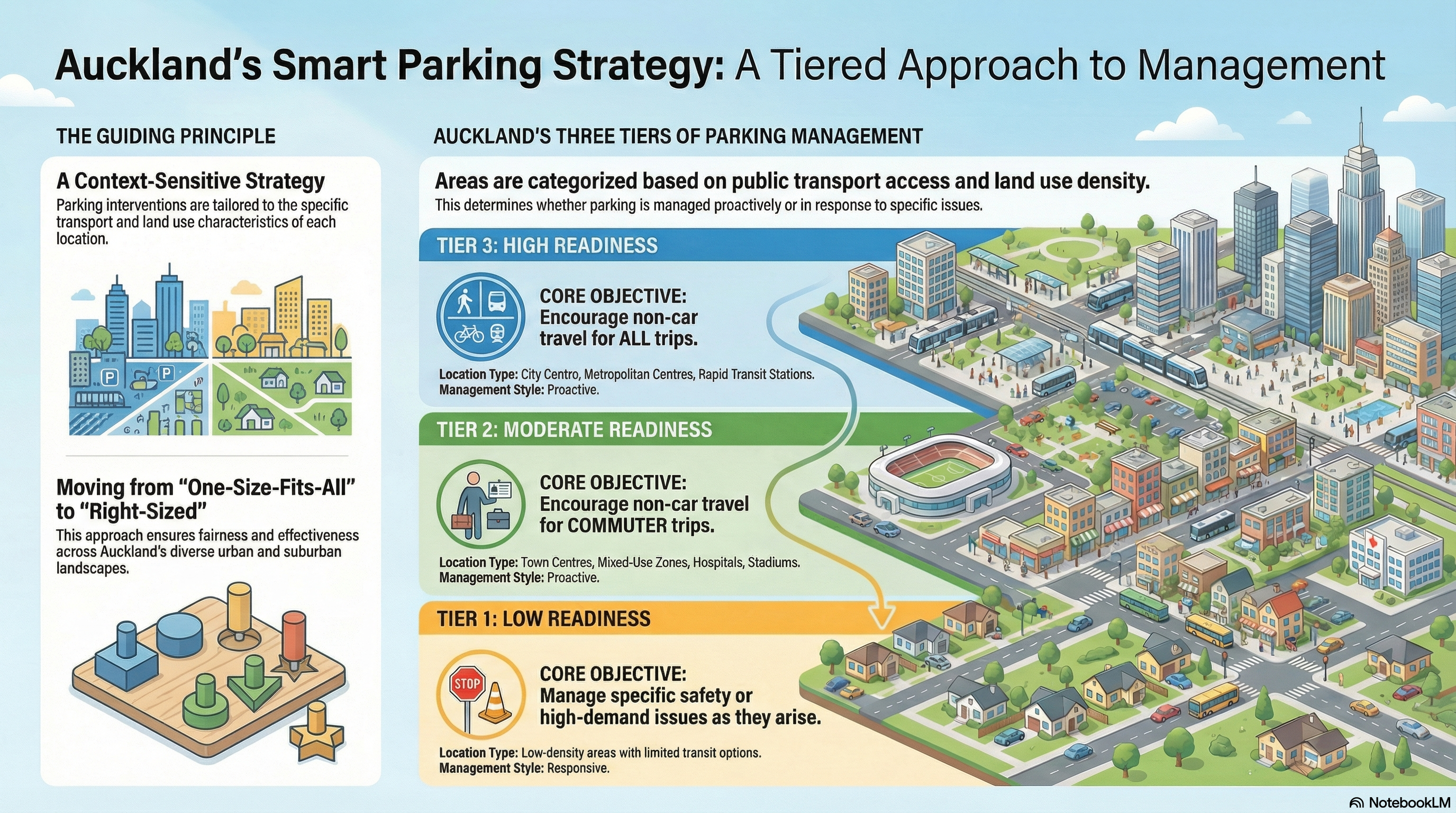
“Readiness for Change” is a systematic assessment of how effectively a community can substitute private vehicle trips with sustainable modes like walking, cycling, or rapid transit. As public transport (PT) accessibility increases and land-use intensifies, the city must shift from a passive, responsive stance to an initiative-taking management model.
| Indicator of Readiness | Impact on Management |
| Rapid Transit Access (RTN) | Tier 3 readiness requires a Rapid Transit Station and a location within 45 minutes of the city centre via PT. |
| Land Use Density | High-density Metropolitan and Town Centres require initiative-taking management to prevent “parking chaos” on sidewalks. |
| Availability of Local Services | Proximity to essential services (groceries, schools) allows the framework to prioritize reclaiming land over vehicle storage. |
| Network Maturity | Shift from Responsive (acting only on safety issues) to Initiative-taking (shaping behaviour to encourage sustainable travel). |
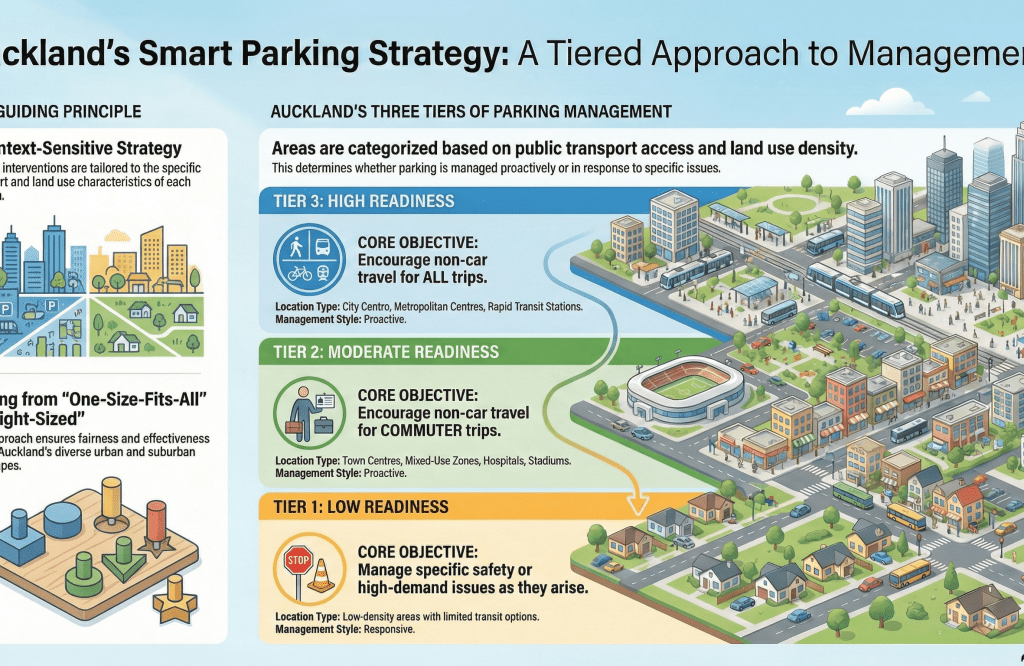
3. The Three-Tier Model of Urban Evolution
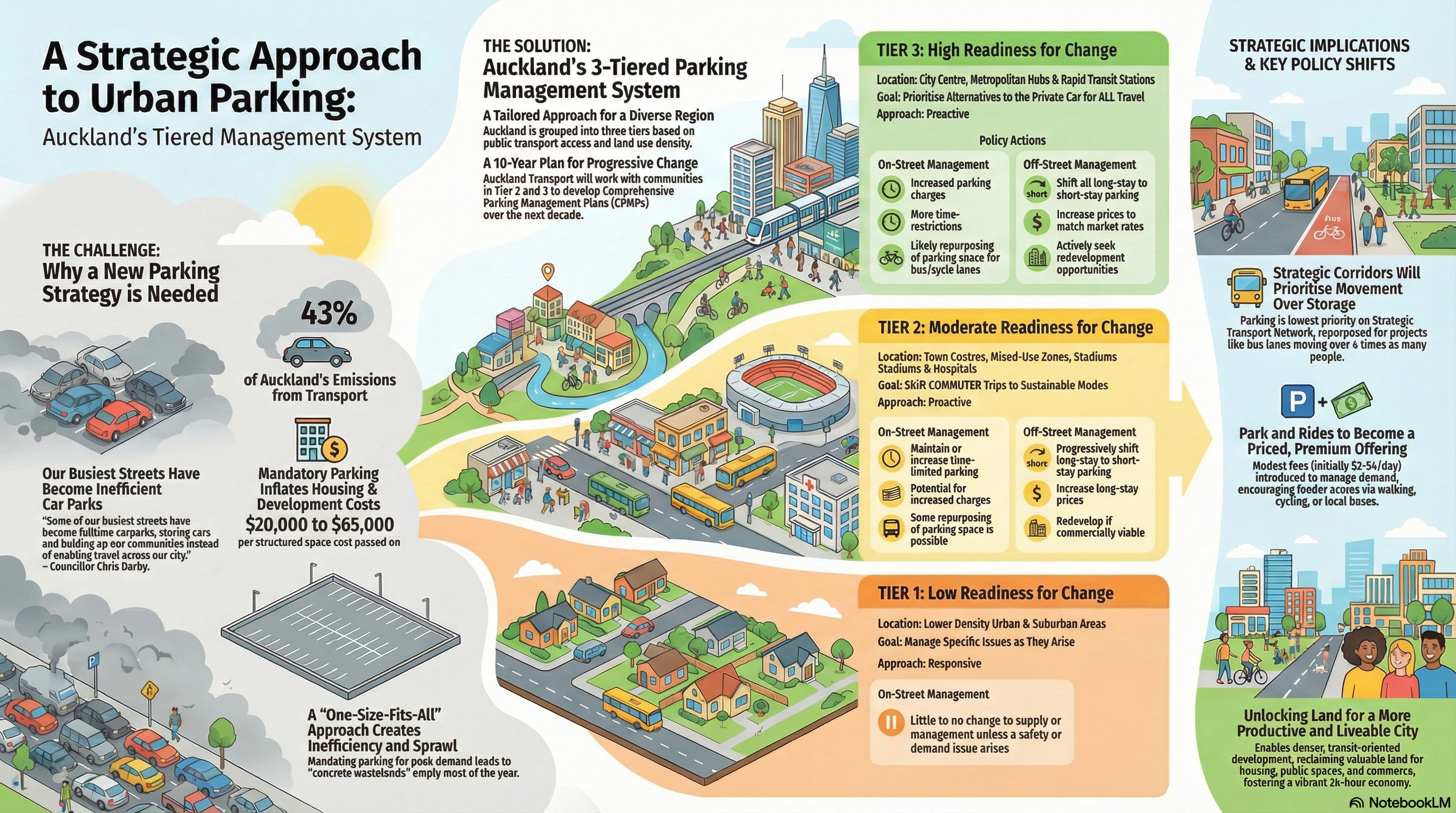
As connectivity increases, the Tiered Parking Management System shifts its focus from vehicle storage to the movement of people and the enhancement of public space.
Tier 1: Low Readiness for Change
- Context: Locations with limited PT options and low-density housing.
- Management Style: Responsive. AT only intervenes when specific demand or safety issues arise. Off-street parking is retained to relieve on-street pressure, and Residential Parking Zones are not considered here.
Tier 2: Moderate Readiness for Change
- Context: Town centres, hospitals, tertiary education sites, and terrace housing.
- Management Style: Initiative-taking. The focus is on reducing commuter trips (all-day parking) while supporting short-stay parking for retail and visitors. Park and Rides in these areas are priced (initially 2–4/day) and time-regulated to reflect the cost of public transport access.
Tier 3: High Readiness for Change
- Context: City Centres, Metropolitan Centres, and areas near Rapid Transit Stations.
- Management Style: Initiative-taking. The goal is reducing private vehicle use for all travel types. Space is reappropriated for cycling and transit, and long-stay parking is aggressively discouraged or shifted to market-priced short-stay facilities.
The Parking Priority Rank
The following hierarchy guides the allocation of kerbside space, placing vehicle storage near the bottom:
- Safety (The non-negotiable priority)
- Property Access
- Movement of People (Buses, RTN, cycling)
- Public Space (Dining, seating, trees)
- Mobility Parking
- Specialty Parking (Loading zones, car shares)
- General Vehicle Parking
- Overflow Parking (Only applicable for developments consented after September 30, 2013)
4. Case Study: The Transformation of Manukau (1959–2020+)
The evolution of Manukau City Centre illustrates the systemic shift from a car-centric “wasteland” to a transit-rich metropolitan hub.
- 1959: Manukau was largely rural farmland; the Southern Motorway terminated at Redoubt Road, and the airport did not yet exist.
- 1976–1981: The city’s “seeds” are planted with the MCC Council Building and the IRD Building, though the design remains siloed.
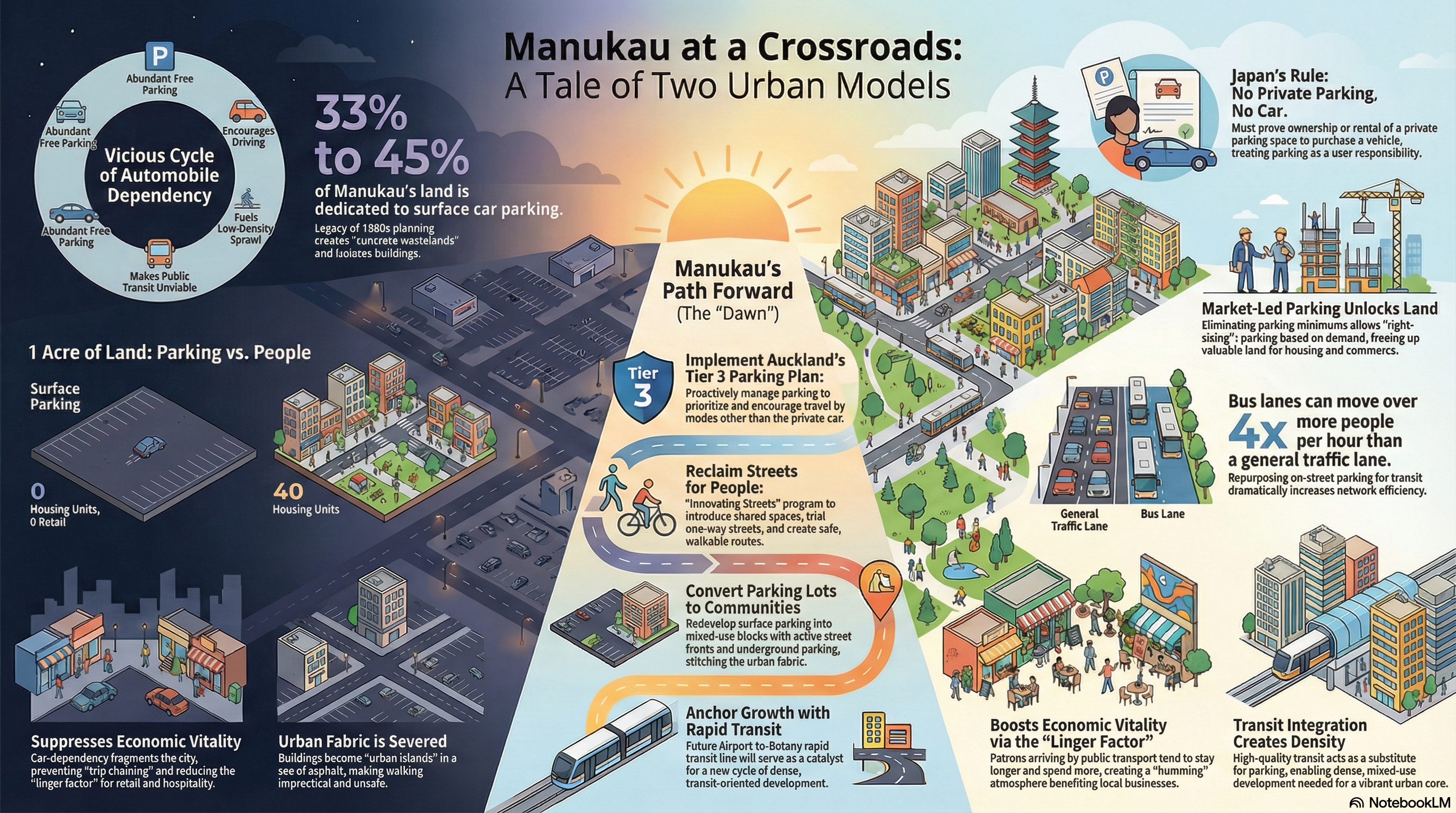
- 2010: Characterized by “parking wastelands”—vast surface lots that occupied 85% of prime central land, often sitting empty.
- 2012 (Critical Inquiry): Urban thinkers began questioning the legacy of Manukau Station Road, a former State Highway. The system-thinking question emerged: Does this core east-west spine still need to be a four-lane, high-speed road, or should it be a place for people?
- 2019–2020+ (The Critical Turning Point): Manukau achieves Tier 3 maturity with the expansion of MIT (Technology and Engineering), a major new Bus Station, and the integration of the Airport-to-Botany Rapid Transit links.
Auckland Transport is progressing parking management in Manukau, You can read more on it here: https://akhaveyoursay.aucklandcouncil.govt.nz/parking-in-manukau
5. The Market-Led Paradigm: Efficiency over Excess
Mature cities move toward a “Market-Led” model by removing Minimum Parking Requirements. This policy shift allows the market to determine the appropriate amount of parking based on land value and demand, rather than arbitrary government mandates that cater to “Black Friday” or “Boxing Day” peak madness.
The Three Pillars of Market-Led Efficiency:
- Right-Sizing: Developers build only what is needed. Housing near transit may have zero parking, significantly lower construction costs and improving affordability.
- Unbundling: Transparency in pricing ensures that the user pays directly for vehicle storage rather than hiding that cost in rent or the price of groceries.
- Reclaiming Land: Land is used for higher-value activities (housing, dining) that generate greater economic returns than stationary vehicles.
The Trader Joe’s Effect: The grocery chain Trader Joe’s achieves sales of $1,734 per square foot—nearly double the $930 of competitors like Whole Foods. They achieve this by catering to “average usage” rather than peak holiday spikes, keeping parking footprints small and stores dense.
The Debate on Parking
6. The Strategic Transport Network (STN) and the Future of the Curb
The Strategic Transport Network (STN) comprises the critical arteries of the city, representing approximately 15% of Auckland’s total road network. On these routes, parking is designated as the absolute lowest priority.
To improve the movement of people and goods, the framework dictates that parking will automatically be repurposed for safety projects, bus lanes, or cycleways. Currently, 20% of the STN is targeted for such improvements over the next 10 years. This repurposing is only waived in “exceptional circumstances” because the efficiency gains are undeniable:
- 1 General Traffic Lane: Limited people-carrying capacity.
- 1 Bus Lane: Capable of transporting 8,000 people per hour—effectively four times the capacity of a traffic lane in the same amount of space.
7. Conclusion: Towards the 8-80 City
The Tiered Parking Management System is not a project of restriction, but one of liberation. It provides the pathway to an “8-80 City”—an urban environment where infrastructure is designed to be safe and inviting for the most vulnerable users: the 8-year-old child and the 80-year-old grandparent.
The vibrancy we admire in the narrow, inviting streets of Tokyo or the outdoor dining districts of Europe is a direct result of the “Stationary vs. Movement” logic. These spaces thrive because they treat the curb as a public asset rather than a storage unit. By aligning parking management with transport choice, we transform urban wastelands into productive, connected communities.
Final Takeaway: Urban vibrancy is a byproduct of prioritizing movement and public life over vehicle storage. As a city matures, the curb must evolve from a “free” stall into a strategic asset that supports a safer, more affordable, and human-centric future.
Manukau Awakening post parking strategy
I notice it likes using the Albany Park and Ride. Same principal as Manukau as that land can be utilised much better.

 Talking Southern Auckland