Submission Highlights
Context as per my opening remarks in my main submission: The basic premise of my submission is doing what Minister Bishop has stated more than once, to emulate the Japanese planning system particularly for the Standardised Zones (the NZ version yet to be drafted by the Ministry for the Environment). However, for Bishop to emulate the Japan system especially around the Standardised Zones, you need to understand the two key pieces of legislation that set those zones: the Japan Land Use Law Act 1974, and the Building Standards Act 2011 (sets urban design and building controls (a superior version to our obsolete Building Act 2004). I won’t comment nor draw on comparisons to the Building Standards Act but the Japan Land Use Law Act is the main inspiration for my submission.
Again, as you will notice through my comprehensive submission the main tenants of the Planning Bill, and even the NPS UD (including to be drafted Standardised Zones), Infrastructure, and Natural Hazards are generally supported. What I am doing in bringing in Japanese wisdom to strengthen the Bill to produce outcomes the Minister is trying to emulate. This includes better urbanism and a protected but functioning rural sector.
The submission fuses a mix of storytelling, comparisons, and desired outcomes to form the who, what, where, when, why, and how around the technical aspects document and the Bill. Thus, it can appear aspects of the submission are repeating itself when they are actually covering another but complementary section of the Planning Bill.
PLEASE NOTE: for sake of clarity and avoiding confusion any mention of Aotearoa Planning Bill (2025) (or simply the Bill) is pertaining to the AMENDED version of the Planning Bill if all points of my submission are carried.
The (amended) version of the Aotearoa Bill 2025 follows the Public Welfare Supreme practice at all times.
1. The Paradigm Shift: From Discretionary Art to Strategic Engineering
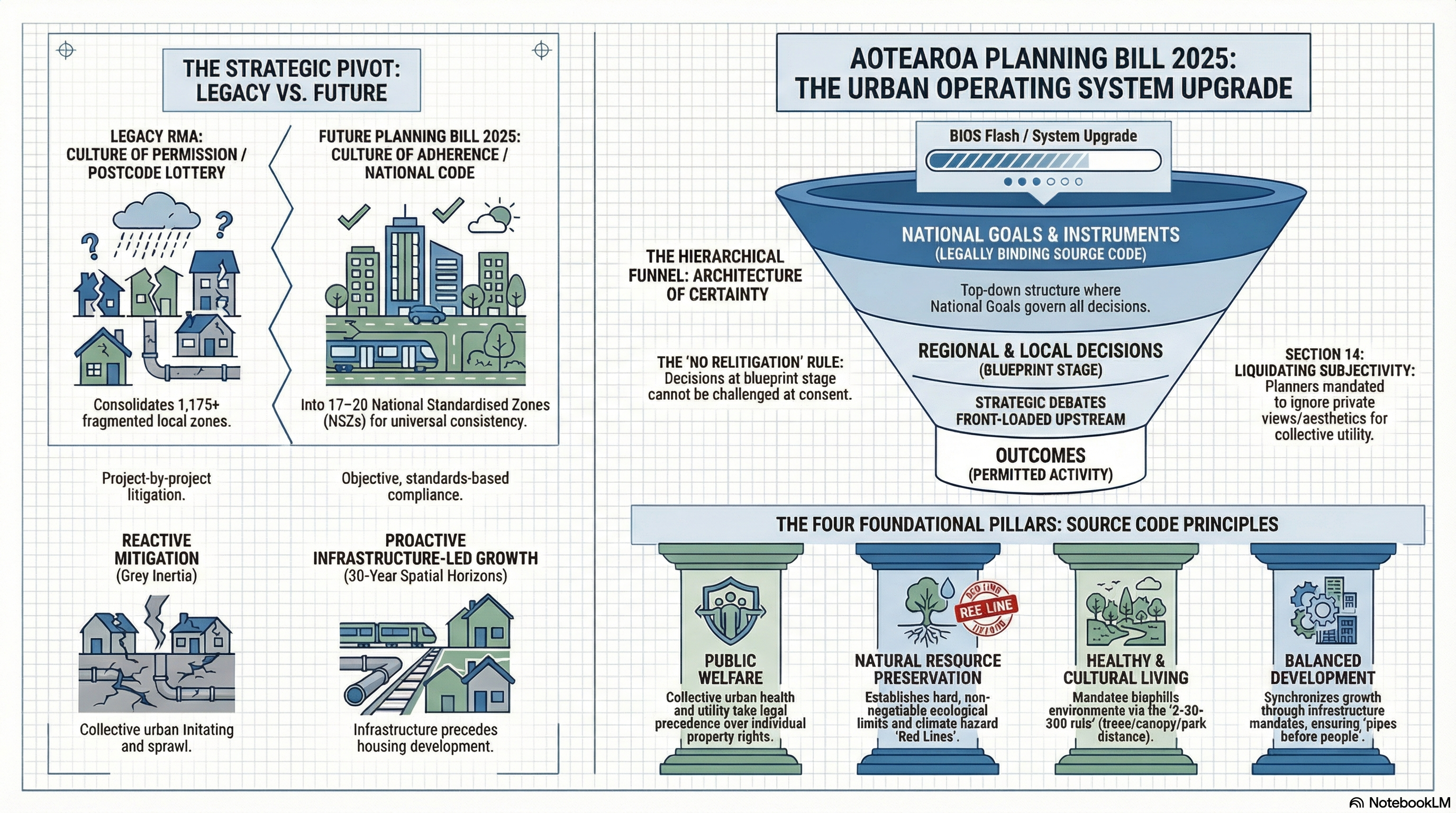
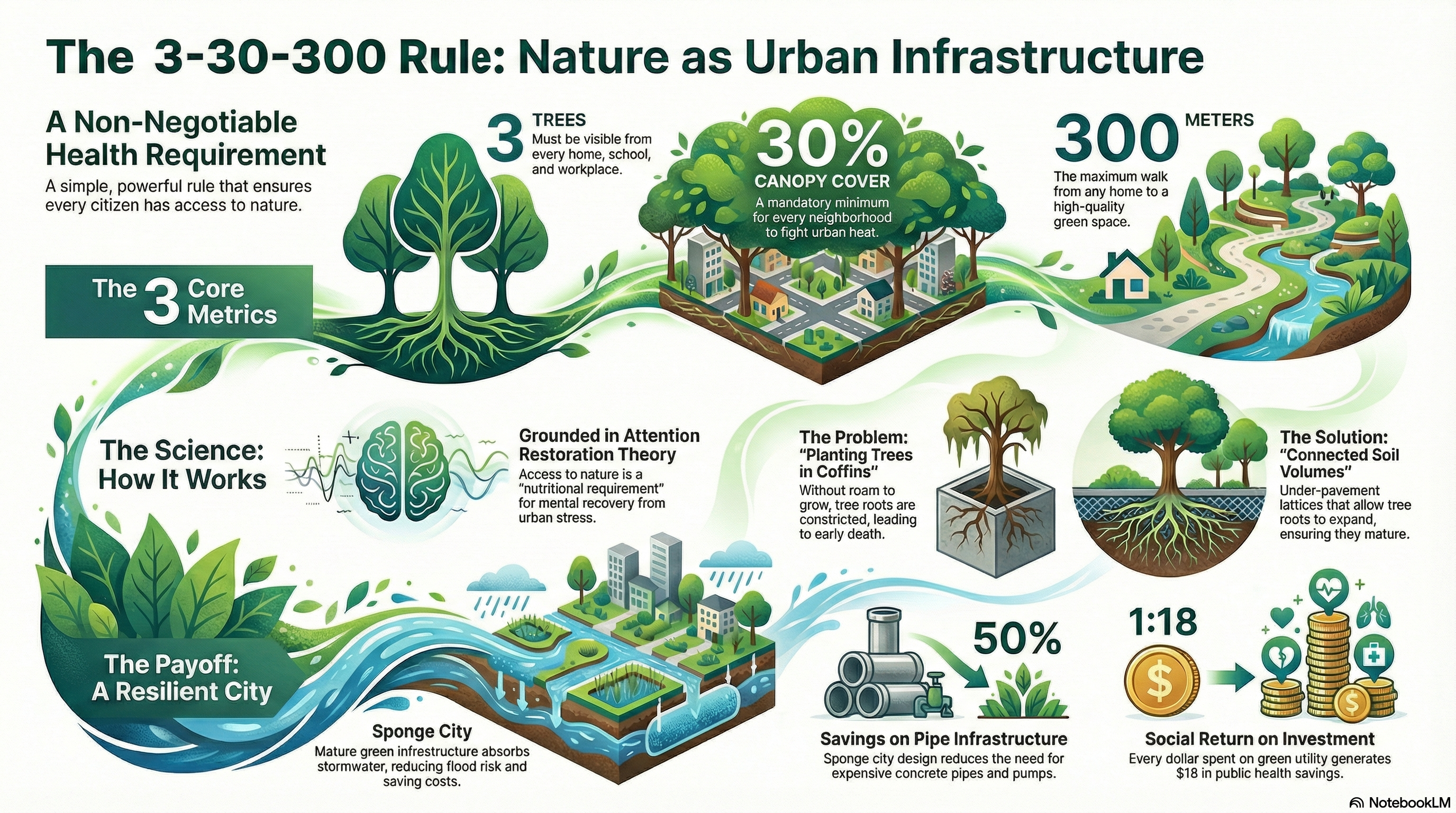
The Aotearoa Planning Bill 2025 constitutes a definitive hard reset of the national urban operating system. This legislative architecture signals the terminal phase of the “discretionary culture of permission” fostered by the Resource Management Act (RMA), replacing it with a rigorous “culture of adherence.” We are transitioning from a system that treated urban growth as a subjective, artistic negotiation to one that treats the city as a pressurized vessel. This is not a mere regulatory update; it is the strategic engineering of the built environment.
The “Gray Inertia” Crisis and Regulatory Debt
The legacy system collapsed under “Grey Inertia”—a state of bureaucratic stagnation where over 1,175 fragmented local zones created a “Postcode Lottery.” This fragmentation paralysed construction at scale and accumulated massive “Regulatory Debt.” This debt represents the long-term fiscal liability of extending infrastructure into unserviced fringes to chase unplanned, low-density sprawl. The Bill liquidates this debt by mandating national standardization, effectively ending the era of asphalt deserts and inefficient land use.
The Functional Re-Calibration
To achieve this, the Bill imports four philosophical pillars from the 1974 Japanese Land-use Law, fundamentally re-coding Western property rights to prioritize the collective:
- Public Welfare: Collective societal needs and infrastructure capacity now take legal precedence over individual property speculation.
- Natural Resource Preservation: Planning serves as the primary defence for ecological assets and soil integrity.
- Healthy Environments: Statutory guarantees for biophilic connectivity and sunlight access are mandated as biological necessities.
- Balanced Development: Growth must be geographically equitable and infrastructure-led to ensure systemic stability.
This re-calibration moves the state from reactive mitigation of “effects” to proactive stewardship of national urban health.
2. The Japanese Source Code: Lessons from the 1974 Land-Use Law
The selection of the 50-year-old Japanese blueprint is a clinical response to historical parallels. In 1974, Japan faced an existential “crisis of chaos” defined by abnormally high land prices, rampant speculation, and “chaotic development.” The Japanese solution was to move beyond the “discretionary trap” of local boards and install a national machine of adherence.
The Waterfall of Authority
The Bill adopts a hierarchical “Funnel Model” where strategic authority flows downward, ensuring that high-level national objectives are not paralyzed by localized litigation:
- The National Plan: Cabinet-approved spatial vision setting the broad national requirements.
- Regional Plans: Regional Councils adapt the national vision into single regulatory plans utilizing National Standardized Zones (NSZs).
- Municipal Plans: City and District Councils manage sub-zones and urban facilities.
The Golden Rule: Downstream decisions cannot relitigate upstream policy. Once the national or regional tier settles a decision on capacity or infrastructure, it is settled law, immune to the “nitpicking” of municipal-level committees.
Mapping the Crisis
Like Japan in 1974, Aotearoa faces a housing crisis fuelled by population concentration and speculative land-banking. By adopting this administrative structure, the Bill enables a spatial metaphor capable of containing these pressures: the “Hydraulic City.”
3. Spatial Mechanics: The Hydraulic City and the Urban Dam
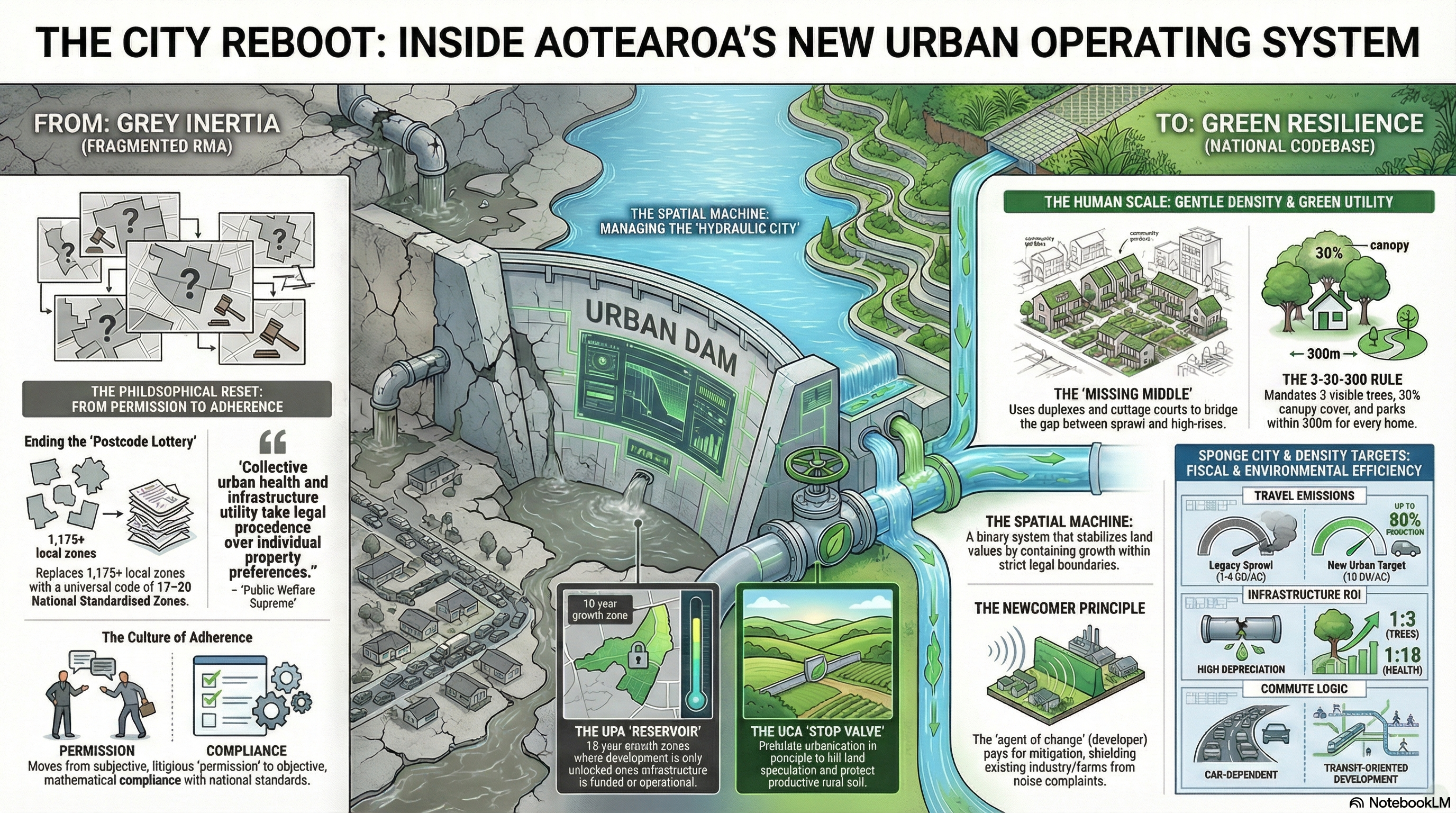
We are engineering the city as a pressurized vessel. Under the “Hydraulic City” model, urban growth is a physics problem involving pressure, fluid displacement, and containment.
Deconstructing the Hydraulic Components
- The Piston: Rising land values and concentrated wealth generated by a successful urban core. As prosperity increases, the piston pushes down, creating immense internal pressure.
- The Fluid: The working class—the nurses, teachers, and service workers who power the economy. Fluids are incompressible; when the piston descends, they must displace.
- The Leak: Sprawl. When the containment system fails, the “fluid” is squeezed out into unserviced fringes, resulting in soul-crushing commutes and fiscal insolvency.
The Urban Dam Mechanism
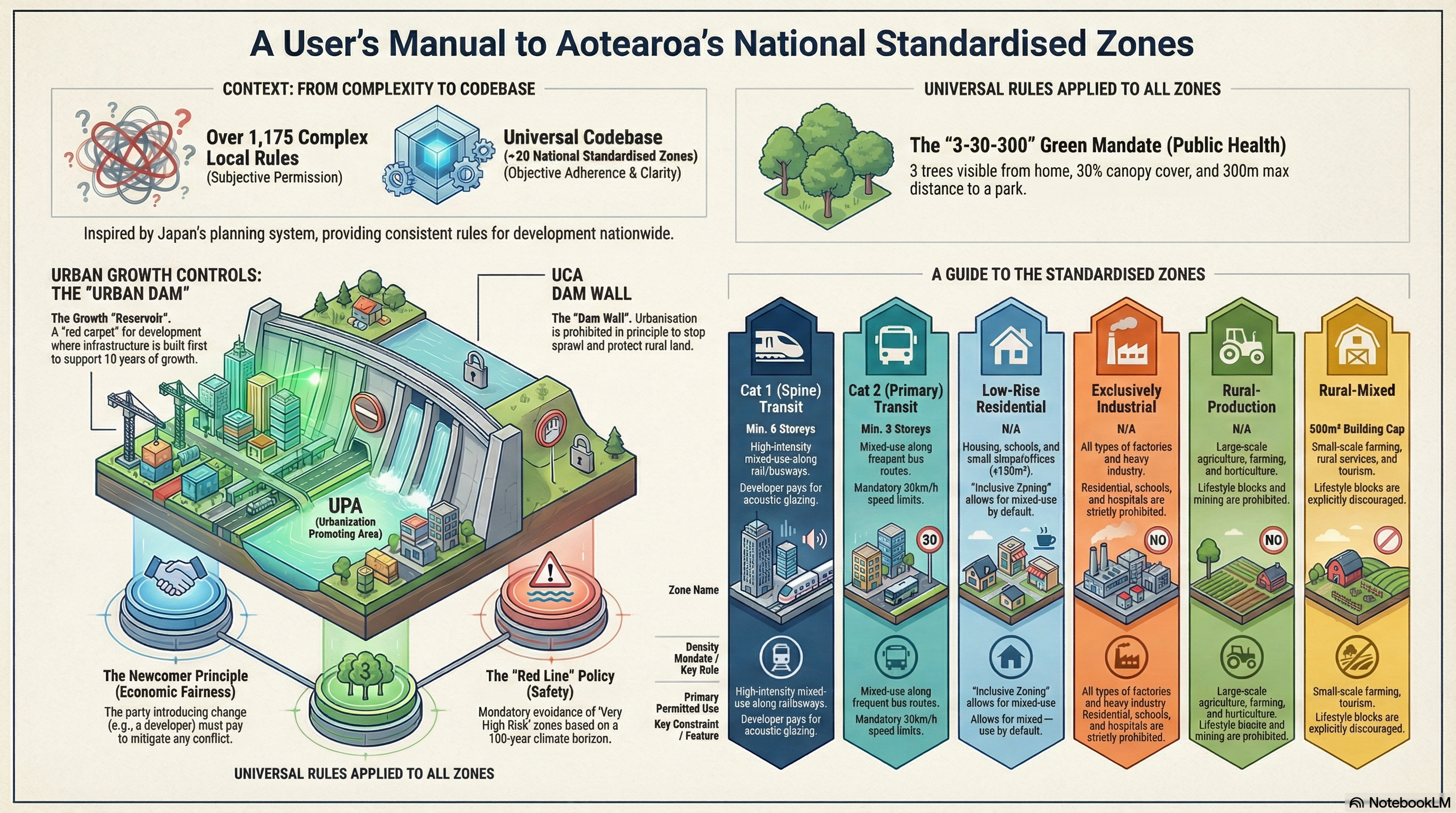
To manage this displacement, the Bill creates an “Urban Dam” to seal the system and force growth into designated reservoirs.
| Feature | Urbanization Promoting Area (UPA / The Reservoir) | Urbanization Control Area (UCA / The Stop Valve) |
| Functional Role | Land designated for systematic urbanization within a 10-year horizon. | A hard barrier where urbanization is “prohibited in principle.” |
| Infrastructure Priority | High: Streets, sewage, and transit are prioritized to support density. | Deprioritized: Investment is intentionally withheld to act as a barrier. |
| Economic Outcome | Encourages investment in serviced land; ties value to utility. | Kills speculative land-banking; land value reflects farming, not potential subdivision. |
Market Stabilization
By weaponizing “Infrastructure Deprioritization” in the UCA, the Bill kills the oxygen for speculative fire. We are decoupling land value from speculative fiction and anchoring it to productive reality. Developers will no longer gamble on rural land if the state explicitly refuses to provide the “pipes” of civilization.
4. The Urban Skeleton: Infrastructure Determinism and National Standardization
The internal city structure is governed by “Infrastructure Determinism.” The “Skeleton” of the city (transit and pipes) dictates the “DNA” of the building zones (height and density).
The “Density Follows Frequency” Rule
Building capacity is mathematically tied to transit frequency. The Bill removes political debate by mandating minimum densities:
- Category 1 (Spine): Rapid transit corridors (rail/busways) mandate a minimum of six stories. Single-story dwellings are an inefficient waste of public investment in these zones.
- Category 2 (Primary): Frequent bus routes mandate a minimum of three stories, integrated with a 30km/h speed limit to ensure pedestrian safety and neighbourhood viability.
National Standardized Zones (NSZ): The DNA
The 1,175+ local dialects of planning are replaced by 13 base NSZs (expanded to approximately 17-20 when including specialized rural zones). Compliance is determined by objective DNA metrics: BCR (Coverage), FSR (Floor-Space), and Diagonal Line Limitations.
- Strategic Rationale: Diagonal Line Limitations preserve sunlight via geometry rather than committee opinion. This prevents “flat top boxes” while granting developers creative freedom to slope envelopes, ensuring light hits the street without the need for subjective aesthetic debate.
The “Section 14 Ignore List”: Liquidation of Regulatory Debt
Section 14 statutorily liquidates the time-cost debt that previously paralyzed development. Planners are now legally required to ignore the following subjective factors:
- Private Views: Impact on a neighbour’s view is no longer a legal ground for objection.
- Aesthetic Character: Subjective “vibe” or style is irrelevant if technical metrics are met.
- Social Status: Objections based on the “type” of future residents are strictly prohibited.
- Trade Competition: Incumbents cannot use planning laws to block market competitors.
5. Protecting the Economic Engine: The Newcomer Principle
In dense, mixed-use environments, the “Newcomer Principle” (Agent of Change) acts as a mechanism for pre-emptive legal settlement, shielding our economic engines from “reverse sensitivity.”
The Liability Shift: Incumbent vs. Newcomer
The principle is absolute: the party introducing change bears the total financial and technical cost of mitigation.
| Responsibility | The Incumbent (Port, Rail, Farm, Factory) | The Newcomer (Residential Developer) |
| Legal Standing | Legally shielded; the “Right to Operate” is protected. | Standing is contingent upon internalizing all costs. |
| Financial Burden | Nil: No cost for additional mitigation. | Full: Must fund 100% of technical interventions. |
| Right to Complain | Retained if operations are interfered with. | Forfeited: No standing to challenge established impacts. |
Technical Mitigation: The “Sealed Unit”
Newcomers in high-intensity zones must engineer away the conflict. This requires Acoustic Glazing and Mechanical Ventilation (filtered air exchange) to ensure the home remains healthy and quiet without the need to open a window to the noise source.
The Morphological Solution: Hard Shell / Soft Core
This is expressed through the Perimeter Block typology. The street-facing facade (the Hard Shell) acts as a robust acoustic and atmospheric shield, protecting the internal “Spirit” of the building—a quiet, green shared courtyard (the Soft Core) insulated from the city’s industrial “Skeleton.”
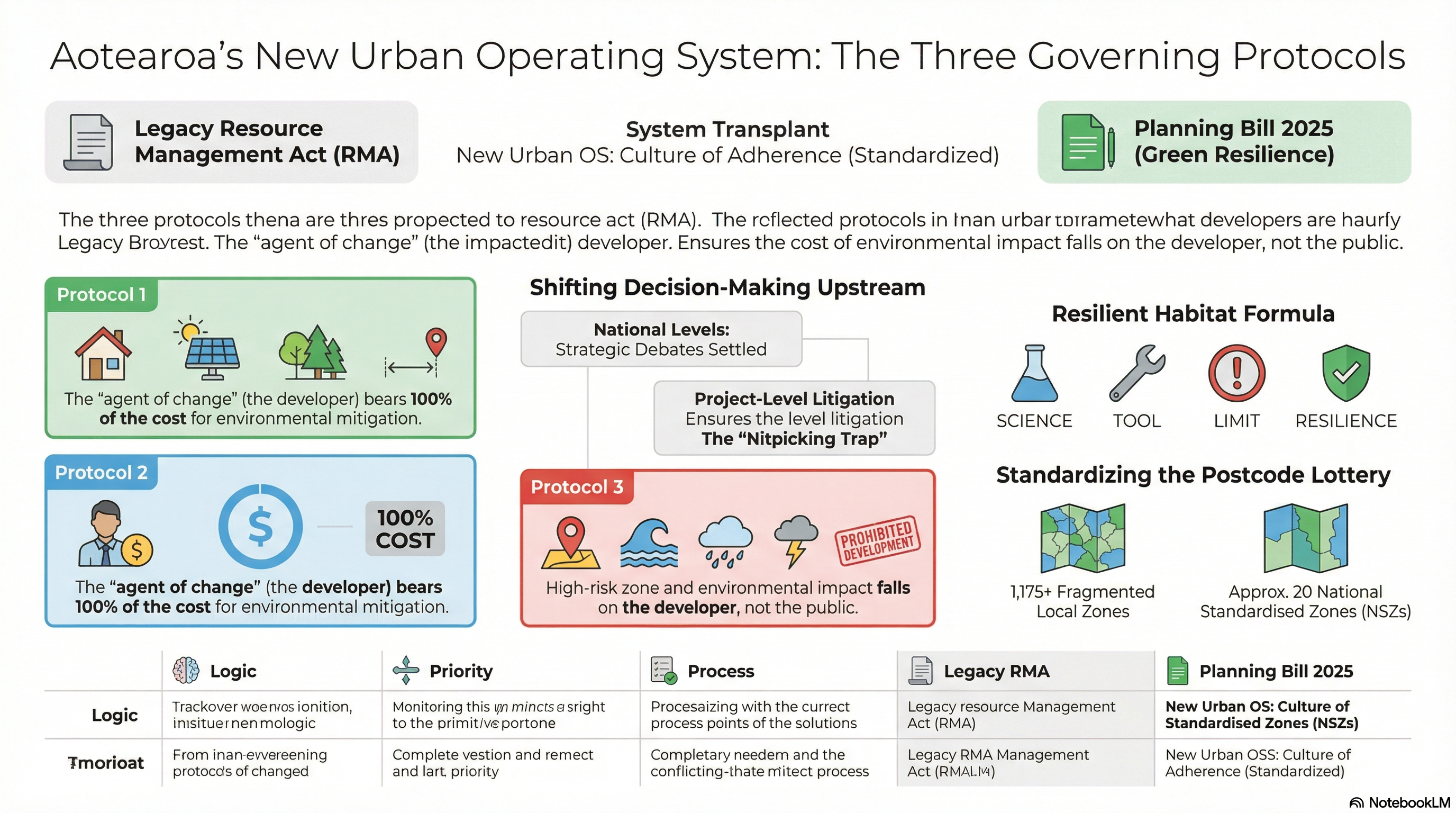
6. Biophilic Utility and Climate Resilience: The 3-30-300 Rule
Nature is no longer an aesthetic luxury; it is “biological utility”—Vitamin C for the city. Integrating green infrastructure delivers a 1:3 Return on Investment and up to 50% capex savings on traditional storm water infrastructure.
The 3-30-300 Mandate
- 3 Trees: Every building must have a direct view of at least three trees.
- 30% Canopy: Mandatory neighbourhood cover for cooling and air quality.
- 300 Meters: Maximum distance to high-quality green space.
To support this, the Bill mandates “Connected Soil Volumes.” Developers must replace “tree coffins” with engineered underground root networks. This “Sponge City” technology uses soil as a “Grey Asset” to manage storm water, saving millions in pipes and pumps.
The Red Line Policy: Fiscal Responsibility
The Bill enforces a 100-year climate horizon (to 2126). Utilizing a mandatory risk matrix, the “Red Line Policy” prohibits development in the “Very High Risk” (top-left) quadrant. Planners must model “Residual Risk”—assuming that even if a flood wall exists, it may fail. This prevents the state from assuming the fiscal liability of bailing out uninsurable properties built in paths of known environmental instability.
7. Strategic Summary: The Four Pillars for Decision Makers
The Aotearoa Planning Bill 2025 provides the legal certainty and economic scale required for long-term resilience. Compliance is the only path to the future.
- The Urban Dam: Growth is channelled into the 10-year UPA reservoir.
- Strategic Directive: Do not gamble on land outside the UCA wall. Infrastructure will be withheld to protect the dam’s integrity.
- Rural Engines: Soil is a critical strategic asset, not a waiting room for the city.
- Strategic Directive: Treat high-quality soil as a permanent economic engine. Lifestyle blocks are quarantined to protect agricultural viability.
- The Newcomer Principle: Existing economic engines are shielded from reverse sensitivity.
- Strategic Directive: The right to operate trumps the right to complain. Internalize all acoustic and atmospheric mitigation at the design phase.
- Standardization and Readjustment: Universal NSZ metrics replace 1,175 local dialects.
- Strategic Directive: Use Land Readjustment to transform irregular plots into high-value urban grids, converting landowners into partners in value uplift.
Final Call to Action: We are deploying the “Hydraulic Machine” to control urban pressure. Failure to adhere to this system will inevitably breach the city’s social and environmental fabric. We either engineer the containment or drown in the sprawl. The operating system has been updated. Adhere or be left behind.

 Talking Southern Auckland
Morning Ben. Interesting series. I’ve enjoyed them. Keep going on your thoughts. Most of your thoughts I agree with in general principles. Intensification along bus routes, around train stations, bus stations and ferry terminals is just basic City Planning 101 and 102. Have a look at the 2 Melbourne Intensification studies for some extra ideas. I see one problem being the Auckland Councill who are – or were? – very reluctant to upzone to 6 levels. Certainly, at the AUP submissions. 6 levels are NOT 18m either. It is a minimum 24m for obvious reasons. It has taken the AC some time – from a Sept 2013 to 2015 AUP submissions for clients of mine and Others – for the Councill to come to that conclusion with some legislation and directions from the Minister. What the profession needs to do is kia kaha – both meanings – the Planning Bill into a NZ specific Act to benefit us all.