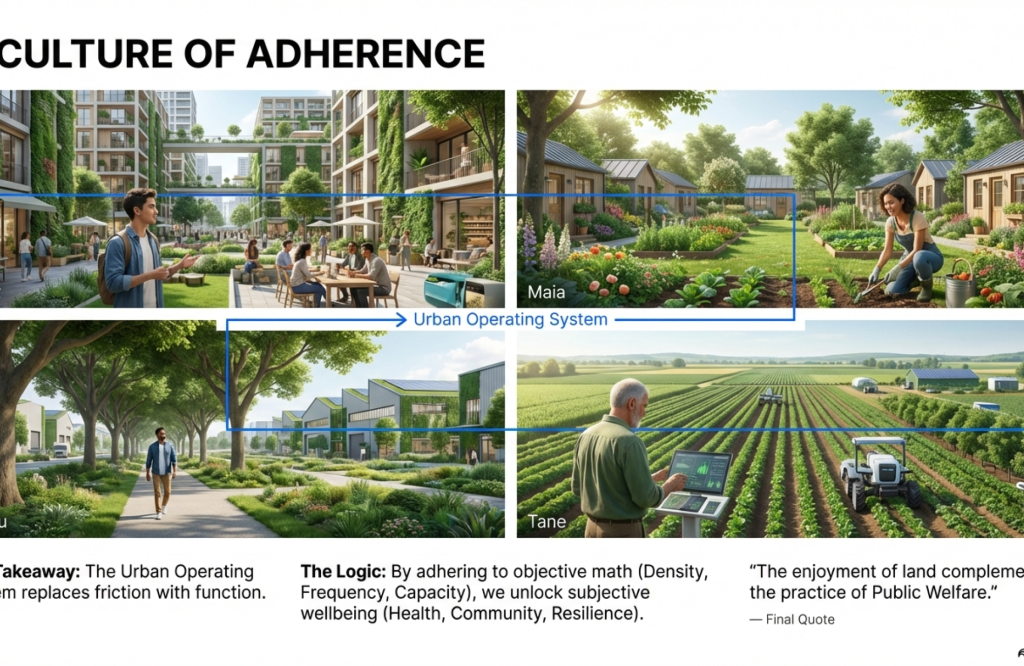
From Planning Legislative Theory, to Actual Design Place-Led Placemaking!
With my submission for the Planning Bill now with the Environment Select Committee (My Submission to the New Zealand Planning Bill – 2026) I move towards the next task which is the Standardised Zones. The Ministry for the Environment is tasked in creating the Standardised Zones with that piece of work not due to be completed until the end of 2026. I decided to draw up my own based on Japan and completed the work within a week. They are part of the main submission. But for the Standardised Zones to work we need a design manual that follows my submission version of the Planning Bill that uses the Public Welfare Supreme practice. For that design manual to work we need some characters to tell that story.
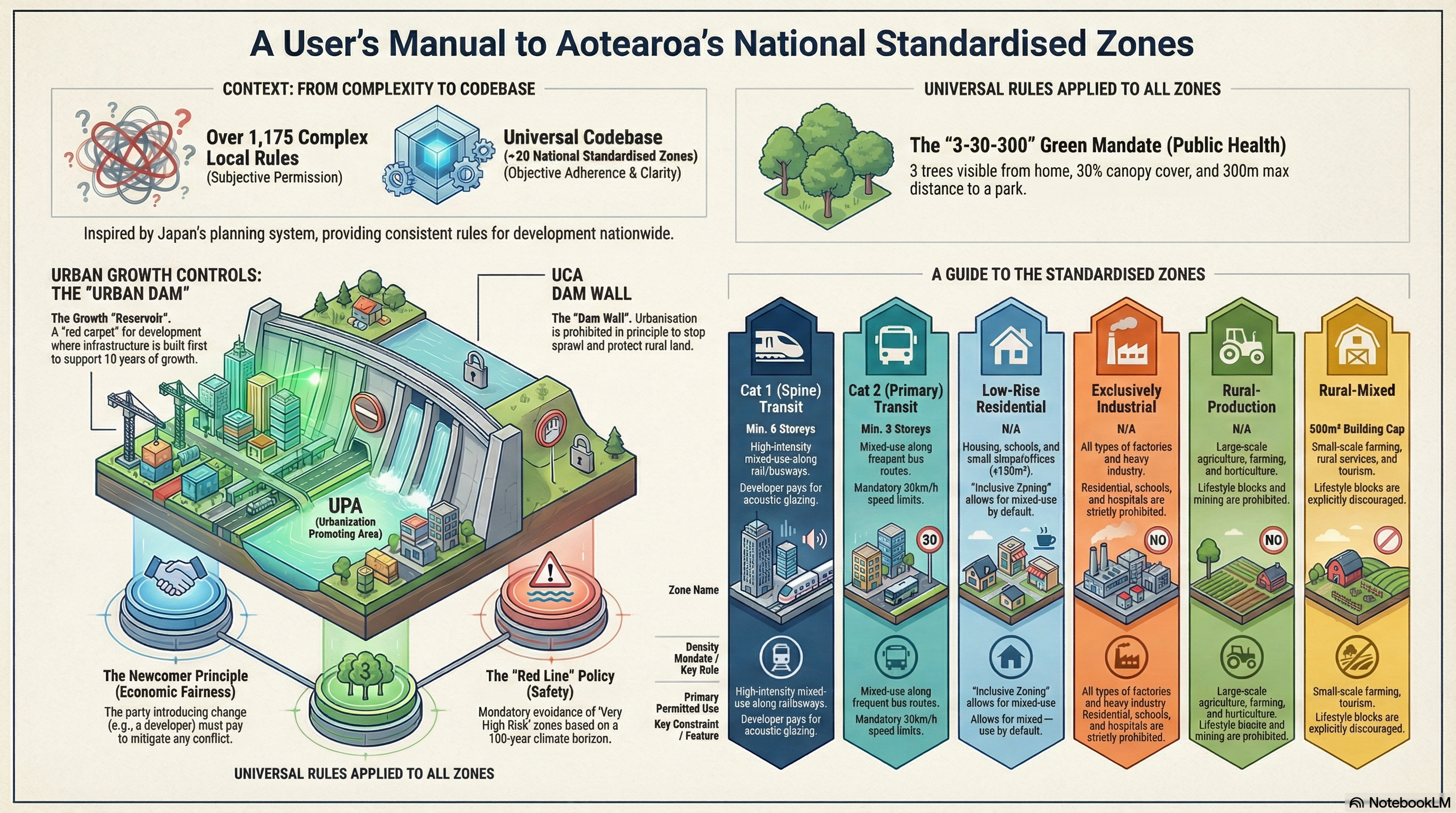
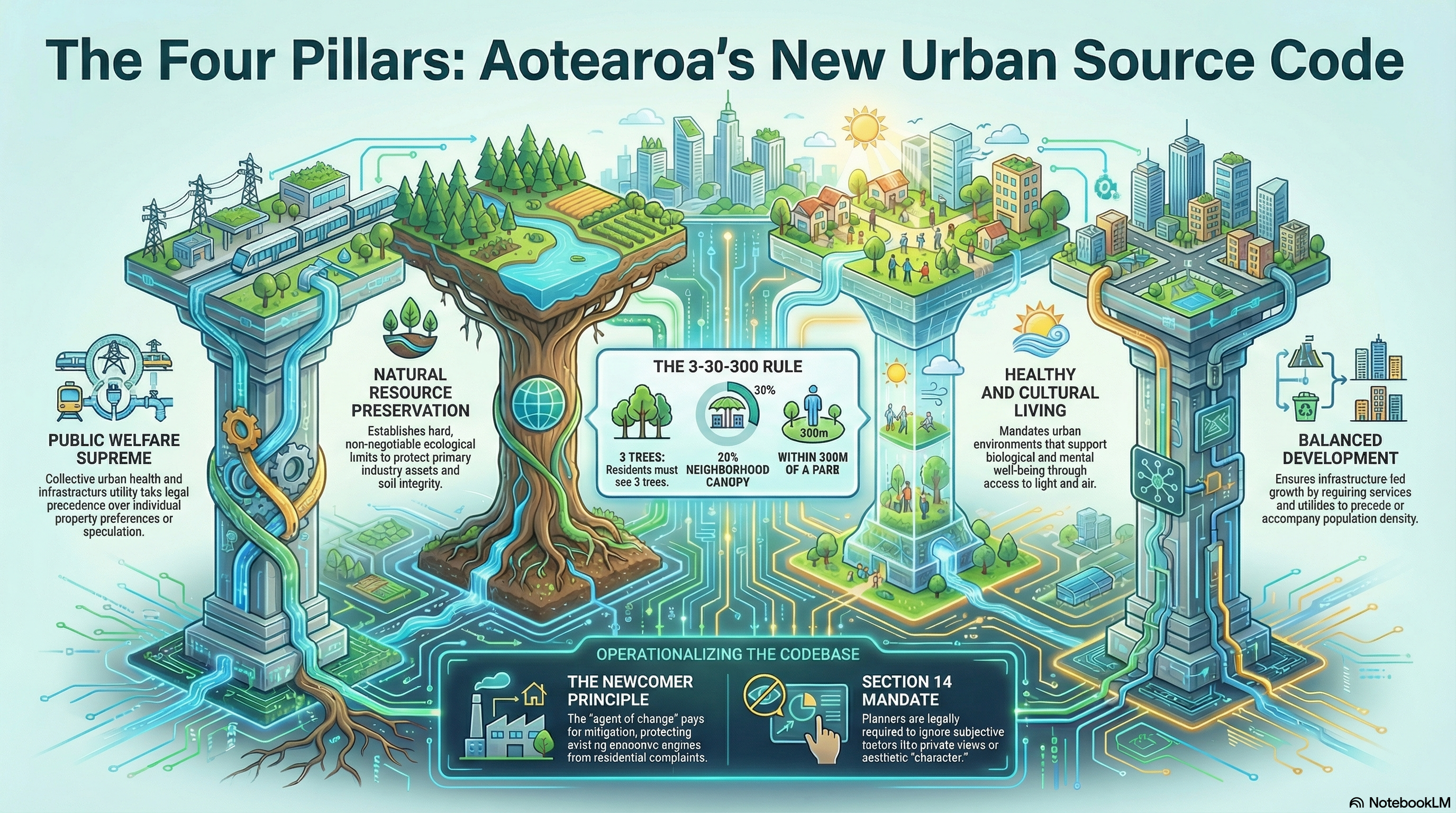
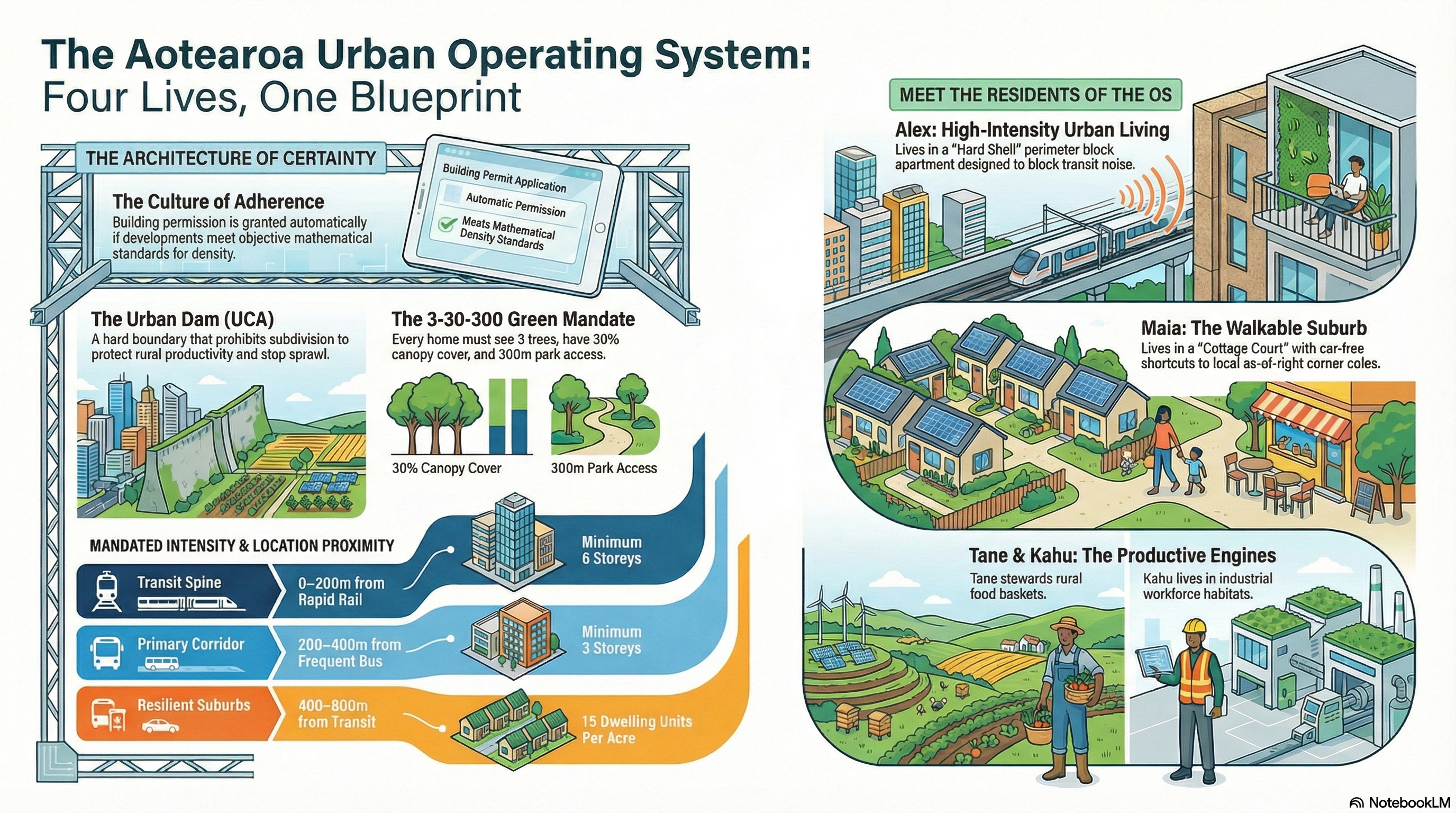
So, to assist moving beyond abstract legal definitions of the Aotearoa Planning Bill 2025 (the Submission), the submission utilised four distinct “User Stories” to demonstrate how the new Urban Operating System functions in daily life. These characters represent the specific zones within the system—from the high-density core to the protected rural hinterland—showing how a “Culture of Adherence” replaces friction with function. These characters continue their story into the Design-Led Placemaking manual. Introducing Maia, Tane, Kahu and Alex.
Maia: The Resident of the “Complete Neighbourhood” (Zone C)
Maia lives in the Urbanisation Promoting Area (UPA) within a Low-Rise Residential Zone designed for “Gentle Density” (15 Dwelling Units Per Acre).
- The Habitat: She wakes up in a Cottage Court, a cluster of small, detached homes arranged around a shared “Green Heart” (courtyard) rather than a driveway. This design engineers “positive social friction,” ensuring she bumps into neighbours daily to combat the “loneliness epidemic”.
- The Lifestyle: Maia does not own a car. She commutes via “Surgical Connectivity”—pedestrian shortcuts cut through cul-de-sacs that turn a 2-kilometre drive into a 5-minute walk. She works in a local Live-Work Unit or co-share office, permitted “As-of-Right” on residential corners to eliminate “Junk Miles” and support a 24/7 ecosystem.
- The Standard: Her life is governed by the 3-30-300 Rule: she sees 3 trees from her window, her street has 30% canopy cover, and she is within 300m of a park.
Alex: The Resident of the “Transit Spine” (Zone A)
Alex lives in the high-intensity Category 1 Transit Corridor, directly adjacent to a rapid transit rail line where the rule is “Density Follows Frequency” (minimum 6 storeys).
- The Habitat: He lives in a Perimeter Block apartment. The street-facing side is a “Hard Shell” with high-performance acoustic glazing that blocks the noise of the city’s economic engine. The interior is a hollowed-out “Soft Core,” a quiet, biodiverse sanctuary.
- The Deal: Under the Newcomer Principle (Agent of Change), the developer paid for the soundproofing, not the railway. This allows the train to run 24/7 while Alex sleeps in silence. He trades a backyard for a 6-minute walk to the station and a car-free life.
Kahu: The Worker in the “Industrial Ecosystem” (Zone B)
Kahu lives in a Zone B Industrial area, now designated as a “Workforce Habitat” where housing is permitted alongside manufacturing to reduce commute times.
- The Habitat: He lives in a loft apartment engineered with an “Invisible Shield”—mandatory mechanical ventilation and acoustic sealing paid for by the developer. This allows him to sleep soundly next to the supply chain.
- The Engine Room: Kahu works in the nearby Zone A (Exclusively Industrial), a “hard core” zone where housing, schools, and hospitals are strictly prohibited to protect the factory’s “Right to Operate” 24/7 without reverse sensitivity complaints.
- The Balance: Even in the industrial zone, the 3-30-300 Rule applies. Kahu walks to work under a 30% canopy of trees thriving in “Connected Soil Volumes” and takes his lunch break in a pocket park located exactly 250m away to reduce cognitive fatigue.
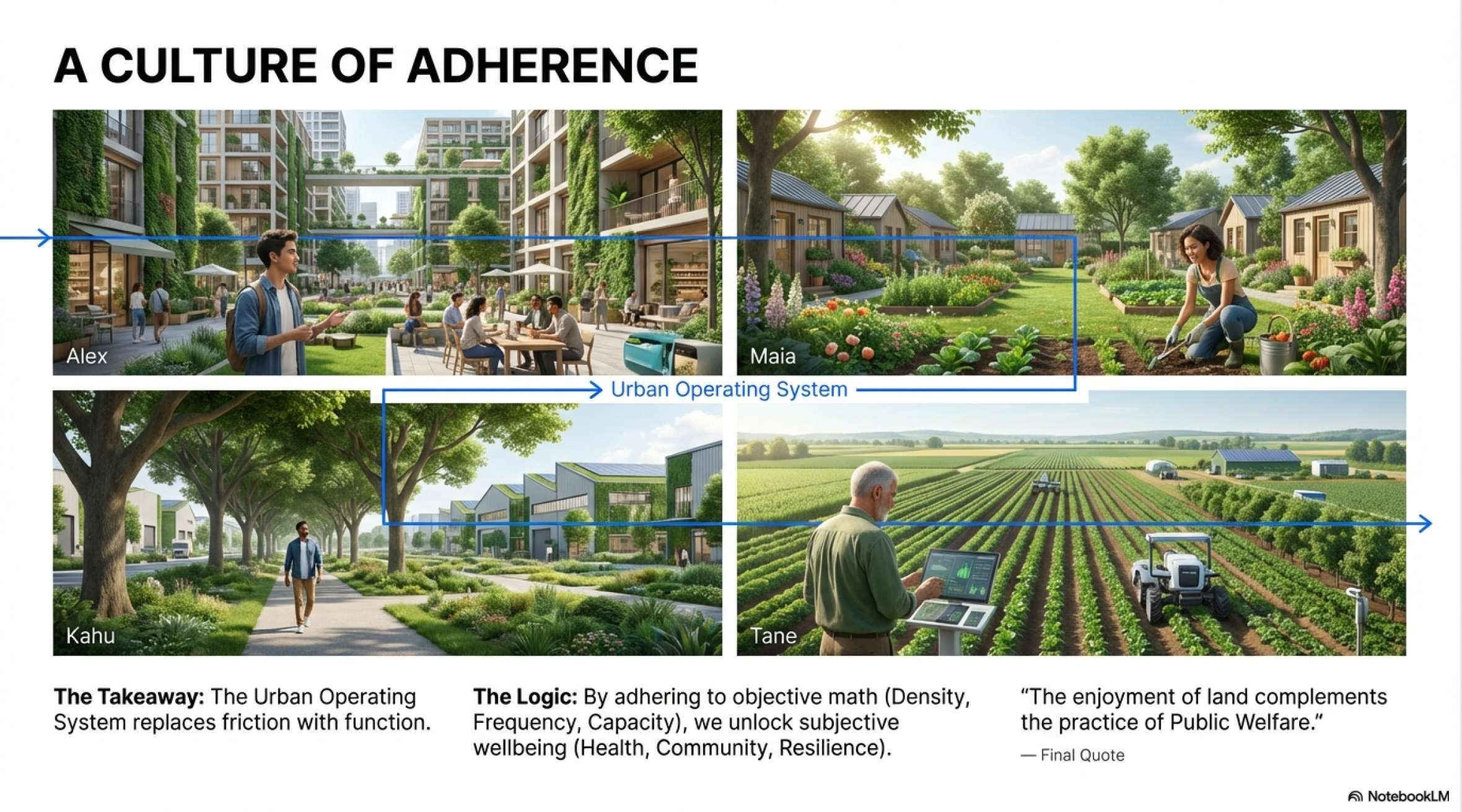
Tane: The Steward of the “Rural Engine” (Rural-Production Zone)
Tane is a farmer in the Rural-Production Zone, located behind the “Urban Dam” (Urbanisation Control Area), which acts as a hard stop to city sprawl.
- The Protection: His land is legally defined as a “factory floor for food,” not a waiting room for suburbia. Because subdivision is prohibited and infrastructure is deprioritized in the UCA, the speculative value of his land is removed, keeping it affordable for production.
- The Conflict Resolution: When a new house is built in the neighbouring Rural Residential Zone, Tane relies on the Newcomer Principle. The new residents (“The Agents of Change”) are legally responsible for installing their own soundproofing and visual buffers against his tractor noise and dust. Tane retains the “Right to Operate” without fear of noise complaints.

 Talking Southern Auckland