Intercity Rail Concept Waiting in the Wings for our Politics Just to Say Yes rather than our Culture of NO!
Auckland is currently a city “imploding” under the weight of its own historical planning failures. With a population trajectory set to hit 2.4 million by 2030, we are reaching the logical limit of “carpet development”—that higgledy-piggledy scattering of low-rise infill that strains our aging infrastructure and creates a permanent net diseconomy. While the public imagination often fixates on the 320km/h “Bullet Trains” of Tokyo, the strategic path forward for Aotearoa actually lies in our long-standing sister city, Fukuoka.
The “Fukuoka Blueprint” is less about speed and more about a fundamental lifestyle revolution. It’s a model where transit, real estate, and retail are forged into a single, self-sustaining ecosystem. By looking to Fukuoka, we can move beyond the “Plain Old Transport Services” (POTS) that have failed our budget and instead build a city that is vibrant, convenient, and—crucially—profitable.
Takeaway 1: Forget the Bullet Train—The “Narrow Gauge” Revolution
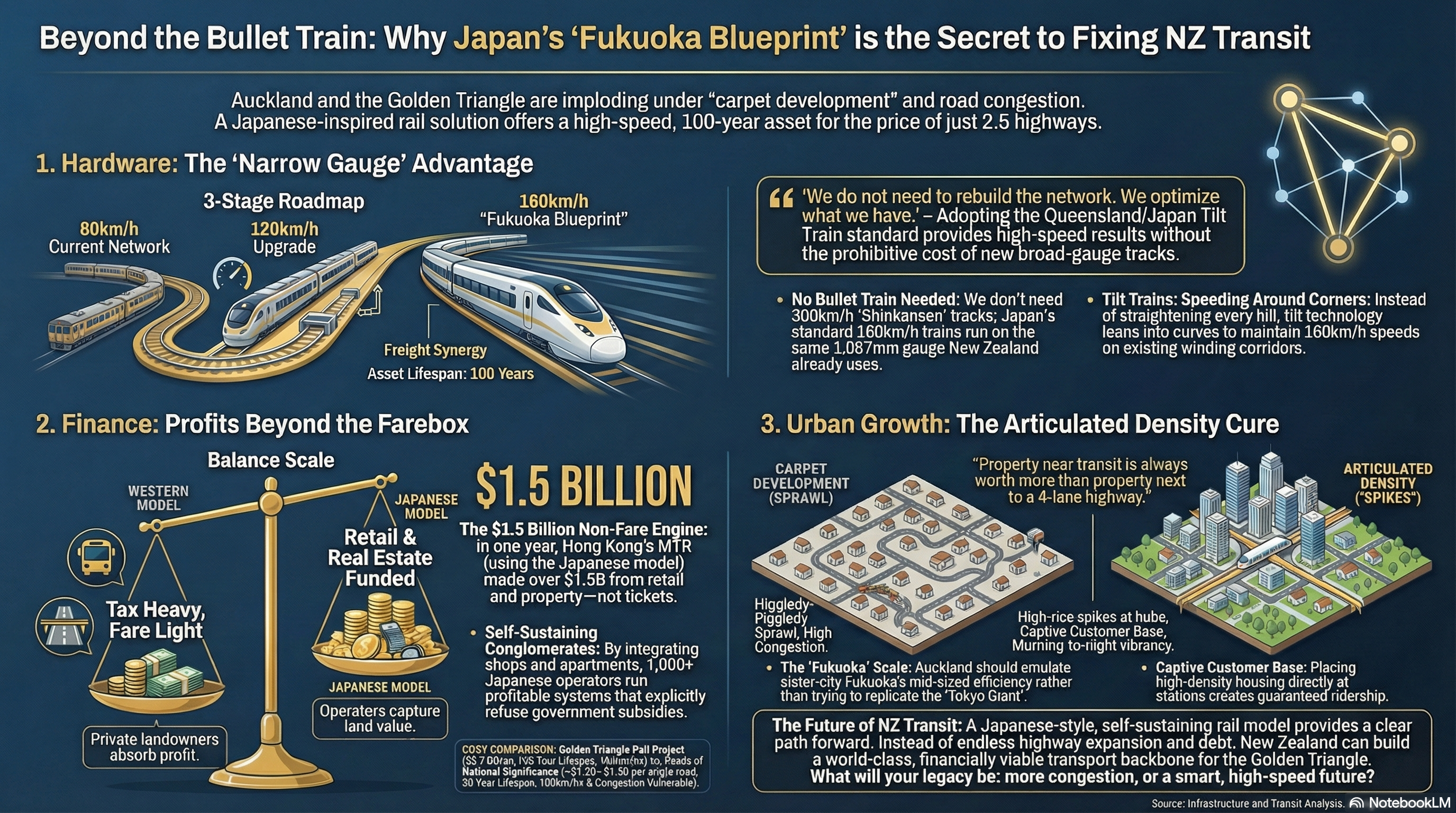
A common mistake in New Zealand transit discourse is the obsession with high-speed rail. Building a dedicated 320km/h line from scratch would be a prohibitively expensive white elephant. Instead, we should adopt the standard Japanese intercity model, which focuses on a highly efficient 160km/h operational speed.
The Technical Advantage of 1,067mm
The secret weapon for Auckland’s rail future is technical compatibility. Japan’s standard intercity services and New Zealand’s existing rail network both utilize the same narrow-gauge tracks (1,067mm). This allows us to upgrade what we already have rather than bearing the astronomical cost of new broad-gauge corridors.
“Because both Japan’s standard intercity services and New Zealand’s rail network use the same narrow-gauge tracks (1,067mm), New Zealand can bring our existing tracks up to speed rather than laying down completely new broad-gauge infrastructure.”
A Three-Stage Phased Rollout
This evolution doesn’t happen overnight, but through a logical, three-step progression:
- Stage 1: Establish 80km/h baseline services on the existing network. Concurrently, begin duplicating the Kaimai Tunnel—a move that immediately benefits KiwiRail’s freight operations as well as future passengers.
- Stage 2: Duplicate tracks through the Meremere Wetlands and the Ngāruawāhia bridge. Begin electrification from Pukekohe to Hamilton. This unlocks 120km/h speeds and initiates passenger services to Tauranga.
- Stage 3: Introduce “Tilt Train” technology, similar to that used in Queensland and Japan, to achieve full operational speeds of 160km/h on existing alignments.
Takeaway 2: Profits Beyond the Farebox—The Self-Sustaining Model
Western transit is often viewed as a “drain” on the taxpayer, reliant on permanent subsidies. Japan inverts this. Many of Japan’s 1,000+ transport operators explicitly elect not to receive government subsidies. They function as diversified conglomerates where the train is just one part of a larger business engine.
The Symbiotic Revenue Loop
Japanese operators do not merely sell tickets; they manage commercial, educational, and residential properties around, above, and below their stations. This creates a “Symbiotic Revenue Loop” were non-fare revenue funds continuous service improvements. By sharing operational costs across retail and real estate divisions, the transit arm lowers its overhead, transforming public transport into a self-sustaining, diversified business.
Takeaway 3: “Articulated Density” vs. “Carpet Development”
Auckland’s current intensification is “higgledy-piggledy,” cramming houses into every available gap regardless of transit access. This creates “breakdown congestion” where the road network simply cannot cope. The Japanese model proposes “Articulated Density” as a strategic hybrid.
Strategic Hybrid Growth
This model focuses high-density development only at transit hubs and frequent routes, while maintaining lower-density, single-family housing elsewhere. This approach:
- Prices In Residents: It places the highest concentration of people exactly where transit is most relevant, providing distinct lifestyle choices.
- Creates Vibrancy: It fosters “morning-to-night vibrancy” at hubs, making them centres of life rather than just places to wait for a train.
- Protects Efficiency: By concentrating growth, it allows arterial roads in lower-density areas to remain fast-flowing, preventing the city-wide gridlock of the “carpet” model.
Takeaway 4: Defeating “Rentier Capitalism” through Property Ownership
In typical Western systems, when a government builds a train line, the surrounding land values skyrocket. However, independent private landowners—not the transit operator—absorb all the financial benefits. This “rentier capitalism” creates a monopoly advantage for landowners who do nothing to create that value.
Capturing and Reinvesting Value
The Japanese model solves this by having the transit enterprise own and develop the sites along the route. Because the operator needs both tenants for their buildings and riders for their trains, they are incentivized to keep rents competitive and ensure a rapid housing-stock turnover (often under 40 years). This prevents the “pricing out” of residents and ensures the transit hub remains a vibrant, active community.
“Under the Japanese model, the transit enterprise captures the financial value created by the transit route and feeds that wealth back into funding the transport system, effectively breaking the monopoly advantage of independent landowners.”
Takeaway 5: Turning Passengers into Shoppers (Moving Beyond “POTS”)
To succeed, Auckland must abandon the “Plain Old Transport Services” (POTS) mentality. Modern Japanese culture prioritizes benrisa (convenience). Stations aren’t just transit nodes; they are “giant, well-run restaurants” and retail hubs.
The Lifestyle Integration Model
Auckland is already deep into the “Asian Century.” With our Asian demographic projected to be a major pillar of our 2.4 million residents by 2030, and “Kiwi millennials” craving global, tech-savvy environments, there is a massive latent demand for:
- Micro-Retailing: Small-footprint kiosks and specialized vending machines linked to smartphone apps on the concourse.
- Spatial Ambience: Clean, colourful, and pleasant environments that turn a commute into a “memorable purchasing experience.”
- Smoothing Demand: By making stations shopping and entertainment destinations, operators attract off-peak travellers, balancing out the passenger flow between morning and evening rushes.
Takeaway 6: The “Golden Triangle” Math—Rail vs. Roads
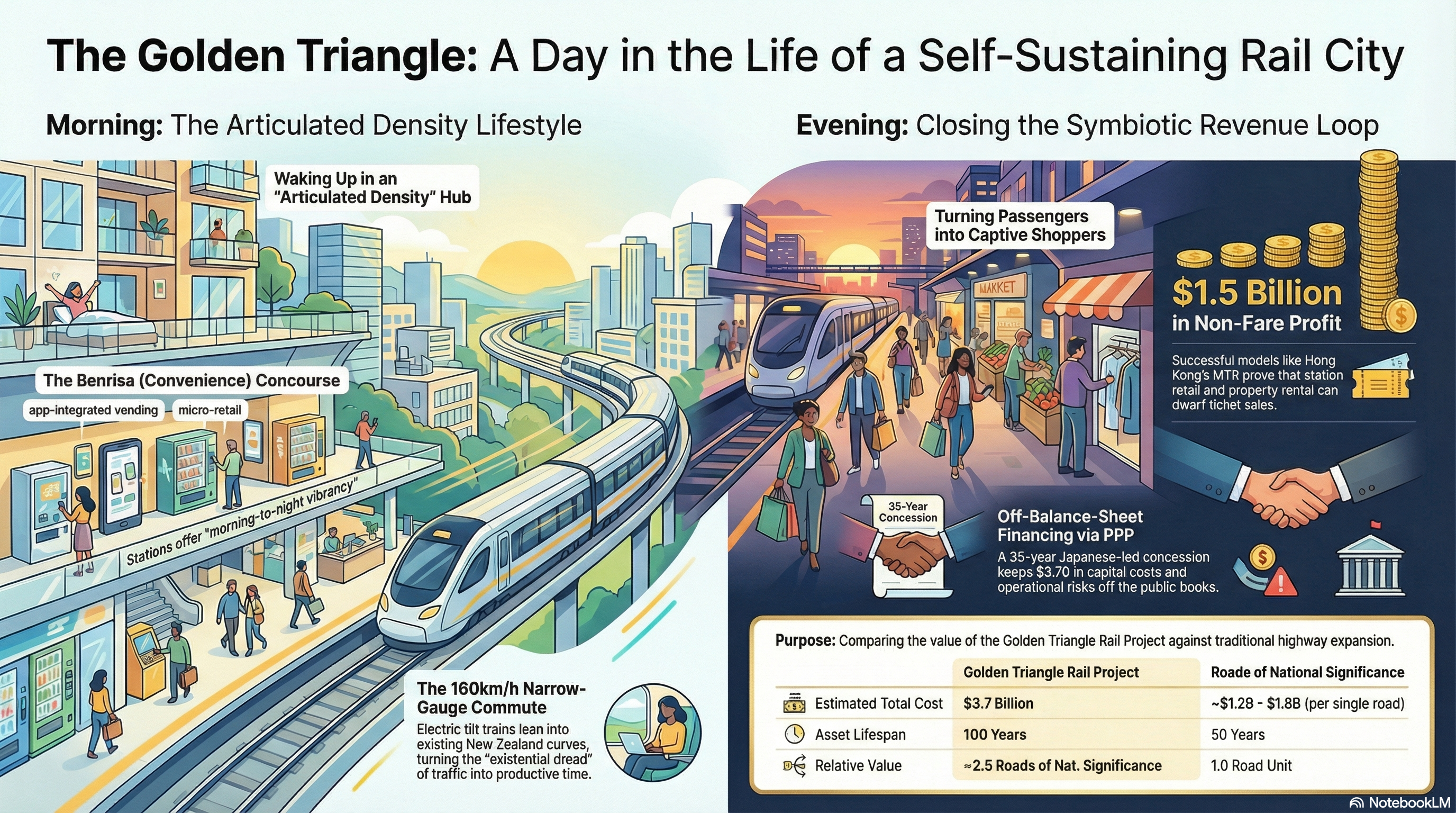
The cost to connect the “Golden Triangle” (Auckland, Hamilton, and Tauranga) is estimated at $3.7 billion. While this sounds high, the strategic math reveals it is an extraordinary bargain compared to our current road-heavy status quo.
The Efficiency and Longevity Contrast
- The 1 vs. 13 Rule: The Auckland-to-Hamilton hourly service leg costs $1.243 billion—exactly the price of one of the government’s thirteen “Roads of National Significance.”
- The 1.5 Road Equivalence: Adding full electrification to Hamilton brings the cost to $1.843 billion, or the price of just 1.5 of those highways.
- Asset Lifespan: A rail network is a 100-year asset, whereas four-lane highways typically operate on a 50-year timeframe.
- Steel vs. Asphalt: “Steel wheels on steel tracks” offer superior energy efficiency and productivity, reducing road deaths and emissions compared to “rubber wheels on oil-based asphalt.”
Conclusion: A 35-Year Vision for Aotearoa
Auckland is currently “imploding,” but we have a choice. By entering into a Public-Private Partnership (PPP) and inviting Japanese rail experts to operate under a multi-decade concession (such as a 35-year term), we can keep the vast majority of capital and operational expenditures off the public books.
The Fukuoka Blueprint offers more than just a train; it offers a way to discipline inflated rent expectations and “reset” our market through Greenfield TODs. Is Auckland ready to trade its inefficient “carpet development” for a Japanese-style integrated lifestyle? The math says we can’t afford not to.

 Talking Southern Auckland