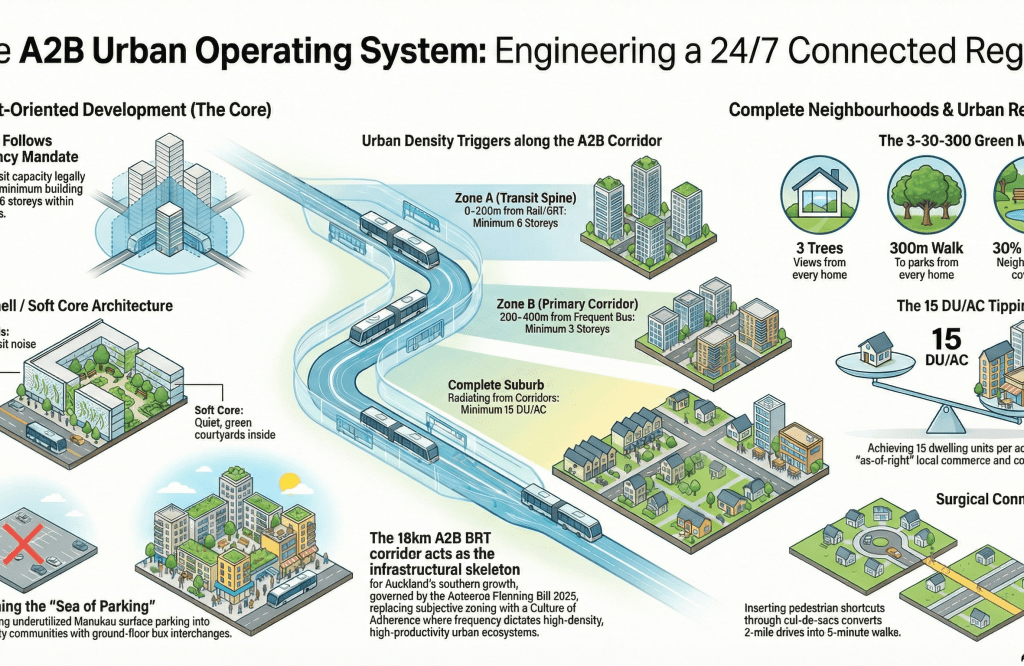
We have been introduced to inter-city rail enabling transformation of our urban centres, now for a look into intra-city transit reinforcing those urban centres
Before moving to our urban and rural building projects, I am briefly touching on two transit ideas (or rather pending projects in their own right) that would enable them. I have already touched on inter-city rail with the help of Japan in my Why Auckland’s Transit Future Isn’t a “Bullet Train”—It’s a Japanese Blueprint and Briefing: Transforming New Zealand’s Transit: The Japanese Integrated Development Model posts. In this post I will look at an 18-kilometre long proposed bus rapid transit line that would also enable and support the design-led place making projects. This line is known as Airport to Botany Rapid Transit or A2B. The subsequent post is a recap on Design-Led Placemaking concepts that inter-city rail, and A2B would enable and support.
Let’s start with an overview of A2B.
Overview of the A2B Rapid Transit Project
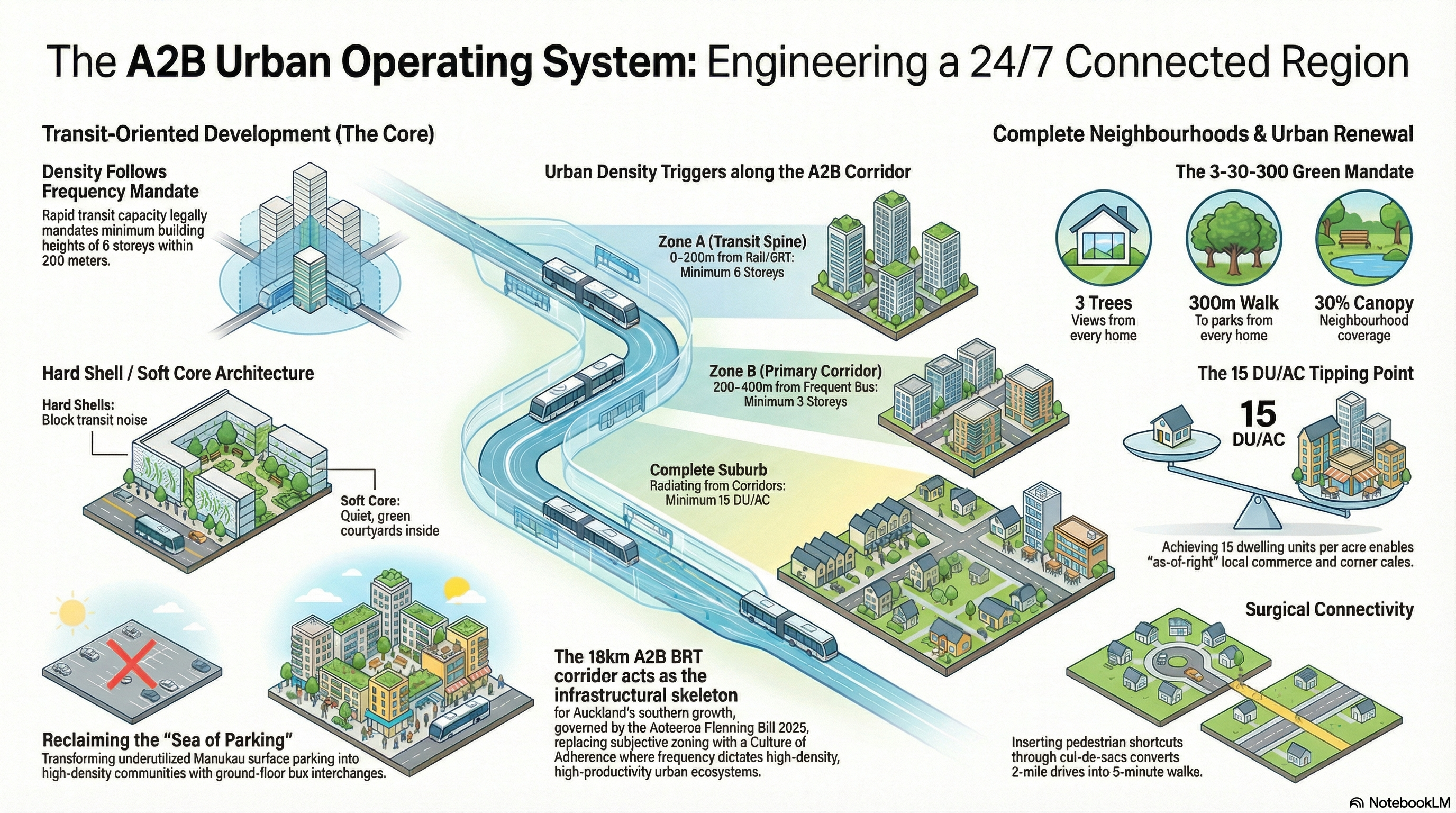
The Airport to Botany (A2B) Bus Rapid Transit is a dedicated, 18-kilometer congestion-free corridor connecting Auckland International Airport, Puhinui Station, Manukau City Centre, and Botany. Beyond simply moving passengers, the A2B serves as the foundational “infrastructural skeleton” for a new Urban Operating System governed by the Aotearoa Planning Bill 2025. By replacing subjective planning with a mathematical “Culture of Adherence,” the A2B acts as a catalyst for high-density, high-productivity urban growth.
Catalyst for Transit-Oriented Developments (TODs)The A2B corridor leverages the principle of “Density Follows Frequency,” legally tethering building massing to the capacity of the transit network.
- Mandated Density: Areas within a 200-meter radius of A2B stations, such as the major interchanges in Manukau City Centre, are designated as Category 1 Transit Spines. This legally mandates a minimum of 6 storeys for new developments, ensuring the city maximizes its return on public infrastructure investment.
- Acoustic Resilience: To allow residents to live harmoniously next to a 24/7 transit spine, A2B TODs utilize a “Hard Shell / Soft Core” perimeter block architecture. The street-facing façade acts as an acoustic shield (funded by developers under the “Newcomer Principle”), while the hollowed-out centre provides a quiet, biodiverse courtyard for residents.
Enabling Complete Neighbourhoods
Radiating outward from the high-density A2B transit nodes, the urban fabric transitions into “Complete Neighbourhoods” that eliminate the isolation of traditional dormitory suburbs.
- The Missing Middle: The framework deploys “Gentle Density” typologies, such as Stacked Duplexes and Cottage Courts, to achieve a density of 15 Dwelling Units Per Acre (DU/AC). This specific density is the mathematical tipping point required to make local commerce viable without massive parking lots.
- As-of-Right Commerce: Corner sites within these A2B-connected neighbourhoods automatically permit small-scale commercial uses (under 150sqm), such as cafes, dairies, and co-share offices. This eliminates car-dependent “Junk Miles” driven for basic needs and activates a 15-minute walkable reality.
- Surgical Connectivity: The surrounding suburban grid is retrofitted with pedestrian trail connections that slice through cul-de-sacs, converting what was once a 2-mile drive to an A2B station into a 5-minute walk.
Driving Urban Renewal
A2B acts as the primary engine for massive urban renewal, transforming underutilized and car-dependent land into vibrant, pedestrian-centric hubs.
- Reclaiming Surface Parking: In Manukau, expansive surface parking lots will be transformed into high-density TODs featuring ground-floor A2B bus interchanges, effectively turning a “sea of parking into an ocean of communities”.
- Boulevard Transformations: Major thoroughfares like Ronwood Avenue will undergo Design-Led Placemaking to become Main Street Boulevards. They will integrate the A2B transit-way while preserving general traffic and adding active mode paths.
- The Green Utility: Urban renewal along the A2B is bound by the mandatory 3-30-300 Rule. Every renewed block must provide a view of 3 mature trees, a 30% street canopy cover supported by “Connected Soil Volumes” beneath the pavement, and a 300-meter barrier-free walk to a high-quality park.
In summary, the Airport to Botany Rapid Transit project is not merely a transport upgrade; it is the physical spine of an integrated 24/7 ecosystem that transforms fragmented sprawl into resilient, high-capacity, and deeply connected communities.

 Talking Southern Auckland