Turing the EV Charge into a Positive Human Experience
Okay so we have transitioned to the land fleet to EVs for both cars and trucks. But now we need to build the infrastructure to support them just as gas stations once did for ICE vehicles. So how? This post gives an overview on some of the supporting infrastructure types
Introduction: The 7-Minute Itch
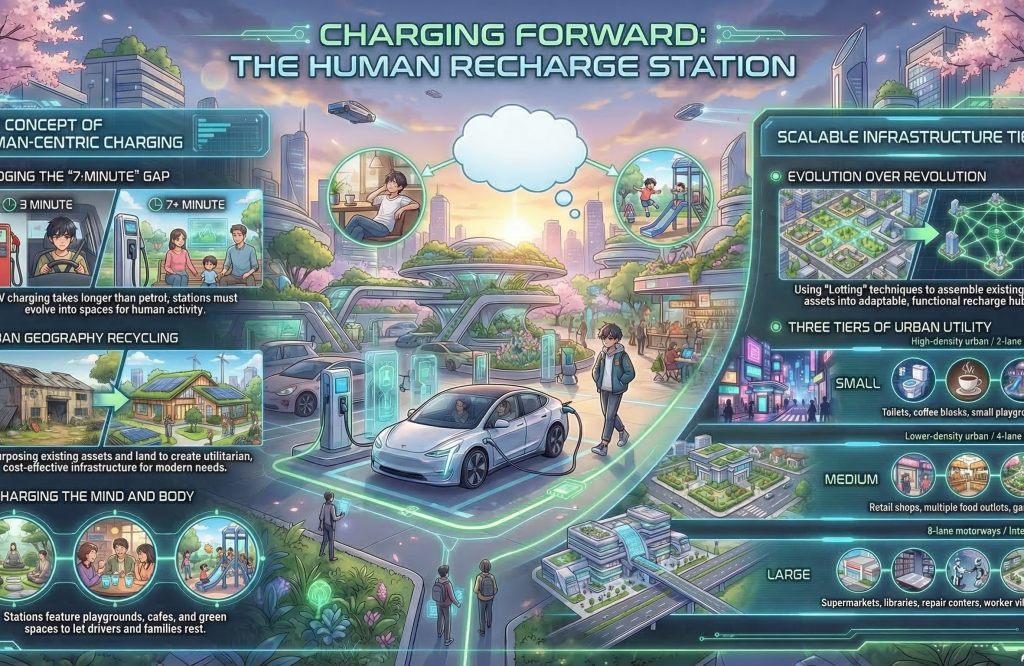
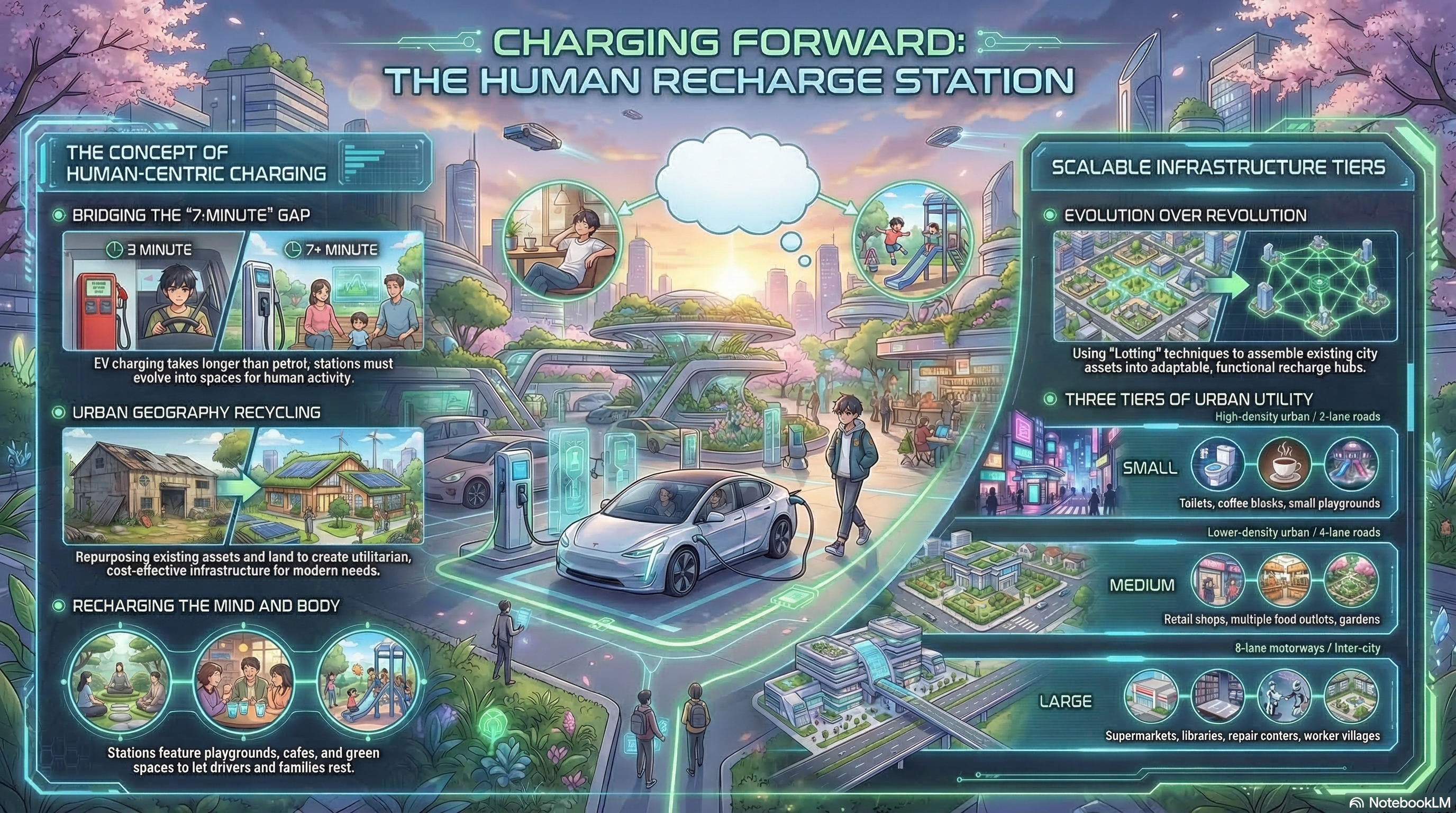
For decades, the “pit stop” was a two-minute transaction: pull in, fill a tank with combustible liquid, and pull out. However, as the global fleet transitions to electric vehicles (EVs), this logistical rhythm is fundamentally breaking. While heavy transport like trucks and buses can leverage battery swaps to maintain momentum, the average consumer is tethered to the charger. Even with high-speed fast charging, the average downtime for an EV is seven minutes.
For a driver with a car full of restless children or a professional on a tight schedule, those seven minutes represent significant logistical friction—a period of “twiddling thumbs” while the kids riot in the back seat. To solve this, we must look beyond the plug. The future of sustainable transit lies in “Human Recharge Stations,” hubs designed to transform mandatory downtime into a productive, human-centric experience.
Takeaway 1: The Death of the “Pit Stop” and the Rise of the “Human Experience”
The transition to EVs necessitates a shift from utilitarian utility stops to “human experience places.” Traditional gas stations are structurally ill-equipped for this shift; they were designed for speed and the handling of volatile liquids, not for hosting people for extended durations. As charging times lengthen the stay, the infrastructure must evolve to provide value that justifies the wait.
This vision draws heavy inspiration from Danish infrastructure, where the focus has shifted from the machine back to the person. As the planning community has observed:
“The Danes decided to make EV Charging Stations… human experience places – that is a place to grab a coffee, take a pee, change a nappy and/or sit in a green space.”
By prioritizing the “human recharge” alongside the kilowatt-hour, we transform a technical hurdle into a community asset.
Takeaway 2: The “Urban Geography Recycling” Manifesto
The most sustainable path forward is not a “revolutionary” overhaul that waits on the stagnant promises of Autonomous Vehicles (AVs)—technologies that have yet to resolve their inherent complexities. Instead, we need “Urban Geography Recycling” (UGR). UGR is an evolutionary approach to urban planning that repurposes existing, underutilized land to fill unsatisfied modern needs.
By recycling “off-the-shelf” assets, cities can build out charging networks that are significantly less expensive and faster to implement than ground-up construction. We must identify and reclaim “stranded assets,” including:
- Poorly used parking lots in high-density urban corridors.
- Aging highway service centres that lack modern amenities.
- Conventional gas stations that face obsolescence as fossil fuel demand wanes.
This is a utilitarian transition. By using what we already have, we avoid the waste of total demolition and create a functional package that addresses the immediate reality of EV transit.
Takeaway 3: Scaling Comfort from the Corner Lot to the Motorway Hub
Human Recharge Stations are not one-size-fits-all. To be effective, they must be scaled to fit their specific urban or rural geography, following a tiered blueprint of small, medium, and large facilities.
Small Human Recharge Stations
Designed for high-density urban areas with limited footprints or two-lane national highways.
- Focus: Core necessities and psychological decompression.
- Amenities: EV fast-charging points, accessible toilets with baby changing stations, and small-footprint food options like coffee kiosks or food trucks.
- Exclusions: To maintain a high-density footprint, retail shops, repair centres, and gas pumps are strictly excluded.
- Recreation: Playgrounds and green sitting areas to allow passengers to de-stress.
Medium Human Recharge Stations
Optimized for lower-density urban areas, two-lane highways, and four-lane expressways where space is more available.
- Focus: Errand-running and efficiency.
- Amenities: All features of the small station, plus an expanded mix of dining (cafes/fast food).
- Retail: Integration of supermarkets and shops, allowing travellers to complete a grocery run while the vehicle charges.
Large Human Recharge Stations
Comprehensive, “destination-grade” out-of-centre hubs located along major four-to-eight-lane inter-city motorways or wide urban avenues.
- Focus: A total utilitarian and residential ecosystem.
- Unique Features: These sites exclusively feature vehicle repair centres and legacy gas pumps to support the long-term fleet transition.
- The Library/Bookstore: A dedicated space for rainy-day waits, where visitors can relax with a book and tea during longer charging cycles.
- The Worker Village: To sustainably support a site of this scale, a small residential village is built adjacent to the hub. These staff are connected to the main urban centre via the “Manukau Trans-Link”—a dedicated public bus route that ensures the hub is integrated into the broader regional transit network.
Takeaway 4: Planning the Future Through the Lens of a Video Game
Visualizing these evolutionary changes requires diving into the “Lexicon Soup” of modern urban simulation. Professional planners like Ben Ross utilize Cities Skylines not as a game, but as a visualization tool, operating within the “BLaM” (Builder, Lotter, Modder) niche. Ross acts as a “Lotter,” assembling existing digital assets into functional “lots” that solve real-world problems.
This methodology is necessary because standard planning tools—and even the “Organic and Local Produce” policies found in simulators—often fail. Such policies are frequently too specialized or “hippie” in nature, focusing on organic shops without providing the gritty, utilitarian infrastructure required for a mass EV transition. By “lotting” Human Recharge Stations, planners can demonstrate how recycled geography fits into an existing city fabric before a single brick is laid. It proves that we do not need to invent innovative technology; we need to rearrange what we already have.
Conclusion: Recharging the Mind, Not Just the Machine
The success of sustainable transit depends on more than battery density; it depends on human comfort. By adopting the philosophy of Urban Geography Recycling, we can transform the “7-minute itch” of EV charging into an opportunity for rest, recreation, and community utility.
As we look at our changing cities, we must ask: How could the “stranded assets” in your neighbourhood—like a half-empty parking lot or an aging corner station—be recycled into a hub that recharges both your car and your mind?

 Talking Southern Auckland