Category: News

First Step in Improving Auckland’s Public Transport

Treat Humans as Humans


Not as numbers, not as dollar signs, not as a total pain in the ass that should be treated begrudgingly.


While I have been running commentary on things like Rail Efficiency Programs and operational models post City Rail Link to boost patronage via infrastructure and operations, another blogger raised a very fine point on something that is very well hammering our public transport patronage statistics – our customer service.


Before I highlight the said post from the other blogger, a quick reminder: Auckland Transport asked for submissions to its Regional Public Transport Program (RPTP) of which the hearings are next month (and that I am attending). One of the main focuses Auckland Transport was looking for in submissions to the RPTP was the “Customer Service Portal” – in other words the quality and level of customer service in our public transport system from front line staff right through to AT bureaucrats in Henderson.

This post is by virtue of an extension to my submission on the RPTP as well as replicating a point made at another blog.


So lets take a look at Customer Service on Auckland’s Public Transport System

This is from Auckland Transport Blog:


By Guest Post, on January 7th, 2013

This is a guest post by John P

The Ministry of Transport, bless ‘em, actually have a lot of interesting information on their website if you know where to look. One of the things they do is carry out a Household Travel Survey, which surveys 4,600 households in various parts of New Zealand each year. There’s plenty to look at, and you can check out various results at their transport survey, but for today I’ll look at a summary they put together on public transport use – taken from here.

The thing that stands out to me is a table showing the percentage of people who use public transport in NZ’s major cities. From this, 53% of Aucklanders surveyed hadn’t used PT at all in the last year. This put us on par with Christchurch and Dunedin, both of which are significantly smaller, neither of which have rail, and neither of which are particularly PT-oriented cities. We’re well behind Wellington, where only 27% of people hadn’t hopped on a train or bus at least once. Remember that (greater) Wellington is around the same size as Christchurch, and both cities are less than a third the size of Auckland.

Wow, that’s not a good start. How about people who haven’t used PT in the last month, but have in the last year? 17% of Aucklanders fell into this camp, in line with the other cities except for Wellington.

So, by this point, we can see that only 30% of Aucklanders had used public transport in the month before they were surveyed. We were in between Dunedin (26%) and Christchurch (34%), and well
behind Wellington where 46% of the people had used it at least once.

The last few lines of the table below are asking people how many days in the last month they had used public transport. I won’t dwell on it except to point out that half the Aucklanders who used PT in the last month hadn’t used it very often. Only 14% used it on 5 days or more, ahead of Dunedin (11%) but behind Christchurch (16%) and Wellington (27%).

Wellington is leaps and bounds ahead of Auckland, but I think we all knew that. I think these results are a pretty telling scorecard, and, to put it mildly, Auckland doesn’t look too flash. The majority of Aucklanders never use public transport at all, and most of those who do don’t use it very often. Two basic questions come out of this:

  1. Why don’t Aucklanders use PT very often?
  2. How do we improve PT usage in Auckland?

Questions that are answered in a number of different posts in this blog! A redesign of the network, and rail electrification, should help boost patronage over the next few years. But the thing is, we should really be aiming to get to where Wellington is now in the short to medium term. Anything less is short-changing ourselves in my opinion.


You can read the full article over at the Transport Blog site.

However the two questions in red are the points being raised and I answered over there. My answer was:

John (P) while a great post I think (from experience) the obvious is missing to give our flagging P/T patronage especially our rail patronage good kick until the infrastructure comes on cue over the next 10-30 years.

I take note here:

  1. Why don’t Aucklanders use PT very often?
  2. How do we improve PT usage in Auckland?

Questions that are answered in a number of different posts in this blog! A redesign of the network, and rail electrification, should help boost patronage over the next few years. But the thing is, we should really be aiming to get to where Wellington is now in the short to medium term. Anything less is short-changing ourselves in my opinion.”

Those are the two questions we are all seeking to actually answer and the reason why (to my personal disagreement as well as Councillor Mike Lee not being amused either) AT are about to embark on spending our money on “professional experts” ( http://www.nzherald.co.nz/nz/news/article.cfm?c_id=1&objectid=10855436 ) in finding “fixes” to our rail slump,


However again Councillor Mike Lee has hit the nail on the head right here with this comment from another article: http://www.nzherald.co.nz/nz/news/article.cfm?c_id=1&objectid=10857062

“Mayor Len Brown says the arrival of the trains will be “a huge step on the path towards the kind of integrated transport system an international city like Auckland needs”.

He believes the electric units – which will have greater acceleration and braking power than the existing diesel fleet – will make rail patronage “rocket” and create even more pressure for a 3.5km underground rail extension from Britomart to Mt Eden.

But council transport chairman and veteran electrification campaigner Mike Lee believes the new trains will not be enough to boost flagging patronage unless they are supported by general service improvements, notably far better punctuality and extended weekend timetables, without prohibitive fare rises.

“I would not bank on electric trains in themselves fixing chronic underlying human management problems,” he said.”


Basically cutting it short why don’t Aucklanders use P/T much and how do we improve our P/T usage in Auckland? Well the infrastructure part of the answer is being dealt with so to me it is rather irrelevant in this point in time. The actual answer came from Dr Lester Levy – Chair of AT:

Dr Levy said he agreed there was a need for “critical measures” to be adopted and Auckland Transport needed to be far more customer-led in creating a demand for its services.

And there is the answer right there and there – he said it himself: ” Auckland Transport needed to be far more customer-led in creating a demand for its services”

THAT TO ME IS (and excuse the caps) PRIORITY NUMBER ONE above else at the moment.

2013 is going to be long and interesting year getting the patronage back round again. However (and in my opinion (what ever that is worth these days)) we (by we I mean AT, Council, the p/t user, you guys here at the blog, myself, and others who give a damn about our city) can do this – slowly but surely. :D


Now I am going to extend the “situation” from another Transport Blog commenter emphasising the point:

George D

But council transport chairman and veteran electrification campaigner Mike Lee believes the new trains will not be enough to boost flagging patronage unless they are supported by general service improvements, notably far better punctuality and extended weekend timetables, without prohibitive fare rises.

He’s right. It doesn’t matter how fast and shiny the trains are if they’re still late and unreliable, and riding them costs more than ever. Every time fares rise, demand decreases – we’ve actually reached the point now where we’ve passed an equilibrium and ridership is decreasing towards a new equilibrium with those who are prepared to pay for a particular level of service.


Now since then a few more comments from Transport Blog have come up however I can’t specifically address those issues at the moment.

But as for my point and George D’s point, the writing for Auckland Transport is literally on the (virtual) wall. Improve customer service FIRST (and restore affordability to fares while at it) or all this multi-billion investment in our public transport system is going to be an utter waste if Auckland Transport can not get the basic human to human interaction right. People (both front line staff and passengers) just want to be treated like humans and be able to at least have a pleasant experience on our public transport network – even in times of disruptions. It can be done, it has been done and it is straight forward if the culture (and tools) are there.


There will be more said on this matter next month when I front up in front of members of the Auckland Transport Board next month for my RPTP hearing. However 5-minutes doesn’t quite seem long enough to hammer on about the “Customer Service Portal” at this current rate of dissatisfaction out there.


(South) Auckland Gets Shafted – Again (Ctd)

Someone Flushed Good Money Down the Loo – on a Possible White Elephant


I got wind of this particular story last night on $14 million of our ratepayers cash being spent on a possible (heck it is actually) White Elephant called a car parking building.

From Bernard Orsman of The NZ Herald:

$14m empty carpark – that you paid for

By Bernard Orsman BernardOrsman

Rates slashed but Manukau’s $14m parking building remains almost empty daily.

A carparking building in Manukau that cost ratepayers $14 million to build is sitting virtually empty and slashing prices to attract vehicles.

The building has been called a “dog” by councillor Dick Quax and lauded by Mayor Len Brown as a transformational project for the Manukau community – few of whom are using it.

When the Herald visited yesterday, the top two levels of the seven-storey Ronwood Ave carpark were empty and there were just 10 vehicles on the top five levels, including five Auckland Council cars.

The first and second floors had 62 and 18 vehicles respectively, but overall the 680-space carpark hadan occupancy rate of just 13 per cent.

It is understood the occupancy rate has improved since Auckland Transport cut the hourly rate from $3 to $1 and the all-day casual rate from $19 to $6 and $4 for an early bird special.

The transport body is matching and, in some instances, undercutting its own on-street rates to lure vehicles to the carpark. The on-street charges are $1 an hour and up to a maximum of $5 for all-day parking.

The $14.05 million carpark opened on June 18 as a revenue-gathering, commercial operation by Auckland Transport.

An Auckland Transport spokeswoman yesterday said it was performing below budget while the new Manukau Institute of Technology campus – which is leasing 240 carparks – was still under construction.

It was also built to free up valuable land in the city centre for future development to provide another 354 leases and act as a park-and-ride facility for the new Manukau branch line railway station with 86 public spaces.

The pro-public transport Auckland Transport Blog has called the carpark a disaster and an appalling waste of money, and published aerial photographs showing it set in a “sea of … car parking” at Manukau central.

Mr Quax said the carpark was a dog and he did not believe it would reach capacity for a long time, and councillor George Wood described it as a strange project with few vehicles using it.

But Mr Brown, who encountered strong resistance to the carpark when he was Mayor of Manukau City, remains bullish.

“This project is an investment in the future of Manukau City along with the neighbouring train station and MIT campus currently being built,” he said. “It is an example of our commitment to our growing metropolitan centres across Auckland.”

A planned $6 million expansion of the carpark has been cancelled.
Carparking woes

$14m cost to build

680 parking spaces

90 spaces in use yesterday

$19 original all-day casual rate

$4 new all-day early bird rate


Oh dear, oh dear what has the Mayor and Auckland Transport done with this folly.


My reaction of Facebook reaction was rather swift as well as Twitter comments on what $14m could of been better spent on:

Meh – the Mayor is full of crap (even more so than the Mangere Sewage Plant) with his comments on the AT public parking building in Manukau City Centre. If AT are having to slash prices to even undercut its own street parking that is already existing then we have a problem.

Note to AT Planners, Manukau is a destination station – not an origin station so a Park and Ride is next to useless here regardless of the Manukau Tertiary Campus


As I have said before; people COME TO Manukau as it is a major service hub, not start their journeys from the station (well there are a few but more of a rarity there) so a public car parking building acting as a Park and Ride is nothing short of a daft idea. In a conversation I had with a Councillor last night; I said that even with the Tertiary Campus being built, the parking building is in the wrong place let alone the fact no student is going to pay $19/day (although that has been slashed now) when they can park on the street for $5/day. Also the fact that most students are most likely to catch a bus or a train (Manukau South Link anyone?) to the campus might be an indicator that this new parking building is going to remain under utilised.


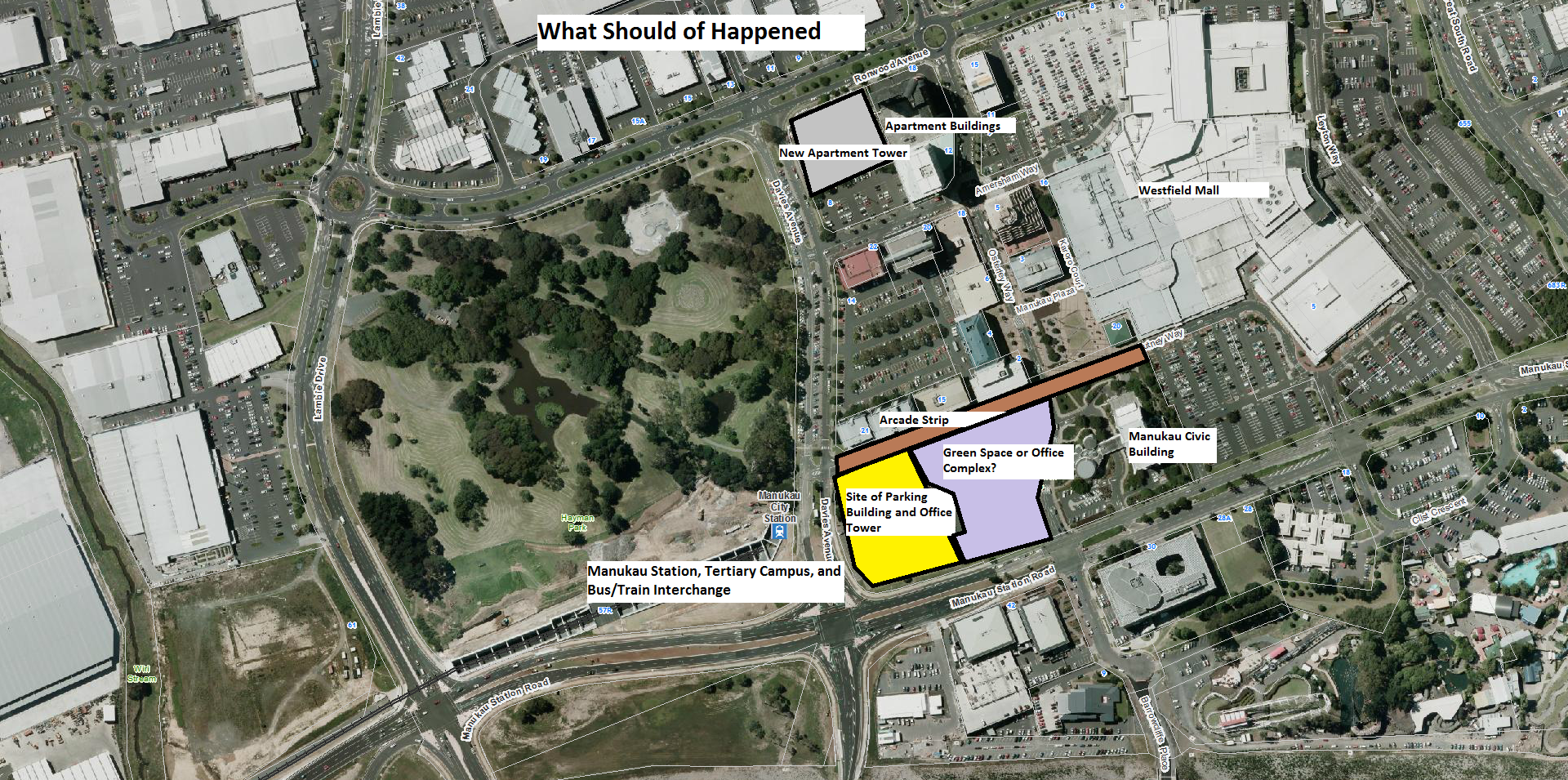
Now as for this AT parking building in the wrong spot, let me show some pictures for you to illustrate my point (click for full resolution):

The annotated pictures show what is currently happening and what SHOULD of happened to get better bang for our buck in ratepayer investment!


So what could of $14 million could of got the ratepayer instead of this parking building? It could have got the following (the newer Avondale Train Station cost $2 million as a base price comparison for a new station)

  • Close to a 1% reduction in our rates bill
  • The Walters Road Rail Station behind the Mitre 10 MEGA at Takanini, complete with Park and Ride, Kiss and Ride and even a shuttle bus facility
  • Upgrades to Papakura Station Interchange including again Park and Ride, Kiss and Ride and Bus Interchange
  • The Manukau South Link (4 times over)
  • Upgrade to the tired Otahuhu Town Centre Bus Station
  • New Bus Stops at Addison and East Takanini (which has no bus routes currently)
  • Deposit on the Selwyn Station complete again with Park and Ride, Kiss and Ride, and Shuttle Bus Facility (Selwyn Station is the relocated Meadowbank Station)
  • Decent lawn mowing and garden services for Papakura and Manurewa Local Boards


But no, we won’t be seeing any of those investments (apart from Selwyn Station and the Manukau South Link) any time soon!


Come on Your Worship and Auckland Transport, get it together with better investment and planning of our scarce ratepayer dollars on WORTHWHILE projects – for which that new Manukau Parking Building is NOT!

Ooooops

Who Got Fined Again?


Ooops at the tune of $3 million a month just in Auckland. Well that is if the Herald article this morning was anything to go by:


From the NZH on this Labour Day:

Drivers fined $3m a month

By Mathew Dearnaley

5:30 AM Monday Oct 22, 2012


AA shocked at rise in amount collected by Auckland Transport for vehicle offences.

Auckland Transport has been slugging motorists with fines of $3 million a month for parking and other vehicle offences.

Figures it supplied to the Herald for its first 20 months have shocked the Automobile Association, which suspects they reflect “anti-car” tendencies of its Auckland Council parent.

The figures detail $36.2 million of fines collected from motorists in the financial year to June 30.

That leaped from $20.5 million for the previous eight months, from when Auckland Transport began business in November 2010.

Although the latest total was for a longer period, the monthly average has risen to just over $3 million from $2.54 million in the organisation’s early days.

The $17 million was Auckland Transport’s half-share of warrant and registration fines. The Ministry of Transport received the rest.

But AA spokesman Simon Lambourne believed an increase in parking fines from $4.4 million for the eight months to last winter, to $7.2 million in the year to June 30, showed too much effort put into enforcement of a flawed system and not enough into education.

That was not counting $16.4 million in court penalties for all types of vehicle infringement over the year.

Auckland Transport also raised $32.7 million last financial year from standard motorists’ fees for street parking and parking buildings, and $2.1 million from bus lane infringements, although that represented an easing from $1.9 million collected for the previous eight months


You can read the rest of the article at the NZH. But what I want to get at is the AA’s rather archaic thinking here, in particular to comment from them:

But AA spokesman Simon Lambourne believed an increase in parking fines from $4.4 million for the eight months to last winter, to $7.2 million in the year to June 30, showed too much effort put into enforcement of a flawed system and not enough into education.

And

Of parking fines, Mr Lambourne said: “The amount of money being collected is alarming. It’s not being realistic about the importance of the car to mobility in Auckland.”

Oh boohoo and go back to the 1950’s as you get no sympathy from me here AA! With education; well teach your member drivers how to read the following signs: No Parking, Mobility Holders Only, Bus Stop, P60, Clearway, Loading Zone, Bus Lane, etc and then you might find the amount of fines given out decreasing. As for WoF and rego fines, well who was the nupty there for parking without a current WoF or registration 😛

As for importance of the car to mobility; dang that is 1950’s thinking knowing where the AA is going with that line of thought!


Look I do not deny the car as one of the sources of mobility in Auckland – that is ONE OF THE SOURCES! However we do have (and need investment) other sources of mobility such as public or active (walking) transport that need equal attention (if not more) as the car. In my submissions to The Auckland and Long Term Plans I gave equal weight to both car and public transport in investment for Auckland. An example was $3.6b on the City Rail Link and Rail Efficiency Program while an equal amount of cash was allocated to The Eastern Highway and the East-West link in Penrose/Mt Wellington. All three of those projects have high benefit to Auckland and are considered Priority One and Two (so completed by 2025 or 2032). There is no skewering towards one particular mode of transport over the other here.


As for the CBD, cars and parking; well the CBD is a premium place with premium parking so I somewhat expected premium parking prices here. The CBD can still be access easily whether by car, bus or train; we just have to be smart on how limited CBD is allocated to traffic and how measures can be taken to best utilise premium CBD space. My parking regime submission to AT gives an idea on what I would propose for the CBD:


ALTERNATIVE TO CENTRAL CITY PARKING ZONE REGIME

Posted by BR:AKL_Admin01 on June 14, 2012 · Leave a Comment (Edit)

Need the Alternative first before “penalising” car users


MY ALTERNATIVE LAID OUT

Last week I wrote a post on how Auckland Council and Transport were planning to change the parking regime in the Auckland CBD. In the post I spelled out the pros and cons of such a change (mainly cost of parking would be more expensive than Central London (exchange rate taken into account) and my viable alternative to such a regime – both pre and post City Rail Link.

Lets take a brief recap of the alternative I laid out:

I would support the new parking scheme if we had a viable alternative in position, but because we do not I OPPOSE the scheme – pure and simple. To get me to support the scheme you need the following in position first for the CBD:

  • The CRL – so the main sections of the CBD are reachable by train regardless on how you got to the CBD from the suburbs first
  • Parking Garages on the outskirts of the CBD, complemented with shuttle buses, and the City and Inner Link Buses (for the North Shore you would need a big park and ride at Akoranga Busway Station). This would allow people to drive from the suburbs to the CBD outskirts, park up then catch a shuttle, bus or train into the main CBD core. You would also get spin offs through being able to add more pedestrian malls and shared zones with reduction of inner CBD traffic.
  • A working and frequent off-peak service to give better incentive to come into the CBD via mass transit from the suburbs (could mean extending timetables and better security on mass transit to discourage anti-social behaviour (a real turn off from using the bus or train).

If one was wondering where the main parking garages would be ringing the CBD I was thinking (but not limited to) these areas:

  • Next to Grafton Station (the old Brewery Site is up for redevelopment) and may be Mt Eden Station on the Western Rail Line.
  • Near Newmarket South (there is some under utilised car lots next to the Newmarket Viaduct that would do just nicely – and still within an 800 metre/10 minute distance gap to Newmarket Station (see Mapnificent Graphic below for areas within reach of proposed parking building)
  • The Auckland Water-Frontier Transit Station (has to be built first and that is at least 20 years away)
  • Orakei and G.I Train Stations which have Park and Rides
  • Wynyard Quarter near Fanshawe Street (State Highway One end) (My proposed Wynyard Transit Station)

Well today I drew up some maps of this alternative scheme, and filed my submission to Auckland Transport formally opposing their Central City Parking Zone WITHOUT viable alternatives in position first.


You can see the rest of that particular post by clicking on the link above


In the end, it is about being balanced and fair (well much as possible) to all users. What the AA suggests is not fair and balanced, what I propose and advocate for is. And while my alternative is CBD focused, it can be easily translated to the suburbs including my home community of Papakura! Speaking of which I think a Town Hall meeting is required in mobility and access in Papakura, especially with 500 “social” and “affordable” houses due to be built behind me – and no access what so ever to public transport…


Time to Take Out the Trash

Waste to Energy for Auckland?


Auckland currently sends to the landfill (according to the last lot of statistics) 1.1 MILLION tonnes of trash. That is a crap-load of trash being buried into our grounds. Councillor George Wood has just returned from Taipei where he (and the Mayor) checked out a municipal incinerator that burns Taipei City’s refuse (industrial, residential and commercial). Here is a translated version from George Wood on the Taipei City Incinerator:


It has been proposed by Councillor Wood that Auckland should investigate and if deemed feasible (a plant of the size of Taipei City costs $400m estimate) build such an incinerator for Auckland. I propose one better and go the full hog in building a Waste to Energy Incinerator to take care of our trashy trash! Basically that means the trash is burnt at extremely high heat (1000-1200C), the waste heat is then either used to boil water (good cooling circuit for a furnace burning at 1000c) to produce steam and crank that turbine for electricity generation or sent to heavy industry nearby for use, and the ash used to make bricks or roads.

To get more of an idea from WtE, check my previous article on the matter:

From “WHAT A LOAD OF RUBBISH:”


Council Continues to Debate Rubbish


HOW TO “TAKE CARE” OF THE TRASH

Strangely enough how to deal with waste that makes it to the landfills is very easy and the First World have mastered it quite well. Its called incineration folks and we already have a mothballed power plant ready to rock and roll. Yep you heard me right; what does not get recycled, composted or used as fill can be burnt with the ashes used as bricks or other materials as pointed out in the accompanying Wiki article. The wiki article along with its references, burning the rubbish – waste to energy seems to have quite few spin offs including being better for the environment gas emission wise:

Carbon dioxide emissions

In thermal WtE technologies, nearly all of the carbon content in the waste is emitted as carbon dioxide (CO2) to the atmosphere (when including final combustion of the products from pyrolysis and gasification; except when producing bio-char for fertilizer). Municipal solid waste (MSW) contain approximately the same mass fraction of carbon as CO2 itself (27%), so treatment of 1 metric ton (1.1 short tons) of MSW produce approximately 1 metric ton (1.1 short tons) of CO2.

In the event that the waste was landfilled, 1 metric ton (1.1 short tons) of MSW would produce approximately 62 cubic metres (2,200 cu ft) methane via the anaerobic decomposition of the biodegradable part of the waste. This amount of methane has more than twice the global warming potential than the 1 metric ton (1.1 short tons) of CO2, which would have been produced by combustion. In some countries, large amounts of landfill gas are collected, but still the global warming potential of the landfill gas emitted to atmosphere in e.g. the US in 1999 was approximately 32 % higher than the amount of CO2 that would have been emitted by combustion.[15]

In addition, nearly all biodegradable waste is biomass. That is, it has biological origin. This material has been formed by plants using atmospheric CO2 typically within the last growing season. If these plants are regrown the CO2 emitted from their combustion will be taken out from the atmosphere once more.

Such considerations are the main reason why several countries administrate WtE of the biomass part of waste as renewable energy.[16] The rest—mainly plastics and other oil and gas derived products—is generally treated as non-renewables.

Go figure


LOCATION FOR SUCH A PLANT

Meremere which was designed to become a Waste to Energy Plant until the Greens stopped it (idiots) would be a good site with road, transport and power grid links all within easy reach. Basically trash goes by road or rail to Meremere, burnt, and the juice sent via the National Grid straight back up to Auckland. Simple

Southdown/Penrose has a gas fired co-generation power station (so produces power and steam for industrial use) already there connected to the National Grid and disused meat works site next door that needs major urban redevelopment. Like Meremere, Southdown sites with extremely easy reach of road, rail and power grid links but with the added bonus of having industry near by that would use the waste heat for their usage (ACI Glass being one example and only just down the road). The extra spin-off with Southdown is it is right in the middle of Auckland so no need for excessive waste transportation for incineration.

If you are concerned about the emissions from a waste to energy plant, then go read the wiki article and more to the point its references attached. It seems the developed world can handle it so we should be able to as well, because we are First or Third World folks?

Landfills = third world

Recycling, Composting and Waste to Energy = First World.

Zero Waste = near impossible as even Earth and the Sun produces some rather nasty waste from time to time (although the Universe has a knack at recycling too)


So Auckland Council, lets keep it simple please.


The Penrose site I have here below in this graphic:


Click for full resolution

The site highlighted is around 7.5 hectares, similar size to the 7.2ha site in Taipei City. The area I am proposing in Southdown is the old freezing works site long abandoned (since 1980) and burnt to the ground twice already. The area is in heavy industrial land (so no residential) right next to the North Auckland Line (rail), Southdown Co-generation Power Station, and the North Auckland transmission line (part of the National Grid). So with the right scrubbers and pollution control measures in place, this site at Southdown would be perfect for Auckland’s first Waste to Energy Plant with full road and rail access. And with the site right next to the power station and National Grid, the power produced from the WtE plant can be fed directly to Auckland and Northland with waste heat also able to be fed along the pipeline from the power station next door to industry. So cleaner for the environment, we get some juice, industry gets heat and the Roads of National Significance gets some ash for road building . I’d say that is a win-win-win for the city 😀


Now then, to get that investigation and plant building going so Auckland can take care of her trash!


Out Meeting the Locals

At Public Meeting on Liquor Store Application


Tonight I was notified of a public meeting facilitated by Papakura Councillor Calum Penrose (so my local Councillor) here in Papakura (my home and community) on opposition to a liquor store being opened in the area. So I trundled down to Papakura Central School where the meeting was held, said my hellos and took a seat to listen to proceedings. Normally in public meetings (as well as hearings) I might get up and ask questions or have a say, but tonight this was new territory for me so it was a case of sit quietly and observe what was going on in this public meeting.


This Facebook status sums up what the meeting was on:


A great turnout in Pahurehure, Papakura tonight – 120 residents turned out in objection to a liquor store proposed for their corner block of shops. Excellent leadership from Calum Penrose for Papakura and Manurewa, he is pictured here with his friend and popular local JP Raj Thandi and Manurewa Local Board Chair Angela Dalton. Aways on hand to give my sister town Papakura my personal support. Photography by Daniel Newman – nice job, good angle 😉

Calum Penrose, Raj Thandi, and Angela Dalton working to stop the opening of a liquor store in Pahurehure.


I also posted a Facebook staus:


Attended my first public meeting inside my on Local Ward (Maurewa-Papakura) on opposition to a Liquor Outlet being opened in the area. Was a good discussion lead by Local Councillor Calum Penrose. — with Daniel Newman and Angela Dalton.


As I said above; while I have been to public meetings before they have been outside my Ward (so Orakei and North Shore), this one in Papakura as I stated in my Facebook status my first LOCAL public meeting – so new territory.

But while new territory tonight, it was also an excellent learning experience for me. There was a chance to mingle afterwards where I would make introductions and conduct some networking like I have done in Orakei and The North Shore; however a fatality on the Western Line tonight (groan) forced me to return home to support Rebekka who had her shift extended by half to assist with all the “disruption” that goes with a fatality.

But in saying that, while tonight was my first LOCAL public meeting where I got to observe the locals in my or rather our own local community, it shall not be my last!

The people present are locals, fellow locals in our fellow community that is Papakura, and the very people I wish to represent next year after the Local Government 2013 elections. So my focus is returning home Auckland, to Papakura. Yes I will keep an eye out for wider Auckland, especially as the Regional Public Transport Plan and Unitary Plan are either up or coming up for submissions. But attention is now back to the home front as it is where I live, play, work (in part) and shop. That home as I have said is Papakura.

Yes I will still attend submission hearings and pop over to other Wards in Auckland to pay a visit, but my primary attention and focus is now returning home – to Papakura.


So look out Papakura, you shall be seeing more of me 😀


BEN ROSS: PAPAKURA

Shining the Light with You – Towards a Better Papakura

Papakura 2013: YOUR COMMUNITY – YOUR CALL


And


BEN ROSS : AUCKLAND

Shining the Light – To a Better Auckland

Auckland 2013: YOUR CITY – YOUR CALL


Our Council Controlled Organisations

How Well do Our CCOs Rate?


Bernard Orsman of the NZ Herald wrote a two part series about Auckland‘s Council Controlled Organisations – a.k.a The Auckland Bureaucracy.

You can read the respective articles in the list below:


What was interesting first up was the fact that the some of the CCO‘s could be up for a merge, or downsizing. That is fine with me to get some savings back to the ratepayer so long as our services are not affected.


Although what was more “interesting” is what Orakei Local Board Chair Desley Simpson had to say on the Herald’s series about our errant CCOs:

 Saving $ is great but what I am interested in is the improvement in communication and interaction with local boards Hope this will be reviewed at the same time Happy to input!

That prompted this remark from me:

  • Ben Ross Might be finding both Local Boards and normal ratepayers wanting to give input to OUR errant CCOs. But the CCO that needs the largest kick up the backside can not be touched due to the law…
  • Desley Simpson No guesses needed as to what you are referring to there Ben!


Upon reflection of that comment, ATEED is the CCO that needs the biggest kick up the backside for the amount of grief that CCO has put Auckland through. From the Rugby World Cup to the V8 Pukekohe saga, ATEED seems to have the knack in really annoying Auckland ratepayers from either daft decisions or being all Secret Squirrel with Councillors and the public over some of its decision-making processes (The V8s being the most recent). So using Desley’s remark on interaction and communication, ATEED fails badly there.

As for that other CCO that we shall not name and I was initially commenting about, well I can not exactly give it a kick up the backside for interaction and communication as that CCO which we shall not name has actually improved, especially if their Twitter communication and interactions are anything to go by as that has gone for strength to strength. So thumbs up there. As for a few other things, well we shall say that is a work in progress folks and leave it that.


But at the end of the day it is the communication and interaction that the CCOs really need to work on. While at arm’s length from Council Governing Body, having a healthy and open relationship with the GB, Local Boards and the ratepayers would be a wise idea unless the CCOs want open hostility from the ratepayers on a really good day.

So I recommend to the CCO’s if they want to help boost their “street-cred” with the Local Boards and ratepayers adopt these simple philosophies and stick to them:


  1. Open Governance: I believe in open governance where the public can sit in, listen and where possible discuss “matters-of-state” as much as possible with their representatives. None of this hiding behind closed doors (except for commercially sensitive material that does come up from time to time), and fessing up when you know you have stuffed up. You might find the public are more sympathetic you one acknowledges and apologies for a legitimate mistake
  2. Basics first: One thing I learnt when I moved out from the parents’ home and struck it out in the real world (including getting married and owning our first house) is that with the limited resources you have got, you did the basics first then with anything left over you just might be able to afford a luxury. Same applies to our civic institutions; they have limited resources so get the basics right first then “treat yourself or others” to a luxury if you are able to do so once the basics are taken care of.
  3. Listen and Engage: God gave us two ears and one mouth. In my line of work you actively listen with both ears THEN engage IN DAILOUGE with your one mouth. Not the other way around as that is usually monologue and the fastest way to get your ears clipped. Same applies to civic institutions:  you actively listen with both ears THEN engage IN DAILOUGE with your one mouth unless you like getting your ears clipped… Oh and remember some days all the person wants you to do is JUST LISTEN to their little piece – as all we want some days is just to get it off our chests.


That was from my What Do I Stand For and Believe In – For a Better Auckland. Something I will be using as benchmarks if elected to Papakura Local Board next year to see how our CCO’s are  treating the ratepayers and their money. But if the Herald article from yesterday was anything to go by, all three points above need some serious working on from ALL our CCOs.


In the meantime back to submission writing!


In Brief

A Brief View of Auckland


Was a busy day in the NZ Herald today with two different articles on Auckland’s Transport, and another two on our Council Control Organisations.


The two transport articles were:


In both these cases I have run commentary on these and are giving specific mention in my submission to Auckland Transport‘s Regional Public Transport Plan. Further commentary will be at hand as the week advances and I continue my RPTP submission.


As for the other two articles covering our CCO‘s, they were:


In regards to these issues, I have run commentary on this before and it seems I will be doing so again here at BR:AKL again this week if not next week. CCO’s being secretive is one of my pet hates and a campaign plank as I run for Papakura Local Board in next year’s Local Government 2013 Elections.


So yes today was a very busy day in the NZ Herald, with plenty more to campaign on for a Better Auckland here at BR:AKL!


BEN ROSS : AUCKLAND

Shining The Light –
To a Better Auckland

Auckland 2013: YOUR CITY – YOUR CALL


Papakura Set for ‘Large’ Housing Development

Upwards of 500 “Low Cost” Housing to be Built – In Papakura


We all know housing affordability in Auckland sucks with the Demographia Affordability rating being around 5.3 or “severely unaffordable (affordable is at 3.0 meaning the total cost of a home purchase should not exceed three times the total annual income of the household living in it. Currently Rebekka and I sit around the 3.52 mark). All sorts of measures are trying to be taken to allow the average person to at least being able to afford their very own house to live in. In this particular case Housing New Zealand has put out a tender to the private sector for the construction of upwards of 500 new homes that are: state houses, social housing and full private houses. The NZ Herald explains:


From the NZH:

Big low cost homes job set to start

By Simon Collins

5:30 AM Friday Oct 12, 2012


Housing New Zealand is seeking a private partner to build houses on former Papakura army camp land.

Earthworks for Auckland’s biggest low-cost housing development in 25 years will start next month on land that used to be part of the Papakura army base.

Housing New Zealand is seeking a private sector partner to build between 450 and 500 homes on the 24ha site between Walters Rd and McLennan Park. Tenders close on October 16.

Its general manager of asset development, Sean Bignell, said the homes would be a mix of 10 per cent state houses, 20 per cent other social housing and 70 per cent for private sale at prices likely to be “in the high 200s to the high 300s” – putting most of them below the lower quartile mark of Auckland residential properties sold this year.

Finance Minister Bill English said recently that high land prices had skewed Auckland builders towards large, high-value houses, and there was “no housing being built for people in the lowest quartile of income”.

“That is clearly unsustainable,” he said.

A start on the Papakura project comes as Housing NZ bows out of another long-planned 10ha development next to the Weymouth child welfare home, which the new Social Housing Unit in the Ministry of Business, Innovation and Employment has allocated to “third-sector” social and affordable housing.


If you want to know where approximately, check the map below


Click for full resolution


So between 450-500 new houses are to be built in the vicinity to where I live. Hmm means its going to be noisy and dusty for a while but I am not particularly minding too much. Look we need more “affordable” housing and if Housing NZ can take the lead in offering this affordable housing then so be it. If I was to have any concerns it is not around the fact “low-cost” housing is about to be built in my backyard; my concern is around the urban design factor which sets the future for this large-scale project for life.

I assume the houses will be a mix of 2-4 bedrooms on sections between 400-600m2? I need to go hit up my Local Board and take a look at the plans as they are not easily found online at the moment. The plans would tell me what kind of urban design work is being done and whether the urban design method chosen will be a benefit or a total hindrance to the future of this development. And something tells me the urban design of this development is actually going to be a hindrance more than a benefit here. How so?

Quick crude maths tells me the following:

  • My house is 110m2 on 520m2 – and I have a 3 bedroom home, so that means I have a front and back yard
  • The new development site is 24 hectares or 240,000m2
  • Divide the 240,000 into 500 houses and you get 480m2, however take into account roads, paths and berms and the average lot would be around 400m2
  • Divide the 240,000 into 450s house and the figures move to 533m2 and 450m2 respectively
  • This does not take into account parks, green spaces or “alleyways”

If we want the kids to at least have a decent backyard to play in and maybe grow the vegetable garden as well (although that is a lost art in Auckland) I would suggest 450m2 sections for three and four bedroom houses would be a generous and comfortable size. Anything smaller and we get no yard space for the kids and that can generate problems if there are no parks nearby. And no Bruce Pulman Park does not count unless you want to cross a very busy Walters Road while the McLennan Park is often used for sports. From what I have also gleamed from the graphic for this new development, thankfully the roads inside the new development are grid which promotes easy of traffic (foot and vehicle) flow while mitigating against the Fear of Crime perception that often comes about in urban development. However there are only two ways in and out of the development (so connecting to main roads) which could be a bit of a pain and isolating factor to this new development. In fact the lack of access to the main roads could isolate this new development and lack of accessibility can mean crime can fester inside the development.

In all that regard, I am going to have to go take a look at the plans to see what is exactly proposed. As I said nothing wrong with new development even in my backyard (I knew things like this would happen in Papakura when we chose to move here), but piss-poor urban design that turns this much needed housing into a crime-bed will not go down particularly well with me.


Now as for public transport access. This development is somewhat isolated from the main bus network which runs up and down the Great South Road. Rail-wise you have Takanini and Papakura Station both within 5-minutes of each other although 450 new houses will put pressure on Papakura’s existing Park and Ride which is already short of spaces. This new development would be the perfect time for Auckland Transport to haul arse and get the new Walters Road Rail Station along with a Park and Ride (with 450 spaces) and shuttle bus bay to serve Papakura north, Addison, Takanini east and the new development soon to be built. Trying to encourage public transport with Walters Road Station and Park and Ride would be a good start in improving public transport accessibility, especially for our new residents soon to move in.

Papakura Local Board as well as myself support and are advocating to AT on the Walters Road Station, this new development PLUS the continued development of Addison would be the perfect catalyst into getting our new station by 2015!

I have written in previous submissions as well as the current submission I am writing (the AT Regional Public Transport Plan) for the construction of Walters Road Station, and am making it an election campaign pledge to continue to have the station built sooner rather than later in the Local Government Elections next year!


But in the mean time, I shall go search those plans for this new development.


Dodgy Governance

White Water Rafting in Manukau or White Water Shafting in Auckland?


It seems Dodgy Governance at Auckland Council continues, again around the White Water Rafting Shafting facility that was “approved” (subject to public “consultation”) by – oh look the Auckland Council Strategy and Finance Committee. The very same committee blasted over The Long Term Plan and the V8 saga down in Pukekohe!


A press release from Councillor Cameron Brewer – Orakei


Rafting’s compelling economic story news to economists

Tuesday, 9 October 2012, 6:44 pmPress Release: Cameron Brewer

Whitewater rafting’s compelling economic story news to Council’s economists

Today’s revelation that neither Auckland Council’s own economic development unit nor Auckland Tourism, Events and Economic Development (ATEED) were asked to have input or to review last week’s proposal to support a $20m – $30m ratepayer investment into a whitewater rafting facility in Manukau, shows the poor process surrounding the project going from bad to worse, say Auckland councillor Cameron Brewer, who chaired today’s Economic Forum.

“At today’s forum some councillors were genuinely surprised to hear from representatives of ATEED and council’s own EDU that neither were involved in the Counties Manukau Pacific Trust and Regional Facilities Auckland’s proposal for proceeds of a council land sale to go into converting a South Auckland paddock into a whitewater rafting facility.”

Mr Brewer says that’s concerning given the controversial proposal narrowly got through last week largely off the back of all the economic development promises sold to councillors.

The report circulated to the 4 October 2012 Strategy & Finance Committee promised that the project would create 110 full-time equivalent jobs, attract 31% of its visitors from outside the Auckland region and New Zealand, act as a catalyst to attracting quality development within the surrounding area, and contribute an additional $7.4m annually to Manukau’s GDP.

“Now we learn that the compelling economic story that helped to successfully sell this project was never audited or even inputted by council’s own economic team or ATEED which employs 60 people in its economic development operations alone. That’s not good enough, particularly when you consider the proponent’s business case for this facility was completed in July last year. As councillors we need to be confident that what is promised can stand up to scrutiny and that should start with internal reviews of such big economic promises at the very least.

“I support those councillors who now want to see this project’s economic feasibility and business case peer reviewed by either council’s own economic development unit or ATEED. That needs to be done before this project becomes part of council’s draft annual plan for 2013/14.”

“This project was rejected outright by the former Manukau City Council three years ago. It then somehow escaped this council’s proper 10-year Long Term Plan budgetary process, and now we learn it has also avoided the scrutiny of council’s two economic development teams despite it being sold as an economic development project. Ratepayers should be even more worried,” says Mr Brewer.

ENDS


Well this sorry saga flies in direction contravention to just about every fundamental I stand for – for a better Auckland, specifically these points:

  1. Basics first: One thing I learnt when I moved out from the parents’ home and struck it out in the real world (including getting married and owning our first house) is that with the limited resources you have got, you did the basics first then with anything left over you just might be able to afford a luxury. Same applies to our civic institutions; they have limited resources so get the basics right first then “treat yourself or others” to a luxury if you are able to do so once the basics are taken care of.
  2. Listen and Engage: God gave us two ears and one mouth. In my line of work you actively listen with both ears THEN engage IN DAILOUGE with your one mouth. Not the other way around as that is usually monologue and the fastest way to get your ears clipped. Same applies to civic institutions:  you actively listen with both ears THEN engage IN DAILOUGE with your one mouth unless you like getting your ears clipped… Oh and remember some days all the person wants you to do is JUST LISTEN to their little piece – as all we want some days is just to get it off our chests.


Council is not getting its basics right if it splashes out on this rather large-scale luxury item. Council is also not listening nor even consulting those who should be auditing this facility proposed in Manukau City so how the hell are we meant to display the remotest of confidence in our civic leaders which Councillors and the Mayor are.

The answer is we can NOT!

Council has infringed on my fundamentals with this White Water Shafting deal and I am not very happy about it – in fact I am disgusted by those Councillors who voted for the proposal…


Can I spin a positive out of this? Well apart from standing for Papakura Local Board next year the answer in short is sadly NO!


Although I have to ask this question: Do I continue to stand for Local Board, or try my hand at Council itself and try to tip out a centre-left sitting Councillor north of me (in other words NOT contesting Papakura as the current councillor centre-right and it is pointless trying to tip out one of your own). It is a question that I will need to think long and hard over as the elections draw near.

In the mean time it is back to submission and speech writing – before Council does anything else rather daft!