Large scale redevelopment to happen I have seen the following about the St James Theatre ‘rebuild:’ ST JAMES THEATRE A STEP CLOSER TO RE-OPENING FOLLOWING SALE OF SITE Auckland’s … Continue reading St James to be Reborn(?)

A News Post on something that has happened
Large scale redevelopment to happen I have seen the following about the St James Theatre ‘rebuild:’ ST JAMES THEATRE A STEP CLOSER TO RE-OPENING FOLLOWING SALE OF SITE Auckland’s … Continue reading St James to be Reborn(?)

From Auckland Council – and read the bit in bold carefully too
Auckland Council’s Regulatory and Bylaws Committee adopted a draft Air Quality Bylaw today to tackle Auckland’s air pollution. The proposed bylaw has been recommended as a way of meeting national air quality standards, as required by the Government.
In winter, 75 percent of Auckland’s air pollution is due to fine particulate emissions (PM10) from open fires and old, non-compliant wood burners. The inhaling of fine particles – which can lodge in the lungs – has raised the level of respiratory illness in the region, a surprise to many who thought that vehicles or industry pollution was to blame. The proposed Air Quality Bylaw will focus on the management of indoor fires to reduce the emissions of these fine particles into our air.
“It is hard to comprehend that the warmth emanating from that wood fire we enjoy on a cold winter night is the cause of serious health issues. By concentrating on the air pollution culprit in winter – indoor fires – we will not only achieve cleaner air, we will be well on our way to meeting national air quality standards,” says Calum Penrose, Chair, Regulatory and Bylaws Committee.
The committee held a robust discussion about the various implementation timings of the bylaw and Councillor Penrose was pleased with the resulting recommendation of prohibiting both open fires and older wood burners (pre-2005) in October 2018. This will allow homeowners and landlords time to consider alternative heating sources.
All regional councils are required to monitor air pollution levels to ensure particle concentrations are within National Environmental Standards for Air Quality (AQNES) requirements and that we identify any areas – airsheds – where air quality may exceed standards. The Ministry for the Environment now requires all councils to meet the AQNES standards with no more than one exceedance per year in a region by 2016.
The bylaw is expected to be tabled at Auckland Council’s Governing Body meeting later this month. Calls for public submissions will begin on 10 November.
—-Ends—-
The Urban Air Shed where the restrictions will be in place by the order of Central Government per Resource Management Act – National Environmental Standards for Air Quality
Some Frequently Asked Questions – and answered
Still Missing a Planning Minister though Labour have been watching Auckland Council as the Council goes through the motions of setting up a new Council Controlled Organisation to … Continue reading Labour Wants Development Companies

32% Valuation Rise does not mean a 32% rates rise By now you would have seen the increased chatter around the new Council Valuations on property around Auckland … Continue reading Rates and your Council Vaulations [Updated]
From Auckland Council
Cultural impact assessments: balance needed
“Protecting Auckland’s cultural heritage is a key part of Auckland Council’s job but so is making sure consent applicants don’t find themselves tied up in unnecessary red tape,“says Roger Blakeley, Auckland Council’s Chief Planning Officer.
“There is always a balance to be struck.”
Dr Blakeley was responding to public debate about the proposed Auckland Unitary Plan provisions concerning mana whenua including a public meeting tomorrow organised by the group Democracy Action.
He says the rules in the proposed Unitary Plan regarding sites of significance or value to mana whenua were brought in following feedback the council had received on the draft plan asking for more protection for cultural sites and places.
The Unitary Plan hearings process is now underway and the Independent Hearings Panel will review the rules as people have their say.
The Proposed Auckland Unitary Plan (PAUP) provides greater emphasis on the consideration of Mana Whenua values, establishing a framework for Auckland Council and Mana Whenua to work together.
It contains a range of provisions relating to Te Tiriti o Waitangi, intended to meet the council’s broad obligations under the Resource Management Act.
“In the meantime, we need to keep focusing on a balanced, workable approach. The ‘Cultural Impact Assessment’ that critics have been complaining about isn’t new – it’s been around for years.”
It is currently required in a very small number of cases where a property is near a site that is of value or significance to mana whenua and involves changes that could potentially impact those sites. This can include, for example, former burial sites or pa sites.
In the last six months, Auckland Council has processed over 6000 resource consents and less than 200 of them (3%) triggered a possible assessment. There have been 50 site visits and 12 cultural impact assessments formally requested in that time.
“As a council we’ve worked closely with iwi to find ways to minimise the impact on landowners and have introduced a facilitation service to simplify the process.
“This involves the council contacting iwi on behalf of the applicant, and the iwi will say whether an assessment is needed. Most people are taking advantage of the facilitation service.
“There is a misconception that these assessments involve some kind of veto from iwi. They don’t. They are about iwi providing expert advice. The council takes that expertise into account, but it is the council that makes the decision.
“While we continue working towards the right balance, it’s good to remember just how important protecting our Māori heritage is to Aucklanders – including recent arrivals who really embrace this aspect of their new home. It is our point of difference in the world. Like other global cities, we want to retain our heritage, as an important part of our culture and identity.”
—-Ends—-
Quoting again: In the last six months, Auckland Council has processed over 6000 resource consents and less than 200 of them (3%) triggered a possible assessment. There have been 50 site visits and 12 cultural impact assessments formally requested in that time.
After quite a few Memorandum for Counsel letters appearing (see: Developments from the Unitary Plan Hearings ) the Unitary Plan Independent Hearings Panel is working through things to simplify the processes.
From the Unitary Plan Independent Hearings Panel:
Help is at hand for submitters to the Auckland Unitary Plan hearings who are having difficulties understanding and navigating the hearings process.
The Independent Hearings Panel considering the more than 9500 submissions – and a further 3500 further submissions – says it’s important that the process encourages everyone to be involved.
One misconception is that submitters can only take part in the hearings process if they have legal counsel, expert witnesses and evidence.
The chair of the Independent Hearings Panel, Judge David Kirkpatrick, said this most definitely is not the case and while this was explained in documents on the Panel’s website, it needs to be highlighted.
“Some feedback is highlighting the complexity of the process and the difficulties some members of the public are having getting to grips with the key information so we are addressing that immediately,” said Judge Kirkpatrick.
“We want it to be as simple as possible for submitters to participate.
“The Unitary Plan process is big and complicated – it’s a complete review of the regional policy statement, four regional plans and seven district plans – but submitters can keep it relatively simple if they want to.”
Judge Kirkpatrick said Panel staff are:
This will all be available by the end of October.
The first Drop In clinic is at the Panel’s offices in central Auckland, another is being planned for Orewa and more will be organised around the region if there is demand.
The Panel may also consider holding a number of hearings outside of central Auckland and, possibly, outside normal working hours once more locally specific topics are being considered.
“It’s early days in a two-year process and as submitters get more used to the process and we make improvements, it will be much less daunting than some people have found it to be,” said Judge Kirkpatrick.
Panel staff are available to help submitters with questions and guidance through contact at info@aupihp.govt.nz or 09 979 5566
……….
This is a start. The Litmus Test will be the Regional Policy Statement, and the Rural Urban Boundary submissions working their way through the Hearings Panel now (where also the most anguish around the complexity of the Hearings process occurred as well).
I am not due to present and give my submission until next year.
From the Minister for the Environment – Dr Nick Smith
The Resource Management Act needs to explicitly recognise the importance of New Zealanders’ access to more affordable housing if the downward trend in home ownership over the past 20 years is to be reversed, Building and Housing, and Environment Minister Dr Nick Smith said today at the Property Council New Zealand’s Residential Development Summit in Auckland.
“The Resource Management Act must safeguard our natural environment but it is also a crucial piece of planning legislation. It forms the basis for the decisions that determine what we can do on our land. So it’s important we have a system that balances environmental protection with the wider needs of New Zealanders. We need a system which ensures that important environmental standards are maintained, but that which also enables growth and development – including a strong housing supply,” Dr Smith says.
“It is the price of land and sections that has gone up so rapidly in unaffordable housing markets like Auckland, and it is the Resource Management Act and how it is implemented that is largely responsible for this cost escalation. The new law allowing Special Housing Areas is a short-term fix but we must address the fundamental problem with the Resource Management Act if we are serious about long-term housing affordability.
“The vast bulk of consent processes under the Resource Management Act are about urban development, yet they barely rate a mention in the purposes and principles of the Act. This is why the Government is determined to make changes. We need to get everybody working in the resource management area from a policy, planning and consent perspective to understand how their decisions impact on young Kiwi families who aspire to own their own home.
“I welcome the challenge working as Building and Housing, and Environment Minister. No one Minister has previously been responsible for the full regulatory framework affecting housing, from subdivisions, building consenting to occupational regulation. This presents the opportunity to streamline how we develop new housing so as to increase housing supply and affordability.”
….
It will be interesting to see what comes about when the draft reforms list is finally released – most likely by Christmas if the Government is going full speed on this.
Still I wonder if we would have been better served if we had a Planning Minister: Queensland Gets It Right, Auckland Continues to Dither and Get it Wrong
Also the old issue of property rights is bound to crop as well: Property Rights and the Unitary Plan
So lets see what the reforms do truly give us….
From Auckland Council
Watercare’s decision to close two water supply lakes in the Hunua Ranges in May 2014 after traces of herbicide (metsulfuron-methyl) were detected has been the subject of media reports this morning.
Auckland Council CE Stephen Town is confident public safety was never at risk but is reviewing the reporting procedures around potential drinking water contamination.
“I am confident that proper safety procedures were in place and were followed by the parties concerned.
“Watercare took all steps required to ensure that neither water quality nor water supply were put at risk.
“There remains a concern about who should have been informed of these events and when, and whether this should have been made public at the time.
“I will therefore undertake a review of council’s reporting procedures.
“Our organisation must be as open and transparent as possible – and that includes matters within the wider Auckland Council family that are in the public interest,” he says.
—-ends—-
And still my water when it comes in from the Waikato smells like a swimming pool…
From Voxy
Auckland’s newest road is expected to take thousands of trucks a day off Panmure roads when it opens to traffic in early November.
Auckland Transport will open the 1.5km Te Horeta Rd in Panmure to traffic on Sunday 2 November. The road goes through a 220m tunnel, has new cycle lanes and a shared cycle and foot path alongside, which will all open at the same time.
A community event will be held on Saturday 1 November so people in the area can walk or cycle through the tunnel, along the road and on the shared path.
Completing the new road is the final major milestone for the $180m first stage of the Auckland Manukau Eastern Transport Initiative (AMETI). It also included building the new Panmure Station, three new bridges and new cycling and walking links.
AMETI is a group of projects aimed at giving people in the south-eastern suburbs improved transport choices and better connections to the rest of Auckland. See an aerial video and photos of the new road, station and other upgrades here: at.govt.nz/projects-roadworks/ameti/.
Auckland Transport Chairman, Dr Lester Levy says completing the first stage of AMETI will be an important milestone for transport improvements in the area.
“People in the area are beginning to realise the benefits of the longer term programme of improvements for the south east. It is also one of the first major transport infrastructure projects to be completed by Auckland Transport since the new Auckland Council was established.”
AMETI Programme Director, Peter King says the new road is expected to carry 20,000 vehicles a day, including 2400 trucks.
“Te Horeta Road will link Morrin Rd to Mt Wellington Highway to cut peak journey times between Mt Wellington and Glen Innes.The direct link will bypass the Panmure roundabout and Ellerslie-Panmure Highway, easing congestion on this route.
…..
Full details, article and source: http://www.voxy.co.nz/national/walk-or-cycle-aucklands-new-road-and-tunnel-panmure/5/204559
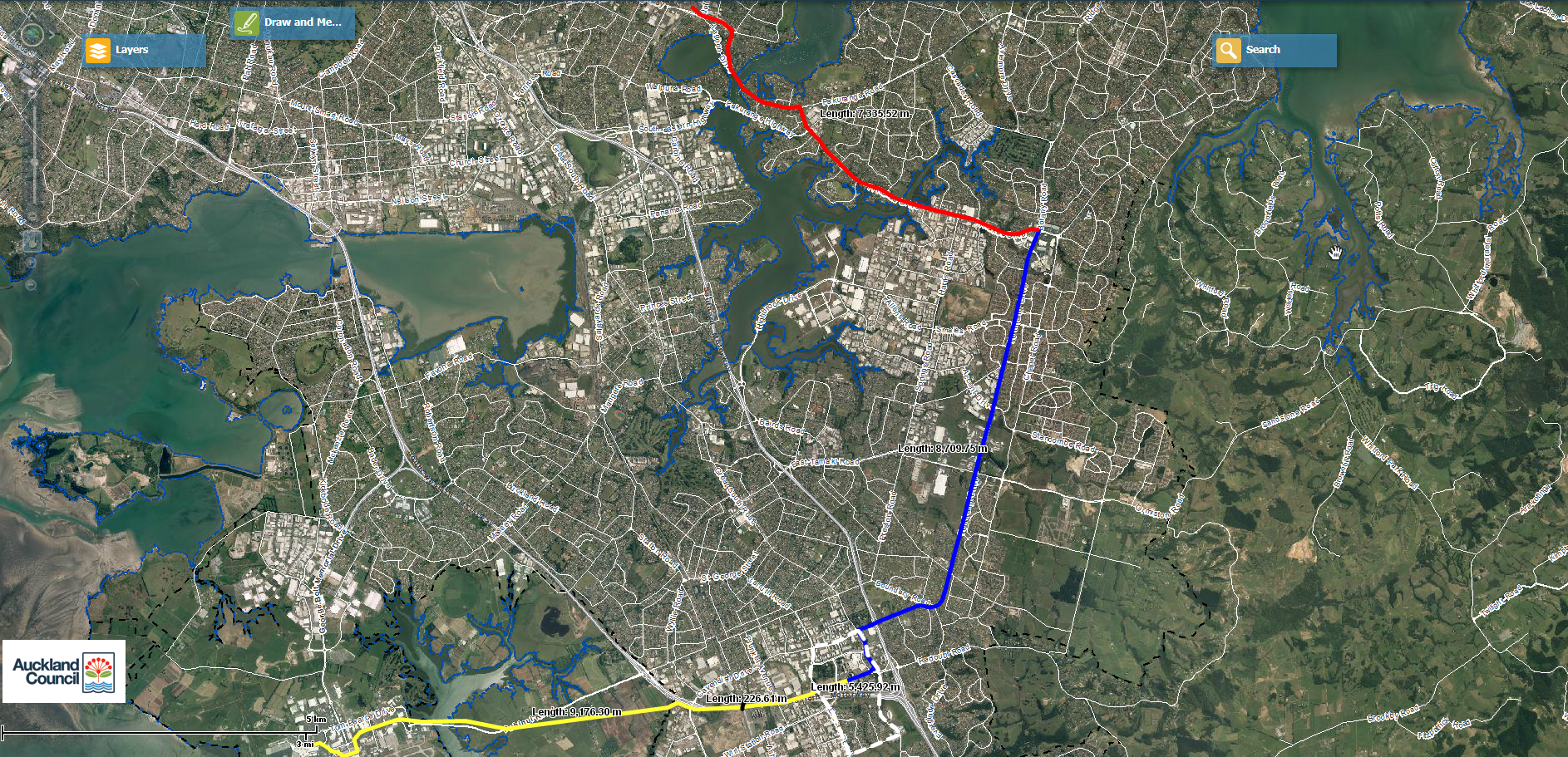
Now to get Part Two under-way. The Busway from Panmure Station to Pakuranga Town Centre. Parts Three and beyond would be extending that bus way to Botany and Manukau City Centre forming the South Eastern Bus-way. In due time it can be converted to rail to form the Botany Line (The Botany Line Sky Train)
This story gets more bizarre as the story rolls on each new day. We first are made somewhat aware in May when a high-profile Aucklander is granted name suppression on some charges brought by some public authority. Then we see the headlines of former Heart of the City CEO Alex Swney is up on 39 charges of tax evasion brought on by the IRD. Swney as a result has his contract terminated by HotC and the forensic accountants brought in to have a look. I was wondering when Council would react to the situation and hello we have this from Todd Niall of Radio NZ:
Updated 14 minutes ago – Todd Niall
The Auckland Council is moving to protect millions of dollar of ratepayers’ money after the head of the city’s downtown promotion agency was sacked over tax evasion charges.
Listen to more on Morning Report ( 1 min 56 sec )
Mr Swney has denied 39 charges of tax evasion. Inland Revenue alleges tax of almost $1.8 million was unpaid, and a further $1.3 million is owed in penalties and interest. Some charges involve allegedly fictitious invoices.
Firm requirements
Auckland Council chief executive Stephen Town has written a firmly-worded letter, requiring Heart of the City to confirm in writing that it has engaged forensic accountants to go through its books and to give a timeframe for that work and any other investigations.
He also wants details of the agency’s financial position and cash-flows and is seeking clear assurances about its management processes.
Mr Town said it has been told its future could be in question if it does not respond appropriately.
Coincidentally, the latest quarterly installment of $1 million of ratepayers’ money was transferred to Heart of the City the day before the council was notified of Mr Swney’s dismissal.
The council’s letter to the agency underlines its dependence on council support and concludes: “Council will be reviewing this matter formally, including Council’s rights under the Business Improvement District Policy, and Partnering Agreement, and implications for arrangements going forward.
…..
Source and full article: http://www.radionz.co.nz/news/regional/256481/financial-scrutiny-of-heart-of-the-city
May I nudge Council to widen the case a little bit more to restore confidence in the ratepayer after this high-profile incident. Call it an insurance policy after this saga as we don’t need any more surprises as other large projects come through the pipeline.
 Talking Southern Auckland