Still Missing a Planning Minister though Labour have been watching Auckland Council as the Council goes through the motions of setting up a new Council Controlled Organisation to … Continue reading Labour Wants Development Companies
Looking at all things planning.
Check the Sub Categories for more specific forms of planning
Still Missing a Planning Minister though Labour have been watching Auckland Council as the Council goes through the motions of setting up a new Council Controlled Organisation to … Continue reading Labour Wants Development Companies

32% Valuation Rise does not mean a 32% rates rise By now you would have seen the increased chatter around the new Council Valuations on property around Auckland … Continue reading Rates and your Council Vaulations [Updated]

Bringing the two projects together Over the last wee while I have been working on two Sketch Up projects at the southern end of the Manukau City Centre. They … Continue reading Manukau City Centre Southern End – Renewal
Because they do not look like they are being spent in Addison When I wrote the Updates on Takanini-Addison Area post I had a few questions come in about where the … Continue reading Where have the Development Contributions from Addison Gone?
Combined Letter Sent I saw this yesterday come across Twitter: https://twitter.com/HarveySpectre_/status/522945585679056896 I thought to myself what is this all about and so I opened the link which lead to … Continue reading Local Boards Fire Shot Over Mayor’s Bow

Also Council to consider setting up a new Council Controlled Organisation And so yesterday I gave the abridged version of my presentation to the Auckland Development Committee. The main … Continue reading The Reaction To My Presentation to the Auckland Development Committee [Updated with figures and links]
From Auckland Council
Cultural impact assessments: balance needed
“Protecting Auckland’s cultural heritage is a key part of Auckland Council’s job but so is making sure consent applicants don’t find themselves tied up in unnecessary red tape,“says Roger Blakeley, Auckland Council’s Chief Planning Officer.
“There is always a balance to be struck.”
Dr Blakeley was responding to public debate about the proposed Auckland Unitary Plan provisions concerning mana whenua including a public meeting tomorrow organised by the group Democracy Action.
He says the rules in the proposed Unitary Plan regarding sites of significance or value to mana whenua were brought in following feedback the council had received on the draft plan asking for more protection for cultural sites and places.
The Unitary Plan hearings process is now underway and the Independent Hearings Panel will review the rules as people have their say.
The Proposed Auckland Unitary Plan (PAUP) provides greater emphasis on the consideration of Mana Whenua values, establishing a framework for Auckland Council and Mana Whenua to work together.
It contains a range of provisions relating to Te Tiriti o Waitangi, intended to meet the council’s broad obligations under the Resource Management Act.
“In the meantime, we need to keep focusing on a balanced, workable approach. The ‘Cultural Impact Assessment’ that critics have been complaining about isn’t new – it’s been around for years.”
It is currently required in a very small number of cases where a property is near a site that is of value or significance to mana whenua and involves changes that could potentially impact those sites. This can include, for example, former burial sites or pa sites.
In the last six months, Auckland Council has processed over 6000 resource consents and less than 200 of them (3%) triggered a possible assessment. There have been 50 site visits and 12 cultural impact assessments formally requested in that time.
“As a council we’ve worked closely with iwi to find ways to minimise the impact on landowners and have introduced a facilitation service to simplify the process.
“This involves the council contacting iwi on behalf of the applicant, and the iwi will say whether an assessment is needed. Most people are taking advantage of the facilitation service.
“There is a misconception that these assessments involve some kind of veto from iwi. They don’t. They are about iwi providing expert advice. The council takes that expertise into account, but it is the council that makes the decision.
“While we continue working towards the right balance, it’s good to remember just how important protecting our Māori heritage is to Aucklanders – including recent arrivals who really embrace this aspect of their new home. It is our point of difference in the world. Like other global cities, we want to retain our heritage, as an important part of our culture and identity.”
—-Ends—-
Quoting again: In the last six months, Auckland Council has processed over 6000 resource consents and less than 200 of them (3%) triggered a possible assessment. There have been 50 site visits and 12 cultural impact assessments formally requested in that time.
After quite a few Memorandum for Counsel letters appearing (see: Developments from the Unitary Plan Hearings ) the Unitary Plan Independent Hearings Panel is working through things to simplify the processes.
From the Unitary Plan Independent Hearings Panel:
Help is at hand for submitters to the Auckland Unitary Plan hearings who are having difficulties understanding and navigating the hearings process.
The Independent Hearings Panel considering the more than 9500 submissions – and a further 3500 further submissions – says it’s important that the process encourages everyone to be involved.
One misconception is that submitters can only take part in the hearings process if they have legal counsel, expert witnesses and evidence.
The chair of the Independent Hearings Panel, Judge David Kirkpatrick, said this most definitely is not the case and while this was explained in documents on the Panel’s website, it needs to be highlighted.
“Some feedback is highlighting the complexity of the process and the difficulties some members of the public are having getting to grips with the key information so we are addressing that immediately,” said Judge Kirkpatrick.
“We want it to be as simple as possible for submitters to participate.
“The Unitary Plan process is big and complicated – it’s a complete review of the regional policy statement, four regional plans and seven district plans – but submitters can keep it relatively simple if they want to.”
Judge Kirkpatrick said Panel staff are:
This will all be available by the end of October.
The first Drop In clinic is at the Panel’s offices in central Auckland, another is being planned for Orewa and more will be organised around the region if there is demand.
The Panel may also consider holding a number of hearings outside of central Auckland and, possibly, outside normal working hours once more locally specific topics are being considered.
“It’s early days in a two-year process and as submitters get more used to the process and we make improvements, it will be much less daunting than some people have found it to be,” said Judge Kirkpatrick.
Panel staff are available to help submitters with questions and guidance through contact at info@aupihp.govt.nz or 09 979 5566
……….
This is a start. The Litmus Test will be the Regional Policy Statement, and the Rural Urban Boundary submissions working their way through the Hearings Panel now (where also the most anguish around the complexity of the Hearings process occurred as well).
I am not due to present and give my submission until next year.
From the Minister for the Environment – Dr Nick Smith
The Resource Management Act needs to explicitly recognise the importance of New Zealanders’ access to more affordable housing if the downward trend in home ownership over the past 20 years is to be reversed, Building and Housing, and Environment Minister Dr Nick Smith said today at the Property Council New Zealand’s Residential Development Summit in Auckland.
“The Resource Management Act must safeguard our natural environment but it is also a crucial piece of planning legislation. It forms the basis for the decisions that determine what we can do on our land. So it’s important we have a system that balances environmental protection with the wider needs of New Zealanders. We need a system which ensures that important environmental standards are maintained, but that which also enables growth and development – including a strong housing supply,” Dr Smith says.
“It is the price of land and sections that has gone up so rapidly in unaffordable housing markets like Auckland, and it is the Resource Management Act and how it is implemented that is largely responsible for this cost escalation. The new law allowing Special Housing Areas is a short-term fix but we must address the fundamental problem with the Resource Management Act if we are serious about long-term housing affordability.
“The vast bulk of consent processes under the Resource Management Act are about urban development, yet they barely rate a mention in the purposes and principles of the Act. This is why the Government is determined to make changes. We need to get everybody working in the resource management area from a policy, planning and consent perspective to understand how their decisions impact on young Kiwi families who aspire to own their own home.
“I welcome the challenge working as Building and Housing, and Environment Minister. No one Minister has previously been responsible for the full regulatory framework affecting housing, from subdivisions, building consenting to occupational regulation. This presents the opportunity to streamline how we develop new housing so as to increase housing supply and affordability.”
….
It will be interesting to see what comes about when the draft reforms list is finally released – most likely by Christmas if the Government is going full speed on this.
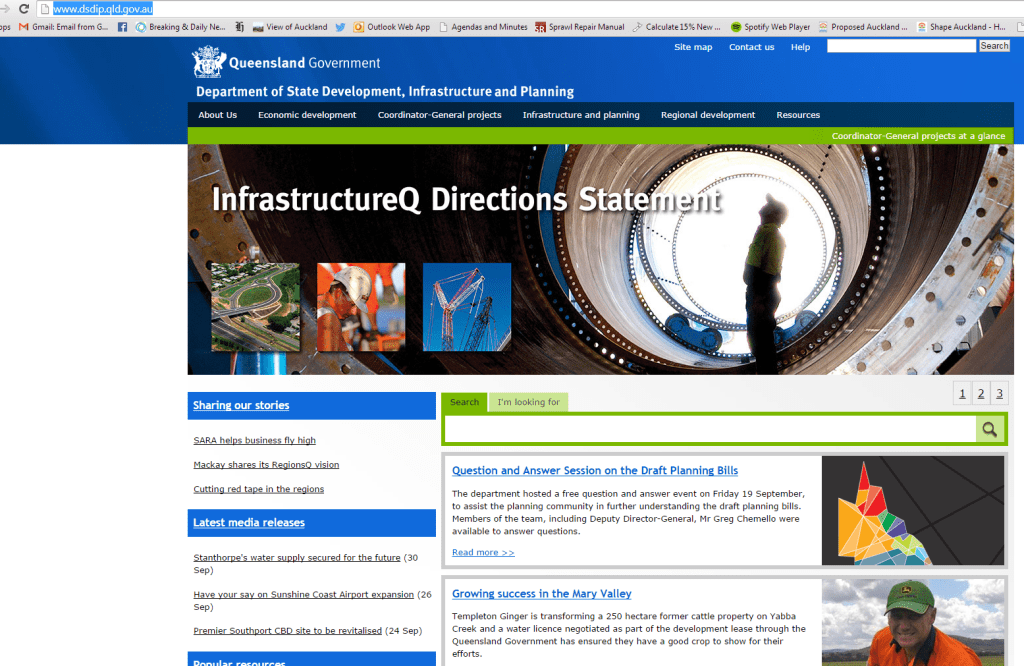
Still I wonder if we would have been better served if we had a Planning Minister: Queensland Gets It Right, Auckland Continues to Dither and Get it Wrong
Also the old issue of property rights is bound to crop as well: Property Rights and the Unitary Plan
So lets see what the reforms do truly give us….
For your reading Source: Auckland Council Tomorrow I give my presentation in the Public Input section of the Auckland Development Committee tomorrow at Town Hall. You can see the agenda … Continue reading Presentation for October Auckland Development Committee Up
 Talking Southern Auckland