Category: Planning

Looking at all things planning.
Check the Sub Categories for more specific forms of planning

Developments from the Unitary Plan Hearings

Contention around access to resources for Community Groups


I have seen this from Local Board Chair Peter Haynes in regards to a motion Councillor Cathy Casey put forward at the Unitary Plan Committee today:

At the open meeting of the Council’s Unitary Plan Committee. Cathy Casey moved for a report to prolong the hearings process to assist community groups faced with a very unequal battle against major developers such as Eden Park. I urged the Governing Body to give serious consideration to resourcing certain community groups to engage expert witnesses. My colleague from Orakei, Desley Simpson also spoke about the difficulties the convoluted hearings process pose for such groups. Sadly, Cathy’s motion was lost on Alf Filipaina’s casting vote.

I have noted from a couple of Procedural Minutes from the Independent Hearing Panel for the Unitary Plan as well as the Committee Agenda (see: website down so will get the link when it is back up) that the Council nor the Hearings Panel are particular interested in making resources available to submitting groups so that they can front the Hearings Panel better equipped. Furthermore the Minister for the Environment has refused access to those resources as well.


It definitely seems so after my previous Unitary Plan Hearings Already Into Trouble? first pointed it out.


AMETI Part One – Walking/Cycling Day

Your Chance to Walk AMETI Part One before it opens


From Voxy

Walk or cycle Auckland’s new road and tunnel at Panmure

Auckland’s newest road is expected to take thousands of trucks a day off Panmure roads when it opens to traffic in early November.

Auckland Transport will open the 1.5km Te Horeta Rd in Panmure to traffic on Sunday 2 November. The road goes through a 220m tunnel, has new cycle lanes and a shared cycle and foot path alongside, which will all open at the same time.

A community event will be held on Saturday 1 November so people in the area can walk or cycle through the tunnel, along the road and on the shared path.

Completing the new road is the final major milestone for the $180m first stage of the Auckland Manukau Eastern Transport Initiative (AMETI). It also included building the new Panmure Station, three new bridges and new cycling and walking links.

AMETI is a group of projects aimed at giving people in the south-eastern suburbs improved transport choices and better connections to the rest of Auckland. See an aerial video and photos of the new road, station and other upgrades here: at.govt.nz/projects-roadworks/ameti/.

Auckland Transport Chairman, Dr Lester Levy says completing the first stage of AMETI will be an important milestone for transport improvements in the area.

“People in the area are beginning to realise the benefits of the longer term programme of improvements for the south east. It is also one of the first major transport infrastructure projects to be completed by Auckland Transport since the new Auckland Council was established.”

AMETI Programme Director, Peter King says the new road is expected to carry 20,000 vehicles a day, including 2400 trucks.

“Te Horeta Road will link Morrin Rd to Mt Wellington Highway to cut peak journey times between Mt Wellington and Glen Innes.The direct link will bypass the Panmure roundabout and Ellerslie-Panmure Highway, easing congestion on this route.

…..

Full details, article and source: http://www.voxy.co.nz/national/walk-or-cycle-aucklands-new-road-and-tunnel-panmure/5/204559


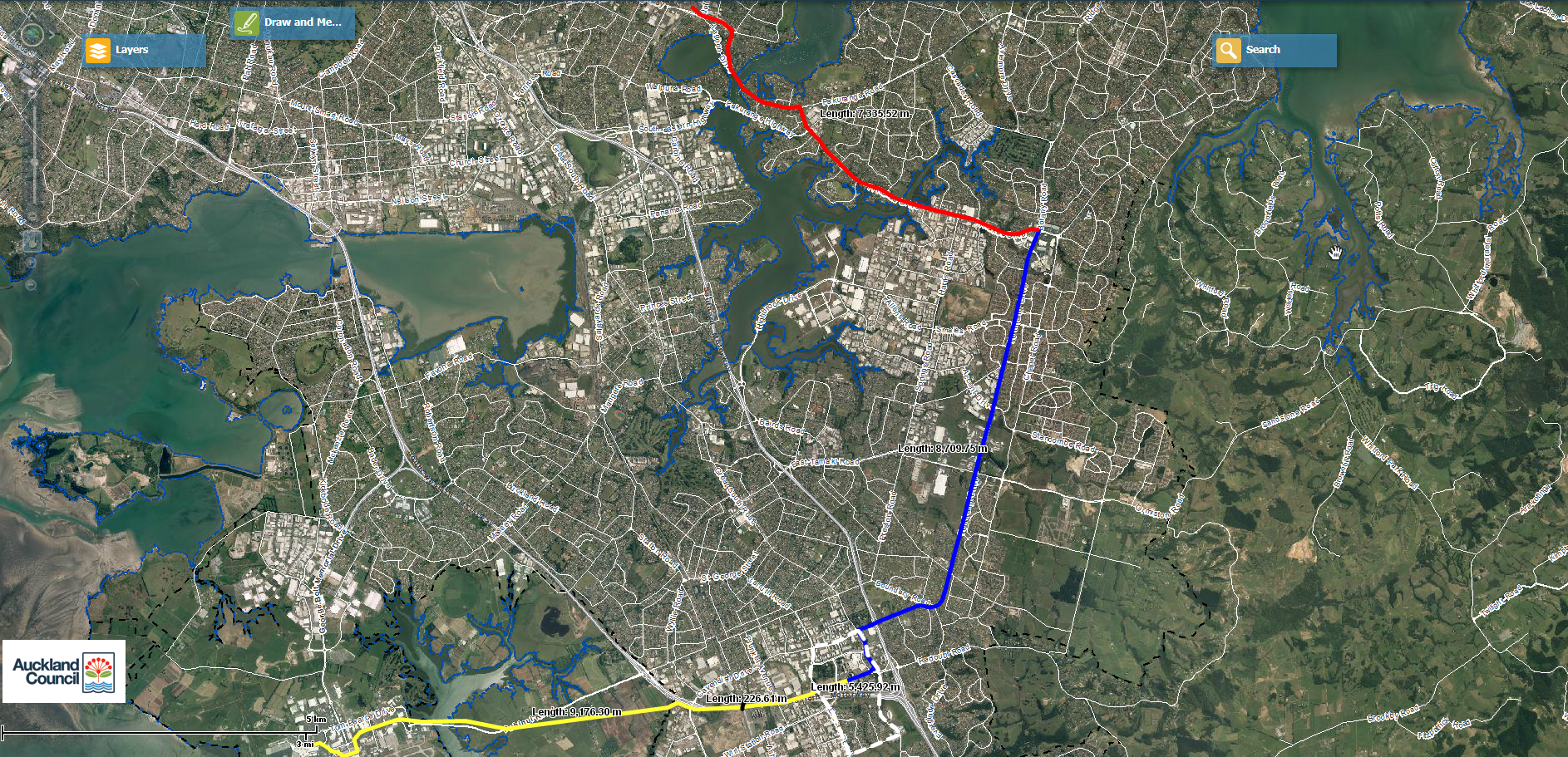
Now to get Part Two under-way. The Busway from Panmure Station to Pakuranga Town Centre. Parts Three and beyond would be extending that bus way to Botany and Manukau City Centre forming the South Eastern Bus-way. In due time it can be converted to rail to form the Botany Line (The Botany Line Sky Train)

The Botany Line Sky Train Route


School Safety on the Cards

NZTA and Auckland Transport Streamline Funding Processes


From NZTA (and Auckland Transport)

School safety benefits from streamlined funding process

9 Oct 2014 08:38am | NZ Transport Agency: Auckland and Northland

Projects to improve safety around several schools in Auckland are being fast-tracked through a new streamlined funding process developed between the NZ Transport Agency (NZTA) and Auckland Transport (AT).

The projects are part of AT’s Safety Around Schools initiative, which is primarily focused on 20 high risk schools located in Otahuhu, Mangere, Otara, and the eastern suburbs of Manukau from Howick to Botany Downs.   They include the installation of pedestrian crossings and refugee islands, 40kph school zone speed limit signage, and cycle lanes.

Total cost of the projects is $4.5m.  The Transport Agency is covering $2.4 million of the cost (53%), and AT the remainder.

In the past, both AT and the Transport Agency would review and approve funding applications.  Under the streamlined process introduced earlier this year, AT can review and approve funding applications for projects under $5m using the Transport Agency’s funding criteria.

“It means that funding can be delivered more quickly than in the past,” says the Transport Agency Planning and Investment Manager Coralie O’Brien. “Helping improve safety for children around schools is a very positive example of how the simplified process works.”

AT’s Community and Road Safety Manager, Karen Hay, says the Safety Around Schools initiative also aims to reduce morning congestion by encouraging people to walk and cycle and use public transport as an alternative to the car.

“This is having a significant impact on congestion and pollution. Initiatives have reduced the number of cars delivering students to school by 12,000 during each morning rush hour.  That equates to 2.4 million trips saved every year without even counting the trips saved in the afternoons.”

AT is also investigating further safety initiatives for schools in central Auckland, and in the west and north of the city.
One of the Transport Agency’s roles is to provide funds from its National Land Transport Programme to help councils and their organisations deliver a range of public transport, roading and cycling and walking projects for their communities.

Transport Agency funds are gathered from excise duties on fuel, road user charges and vehicle registration fees and re-invested in transport-related projects like AT’s Safety Around Schools initiative.
———

Source: NZTA website


Good to see this happening. That said I have not forgotten about the Southern Motorway upgrades including the Takanini Interchange upgrade which caused some concerns around lack of bus lanes in the given area. I am waiting for the next phase of the development to be complete to see what comes up before firing any relevant questions off again – to Auckland Transport.


NZPI In Denial?

Yeah… But English also cheap shot-ting as well


I saw this presser from the New Zealand Planning Institute:

Urban planning not to blame for inequality

Regardless of whether the government accepts or rejects a growing gap in equality within New Zealand, it has agreed that there are a variety of national and international issues that cause inequality, including finance and tax policy, under and un-employment, the pressure of foreign investment etc.

NZPI is therefore surprised and disappointed at Minister Bill English’s recent comment that the single biggest contributor to the gap between the haves and have nots is ‘urban planning processes’.  This view is unsupported in any publicly available government report on inequality within New Zealand. On the contrary, the evidence available suggests that urban planning processes play a negligible part in housing affordability which is now being inextricably linked with inequality.
The regions of New Zealand face quite different pressures.

Land availability and housing affordability are not typically problems that face provincial New Zealand and yet poverty is very evident in our provinces. Local planning policy is one contributor to housing affordability but certainly not the main one. The relative inability to build at scale, relative high cost of building materials, land banking, tax structure, interest rates, profiteering and sentiment towards residential property as an asset class in general have a huge role in housing affordability.

NZPI waits with interest to hear of the Government’s proposed changes to the RMA, the legislation that sets the context for all planning policies in NZ.

Ends.

……..

A fellow Tweeter did say the NZPI is in a bit of self denial and that Bill English did certainly fire a cheap shot after sitting on his hands for the last six years when he could have been a tad more productive then and now.

The inability to build at scale, and land banking are both direct consequences of actual planning policy and regulation. Thus I would also argue those two issues are two of the three biggest issues around the housing situation (the other being the NIMBY – Consenting (so development controls)).

Not rather pleased with NZPI in light of that presser…