AT Asks For Money FOR THE WRONG PROJECT… Yesterday I had mentioned my presentation and the results from that presentation to Auckland Transport yesterday: Returned from RPTP Panel … Continue reading Auckland Transport Has a Moment
AT Asks For Money FOR THE WRONG PROJECT… Yesterday I had mentioned my presentation and the results from that presentation to Auckland Transport yesterday: Returned from RPTP Panel … Continue reading Auckland Transport Has a Moment
Yesterday buried at the bottom of my Annual Plan post I had a chart on rates movements for the 2013/2014 Council financial year per Local Board area. I thought I might repost it here along with the percentages of the movements on rates increases and decreased spread over the Auckland Area to see how many got an increase, and how many got a decrease – so lets take a look:
I’ll let you figure out if the majority are facing increases or decreases – and by how much 😉
Draft Unitary Plan Has a Date WITH THE SHREDDER – IF I HAD MY WAY! Deputy Mayor and in-charge of overseeing the development of The Unitary Plan – Penny Hulse … Continue reading Draft Unitary Plan Nearly Ready
Auckland Council have called for submissions to the Draft 2013/2014 Annual Plan – the main budgetary document for Auckland Council for the next 12 months. All revenue and expected expenses (including capital outlay for proposed capital projects) over this twelve month period are laid out in the Annual Plan documents which I shall link and embed below.
I am still working through the Draft Annual Plan at the moment before compiling a submission (submissions close 4pm – 25 February 2013) but will upload my submission to BR:AKL as soon as it is done.
It is of note that Council has asked for our feedback via the submissions on the “Regional Facilities Auckland grant towards development of the TelstraClear Pacific Events Centre” – which is building this White Water Rafting Facility at a cost to the ratepayer of $32m as well as taking on some financial risk if the project fails. In order for this development to happen (and as stated in the Draft Annual Plan) there will have to be an amendment to the 2012-2022 Long Term Plan which is already in operation. This would be because this particular development is calling on for extra funds made outside what has been allocated already in the existing and current Long Term Plan.
As a result I will be submitting in strong opposition to this as it creates precedent for every other Tom, Dick and Harry project with dubious actual economic merit to come before Council and thus allowing an existing LTP to be butchered to cater for it – when if needed, it should be kicked over to the next Long Term Plan which is the 2015-2025 LTP.
This is not how we budget for things anywhere – and I expect Council to follow the same standard. Besides I can think of better used to go and sink $32m such as cleaning up Otara Creek which is a toxic site or to our struggling Local Boards to fund local community facilities or events.
However I will run further commentary on this as I draw up my submission
In the mean time some links and documents
Draft annual plan 2013/2014 – Home Page
Draft annual plan 2013/2014 – Documents
Draft annual plan 2013/2014 – Key topics and events
Draft annual plan 2013/2014 – Draft Annual Plan 2013/2014: Have your say
VolumeOne of the Draft Annual Plan
Volume Two of the Draft Annual Plan
Volume Three of the Draft Annual Plan
(Yep another rates decrease coming my way)
Central Government last year passed the Sale and Supply Alcohol Act which gives Council and Local Board increased authority and delegation on how alcohol (a demerit good) is sold and supplied in local communities.
Councillor George Wood has been made chairman of a working party (as noted in his Facebook status below) of members Auckland Council and Local Board to begin the slow and long process in getting ready to set up a Local Alcohol Policy or LAP:
George Wood shared a link.
Auckland Council starts long process to prepare local alcohol policy. I’m chairman of the working party along w/ 7 Crs and 7 LB members.
George also Scribd‘ed a fact sheet on Part One in developing such a LAP:
So as alluded to Part One is developing a Draft Local Alcohol Policy before step two kicks off which is: consultation
BR:AKL will keep an eye on Councillor Wood’s working party as it begins drawing up a Draft LAP and see where this new direction in alcohol policy goes for Auckland and its Local Boards
And I bet we are all sick of the Housing Affordability Debate swinging from one extreme to the other and back again; both at central and local government levels, both by the centre-left (social authoritarian section) and centre-right (neo-conservatism). The conservatives from both sides of the political spectrum are basically bashing each over the heads trying to score “up-man” points on one another with housing, yet really don’t offer what WE really want in housing (it is what THEY want in housing and telling US how and where to live). Interestingly Social Liberals (from the left), Neo Liberals (centre right) and even the libertarians (down the bottom of the political compass) have gone extremely quiet on housing and urban land use policy.
This is rather a shame as the liberals could very well offer some viable alternatives that we (the residents and businesses) could be very well-looking for. You know “US” making our own choices and working in a collaborative manner and shape OUR CITY, OUR WAY (not the Government (Local and Central’s) way). Now before I post the “redux” on a social liberal‘s view for “housing” just a quick differentiation between how a social liberal and neo liberal would achieve similar goals.
What Social and Neo Libs share the same in housing:
What Social and Neo Libs do not share the same in housing:
As for the “Redux” here it is; my social liberal (and well read) Submission to the (then) Draft Auckland Plan where extensive mention of land use was made out:
Unfortunately though despite the hearings and constant lobbying, this extensive submission gathers (digital and actual) dust sitting in the draw. So while the conservatives bludgeon each other and boring us with no actual solutions, this liberal document waits for some brave political soul to bring it into the light and see it through in execution.
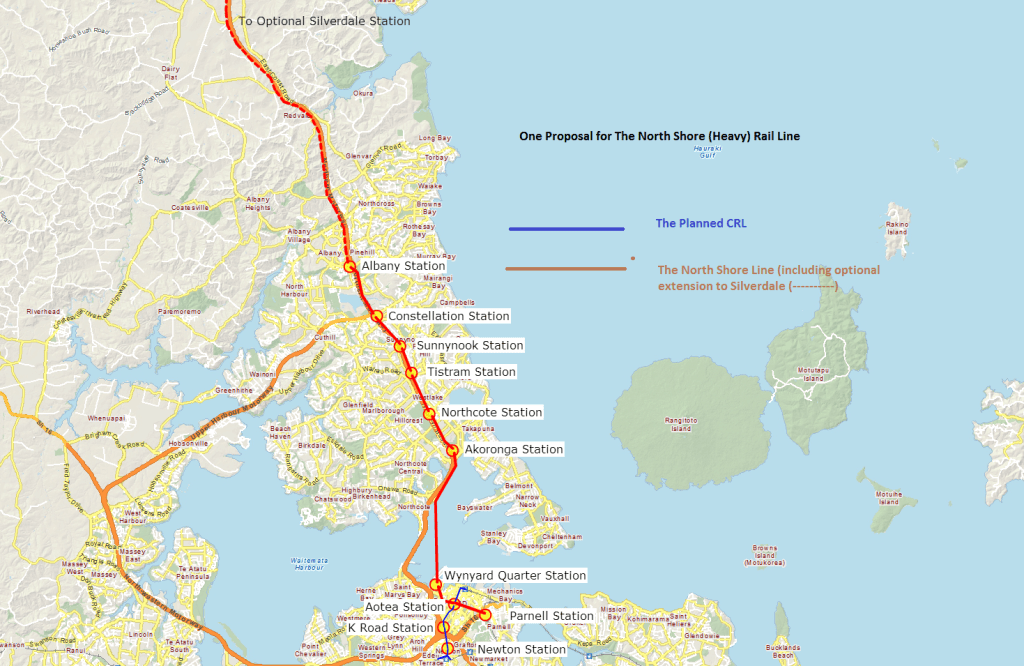
Is the CRL Future Proofed for The North Shore Line? Last week Auckland Transport released the long-awaited Notice of Requirement for the City Rail Link (CRL) and opened the … Continue reading A Question for the CRL
The Herald ran a rather academic story on transport this morning and its relationship with the human body. To be honest the article is rather heavy for this time of year and looks like something err geeky from the blog next door. You can see the Herald article in the link below:
We hold the key to better transport
Some forms of getting from A to B are badly affecting the health of humans.
Incorporating the human body into transport design and planning could save millions.
We demand and expect our transport systems to get us where we want, when we want to be there, and as fast as possible. We are, however, human beings. And as with any other built system, we have to ask whether our fast and efficient modes of travel are necessarily always good for us.
And it goes on…
However when it came to solutions, yes they are under way but with Auckland‘s case it has a long way to go:
From the same article
…
For all the human health impacts of the modern transport system, there are obviously substantial benefits in the form of greater economic productivity, vastly increased spatial access and mobility, and even health gains, such as increased ability to get preventive and other medical care.
All technology imposes health risks of some sort. So a purely negative focus on these is unhelpful. Nonetheless, it’s useful to ask whether our transport technologies, policies and investments are good for us. If not, we need to adjust and redesign our transport accordingly.
Positive changes, many of which are currently underway, include:
- A greater focus on redesigning congested urban spaces to encourage walking and social interaction and to lower automobile use and speeds. This could achieve many health and safety outcomes simultaneously.
- Traffic calming – a range of techniques ranging from speed humps to pedestrian malls which create attractive active transport environments.
- Road pricing and increasing parking fees, or eliminating parking altogether to encourage public transport use and walking.
- The expansion of bike-share schemes, where public bicycles can be rented and dropped off from multiple locations.
- Further safety improvements to automobile safety design for new car models.
- Prioritising action on “black spots” on roads and highway “geometrics”, which includes improving lines of sight at intersections and around curves.
These reforms need not involve costly or radical overhaul. Road safety used to be a neglected policy; small but significant changes there have saved millions of lives. A broader incorporation of the human body into transport design and planning could save millions more.
Urban design and continued evolution of vehicle mechanics will go someway in addressing a more integrated system where transport and urban design are interwoven rather than treated separately as they are now. However the chicken and egg analogy comes up for the point I highlighted in bold: Road pricing and increasing parking fees, or eliminating parking altogether to encourage public transport use and walking.
It is a case of do we slap on road pricing and increased parking fee measurements to build an adequate mass transit system that people would take as first choice rather than a forced choice (as of current), or do we build the mass transit system and get that running up first before slapping in the road pricing measures. It is actually a tough question and one who would have to provide a very good justification to the tax paying public no matter which of the two options they take.
But sadly Auckland seems to be in a bit of bother at the moment with is road and (in this particular case) mass transit systems. Take this article piece from the Herald (the post I have on it is sitting on ice at the moment):
Experts called in to fix rail slump
5:30 AM Friday Dec 21, 2012Auckland Transport is resorting to professional help for a strategy on how to stop losing patronage from trains and buses. Chief operations officer Greg Edmonds has promised to provide his board with a plan early next year on how to staunch bleeding which saw a 17.2 per cent decline in train boardings last month compared with the previous November. That followed concern raised by Auckland Council transport leader Mike Lee, which was acknowledged by new board chairman Lester Levy, about a need to lift service performance. Mr Lee said patronage, which was boosted last year by the Rugby World Cup, started “flat-lining” in March and the organisation was starting to see a distinctive downward trajectory. “I don’t think this is sustainable without Auckland Transport intervening in a decisive way,” he said. “One of the measures of quality is punctuality or train performance and, while the price of our services is high, quality tends to be poor consistently.”
…
Mr Lee said the board, on which he is a council appointee, had been assured a new timetable would improve rail performance and that the rollout of the new Hop transport card on trains would combat fare evasion. But the board heard that train punctuality deteriorated last month to 84.1 per cent of services running to schedule, compared with 87.1 per cent in October, and he said rail staff were having difficulties stopping free-riding passengers. He had been told of fare evasion as some people were presenting their Hop cards to train staff to avoid paying their way. This did not apply to Britomart or Newmarket, which have become gated stations. “Busy, harassed train managers trying to collect fares are shown a Hop card and they move on,” he said. “The person may have paid $5 [in a since-expired half-price opening deal] for a card and, according to rail staff, they are using it to evade fares. “There are electronic checkers but they are slow and cumbersome and there’s not enough of them.” Dr Levy said he agreed there was a need for “critical measures” to be adopted and Auckland Transport needed to be far more customer-led in creating a demand for its services. “From the board’s point of view, this won’t go away – it’s the number one issue,” he said.
I think at this rate Auckland will be some way off before coming to the Chicken and Egg question on new infrastructure (which is where the point in bold above comes in) when we can’t even get the basics right on existing infrastructure.
Another blog ran a post on who will be mayor and who will be our councillors that make up the next Auckland Council after we post our ballots next year for the Local Government Elections.
I was searching through my posts from this year and found past commentary on my take of the Local Government Elections next year and found that; “yep – we are still heading down that path.”
So for a recap on 2013, I shall link my 2013 articles here as an easy reference for your holiday thinking:
Quite comprehensive isn’t it? And the coverage of 2013 – Your City – Your Call will start in earnest next month especially as I ramp up my campaign for Papakura Local Board next year.
And oh, Communities and Residents (C&R) must be have a strategy session over the break if they want to achieve that 6-seat swing in Council to regain control…
Fun times ahead for all – indeed 😮
Recently I had filed a Local Government Official Information and Meetings Act request to Auckland Council over the business case for the now Auckland Transport owned and operated Manukau City Centre Public Car Parking Building:
Time for a Local Government Official Information and Meetings Act Request
It is time to file another Local Government Official Information and Meetings Act request to the Auckland Council. This time the LGOIMA request will be on the recently opened Auckland Transport public car park building in Manukau which I reported on this morning. The request I will be filing will be for the originalbusiness case presented to the former Manukau City Council (under Mayor Len Brown) on this $14m building before it was carried over as a legacy project by today’s Auckland Council.
I am curious to what the business case was for this parking building in trying to understand why the former Manukau City Council went ahead with this project and possibly why Auckland Council did not stop it.
I’ll be keeping the readers up to date on the request – whether it is accepted or rejected by Council officials.
But in any case it is time to take a peek and what was the methodology behind the construction of this parking building in Manukau City Centre!
And so the information requested has come in today and is posted (as four attachments) below.
This is the revised version
Now I am still reading the documents, but on first glance I think we have just been sold down the road initially with this building if we do not get any more high density development around Manukau soon (the Manukau South Rail Link adds another dynamic to the mix as well).
However check this out from AT’s website in the Ronwood Avenue Parking Building:
Ronwood Avenue car park
Last reviewed: 10/12/2012 11:55 a.m.Car park location: Corner Ronwood and Davies Avenue, Manukau – entrance from Ronwood Avenue
Parking description: Multi-storey parking facility with a Vehicle Height Clearance of 2.1m. Eight levels with 676 spaces.
Car park features:
- System for quick and easy parking (space availability signage by level)
- Well lit
- Clean and tidy
- CCTV cameras that link through to a central control room monitored by security personnel.
Contact us about this car parking facility, or if you require immediate assistance in the car park building, press the blue “assistance” button located on the payment machines.
Hours | Tariffs | Lease Parking | Debit Card | Parking Vouchers | Ways to Pay |
Day of the week Opens Closes Monday to Friday 6.00am 9.00pm Saturdays, Sundays and public holidays Closed Note: Customers can park their cars in the building for 24 hours or longer, but can only exit before the last exit or opening times. See Other Parking rates to work out the cost of leaving your car overnight. For example, should you park your car in the building after 5pm on Friday night, and remove it on Monday morning at 6am, you will pay the $5 evening rate for each night it is in the building ($15 in total).
Tariffs
The following tariffs are a guideline only and subject to change. Refer to the schedule of fees at the car park entry.
Casual parking (Monday – Friday)
Casual parking 0 – 1 hour $1 1 – 2 hours $2.00 2 – 3 hours $3.00 3 – 4 hours $4.00 4 – 5 hours $5.00 Max daily rate $6.00 * Lost ticket fee $40.00 * If customer loses their parking ticket, an instant $40.00 fee will be charged to be released from the car park.
Other Parking
Other parking Tariff Times & Conditions Early bird parking $4.00 Weekdays only Enter and pay before 9.30am
Availability during this time is on a first come basis until full
Levels 1 and 2 only
Evening rate $5.00 Enter after 5.00pm – valid until 6.00am (following morning) One entry, one exit
Pay at the machine
Lease Parking Monthly lease deals (incl. GST)
See application forms for lease parking
Concession $150.00
Level 3 No reserved allocated space -“first come – first served”
Global concession $360.00
Reserved allocated (undercover) $250.00
Level G Reserved allocated (external) $160.00
Level G Reserved unallocated $200.00
Level 4 Debit card Coded for denominations $20.00 to $200.00. Rechargeable.
Contact us for more information Parking vouchers See casual rates above Available in 1,2,3 hour; half or full day periods, parking vouchers are used at the pay machine together with the entry ticket. Request via fax or contact us
Ways to pay Automatic payment machines can take Visa, Mastercard, Diners card and EFTPOS payments, as well as cash. Help is only a button push away if required.
* If customer loses their parking ticket, an instant $40.00 fee will be charged to be released from the car park.
So what methodology was used? Love to seriously know
And I would really love to know how the diminished operating hours and parking tariffs compared to the original and revised Business Case studies are meant to assist in paying off the building as well as building a “sustainable” positive cash flow for Auckland Transport and Auckland Council. Now remember the parking building’s parking tariffs have already been slashed to these current levels to match or even underpin the All Day Park and Display street parking around Manukau. Even then that has not enticed people off the street and into the building (and it wouldn’t for me either).
I also have to ask, it is packed at Westfield Manukau Mall with Christmas shoppers and will be this weekend. Have AT even thought of opening the building this weekend to catch the overflow – you know a win-win for AT and Westfield? Probably not. So while you the shopper go round and around looking for a park, you have a perfectly empty dead parking building just sitting there – NICE ONE AUCKLAND TRANSPORT!
Why does Cabbage Boat come to mind here folks.
More in this business case later.
 Talking Southern Auckland