I noted yesterday that Councillor Cameron Brewer (surprise – surprise) released an “opinion” on the public losing interest with Auckland Council. The actual question is ‘has the public actually lost interest?’ I would say no and even Radio new Zealand’s Todd Niall would say no in his written correspondence earlier this week.
Lets take a look at what Councillor Brewer is saying this time.
The second term Auckland Council is proving to be an interesting one and very different to the inaugural 2010 – 2013 Governing Body.
We are currently going through a budget round to lock in where council’s $3b expenditure is directed for the forthcoming 2014/15 financial year.
This year we had fewer than 2,000 written submissions from the public on our Draft Annual Plan with only a few dozen turning up to speak to their submissions. The Mayor takes this as a vote of confidence in the council, but I take a different view.
My view is that the public interest in this council is at an all-time low because Aucklanders are increasingly of the view that this term is a bit of a lost cause, a bit of a political basket case. The Mayor has hung on to his political career but has lost a lot of political capital. Whatever your view on that, this is bad for Auckland.
….
Todd Niall and myself have already commented on the low Annual Plan submission count and why it was that low. You can see my own commentary behind to low submission count (which includes extract’s from Todd’s analysis) here: “Todd Niall Hits the Budget Nail on its Head.”
From that commentary piece:
To be honest I can see why both the Annual Plan submission count is very low and how most submissions were pertaining to local rather than regional issues. For the low submission count the Annual Plan submissions were called for during the final weeks of the massive Unitary Plan submission period. With limited time and resources available a conscious call might have been made on which of the two submissions you would pick to get done. Is it the Annual Plan or is it the Unitary Plan? I made such a conscious decision and chose the Unitary Plan over the Annual Plan to dedicate my submission time to – so as a result no submission from me on the Annual Plan this round.
What also factored into not doing an Annual Plan submission this round was the knowledge knowing the 2015-2025 Long Term Plan (the main Council budget document) is coming up for debate soon. Something again Todd Niall points out…
…
Maybe that’s why Aucklanders have turned out in such low numbers to have their say on this year’s annual plan. They know that far bigger debates lie ahead.
Again I would say that is why the submission count is low not because we have lost interest but rather we had the Unitary Plan at the same time as well as knowing those bigger more important debates ahead (like the Long Term Plan).
The Unitary Plan submission count (at 8,900 as of the beginning of the month) I would say is a testimony to Auckland paying interest into what Council is doing. Of course we have the next Unitary Plan submission round late next month where anyone can submit on the points previously made (so no new material). Also if you are like me you are taking a break between all these big submission and consultation periods unless you want to burn yourself out from it all.
Continuing from Voxy
The lack of interest and coverage shows that the public and media have effectively given up on this term, with 2016 set to be a watershed election.
One thing’s for sure the third term will be just as different again with a new Mayor and many new councillors after a whole new public mandate and direction sought and secured.
….
Be very careful what you wish for Councillor. I can assure you the public and media (both Main Stream, and Social) have certainly not given up on this term. That said I do believe and agree that the third term will be quite different with new Councillors including a possible replacement for Orakei Ward too 😉 .
Finally:
In the meantime all councillors are committed to making a difference. For me it means keeping the Mayor accountable and focusing on the likes of fighting for lower rates increases and pushing for more sustainable debt levels. I will also continue to advocate for regional funding for projects in the Orakei ward area.
….
Groan…
Local Boards I thought would be the best advocates for getting funding for projects in their local area while ward Councillors are meant to be focusing on the big picture regional stuff. Or did Cameron not read this: Slow News Day. We Have the Bigger Picture to Focus On
Oh well I suppose the above was expected from Councillor Brewer.
In the mean time this storm outside is causing enough havoc as is – although I still have mains power in Papakura for now
Stay safe out there folks and keep listening to updates from Civil Defence please.
Councillor Cameron Brewer made an off-hand remark to New Zealand Herald’s Bernard Orsman about how the special one-off Auckland International Airport Dividend of $101 million should be used to restore berm mowing to areas of the Isthmus that had it before the Super City came into existence.
Residents who can’t cut the grass, or refuse to, will get a trim but contractors can wait until it is 20cm high.
…
Orakei councillor Cameron Brewer said he planned an amendment for the proper reinstatement of berm mowing, which could be funded from a special $101 million dividend from Auckland Airport, or internal savings.
It is one of the few times condemnation from both the Centre Left and Right were rather swift against Councillor Brewer for mentioned that a dividend would be used for a OPEX rather than CAPEX line (Opex means Operational Budget for Day to Day running of the Council, CAPEX is your Capital Expenditure – that is investment into things like infrastructure).
That $101 million would be best set for infrastructure like say some cycle ways, the St Johns Station, maybe the Manukau South Rail Link and some grade separation of our dangerous rail crossings, perhaps some storm-water infrastructure or paying down some debt which actually is not a bad suggestion from Councillor George Wood.
But to pay for OPEX expenses like berms for a few on the Isthmus? I think not.
Look the solution is dead simple for the berm situation.
I recommend that the issue be sent to the Local Boards for their final decision. That is if the respective Local Board would like berm mowing for their residential areas then they would have the chance to:
Pass a targeted rate for the service as two Local Boards did for universal free-swimming pools (rather than the Auckland-wide policy of free for under-16’s)
Have the opportunity to tender the service out to either:
Auckland Council’s Park Services main contractor
Auckland Transport’s berm contractor
Local private sector contractor
If I was to say the Papakura Local Board and was going to charge a targeted rate for berm mowing for the area I would tender the service out to a local firm in the area (if possible). This means a local business with local area knowledge has the chance of providing a service to the community of Papakura and providing employment to the local area. More local employment means more spending and more investment in the area. I call that a Win-win-win-major win if this was able to occur.
So lets kick this issue of berm mowing to the goal line once and for all and hand it over to the Local Boards to decide rather than the main Governing Body.
As for the Isthmus and their berms I found this rather telling from a comment on Cameron Brewer’s public Facebook remark on the issue (note Cameron did not write this comment but a ratepayer of Auckland did):
We drove to the airport back in October and went through Gillies Ave and Manukau Rd. Those who had not mown their berms in the upmarket area should be ashamed of themselves. The neighbours would be really annoyed with them. As we drove through the not so affluent area all the berms were mowed nice and tidily (bar one that had construction activity in the adjacent section). I would be mowing the neighbour’s unmown berm myself because it affects your own place. And most of the houses bedside the umown berms had lovely tidy mown lawns.
And I can vouch for that the numerous times I have travelled through the Isthmus. That said the commenter and myself are not painting our affluent areas all with the same tar brush as there are some who do mow their berms and look after them. What was telling though was where however, most of the issues were coming from on the Isthmus. Also at the same time there are those on the Isthmus who have converted their berms to gardens of different varieties. This should be encouraged rather than punished as it does add spice and “colour” to Auckland.
I think this picture from the Sydney Morning Herald piece on ‘Resident Groups’ was rather apt when I saw it:
Illustration: Simon Bosch
The Dog-eat-Dog situation that can erupt (and did) when it comes to planning – especially large-scale planning like the Unitary Plan (and soon Area Plans).
From the SMH on the Dog-Eat-Dog World that is Associations and Planning
Sydney Morning Herald columnist, author, architecture critic and essayist
Residents groups are relentless in their demands for more ”consultation” – by which they really mean the right to insist on their own views.
Moody morning. Bruised sky. Feels like the morning after. I’m walking the dog but the ambience is more hair of the dog.
I’m thinking about this habitat we make. This lovely, mazy, fecund, fetid city and the extraordinary dogfight we’re having over it. I’m thinking about how we’ve bashed the bejesus out of planning. Literally.
A relentless and emotive campaign for your own interest is not consultation. It’s lobbying.
Of all disciplines, planning demands a God’s-eye point of view. It needs to grasp the big swirling patterns we make, how they smell and feel up close and how they ramify through the aeons. It’s a job for a sage, or a prophet. But we go at it like crazed pygmies.
“Hey, Sis!” someone calls. I love that. In my neighbourhood only Aboriginal people call you Sis. I love how it makes you feel part of the gang – although, frankly, it’s not a gang to which many people aspire and, even more frankly, you know they probably just want money.
This skinny kid is no exception. “Hey, Sis! Ya got 30 cents for a phone call?” I say no, which is true. Walking the dog, who carries cash?
Then I think, 30 cents? I’m worrying about my Wi-Fi speed and the ratbag who refuses to fix my dishwasher and how on earth you’re supposed to have a million bucks worth of super if you didn’t even get onto it until, like, last week. And this boy hasn’t got a phone? Even a landline?
So I track back and offer my iPhone. True, I remove the credit card, but that’s my bad. The boy doesn’t do a runner. He makes the call, two calls, and it’s fine. Except it makes me cry a little because, what can you do?
I’ve lived around here 15 years but I’ve been crying a lot lately, mostly for the poor old human race, trashed by systems that should protect it: especially those who most need protecting, and especially the systems they most need. Like planning. What a snafu.
Dogfights are not uncommon in the hood. People have pit bulls. It’s that kind of place. But these fights are nothing beside the self-concerned snarling and spitting we’ve had lately over planning.
“But it’s all so crude, so emotive, so profoundly selfish. Where, I wonder, do the middle classes get off?”
So true when it came to the Unitary Plan debate. The biggest noise makers came from:
Eastern Isthmus
Lower North Shore
A select few local boards right across the City
Auckland 2040 lobby group (as that is all they are – no point dressing it up as something else)
Unfortunately though the out noise makers spooked our Councillors prior to the elections and the Unitary Plan was watered down to more restrictive planning than what is in our current legacy plans. This will have to be reversed and again liberalised when we face the Commissioners later on this year. None-the-less for some of the more progressive ones out there, attention has turned to the Area Plans which are due to be released next month where the foundations for more “progressive” planning can take place. Effectively and for example Manukau City Centre I could lobby for some provisions for higher density developments inside the Metropolitan Zone. If someone from say Auckland 2040 (based on the Shore) comes over and tries to push for low density developments in the Manukau Metropolitan Zone they could be told to take a hike and go back to their own area.
This can lead to the question of what about the Unitary Plan as that is a regional document. For example in my Unitary Plan submission I could say that the minimum zone for all residential areas in the old Auckland City Council Isthmus area should be Mixed Housing Urban rather than Mixed Housing Suburban or Single Housing Zone. But in the Area Plans I could tell the North Shore based Auckland 2040 group to keep their nose out of the Manukau Area Plans. So the question is how do we reconcile this kind of situation and avoid Dog-Eat-Dog problems.
The answer is a perplexing one however, for Manukau as it is a second tier centre (along with Albany) with very wide implications when its Area Plan gets drawn up. For me I would be welcoming of those outside South Auckland to participate in the Manukau Area Plan. Mind you in saying that keep your NIMBYism at home. It is often good to get outside eyes casting over plans in case something went amiss. That said we will have to see how Area Plans play out from next month when the timetable is released.
Continuing from the SMH:
The plethora of residents’ lobby groups has coalesced into the Better Planning Network, which is at least reasonably smart and big-picture. But the groups themselves are relentless in their demands for more ”consultation” – by which they really mean the right to insist on their own views, amenity, traffic ease, property values.
A relentless and emotive campaign for your own interest is not consultation. It’s lobbying; no different from the oil or coal lobby.
No point dressing mutton up as lamb okay. It is what it is – a lobby group campaigning for their own interest disguised as “advocacy” on behalf of wider Auckland. Say hello to Auckland 2040 – a coalition of “advocates” forming up to create a rather large lobby group.
From their opening lines:
AUCKLAND 2040
Auckland 2040 is committed to ensuring that the future development of Auckland under the Auckland Unitary Plan balances the need for intensification with protecting the character of our residential areas
From their actions in the last set of stages of the Unitary Plan prior to the election you can see how Auckland 2040 fits into the last SMH quote above I pasted in. Auckland 2040 though while they got a few minor victories they took a heck of a debunking in the social media realm and lost overall especially when Councillors George Wood and Wayne Walker were re-elected to this Council.
It should be scribed on the soul of every planner. The only reason to have planning is to protect the weak. Weak people, weak causes; assets to which capitalism assigns no value. Heritage. Access. Clean air. Clean water. The unvoiced.
In other words, planning exists not to facilitate capitalism but judiciously to oppose it. This is something neither governments nor residents seem to understand.
The government, contrary to its promises, goes on broadening its discretion, as an outright invitation to corruption. And the rezzies go on issuing demands. No one argues for what is right, just for what they want. “Commit to a solution that is acceptable to us!” said one.
But that’s idiotic. Planning is like traffic rules. You don’t want an argument at every intersection. That’s not democracy. It’s a big family of only children, each defending their own ugly solipsism.
Planning should ban the rebuilding of hopelessly fire-prone bush-hamlets. It should ban building on the Hawkesbury floodplains, aged-care down bush cul-de-sacs and all development in water catchments.
It should preserve agriculture, prioritise public transport, fund public infrastructure and provide cheap inner-city public housing.
Our rules should not be a balance of competing me-isms. Rather, they should embody a shared view of what is best for us all. It’s not rocket science, but it must at least attempt a God-view.
“No one argues for what is right, just for what they want. “Commit to a solution that is acceptable to us!” said one.” – reminds me of that err silly person from the Orakei Local Board area at a Unitary Plan public meeting last year where he stated “he did not want change at all.” A pity no one told him to take his blinkers off as the area has changed from paddocks to what it is now – and is still evolving today and will continue to do so tomorrow and beyond. Then again Councillor Brewer was no better when he said in a Auckland Plan Committee meeting last year that he lived in Ellersile and that intensification can happen anywhere – just not his backyard. So much for the neo-liberal principles he is meant to adhere too. Neo Liberal principles that dictate liberal planning methods that allow the market to cater for what the consumer wants (that might be a low-rise apartment building in Ellersile) no what Cameron Brewer wants.
“Planning should ban the rebuilding of hopelessly fire-prone bush-hamlets. It should ban building on the Hawkesbury floodplains, aged-care down bush cul-de-sacs and all development in water catchments.”
That kind of planing is mitigation planning to prevent disasters from happening. Planning does have that role to play in mitigation in order to not put or rather allow people in harm’s way, or to preserve areas where we can see resources from (water). The only problem is that we like the Australians are not very good at mitigation planning.
Finally: “Our rules should not be a balance of competing me-isms. Rather, they should embody a shared view of what is best for us all. It’s not rocket science, but it must at least attempt a God-view.”
And there is the $64 million question that would take a team of PhD philosophers a Century to answer…
Disclaimer: I do participate actively to the Auckland Council on:
Urban Planning
Transport Planning
Urban Design
Finances
Governance
Thus I do advocate Council ideas, alternatives, and constructive criticisms on policies, projects and other matters concerning Council and Auckland. Current lobbying has been occurring extensively with Manukau amongst other situations out there in Auckland. I do not hide the fact that I have a strong interest in Auckland politics thus advocate and participate. However, to make it clear I do not lobby for my own personal thus selfish gains or protection (although I have my own values, morals and ideology), I advocate for what I believe would be good for the wider community and wider Auckland. It is about THEM – not me – that is how I advocate.
I was going to wait before putting this particular post up. However, owing to someone making a racket in an NBR piece (I consider it somewhat hot air) I’ll go post my own musings for 2014, Council, and the City.
When his own credibility crisis broke in October he promised to fast-track the living wage to shore up a bit of political support and keep the left happy.
Now he’s failed to deliver it and rest assured any followers he has left have lost even more faith in him.
This was going to be a circuit breaker for Mr Brown but he has failed. This second term is going to be so much harder for him and his Labour mates to push their political agenda through.
Mr Brown’s planned political expediency was beaten by better process. The council’s decision is a much more prudent and considered approach.
At the last council meeting of the year to sign off the draft 2014/15 annual plan for public consultation in the new year, I put up an amendment, seconded by Dick Quax which was won 11/10.
The successful amendment read: “That the Governing Body agrees that Auckland Council first and foremost prepare a remuneration policy in the 2014/15 financial year, and as part of that policy work fully investigate the costs and wider implications on the organisation, business community and region of the Living Wage policy and have the CE back to the Governing Body at a later date.”
…
You can read the full piece at the NBR site
What the above shows (and what I have also gotten into a debate over with some of the Centre Right) is that there is blood in the water and it is time for the Centre Right to strike. That would be wrong and incorrect analysis of the situation at hand. Actually that could be a fatal analysis owing to the wounding Brewer, Cooper and Quax took after the Censure situation of the Mayor. Yes the Mayor is wounded, whether it is terminally we will know as time plays this out. However, three of the opposition five were also badly hit as both the Deputy Mayor, and Councillor Chris Fletcher saw the Governing Body through situation through to its natural end – all things given. The City in the end rallied behind Hulse and Fletcher for their level-headed and mature approach to a bitter situation. They were both angry don’t get me wrong – I could see it literally in their eyes that day in Town Hall. But rather running round with pitchforks being spiteful and failing big time to even get a No Confidence Motion off the ground (due to it failing standing orders which Quax is a stickler of), Hulse and Fletcher saw through natural justice through the means available – the Censure. If natural justice was not seen done “well,” we will see Central Government tighten up the Local Government Act (Auckland Amendment) 2009 to most likely allow more punitive measures against errant Mayors and Councillors of Auckland.
Despite what one well-heeled strategist has said, Quax and Brewer are not in ascendancy, the Deputy Mayor and Councillor Fletcher technically are. Quax and Brewer can not pull support outside of their own core base where as Fletcher and Hulse can very readily depending on the situation at hand. At one point the Mayor could as well however, the mantle has been passed onto these two well-respected women civic leaders. The City responded and if you take out the fringe with pitch forks you will find where the City has gone looking for leaders and policy guidance – not lynch mobs.
This brings me to the next point – 2014 and what we will see
2014 – and a guess what this will bring for Auckland
First of all I am not doubt going to get an email and a long cup of tea owing to airing my thoughts here publicly with a couple of people (and they know who they are ;-). Talking Auckland though is my public vehicle in airing my thoughts and having a conversation with you. And so this is where I see Auckland over the course of the 2014 year.
To bring the post into context I will outline some key points coming through this year:
2015-2025 Long Term Plan being drafted and open to submissions (Long Term Plans are master budget documents that influence the subsequent Annual Plans)
2015-2025 Integrated Transport Plan also gets drafted and open to submissions (The ITP determines the transport spending program over a period of time and is updated every three years)
Unitary Plan: while this is now before the Commissioners and away from the Council we still are in the process of lodging our submissions and preparing for the hearings. Council will be watching proceedings carefully
Area Plans: the timetable for these (to be all completed within this term of Council) is released in late February. These Area Plans as I have mentioned before will guide urban development in local areas over the next 30 years. Although Area Plans are subservient to the Unitary Plan
Congestion Free Network: this will get fleshed out through the ITP debate. How much the CFN gets put in to the 2015 ITP substituting what was put in the current 2012 ITP is yet to be seen
City Rail Link: well this is on a Merry-Go-Round with Central Government committing to 2020 for construction to start although if strict targets can be met (8% patronage growth year in year out as we head to 20 million rail trips per year) construction could start around 2018 (regardless of which Government is in power at the time)\
Manukau: arguably a pet project of mine that has started in the wheels turning of that being seen through. Early next year after some site visits and workshops will determine where this particular project goes as well as wider consequences to our planning here in Auckland and beyond
Breaking down the outlook point by point
The 2015-2025 Long Term Plan
I expect this version of the Long Term Plan to be more fiscally conservative than its 2012 counterpart. As the City adjusts and settles in behind its natural leaders (who can be different from ones we elect) more conservative fiscal policies will come about. The 275% projected debt level does shock most ratepayers in Auckland – both residents and businesses. The extremely high level even shocks some of our civic leaders who you wouldn’t expect unless you took a proper look. Even the current 175% level is pushing some Councillors’ tolerance levels considerably and despite the City still needing significant investment do not want the level to blow out any more than it needs to. This could mean even a scaling back towards 150% while still funding infrastructure provisions through. For that to happen Council will need to watch our pennies very carefully and not waste it in areas where it should not be going (White Water Rafting and Cathedrals as an example….).
If our civic leaders rise to the plate and push through a more fiscally conservative Long Term Plan document regardless of what the Mayor does you most likely find general support on the Governing Body to see the policy through. I would guess the vote would be 12-9 in passing it through if this scenario were to occur and the Governing Body guns for that alternative away from the Mayor’s own LTP (despite the fact he sets it initially). If our civic leaders do not rise to the plate and the Mayor literally rams through his own LTP policy without more restraint then both Council will get divisive and debt levels blowing out to unacceptable levels (175% is pushing my tolerance already with 275% beyond the pale).
The 2015-2025 Integrated Transport Program – and the Congestion Free Network
This is make or break for a few of our Councillors, Generation Zero, Transport Blog and Campaign for Better Transport; in getting sufficient amounts of the Congestion Free Network onto the 2015-2025 ITP. The Integrated Transport Program sets out the transport policy, investment and expenditure over the 10 year time period. Roading, rail, cycleways, public transport are all laid out in the ITP document so if you want a particular transport objective included, the ITP would be it. The operative 2012-2022 ITP is a total dog with a $60 billion package that is $15 billion short – but yet if we carried everything out in the 2012 ITP congestion levels get worse than now (in a relative sense).
Generation Zero, Transport Blog and Campaign for Better Transport have been rallying and lobbying hard for the Congestion Free Network – an alternative that is cheaper and actually lessens congestion (so gets Auckland moving better than now). You can see the Congestion Free Network and what that is/means here: http://transportblog.co.nz/our-proposals/congestion-free-network/
To get the CFN into the 2015-2025 is going to be no small task with Central Government still pro-road and motorway (thus taking up significant amounts of the transport funding budgets). Even though the Government has said provincially yes to the City Rail Link it and the Mayor are still cosey on massive roading projects here in Auckland. These projects include the East West Link,in part the Holiday Highway north of urban Auckland and the expensive Mill/Redoubt Road Corridor (although that is solely an Auckland Transport project).
So the catch is can the pro Congestion Free Network group get the numbers from Council to get the bulk of the program into the 2015 ITP. Taking a run at the numbers and even with open support of key players like Deputy Mayor Penny Hulse and Councillor Chris Darby I say its going to be close with a lot of resistance from a few corners of the City. I do not currently expect the CFN as it currently stands with this Government in power (and at the moment I am taking into account it gets a third term on the back of a growing economy and apparently happy citizenry (87% according to Stats NZ)) to make it through the Governing Body. The CFN looking at the situation and to get it through in part will be modified to a different timetable (if the CFN does not get Cherry Picked prior).
The City Rail Link also at the moment looks more likely to be delayed until 2018 for construction starting with construction finished by 2025 at the latest. Even if Labour do come to power construction can not technically start until 2016 owing to the fact The Budget in 2015 needs to happen first to allow money to be appropriated legally for the project. There are a couple of reasons behind the 2018 forecast start date and I have made them clear in my Rail Fallacy posts why. You can search up Rail Fallacy here at Talking Auckland for those explanations.
For the rest of the CFN to get it through the Governing Body you are most looking at a delayed time frame as well. So the 2020 milestone gets pushed back to 2025, the 2025 milestone back to 2030, and the 2030 final milestone being pushed back to 2035. Ironically if this were to occur it the CFN aspects would fall into line with parts of my own Auckland Plan Submission as seen below (although still subject to tinkering as I work my way through projects like Manukau as well as changes to the Auckland Environment (Port of Auckland)):
Priority One (To be completed by 2018)
Building of the Eastern Highway (to the Sub-Regional Standard Option as mentioned in Section 3.5 of the EASTDOR Final Report
Realigning the Westfield Diamond
Relocating or adding rail stations
Re allocating bus routes, improving bus feeder systems to rail stations or bus RTN systems
Feasibility Study of the Airport Rail Line including freight option
Starting the bus RTN roll out especially along State Highway 20, 20A and 20B
South-to-Manukau Rail Link Completion
Priority Two (To be completed by 2025)
Completion of Inner City Rail Link
Third Rail Line from Port to Papakura
Airport Rail Line (if deemed feasible)
Second Harbour Crossing
South West Rail Line (if freight is still moving to Northland)
Rail Electrification to Hamilton (not mentioned or included in this submission)
Priority Three (To be completed by 2040 or optional)
Botany Rail Line
North Shore Rail Line
Upgrade Eastern Highway from Sub Regional Function option to full Regional Function option
If you ask would the Councillors go down such a path as mentioned above then yes they would. They would in order to secure the Congestion Free Network (whether in-whole or in-part) through political prudence rather than having the whole thing scotched because of political “expediency.”
Politics is a fickle animal and will the Council heading towards a more conservative path in some aspects, some ideas and projects will go through the processes a bit longer than what we would like. In the end though those ideas and projects will be seen through to the end result if the proponents can keep level heads.
Unitary Plan
At the moment the Unitary Plan is under formal notification with the plan open for formal submissions until February 28th next year. After that Commissioners will begin hearings from those who wrote submissions after which they will go into deliberations and pass down a final version of the Unitary Plan. Unless Council appeals on points of law by 2016 we shall have an operative Unitary Plan. The Unitary Plan as such is out of this current Council’s hands apart from the fact they can make their own submission I believe to the Unitary Plan. Once the Commissioners have decided on the final version of the UP, that is it pretty much with the plan becoming operative. In saying that the Council does have mechanisms to review the Unitary Plan around every ten years and adjust it accordingly (for factors such has changes in population growth or trends).
That said with the submission and hearings all sides will be jostling to the Commissioners to try to ensure the final version of the Unitary Plan reflects their wishes best. There will be countless letters to the editors, blog posts, talk back calling and the Herald spamming like mad as we saw in the earlier feedback round this year. If you are asking what way the Unitary Plan will end up? Even that I do not know.
Area Plans
As I mentioned after the Auckland Development Committee meeting on November 28, the Area Plan timetable will be released late February next year to Council and the wider public arena. When the timetable comes out there could be some debate on who goes first on the Area Plan timetable list. I am taking a punt that it will end up being between myself pushing for Manukau and Albany to have those Area Plans being done first (as they are deemed the higher order Metropolitan Centres or Super Metropolitan Centres) and Orakei Local Board wanting to go first with their Area Plan. OLB will say market attractiveness (that is residents wanting to move there) dictates they go first while I say market attractiveness yes but where the big economic hubs are in Auckland. Those hubs being Albany for the North Shore and Manukau for Southern Auckland (which houses 38% of the City’s population).
Once the debate on who goes first is sorted we will soon see which way the Local Boards will swing in influencing the Area Plan designs. Effectively you have a dual split between the inclusive and exclusive Area Planning where exclusive will lower density developments with a wanting of cars and lots of on street parking going down their main streets (yuck). Inclusive will push for more higher density developments, shared spaces on the main street and parking moved to “around the back” away from the main street. These two methods of planning will apply to Local, Town and the Metropolitan Centres across Auckland and give an indication on where communities lie in the direction of the Unitary Plan come 2016.
Crunching numbers across the Local Boards I would say West Auckland will be up for inclusive planning as well as parts of the western and central Isthmus (Albert-Eden-Roskill, Waitemata and Whau). The southern and eastern parts of the Isthmus will most likely go exclusive as will large parts of the North Shore and Rodney. Howick and Botany Local Boards will most likely go down the Exclusive Path as well with their Area Plans. The Papatoetoe/Otara, Manurewa and Papakura Local Boards seem to be an enigma in the fact they are mostly conservative and will have a tendency to go down the Exclusive Path for their areas. However, I suspect there will be strong challenges to flip that over to inclusive which will actually save dying Town Centres like Papakura rather than continuing down the Exclusive Path. It will be interesting to see how things play out with these Local Boards while acknowledging the fact I live in the Papakura area and participate in activities in all of those areas. Finally with Pukekohe/Franklin by the looks of things they want to go down the Inclusive Path after seeing successes with areas like Fort Street and Elliot Street in the CBD as examples of more inclusive planning.
In saying all that with Area Plans when they do come out for submissions, if you love your local community to bits then I recommend submitting on that respective Area Plan. It will help shape your local community for at least a generation to come.
I have already commented on the Congestion Free Network and City Rail link in the ITP point back above.
Manukau
Arguably a pet project I have spent three years cultivating and starting to see the shoots of progress to an auto-centric and dominated hub of Southern Auckland. While we go through the motions of; site visits, workshops and Area Plans for Manukau there are some more far-reaching inclinations that can affect our planning methodologies here in Auckland.
I was first alluded to inter-regional planning between Auckland, northern Waikato (Hamilton) and Western Bay of Plenty (Tauranga) and those respective Councils in May this year. From what I gathered we are looking towards more collaborative planning between those three areas in urban/rural planning as well as transport planning. There is a chance we could drift away from the Mayor’s Vision for Auckland and be looking at a more Megalopolis or Mega-Region look in the upper North Island. Meaning Auckland, Hamilton and Tauranga acting as central urban node points (with Auckland being the anchor point) and all linked up by efficient and eventual high-speed road and rail links. Admittedly this can lead to a more dispersed pattern in our development with many satellite centres of various sizes spread through what is known as the Golden Triangle. By extension you could link our Marsden Point and Whangarei to equation and get the Golden Banana.
I remember a conversation I had in May with a particular civic leader in Town Hall after the May presentation that Manukau could be a catalyst in kicking off the mega-region approach I have mentioned above. And with thoughts around the Unitary Plan after it went for notification in September coupled with comments made again at the Infrastructure Committee this month in regards to heavy industry in Penrose and Onehunga; I am more convinced that this chance of the mega-region is becoming more actual as time progresses. So where does this leave Manukau in 2014?
We keep trucking on with the Super Metropolitan Concept for Manukau and with renewed emphasis as some of our Civic Leaders draw us away from the Mayor’s vision and towards this natural drift of a mega region. I asked in May would Manukau become a gate-way to Auckland from the South and the answer was yes. While the Isthmus moves towards its high-end commercial and residential evolution, southern Auckland is the main southern gateway by road and rail for all people and freight movement in and out of Auckland. Industry and large Logistics over time will relocate southwards where land is plentiful, cheap and very close to State Highway One and the main rail line (without the inner Auckland congestion). From there; freight shuttling to destinations within Auckland would occur from the large southern based inter-city hubs. As industry and logistics need support services from the commercial sector, that commercial sector while still having bases around the rest of Auckland will cluster around a commercial hub so that they can support both the residents and industry in the South. Cue Manukau City Centre – a Super Metropolitan Centre. Not quite a fully fledged CBD/City Centre by considered a second tier City Centre (and even carries the name (Manukau) City Centre). Sure Manukau City Centre won’t house the main bases for tertiary, financial and legal institutions as the CBD would, but Manukau would house commercial sector businesses (retail/ hospitality/trade/service and office) that would be supporting in large the residents living in the south as well as the industry and logistic firms that need support as well.
All this has to be considered as land use changes and evolves in Auckland owing to the changing national economy. Where our Council goes depends on how they see Auckland fit into the puzzle in the terms of the upper North Island machine. For now I can see the Council slowly drifting towards the more dispersed mega region model through the 2014 year.
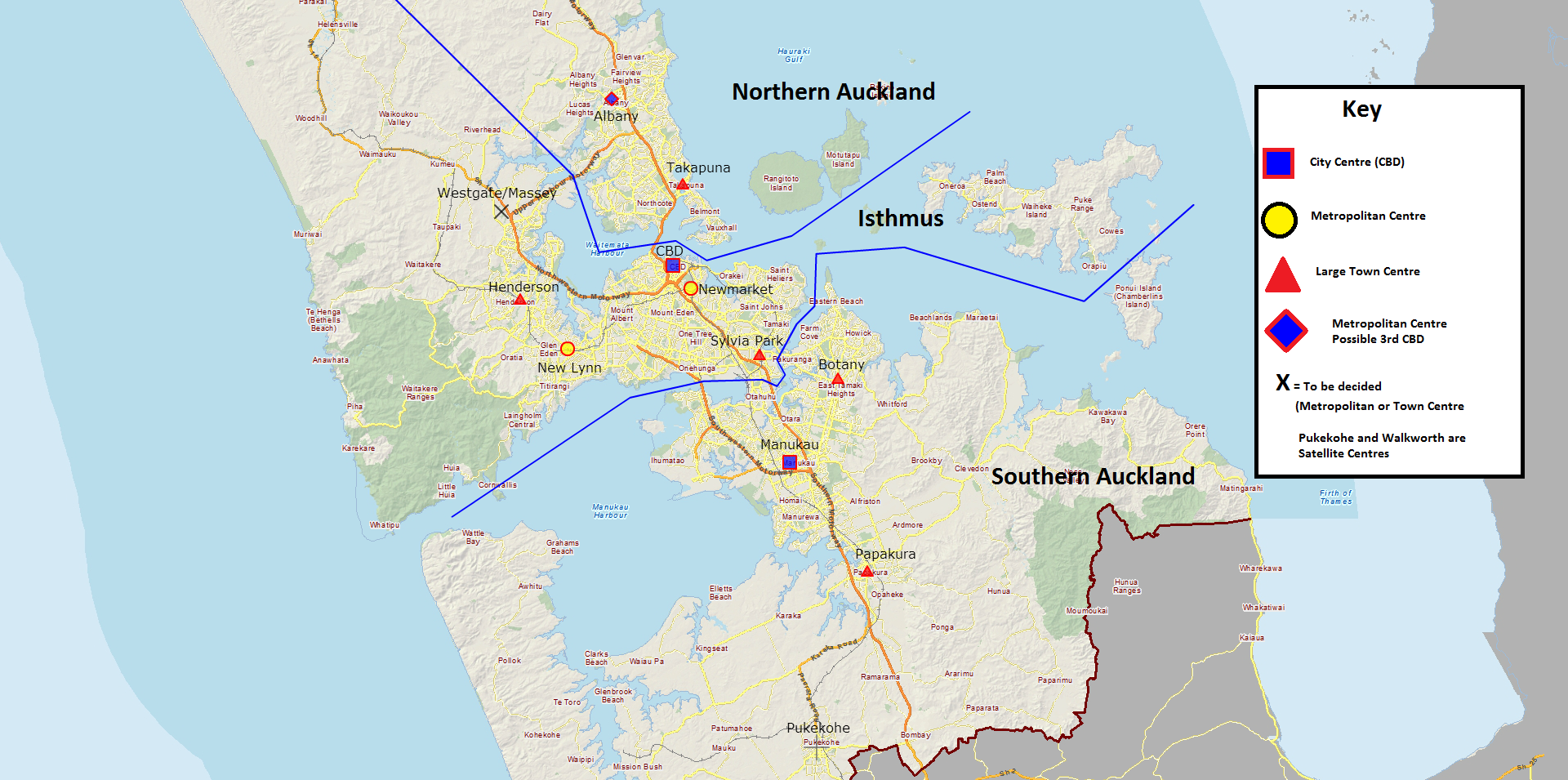
Locations of the Centres (from May Presentation) Click for full resolution
Concluding Remarks
2014 is the year we enter the City Building Phase for Auckland. While we go more fiscally conservative and the leadership will naturally drift towards new rally points away from the Mayor, Auckland will start this building phase in increasing large strides after a slow and methodical start. Slow and methodical – what will determine the Council in 2014 as it progresses through and resets itself after the Len Brown saga. The City has already rallied behind two alternative leaders in case the Mayor goes lame-duck on us (which can still happen). However, we are seeing policy drives starting to drift away from the Mayor who is effectively no longer in the captain’s seat and more towards cross-table collaborative approaches. This could end up as a good thing if the City perceived negatively that the Mayor took a more authoritative approach in his administrations up until now. I do not think looking at the 15-5 split at the last Governing Body meeting of 2013 that we will slip into paralysis, not unless three of those five opposition Councillors really want to commit political suicide…
Thus the City is at this point in time in safe hands as we march towards the first year of City Building – Auckland – albeit a slow and methodical start at that
This is a rare piece of commentary from me personally into the entire “Len Brown affair.” Since the story broke I have been more or less silent on the “affair” aspect while constantly keeping an eye on the “conduct” side of the matter. From Day One when the story broke (while returning from a Council briefing on I believe it was on the Unitary Plan heading for notification) I have always said for me to no longer give “support” to the Mayor, he would have to conduct a criminal act (and be convicted) or conduct serious misconduct (an affair is not misconduct) through misuse of resources or power, and/or other serious nature.
I have the EY report that was commissioned by Council CEO Doug McKay after it landed (with an accompanying release) in my email box this afternoon. You can read the report over at this post here: The EY Report Commissioned by Auckland Council CEO. That said I was NOT at the Press Conference in Town Hall this afternoon over the release of the report.
After receiving and reading the report I have come to three conclusions:
The “rules” set by the Council Code of Conduct, that by the Remuneration Authority, and the Local Government (Auckland Amendment) Act 2009 are too loose with little measures provided if something does go wrong/breached
Government must tighten up the regulations set about by the Remuneration Authority for issuing rules around use of ratepayers resources – e.g the mayoral car and when it can be used or not. In the same regard the Local Government Act needs tightening up so the Governing Body have available a wide range of measures to deal with errant elected members. This can range from a Censure motion to something more punitive (whatever one decides that might be short of sacking a mayor)
Owing to this error in regards to several matters pointed out in the EY report (cell phone, mayoral car, and not declaring the hotels on the register)(and rather than the actual affair) my confidence in the mayor is shaken with support moving from positive to negative. That said I still have confidence and positive support in the wider main Council (although a particular CCO is an exception at the moment) and the rest of the elected members (regardless of whether I agree with them or not (Dick Quax and Cameron Brewer)). In being honest it has weighed on my mind on what else has the mayor not declared outside of the “affair” and could have this affected any other mayoral decision-making
I stress again to make it crystal clear that yes confidence in the mayor is shaken with support switching from positive to negative. HOWEVER, confidence and support remains with the Deputy Mayor and the rest of the Councillors despite disagreements from time to time.
One thing I do ask of the Governing Body after the elected members have had time to review the EY report is that an extraordinary meeting be called of the GB ASAP! In that extraordinary meeting a motion of censure is called and voted for against the mayor immediately. Whether the vote passes or fails is beside the point in my opinion. The point being is that the Governing Body has now been damaged and in the eyes of the City the censure motion needs to occur to help restore confidence towards the Council. Failure to move the censure motion quickly could paralyse worthwhile projects before the Council – and that would be a true detriment to Auckland. It is risky
For the rest of it Parliament is going to need to haul backside and tighten up rules around Local Government to prevent this kind of mess from happening again. And to me that is going to be the main point coming out of this entire mess!
Please Vote – Please If there was ever a reason to vote this would be it: Rather than focus on The Unitary Plan which is complex and affects … Continue reading Why You Should Vote
My congratulations to: Cameron Brewer, Sharon Stewart and Dick Quax for being reelected unopposed back to Council. No matter our politics it will be good to see some familiar faces for another three years as I continue to advance some #BetterAuckland projects.
As for my Ward? Calum Penrose should be a shoe-in again for Papakura while Arthur Anae should get one of the two seats of the Manukau Ward. I mention Manukau as that is where the #SuperManukau work is happening from TotaRim, so I like to keep an eye on “things in that area.



 Talking Southern Auckland