Tag: rail efficiency

THE RAIL EFFICIENCY PROGRAM #4

How to get Better Resilience out of the Rail Network


A Rail Efficiency Program Series


THE ALL-ENCOMPASSING RAIL EFFICIENCY PROGRAM – PART TWO


Westfield Junction Fly-Over


Those who travel by train on the Southern and Eastern Lines to their destination and pass through the Westfield Junction can know the delays that happen in that section of track due to another train “crossing over.”

This picture would explain better what I mean:

Westfield Junction jpeg overview mode


Click for full resolution (1920×955)

As you can fathom, there is a lot of conflicting routes at Westfield junction from both passenger and freight trains – all which can cause delays to our passenger services (and they do) at just about any given time.


Now with passenger train frequencies to increase to initially 6 trains per hour (one every 10 minutes)(and that could easily mean one train every 5 minutes on the lines between Westfield Junction and Papakura Station as well) once the electrics are fully on-stream (2016), plus the inevitable increase of Metro-Port freight train frequencies to and from their Southdown Metro-Port base; delays and conflicting movement risks are just going to increase no matter how good the signalling is.

So as an idea (this is not an original one but builds upon those ideas from others) is to build a Westfield Junction Fly-Over to allow trains heading to Britomart via Glen Innes (Eastern Line) from the south to “fly-over” Westfield Junction and reconnect with the Eastern Line on the other side of the junction. The Fly-Over would stop the city-bound Eastern-Line trains conflicting with south-bound trains from Newmarket thus improving the efficiency of travel for those respective services (as they often get held up the most). However the Fly-Over does not assist in dealing with conflicts if a Metro-Port train decides to enter or leave Metro-Port Facility to/from the main-line.


Knowing that Metro-Port trains are long and are either accelerating (so departing the base) or decelerating (entering the base) they take time to complete their movements and have the high potential to foul passenger train movements (which they do on a more regular basis than they should) in the area. Now I am not one for telling the Metro-Port services to bugger off as they are a revenue spinner for Kiwi Rail as well as doing a great service in their part in keeping trucks off our highways between Auckland and Tauranga. So the next extension as part of the Westfield Fly-Over phase is to build approaches and/or passing loops in the Westfield Junction to Otahuhu area to allow more efficient Metro Port freight train and Auckland passenger train movements that will not conflict each other.


Now the idea for these approaches for the Metro Port services comes from the current Third Main being built between Middlemore and Otahuhu which allows freight trains to enter or leave the Westfield yard more quickly than they do now (they have a dedicated road to power up to speed or slow down from speed without conflicting other passenger trains in the area – as trains take a long time to speed up or slow down). By virtue of extension and in anticipation of a full Third Main being fully built from Otahuhu to Papakura within the next 10-years (fingers crossed) – and currently there is plans for the Third Main to go all the way to Port of Auckland; basically what is happening is that the Third Main is being extended to Westfield Junction from Otahuhu with a “Fourth-Main” also being built from near Sylvia Park on the “south bound” side, around Westfield Junction and through to Otahuhu Station connecting back up to the current Main-Lines.


The following graphics and pictures hopefully might explain better:


This picture gives a basic outline of the work proposed at the Junction:

New junction 1 png mode


Click for Full Resolution


This next picture show the extent of the works for the Westfield Junction, the “Fourth Main” and the approaches from Middlemore Station (with the Third Main in place between Otahuhu and Middlemore):

Overview of new junction png mode


Again click for full resolution


And this last one is a crude draft graphic on a simplified version of the Junction and approaches (note I have not added all the cross overs in):
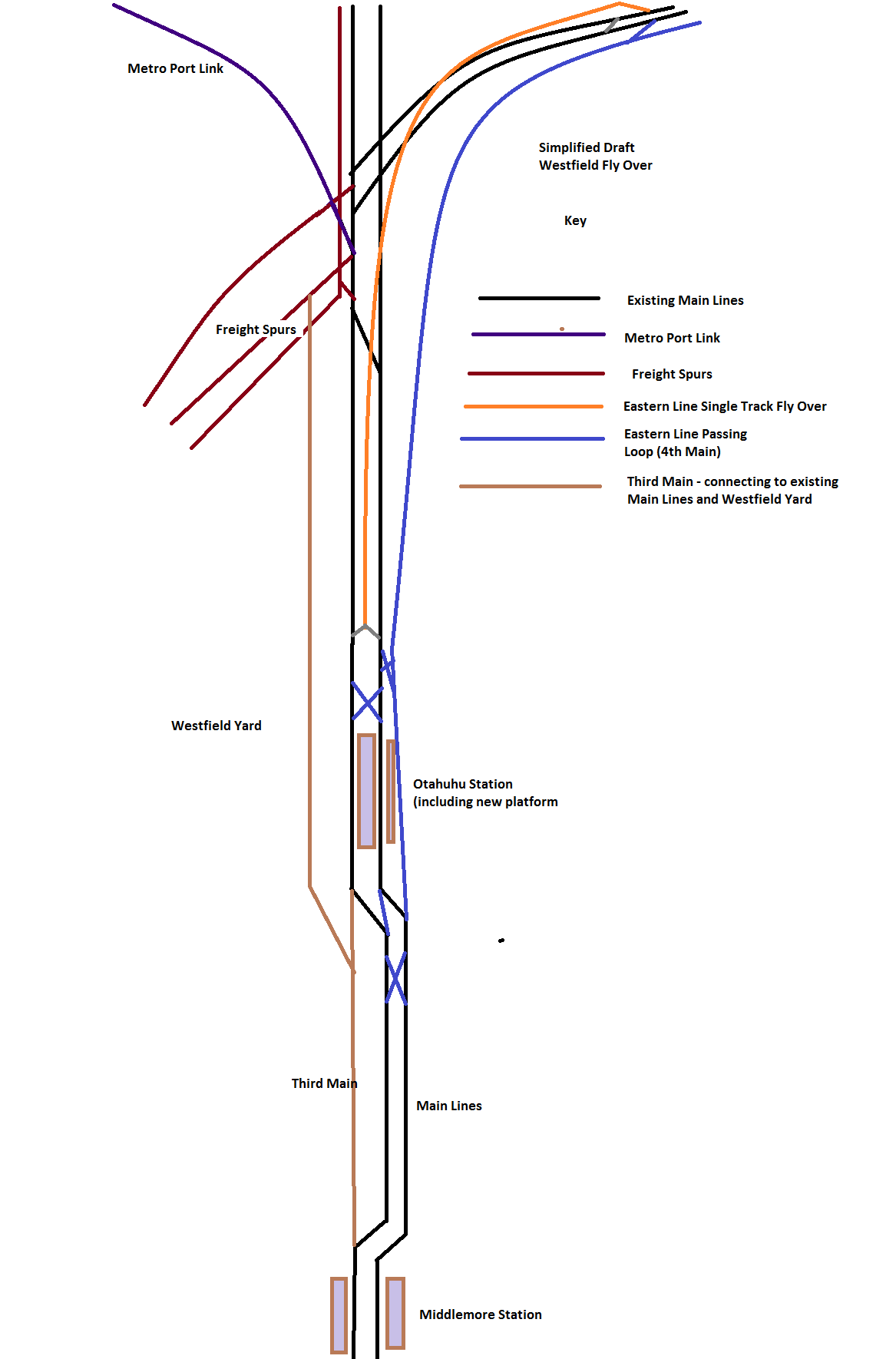
Diagram of Junction Flyover


Click for full resolution


Now this idea takes into account the following:

  • Westfield Station is closed (it is actually slated for close by Auckland Transport anyhow)
  • Accepting that if a Metro Port train comes out from its base at the same time a south bound Southern Line service heading to Papakura from Britomart is also in the area moving, any city bound Southern Line trains will be waiting at the north end of Otahuhu Station for the conflicting movement to clear
  • The Metro Port train uses the Third Main all the way until Middlemore before entering the existing main line (or vice versa if heading to the Metro Port base)
  • The new EMU’s can take the gradient of the Fly-Over as it would be slightly less than the CRL gradient to which the EMU’s are designed too

So while not perfect and still likely to get delays from some conflicting movements in the Otahuhu-Westfield Junction area, those are likely to be caused by a freight train rather than another passenger service wanting to go the other way. And so this is where the junction pays it dividends: allowing Eastern Line trains to cross over the Southern Line trains without conflict of movement at the Junction. The third platform at Otahuhu Station allows the Fourth Main to come from the Eastern Line near Sylvia Park, all the way to the main interchange station (Otahuhu) and then enter the existing Main Lines heading south minimising congestion between Otahuhu and the Junction if the existing Otahuhu Platform One (City Bound) is occupied by a passing Metro Port train and Otahuhu Platform Two (existing South Bound) is occupied by a city bound train.


Cost

Cost of such a project taking into account retrofitting of the electrification system including signals, a bridge, retrofitting existing tracks with new crossovers, building the Fourth Main, building new electrification systems for the Fly-Over and Fourth Main, new Platform at Otahuhu (which could tie in with a Park and Ride plus Bus Park Facility), and future proofing the Eastern Line to allow a direct link between Sylvia Park and Penrose would come at at I would say $110 million (so same as extending electrification to Pukekohe and building two new stations).


Disruption potential and Time of Completion?

Maximum potential for maximum disruption due to the electrification system now in position and the subsequent refit that would be required.

Completion would be 18 months that includes two Christmas Close Downs and as well as Block of Lines on all non special event weekends which means…


Likelihood of this Happening?

With our current civic leadership: NONE – not with what has happened with Electrification now…

Could of it happened? Yes when the Electrification Project started.


So why did I write this then if all it will do is gather metaphorical virtual dust? To illustrate what could have been with proper planning and foresight by our leaders and engineers. However we are relegated to constant bottlenecks and delays at Westfield Junction when our passenger service frequencies increase – along with the increases of freight train frequencies from the Metro Port base.


However I am still open to surprises – and if this part of the All Encompassing-Rail Efficiency Program gets dusted off, shoulder-tapped and built; then heck someone did have vision for Auckland!

The Rail Efficiency Program #2

How to get Better Resilience out of the Rail Network


A Rail Efficiency Program Series


The All-Encompassing Rail Efficiency Program – A New Introduction


August last year I kicked off (then it stalled owing to circumstances until now) the Rail Efficiency Series – How to get better resilience out of our existing rail network:

THE RAIL EFFICIENCY PROGRAM


HOW TO GET BETTER RESILIENCE OUT OF THE RAIL NETWORK


A RAIL EFFICIENCY PROGRAM SERIES


AN INTRODUCTION TO THE REP

In this new series, I be running posts on how we can get more resilience thus punctuality and reliability in the existing Auckland Rail Network prior to the City Rail Link opening. In this post I will give a an introduction to the Rail Efficiency Program which was briefly mentioned in my submission to The Auckland Plan.

Those who travel on Auckland’s passenger rail network as I do on a regular basis know the frustration when your train is delayed or even worse cancelled due either some kind of fault, breakdown, accident, pesky freight train in the way, congestion at pinch-points (such as Puhinui, Otahuhu-Westfield, or Newmarket), and/or the effects of an earlier disruption still snowballing through the network affecting the train you are on. Now there are some things either happening or in the pipeline that will help reduce the frustrations and disruptions such as:

You can read the rest of that particular post through clicking on the respective link.


Now in that introduction series I had listed six technical proposals in getting more resilience out of the existing rail INFRASTRUCTURE:

This is the Five Step – Rail Efficiency Program that I will dedicate a post to each of the five steps (including graphics) before giving a final sum up and final submission ready for Auckland Transport and Council.

THE FIVE STEP – RAIL EFFICIENCY PROGRAM (TO BE COMPLETED BY 2018 (PRIORITY ONE IN MY AUCKLAND PLAN SUBMISSION))

  1. New or rebuilt cross overs at major stations (basically all stations that act as Fare Boundary stations on the rail network)
  2. Westfield Junction Flyover
  3. Relocation or adding of new stations on the rail network
  4. Cross-overs at all stations between Papakura and Swanson
  5. Third Main from Westfield to Papakura

Now there is a sixth step in my REP, that is remove level crossings on the rail network between Papakura and Swanson. However I have placed step over a 15 year program due to the resources and planning required to grade separate some of our level crossings.


Now the above still stands and will be “advocated” for where possible. However since then (as things do) other things come along and crop us – such as the  accompanying posts: TO BETTER (AUCKLAND’S) TRANSPORTELECTRICS NEARLY THERE, and a post by another blog on existing infrastructure; THE VIRTUES OF INVESTING IN TRANSPORTATION. And especially in light of remarks from Councillor Mike Lee – Chairman of the Council Transport Committee which were:

But council transport chairman and veteran electrification campaigner Mike Lee believes the new trains will not be enough to boost flagging patronage unless they are supported by general service improvements, notably far better punctuality and extended weekend timetables, without prohibitive fare rises.

I would not bank on electric trains in themselves fixing chronic underlying human management problems,” he said.

Although he was preparing to pop champagne corks last year in expectation of overtaking Wellington’s annual rail patronage of 11.3 million passenger trips, he is bitterly disappointed by a fall from a record 10.98 million trips in Auckland for the 12 months to April – a figure boosted by the 2011 Rugby World Cup – to little over 10 million by November

I thought it might be time to go ‘all-encompassing’ in the Rail Efficiency Program to build a strong proposal to submit to Council and Auckland Transport so that the flagging rail patronage is reversed and going where it should be – UP – again.


So here I go in giving it a shot in outlining the ‘All-Encompassing – Rail Efficiency Program (AE-REP):


THE TEN STEP – All-ENCOMPASSING RAIL EFFICIENCY PROGRAM (TO BE COMPLETED BY 2018 (PRIORITY ONE IN MY AUCKLAND PLAN SUBMISSION) (with additions as of 2013))

  1. New or rebuilt cross overs at major stations (basically all stations that act as Fare Boundary stations on the rail network)
  2. Westfield Junction Flyover
  3. Relocation or adding of new stations on the rail network (Adding Walters Road Station while closing Te Mahia Station being one idea) (extra feeder bus, kiss-and ride, and park-and-ride facilities would be helpful as well for major stations as a starter (plus a select few others like Walters Road Station))
  4. Cross-overs at all stations between Papakura and Swanson
  5. Third Main from Westfield to Papakura
  6. Manukau-South Rail Link
  7. Electrification to Pukekohe
  8. Grade Separation of Rail Level Crossings (although this would be a 15-year program)
  9. Introduction of (modified) full Zonal Fares 
  10. Stepping frequencies all lines to 15 minute frequencies at the absolute minimum between 6am – 9pm on all lines (between Papakura and Swanson) – 7 days a week with 30 min frequencies for Onehunga on weekends, then slipping back to 20-30 frequencies outside those hours. As for Pukekohe frequency could be stepped up to every 30 minutes initially Monday to Friday and hourly on Weekends. Now this is all Pre-CRL due to the restraints at Britomart, however once the CRL is opened you can move to the maximum the new signalling can handle which is 12-Trains Per Hour (every 5 mins).

Now that 10-step program does not include what is already happening on the existing network (or what will be happening in the case of the City Rail Link) but does build strongly upon it:

  • Electrification of the Rail Network allowing Auckland to run the faster electric trains
  • With the new electrics (EMU‘s), capacity is increased from larger and more rolling stock running more frequently
  • The City Rail Link opens up this latent capacity on the Rail Network and in-part removes the Newmarket pinch-point. The CRL turns Britomart into a through-station and through-stations have larger capacity than a dead-end station such as the current Britomart layout
  • The Third Main which seems to be now slowly under-construction from Westfield to hopefully Homai (and extended to Papakura eventually). The third main gives freight trains a dedicated track to run on in a congested piece of network keeping the freighters out of the road of passenger trains – especially in the peak times


I have left some more human “resource” elements out of the AE-REP as that is for a separate debate and for that debate to happen in the Auckland Council Transport Committee – not the blogs!


However the 10-step AE-REP does draw inspiration from the THE VIRTUES OF INVESTING IN TRANSPORTATION piece in the fact that if you don’t get the current infrastructure investment right, it becomes a rotting and collapsing foundation for any heavy-scale new capital infrastructure investment you place on top of it (try placing a house on a layer of cake and see what happens after a period of time).


So as I originally said in August, I will expand on the (now) 10-step AE-REP over the next few months to flesh out the ideas behind the Program.


The All-Encompassing – Rail Efficiency Program by Ben Ross; How to get Better Resilience out of the Rail Network


BEN ROSS : AUCKLAND

Shining The Light – To a Better Papakura (OUR home)
AND
To a Better Auckland – (OUR City)

Auckland 2013: YOUR CITY – YOUR CALL