Sensible and Actual Common Sense Stuff Here Folks – None Bank Breaking
Last Friday I was at the Generation Zero Micro Conference looking at how Auckland could progress into the 21st Century. This was the program although there was a minor alteration:

Unfortunately Deputy Mayor Penny Hulse was unable to join us – most likely owing to some distractions further up Queen Street. But we did have Councillor-elect Chris Darby join us and give a speech on what lays ahead for Auckland. Darby understands all too well how the 1950’s urban and transport planning that have dogged Auckland for over half a Century now must stop and move towards for “sustainable” and socially healthy solutions for the city.
Basically and what the rest of the speakers talked about is that we should be looking at a few things. In short they are:
- Continued investment in mass transit
- Large improvements in our investment in active transport
- More socially inclusive and cohesive urban and community planning/building
- More smart with energy usage (and that is actually quite simple and often not relatively expensive compared to “do-nothing”
- Live and Work Local
Continued Investment in Mass Transit
This one is a no brainer for a healthy and working city but it has to be done right. Already we are slowly making strides with mass transit. Auckland Transport is preparing to roll out a new bus network starting with South Auckland in early 2015 followed by the rest of the city – in stages soon after.
The City Rail Link is a go whether it starts 2015, 2018 or 2020 after commitment from Central Government. The question is where does Auckland stump up its 50% from with most options bottled for now.
Transport Blog and Generation Zero have the Congestion Free Network which they are pushing with Auckland Transport every step of the way. We will know next year when the 2015 draft Integrated Transport Plan comes out how much Auckland Transport has taken on board. While my mind is on the CFN, it won’t be too long before a line is drawn on that CFN chart from Homai to Manukau indicating the Manukau South Rail Link. One question that was legitimately asked what would be the operational aspect of the South Link once Pukekohe was electrified.
Assuming Glenora Road Station is also built and Te Mahia Station finally closed the two operational patterns would be this:
Pukekohe/Papakura to Britomart via the Southern Line (every 10 mins)
- Express Service: Pukekohe – Papakura – Manurewa – Homai – Papatoetoe – All Stations after that
Pukekohe – to Manukau via the South Link (every 20 mins)
- Pukekohe – Papakura – Glenora Road – Takanini – Manurewa – Homai – Manukau
Of course this is back of the napkin stuff here so subject to further refinement
There are many other things we can invest into to get Auckland’s mass transit where it should be. However, we still have some large-scale road projects in the pipeline that not only suck up large portions of CAPEX but are not required as well. The East-West Link and the Second Harbour (road) Crossing being the two that can be definitely struck off. The next harbour crossing should be solely the North Shore Rail Line connecting the Shore to the rest of the city via heavy rail allowing in theory Albany to Airport in 45 minutes. As for the East-West Link I am sure some interchange and intersection improvements along with dedicated freight lanes would give much better outputs for less money and physical/social disruption then a motorway grade project.
Thus it now comes down to what this new term of Council will do (and if we get a new Government in 2014) in regards to re-jigging our transport investment around.
Investment in Active Transport & Socially Inclusive and Cohesive Urban Development
By Active Transport I mean cycling and walking to our destinations. Rule of thumb with walking and Transit Orientated Development is that we will walk no further than 800 metres or 10 minutes from Point A to a mass transit stop. With cycling that limit is pretty much determined on your physical fitness and willingness to go from Point A to a mass transit stop.
Our planning around both Active Transport and more social inclusive and cohesive urban planning has been rather slow and still really has not taken off. Auckland is a dangerous place for both walkers and cyclists with our pro-car above all else mentality. We are slow in getting more shared zones up around the city, slow in getting safer cycling routes and provisions up. Although I have noted the North Western Cycleway is under construction and Auckland Transport is testing lockable bike sheds at some of our larger rail stations.
However our urban planning and urban design for that matter seems to be lagging behind. One thing Auckland has not picked up on is Mixed Use development. Whether Low-Rise or High-Rise we are behind in utilising (or even realising) the benefits of buildings containing retail on the ground level, office on the lower third and residential up the rest of the building.
When I mean behind we do build these mix use buildings but the urban design concepts are really bad and not welcoming. The best example I can think of is up at Flatbush along the join of Murphys and Stancombe Roads
As for examples of it possibly working? We will need to see how M-Central works out once the construction is complete as well as other urban redevelopment work in the immediate area.
In saying this the Auckland Design Manual is now out and in effect. With a major push for quality urban design via the ADM and the Unitary Plan, hopefully we might see more inclusive and cohesive social planning built into our urban planning as well.
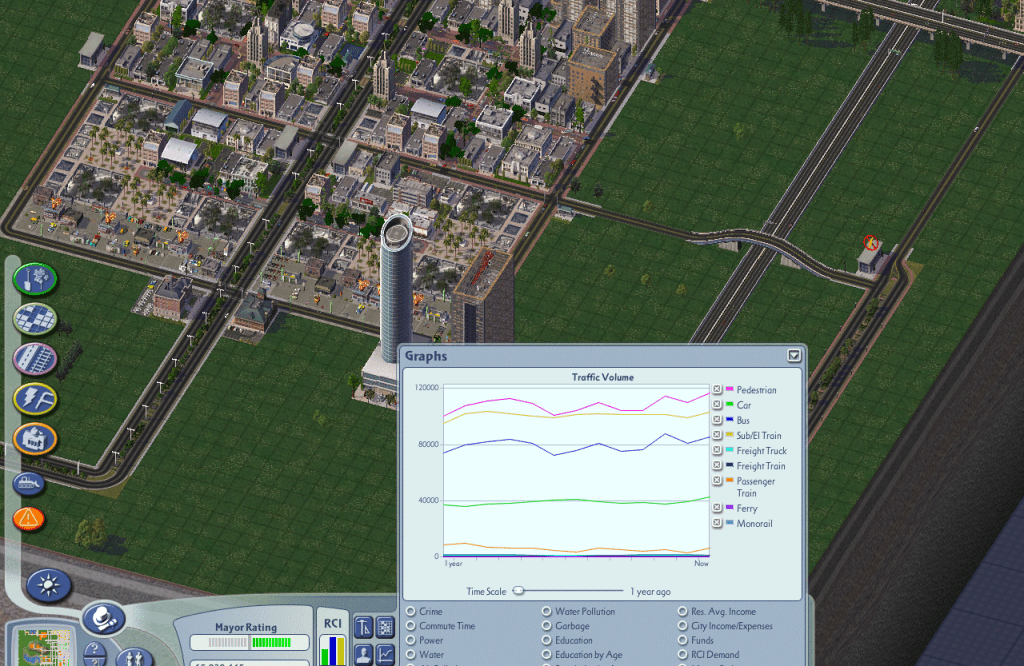
When I start playing urban design in my simulated cities

New Plaza’s both above and underground there.
Also note the commuting trends too
Smart Energy
Auckland as a whole is energy inefficient when it comes to residential, commercial, industrial, transport and civic structures. Simple things like LED-lighting, sensor-lighting, insulation, passive and active ventilation and heating systems, correct and quality building methods, appropriate green shading like deciduous trees can both save $$$ and benefit physical and social health of both an individual and city in the long run. Already at home we switched over to energy-efficient light bulbs until we are ready to put the LED ones in. We also run a HRV system in the house for ventilation and because I have not mentioned it – use our cars in efficient manners when public transport is not an option.
At the end of the day most of this stuff to progress Auckland into the 21st Century is not hard and does not deny you some of the pleasures in life (including keeping a 1960’s Mustang if you are so inclined). But there are perceptions and attitude changes needed in order to get us out of the 1950’s and into the 21st Century. The Generation Zero Micro Conference was an excellent networking and idea sharing session. Now is to make the theory into reality – something New Zealand let alone Auckland really do drag the chain on (probably because we like reinventing the wheel)

 Talking Southern Auckland