I think we might have a more pressing concern first
Regional Annual Plan hearing continue as Auckland Council prepares to finalise the 2014/15 budget. I noted this from our resident NZ Herald reporter this morning in regards to continued lobbying on the East-West Link.
Auckland Council is under fire from business groups to speed-up work and funding for an east-west road freight corridor between Mt Wellington and Onehunga.
They want the council to give the same priority to the east-west link as the $2.86 billion city rail link that Mayor Len Brown is aiming to start building in 2016.
It is unacceptable that this year’s budget only offers to continue investigating the east-west link, business lobbyist Tony Garnier told councillors yesterday.
He was presenting a submission on the council’s budget on behalf of the National Road Carriers, which says freight volumes will increase by 80 per cent in Auckland over the next 20 years.
Mr Garnier quoted comments by Prime Minister John Key last year that freight congestion in Neilson St between Onehunga and Southdown was unacceptable, and part of the Government’s next major transport focus in Auckland.
The south-west link is an extension of the Ameti roading project – a series of roading and public transport projects for southeast Auckland. It is planned to be built north of Manukau Harbour.
The National Road Carriers and Auckland Chamber of Commerce want the council to commit to building the east-west link by 2021 – the same completion date set by Mr Brown for the rail link.
In a written submission on this year’s proposed budget, chamber of commerce chief executive Michael Barnett said the absence of any funding reinforced its concern at slow progress on the east-west link.
“We note that considerable council resource has been allocated to the city rail link, a project with similar ‘highest priority’ status as the east-west link…we strongly encourage council to address this imbalance,” he said.
Meanwhile, the Employers and Manufacturers Association has criticised the projected council debt of $12.6 billion by 2022 and urged it to reduce its running costs and capital investment.
——–
We have all been through this before with the East-West Link and I am sure we do not need to go through it again since Auckland Transport abandoned the “motorway” options north and south of the Manukau Harbour.
Again the reliable Transport Blog have posted a more viable alternative for the East-West Link to assist freight movements in the Southdown-Onehunga industrial complex. You can read up about the alternative here: An Alternate East-West option
Future Land-Use
However, a more pressing concern for the Southdown-Onehunga industrial complex has come up and does affect the East-West Link considerably. As Auckland continues to grow and intensify existing land uses come under pressure and change. Industrial areas are especially prone to change as pressures build from increasing amenity (from residential and commercial growth/spread) that is fuelled by gentrification and plain growth. That increasing amenity will push up the value of land the industrial complex currently sets on thus has a knock on effect on things like rates. Further pressures to industrial complexes is new stricter activity guidelines as residential and commercial areas encroach on the complexes. And to make the Southdown-Onehunga industrial complex more prone to pressures is the fact it flanks the northern edges of the Manukau Harbour which is becoming in itself more attractive as its Waitemata Harbour counterpart.
So when you get increasing amenity pressures, increasing land cost pressures, increasing activity controls, and an evolving city you will find your industrial complexes also adapt. Medium and heavy industry (which is located in the Onehunga-Southdown area) favour land that is well-connected but does not face amenity, activity-control, and land value pressures. If industry does find itself under those pressures for sustained periods of time it will eventually relocate en-mass to land/areas that do not give them these pressures.
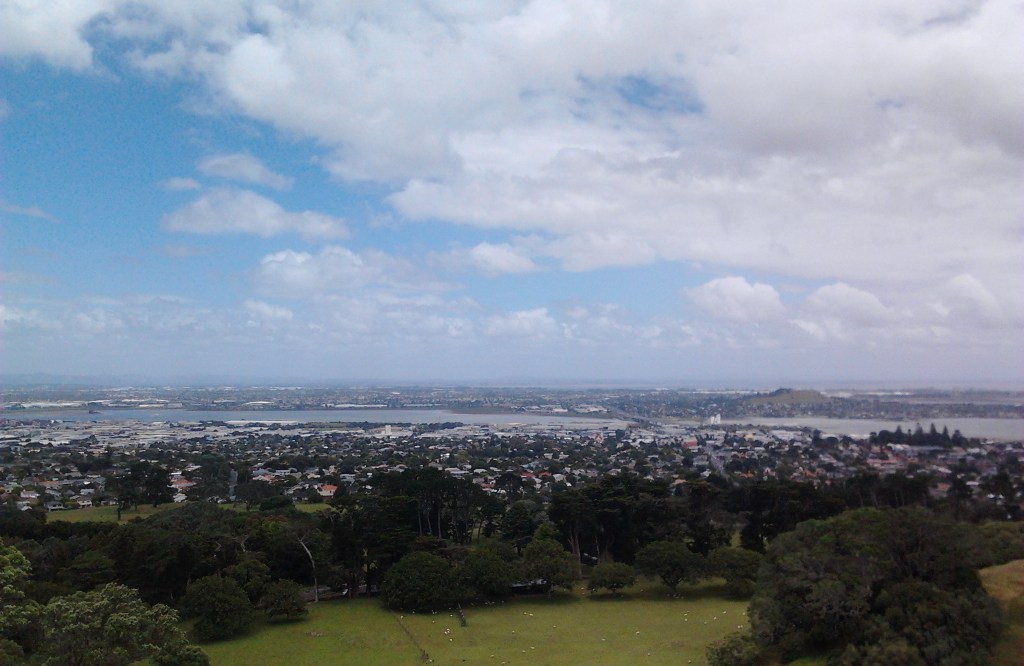
Southdown-Onehunga Industrial Complex as from One Tree Hill
[Click for full resolution]
It has been mentioned in Auckland Council before and I have mentioned it here as well about the future of the Southdown-Onehunga industrial complex. That is, where will the complex be in 40-50 years from now as Auckland grows another one million people. I have a feeling not at Southdown-Onehunga but rather: Wiri, Drury South, and the Northern Waikato. Why? For the reasons I mentioned above with pressures even now starting to apply to Southdown-Onehunga. Pressures that will over time make the industrial complex become non-viable to be at as the demand for residential and commercial near and on the edge of the Manukau intensifies.
So the first thing Auckland Council might want to do before sinking any serious money into an East-West Link that becomes redundant in say 40 years is to figure out the most likely outcome for the Southdown-Onehunga industrial complex. Will it stay as pressures continue to build on it as our population grow. Where will the industrial complex relocate to? Will it be Wiri, Drury South (which is opening up), or the northern Waikato next to emerging satellite centres. I believe this kind of rather large question needs to be answered before we commit to any East-West Links.
In answering the question we also open up a marco-look at Auckland’s land-use AND transport planning (which is not done really well at the moment) that if we get our heads screwed on right can plan in a coordinated fashion.
For if the industrial complex at Onehunga-Southdown moves south to Wiri, Drury South, and/or the Waikato then the dynamics of Auckland, its make-up and its infrastructure change considerably. What those dynamics are would be more than I could fit into this blog post.
None-the-less it is wise to undertake a study into the long-term future of Southdown-Onehunga and where it might be by 2050 before we sink money into potential “gold-plated” highways that could become fast redundant owing to that substantial land use change.
And yes I did see the comment from the EMA at the bottom of the Herald article (in bold). So which way is it going to be? Gold-plated highways that run the risk of becoming redundant in 40 years, or trying to get Council to scale back its debt?


 Talking Southern Auckland