A Good Question
Where will the children play as Auckland grows both outwards and upwards? A long fraught and vexing question that has elected representatives, residents and planners constantly scratching their heads in wondering what to do. And it is a question that again needs not only answering on paper (so plans) but also executed in a coordinated fashion along everything else as we City build. Hmm as a side thought “coordination” seems to be the prevailing theme on Talking Auckland at the moment. I wonder if I should do a name change called ‘Talking Auckland Coordination” 😛 . On further thoughts I might keep that name at the back of my mind for an upcoming project (once the person concerned answers their emails with an answer).
Anyhow back to the topic on where children will play in an ever-growing Auckland.
From the NZ Herald
So tell us, where do the children play?
By Mathew Dearnaley 5:00 AM Tuesday Apr 29, 2014
Researchers find pre-teens’ outdoor physical activities are too restricted.
Health researchers lamenting physical inactivity among Auckland’s pre-teens – most of whom rely on their parents to drive them about – want developers of a “compact city” to reserve more playing spaces for children.
A study of 253 children aged 9 to 12 by researchers from three universities found them more involved in sedentary pastimes such as indoor computer games than in physical pursuits.
And when they left home they were more likely to be driven in cars by their parents than to go on foot or by bike or scooter.
Friends’ homes or local dairies were the only destinations to which they made more than half their trips without adult supervision.
Parents or caregivers accompanied them on 59 per cent of trips to and from school, 77 per cent of shopping excursions and 92 per cent of travel to organised sports.
The children in the study kept trip diaries and wore GPS tracking monitors and accelerometers so the researchers could analyse their movements over seven days.
Only those from low socio-economic southern and eastern suburbs showed any great independence.Karen Witten, the Massey University professor who led the study, said it followed a Transport Ministry finding that the average time children spent on “active travel” such as walking and cycling had shrunk from 130 to 72 minutes a week in the 20 years to 2012.
……..
Quite a fascinating the comment on children basically from the former Manukau City Council and Papakura District Council (so South Auckland) areas as well as Tamaki in the east showing “great independence.” I wonder if that has to do with the less you have materially the often more independent, resilient and happier you are (remember money never buys happiness). I would be interested in the universities conducting a further in-depth study behind this independence from the South and East as I bet they have something offer to the rest of Auckland.
The article also points out the crux of the issue behind children outside of the South and East in not being high participants in unsupervised play:
Professor Witten said parents discouraging youngsters from walking or biking to school because of perceived dangers created a “social trap where the children who remain on the street are less safe because there are fewer other children on the street”.
In other words “Fear of Crime.” Which I find extremely ironic owing that (and I mean no offence to the South and East (I actually live in the South and have done so for 23 years of my life (I am 29 next month) and have no intentions moving from the South any time soon) perceived or actual crime levels owing to the ills that can plague low socio-economic would be higher. So the question then falls to on what is the real answer why those outside of the lower socio-economic areas of the South and East show less independence as the study would imply. A harsh question but one that needs answering as we set about our planning so that children do have spaces to play.
And so we come to the practical solutions for facilitating unsupervised outdoor activities for our children in a growing Auckland. Below is what I said on Facebook this morning in what we can do as a City:
Safety issues from creeps aside (another post in itself) there is plenty we can do for a growing Auckland:
1) Pocket Parks to complement the big parks
2) Returning streets to the people from the car
3) Friendly and safe public/active transport modes/routes
4) Quality urban design that promotes passive surveillance to knock back the Fear of Crime syndrome
A pocket park could be anywhere in size from 100 metres square to 510 metres square (your average single house section) but these pocket parks do need to be frequent and actually connected back to the wider urban fabric (something a lot of our existing big parks do not do very well if at all). The pocket parks while they would work well in low density suburban areas these parks would reach optimum utilisation in our medium and high density residential/commercial areas across the city.
Returning local streets back to the people would allow front yards to be virtually extended and a new common space created for a neighbourhood. Of course the speed limits would need to be reduced to 30km/h and shared spaces created but this could be seen as a quick win in promoting more connected communities and physical activities.
Of course having safe and reliable public and active transport systems would also not only promote less congestion as well but allow kids to move about more freely and safely around places like their friends, school, parks, and shopping centres (the older kids that is). Note I am aware of kids roaming and causing bad behaviour. While that is an issue again like creeps it is a separate issue to be covered separately. In the same regard I am not going to tar brush good and responsible children from the actions of poorly behaved children.
Finally quality urban design that promotes passive surveillance to knock back the fear of crime syndrome. Having a 2 metre front fence when you are not living on the main road might give you privacy but it also gives me total privacy in ransacking your house as no one can see me from the street. Passive surveillance from houses that are well connected to the street and have both good neighbourhood interaction (including kids playing on the street) and vice versa back towards the house will go a long way in reducing crime. Why burgle if the risk of getting caught is high (unless you are a few beers short of a six-pack).
As it said (again to serve as a reminder) in the Herald article:
Professor Witten said parents discouraging youngsters from walking or biking to school because of perceived dangers created a “social trap where the children who remain on the street are less safe because there are fewer other children on the street”.
A self-fulfilling prophecy.
So where will our children play? Hopefully outside relatively unsupervised in communities that are more connected than they are now and have been for the last 20-odd years.

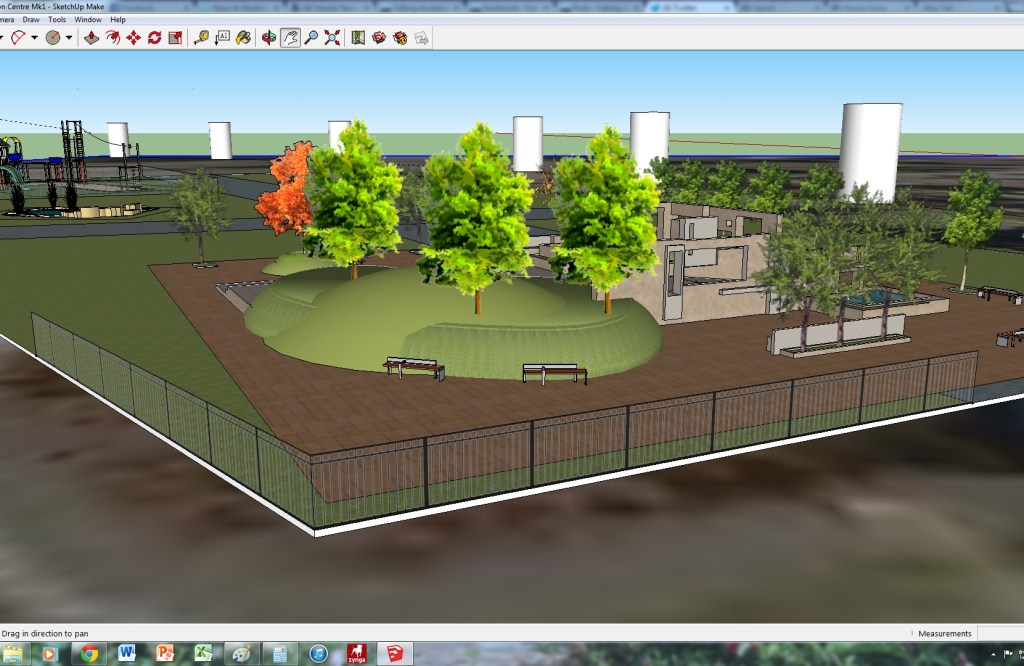
Attribution for the Athens Pocket Park that has been used in the Manukau Metro Town Centre Mock Up: http://land8.com/photo/athens-urban-park-exparking/next?context=user
An example of a higher end pocket park you might in say Manukau City Centre, or say another town centre. More simpler ones (preferably with playgrounds) can be easily drawn up and placed out in the suburbs. We just need coordination.
Talking Auckland Coordination – Our Future? 😉

 Talking Southern Auckland
This is a big issue. I also see a problem is that Local Boards are creating ‘super parks’ at great expense. $700K to build a single playground (Tui Glen) is a big investment. Then comes the inevitable complaints about parking. What could be achieved around an entire neighbourhood with that kind of investment?
“Super Parks” should be left to the regional level with the Local Boards focusing more on the proposed pocket parks.
You should not need driving to any city park within the urban limits (in theory) – only to the big regional parks that dot our city