Planning the engines of urban prosperity
Wondered how your city and/or region works. Wondered what Planners do to enable (that is enable not disable) the ongoing evolution of your city and region that you live, work and play in? Does the Planner Word Salad get you absolutely lost? Don’t worry the word salad gets this planner lost too.
In any case I will be running a six part series using Marsden Point from Cities Skylines 2 to help decipher some of that planning word salad, what planners should be doing as economic enablers, while building a liveable city. Content will be a mix of words, infographics, slide decks, and videos. The content will be using the AI to summarise content drawn from Talking Southern Auckland, and Ben’s Cities blogs.

Ben goes Planning Part 3: Marsden Point Economic Development Strategy: A Master Plan for Integrated Urban Development and Economic Growth
Using Marsden Point from Cities Skylines 2, the slide deck looks at integrated urban economic development, how Planners should be enabling this, and how it will ultimately shape the City User Experience for resident, business and visitor alike!
1.0 Introduction: A Vision for a Self-Sufficient Economic Ecosystem
To secure long-term prosperity, a city must evolve beyond its foundational industries and cultivate a diverse, resilient, and deeply interconnected economic landscape. This master plan dictates the strategic transition of Marsden Point from a town with strong primary and logistical assets into a self-sufficient urban economy. By commanding the development of integrated local supply chains, we will capture greater value, create higher-skilled employment, and build a robust economic base insulated from external market fluctuations.
Our vision for Marsden Point is of a thriving coastal city where economic dynamism and exceptional quality of life are mutually reinforcing. It is a future where locally sourced raw materials are transformed into finished goods within the city’s boundaries, creating a circular flow of capital and opportunity. This economic engine will be supported by world-class, multi-modal transportation and intelligent urban design that prioritizes people, safety, and community. The result will be a sustainable and equitable ecosystem that establishes Marsden Point as the premier destination for residents, businesses, and tourists alike.
This strategy is grounded in a rigorous analysis of the city’s current economic foundations, which serve as the platform for this ambitious next stage of growth.
2.0 Situational Analysis: Marsden Point’s Economic Foundations
A successful growth strategy must be built upon a clear-eyed understanding of existing strengths. Before charting a course for the future, it is essential to conduct a strategic audit of the assets that currently define Marsden Point’s economic landscape. This analysis identifies the core industrial, agricultural, and infrastructural pillars upon which our diversification strategy will be constructed.
2.1 Strategic Geographic and Industrial Assets
The city’s economic bedrock is its strategic location and established heavy industries. These assets form the gateway for trade and provide the essential resources for future development.
- Port and Energy: A functional port has been established, positioning Marsden Point as a key node for import and export coordination. This is complemented by a recently established energy sector, ensuring the power required for industrial expansion.
- Extractive Resources: The region possesses significant untapped potential with recently mapped veins of rich ore, coal, and stone. Initial extractive industries are already in place, providing a foundational resource base for heavy manufacturing.
2.2 Primary Production Sectors
Marsden Point is experiencing rapid growth in its primary production capabilities, creating a strong supply of raw materials for value-added processing.
- Forestry: The forestry sector is expanding quickly to meet both internal and export demand.
- Rural Agriculture: The agricultural sector is a dynamic and growing force, encompassing the cultivation of grain, fruit, and vegetables, as well as livestock farming. These sectors are critical inputs for the development of a local food and beverage manufacturing industry.
2.3 Foundational Infrastructure Network
A robust and expanding transportation network provides the critical connectivity required to support a complex economy, enabling the efficient movement of both goods and people.
- Road and Rail: The city is undertaking a large-scale expansion of its highway and rail networks to accommodate planned growth.
- Urban Transit: An operational metro system serves the urban core, providing a high-capacity transit spine. This is augmented by a modern tram network that is a key mode for connecting districts and serving high-density corridors.
- Air Connectivity: The presence of an airport further enhances the city’s connectivity for business travel, tourism, and high-value freight.
These foundational assets provide a powerful launchpad for the next phase of economic evolution: the strategic development of integrated local supply chains.
3.0 The Core Strategy: Integrated Supply Chain Development
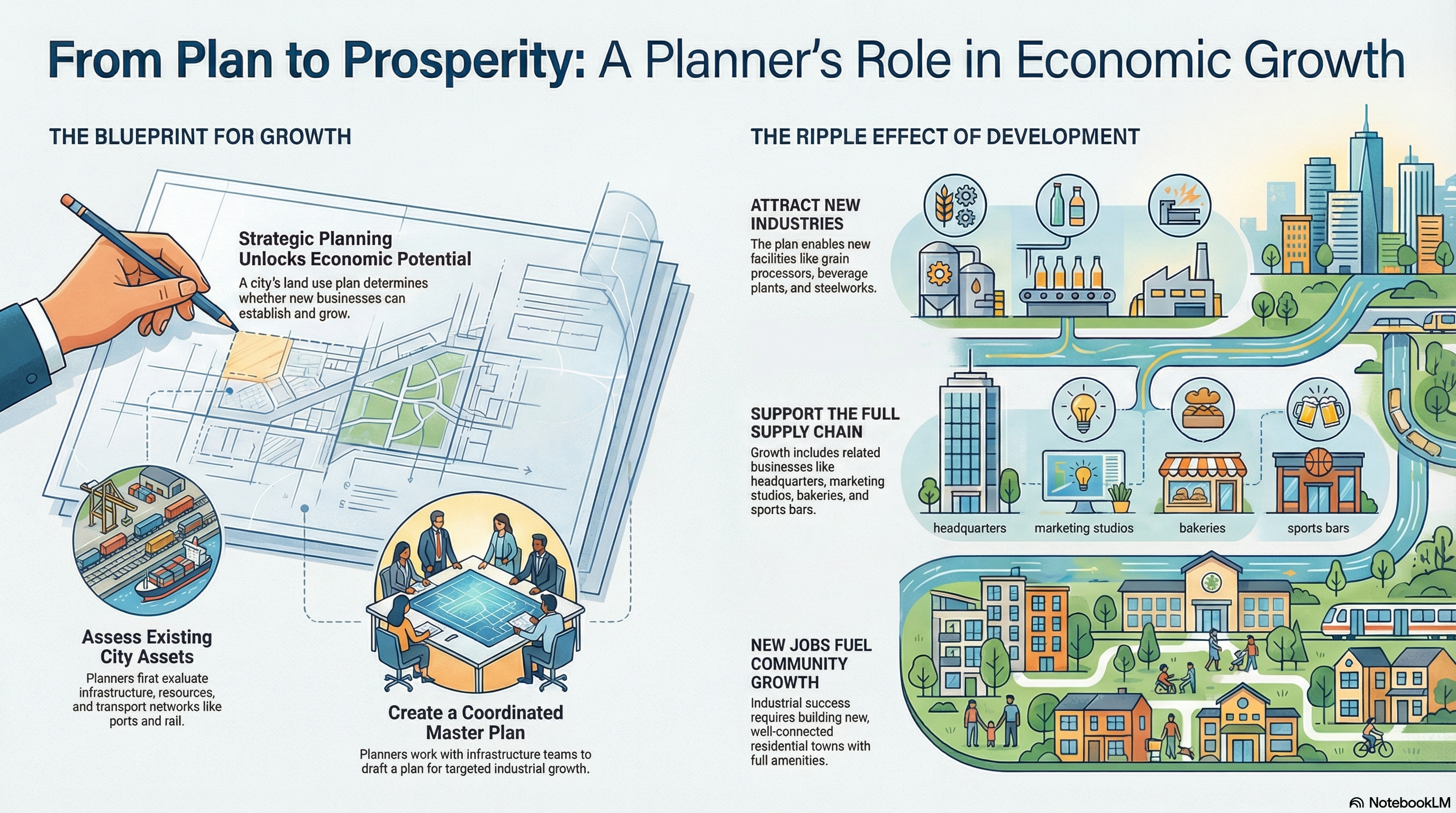
The central pillar of this strategy is a decisive shift from exporting raw materials to developing sophisticated, end-to-end local supply chains. This is the only path to sustainable prosperity, creating an “economic moat” that fosters self-sufficiency and insulates our community from the volatility of global commodity markets. By processing, manufacturing, marketing, and selling goods locally, we will create a resilient economic ecosystem that multiplies opportunities, generates higher-value jobs, and captures the full value of our primary products within Marsden Point.
This “Master Plan for Industrial Diversification” mandates the attraction and establishment of new value-added industries that directly leverage Marsden Point’s primary sector strengths. The initial phase will concentrate on the following sectors:
- Grain & Cereal Production: A Cereal Plant will be established to process locally grown grain, transforming it into high-value consumer food products.
- Livestock Processing: A new Livestock Processing Plant, or meat works, will convert livestock from our rural sector into food products for local and export markets.
- Beverage Production: A Beverage Plant will be developed to produce both alcoholic and non-alcoholic drinks, utilizing inputs from our expanding fruit and grain farms.
- Heavy Industry: To capitalize on the region’s mapped extractive resources, new industries in concrete and steel will be established, supporting construction and further industrial development.
Creating a complete economic ecosystem requires more than production facilities; it necessitates the development of end-user businesses and corporate support services that complete the value chain. The following ventures will be established to ensure that the economic benefits are fully realized within Marsden Point:
- Retail & Hospitality: The establishment of a local bakery and a sports bar will create direct-to-consumer channels for locally produced cereals and beverages, capturing final retail margins within the city.
- Corporate & Marketing Support: The creation of specialized support offices, such as the “Bottlecap Office” for the beverage industry, will anchor corporate functions locally. Furthermore, a television studio will be established to market these locally produced consumer goods, building brand value and driving demand.
The successful establishment of these new industries and the growth of the associated workforce depend entirely on a parallel strategy for urban development and residential planning, which is addressed in the following section.
The Planner’s Blueprint.
4.0 The Framework for Growth: Integrated Land Use and Transport Planning
An economic strategy is only as robust as the physical city that supports it. Sustainable growth cannot be achieved without a deliberate and integrated approach to land use and transportation planning. Together, these elements create the “City User Experience” for residents, businesses, and visitors, determining whether the city is a productive, accessible, and desirable place to be.
Our core spatial planning principle is the “Urban Island” or “Superblock” model. This approach creates a clear hierarchy within the transport network, allowing for both efficient movement across the city and safe, liveable communities within it. The model is defined by the distinct functions of arterial roads and local streets.
| Element | Function & Characteristics |
| Arterial Roads | Designed for the efficient movement of people and goods across the city. They form the perimeter of urban islands and connect different districts. Speed limits are higher (e.g., 50km/h). |
| Local Streets | Designed to serve people and function as extensions of living and social spaces. They form the interior network of urban islands, promoting community interaction and safety. Speed limits are lower (e.g., 30km/h). |
This land use framework is supported by a multi-modal transportation network designed to provide viable, efficient, and interconnected travel options for all citizens.
- Mass Transit: The heavy rail, metro rail, light rail/tram, and bus systems serve as the primary transit spines of the city. These high-capacity modes are designed to move large numbers of people efficiently between urban islands, connecting residential areas with employment and commercial centres. Trams and light rail are particularly suited to operating within urban islands, serving high-density residential and commercial areas.
- Active Transport (Cycling & Walking): Cycling and walking are fundamental to a healthy and efficient city. With most urban trips being local and under 6km, active transport is a strategic tool to manage localized congestion and improve overall network efficiency. It is the ideal mode for trips within urban islands and serves as the critical “first-and-last-mile” solution, connecting homes and workplaces to mass transit hubs. This strategy mandates investment in a complete active transport ecosystem, including on-road bike lanes, off-street separated pathways for bikes, e-scooters, and e-bikes, and essential end-of-trip facilities such as secure bike parking at all transit stations.
This integrated physical framework provides the physical mechanisms for achieving the people-centric principles of safety, health, and equity that are the hallmarks of a truly liveable city.
5.0 Supporting the Ecosystem: Fostering a Liveable and Equitable City
Long-term, sustainable economic growth is intrinsically linked to a city’s liveability and equity. The skilled workforce required to operate the new Cereal Plant, advanced manufacturing facilities, and corporate offices will not be attracted by jobs alone; they will come to Marsden Point—and stay—for its exceptional quality of life. A commitment to people-centric urban development is not an alternative to economic strategy—it is a prerequisite for its success. This commitment is a direct response to the negative outcomes of car-dependent design, such as a rising obesity crisis and social disconnection, which undermine community well-being.
Our approach is guided by a set of non-negotiable principles for urban development that place human well-being at their core:
- Prioritize Healthy Streets: Our urban design will mandate environments that prioritize active modes of travel. By re-engineering our streets to make walking, cycling, and public transport safe and convenient, we will improve public health outcomes, reduce dependence on private vehicles, and create vibrant community spaces.
- Implement Safer Speeds: To dramatically improve safety and enhance community cohesion, 30km/h speed zones will be applied to all residential and commercial streets within our urban islands. Lower speeds are proven to reduce the frequency and severity of traffic injuries, encouraging more social interaction and making streets feel like true community spaces.
- Ensure Equitable Access: Our transport philosophy is that road corridors are shared public spaces that must serve everyone. We will move decisively away from car-dominant planning—where car use is treated as a right—and toward a balanced system where walking, cycling, and public transport are fully supported modes of travel. This ensures that all citizens have equitable access to the opportunities our city offers, regardless of age, income, or ability.
These principles will guide the tangible actions and investments required to bring this holistic vision for Marsden Point to fruition.
Marsden Point: A Metropolis by Design
6.0 Implementation Roadmap and Conclusion
This concluding section outlines the practical pathway from strategy to reality, detailing the initial steps required to bring this Master Plan to life. The implementation will be phased to ensure that development is managed, sustainable, and aligned with infrastructure delivery.
The initial phase of implementation will focus on establishing the new rural and value-added industries outlined in the core strategy. This includes the development of the Cereal Plant, Livestock Processing Plant, and Beverage Plant, along with their supporting agricultural supply chains. In parallel, a new semi-sufficient satellite town, “Whangarei Flats,” will be developed. This community is purposefully designed to house the workforce for these new sectors, providing all necessary local amenities and high-quality transport connections back to the main urban centre of Marsden Point.
In conclusion, this strategy delivers a comprehensive and integrated blueprint for the future of Marsden Point. It is a plan where deliberate economic diversification, intelligent urban design, and an unwavering commitment to liveability and equity are not separate goals, but interwoven components of a single mission. By developing self-sufficient supply chains, building a city for people, and fostering a high-quality living environment, we will build a resilient, prosperous, and vibrant future for all who call Marsden Point home.

 Talking Southern Auckland