Moving from Legislative Theory to Design-Led Practice on the Ground
For decades, our cities have been designed as “dormitory suburbs”—monolithic zones that function merely as storage for people and cars. This legacy of “artificial distance” has crippled our collective metabolic rate, forcing us into a state of negative productivity where hours are lost to the friction of traffic and rigid zoning. The Aotearoa Planning Bill 2025 represents a clean break from this failed model. It signals the transition from the subjective “nitpicking trap” of mid-century aesthetics to a systemic “Culture of Adherence.”
As an Urban Systems Futurist, I see this not merely as a policy shift, but as the launch of an Urban Operating System. We are moving away from planning-by-opinion and toward an algorithmic liberation where the infrastructure skeleton dictates the form of the city. Here are the five most impactful takeaways from this blueprint for a functional, 24/7 ecosystem.
1. “Density Follows Frequency” — Zoning by Math, Not Opinion
The Bill replaces traditional height limits with “Capacity Zoning.” In this model, building intensity is legally tethered to the capacity of the transit network. By removing the ability for local committees to litigate “character,” the Bill ensures we stop “wasting public infrastructure investment on low-density outcomes.”
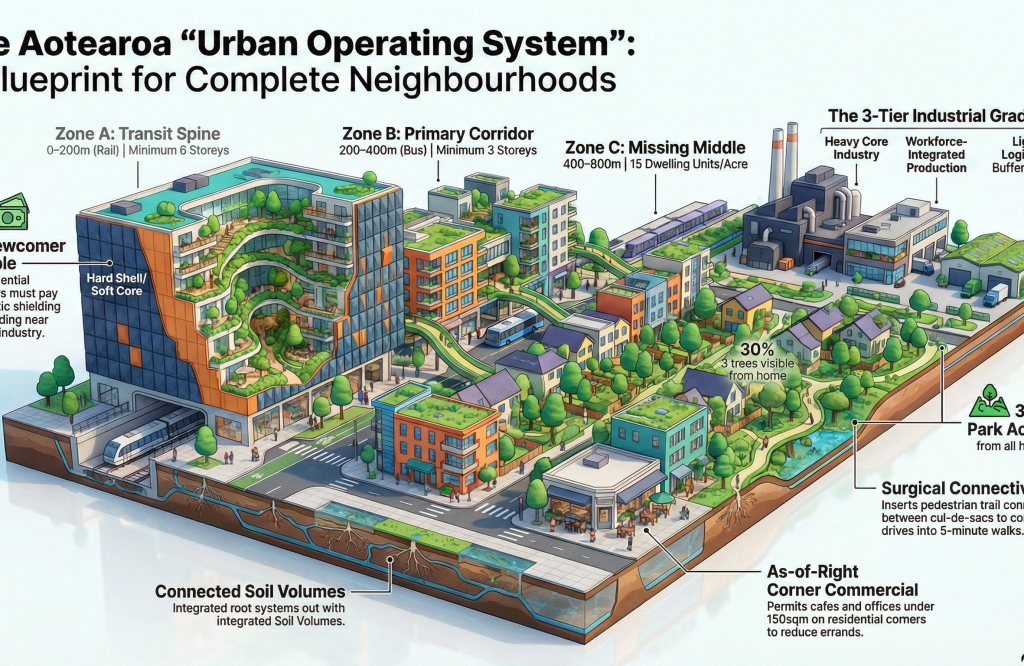
- Zone A (The Transit Spine): Within 200m of a rail station, a minimum of 6 storeys is mandated.
- Zone B (The Primary Corridor): Within 400m of frequent bus routes, a minimum of 3 storeys is mandated.
To manage this density, the Bill introduces the “Hard Shell / Soft Core” perimeter block. The building functions as a machine: the street-facing facade acts as an acoustic shield, while the “soft core” hones a quiet, green internal courtyard. This ensures that the city’s transit “piston” can move at high frequency without compromising the domestic peace of the residents inside.
2. The “Urban Dam” — A Hard Stop to Sprawl
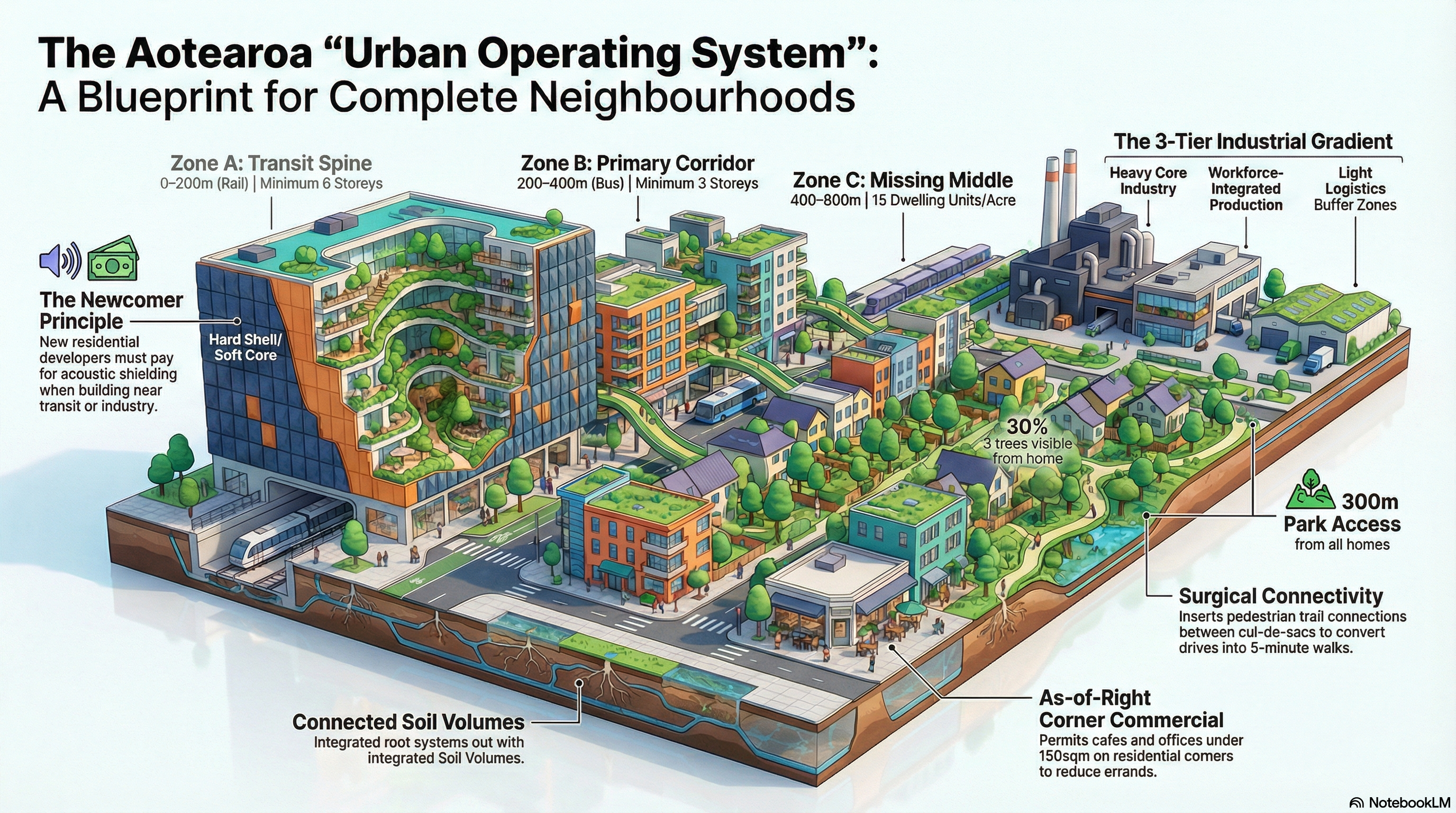
To protect rural productivity, the Bill utilizes a “Reservoir and Dam” metaphor to funnel growth. It creates a binary legal geography: the Urbanisation Promoting Area (UPA) and the Urbanisation Control Area (UCA).
The brilliance here is the fiscal mechanism. By intentionally withholding the “subsidy of sprawl”—refusing to fund municipal sewage or road widening in the UCA—the Bill kills speculative land pricing. Land in the UCA is priced for its actual productivity (farming) rather than its potential for future subdivision. Sprawl is not just “prohibited in principle”; it is rendered economically impossible, protecting the nation’s food basket from the “leak” of unserviced suburbia.
3. The “Newcomer Principle” — The “Right to Operate”
One of the greatest points of social friction in a living city is “reverse sensitivity”—the tendency of new residents to complain about the very industries that power the economy. The Bill resolves this via the “Agent of Change” rule, or the Newcomer Principle.
Under this rule, the party introducing a new use is responsible for all mitigation. If a developer builds an apartment next to a 24/7 rail line or a metal fabrication factory, they must pay for high-spec acoustic glazing and mechanical ventilation. This creates an “Invisible Shield” for the city’s economic engines, securing their long-term viability against litigation.
“The farmer is protected from noise and smell complaints, securing the long-term viability of the economic engine.”
4. Nature as “Green Utility” — The Mandatory 3-30-300 Rule
Nature is no longer a decorative “nice-to-have”; it is now a non-negotiable “Green Utility” mandated by the 3-30-300 Rule. This is a biological mandate for public health:
- 3 Trees: Visible from every window.
- 30% Canopy: Neighbourhood cover to mitigate the urban heat island effect.
- 300 Meters: A barrier-free walk to a high-quality park.
To prevent trees from dying in “concrete coffins,” the Bill mandates “Connected Soil Volumes”—underground trenches that allow roots to share nutrients and manage stormwater. This provides a massive Triple ROI: a 1:3 financial return on maintenance, a 1:18 return in social health savings, and a 50% reduction in stormwater infrastructure costs.
5. “As-of-Right” Corners — Bringing Back the 8-80 Grid
To transform dormant suburbs into “Complete Neighbourhoods,” the Bill mandates Standardized Inclusive Zoning. This permits a “narrow range” of commercial uses (dairies, cafes, and co-share offices under 150sqm) automatically on residential corner sites.
The goal is to reach a mathematical tipping point of 15 Dwelling Units Per Acre (DU/AC)—the density required to make local commerce viable without car dependency. Through “Surgical Connectivity”—inserting trail shortcuts between cul-de-sacs—the Bill “un-breaks the grid.” This follows the “8-80 Rule,” creating a neighbourhood that is as navigable for an 8-year-old on a bike as it is for an 80-year-old in a wheelchair, effectively eliminating “junk miles” driven for basic errands.
Conclusion: A Blueprint for the Resilient Habitat
The Aotearoa Planning Bill 2025 represents the transition from a city that serves as a mere storage facility to one that functions as a living, resilient habitat. By replacing subjective aesthetics with objective mathematical standards, we are building an ecosystem where everyday life happens just outside the front door.
Imagine your life if your neighbourhood functioned as an Operating System rather than a dormitory—where the “piston” of transit, the “dam” of sprawl control, and the “green utility” of nature worked in concert to protect your time and health. How would your world change if your city was finally designed to work?

 Talking Southern Auckland