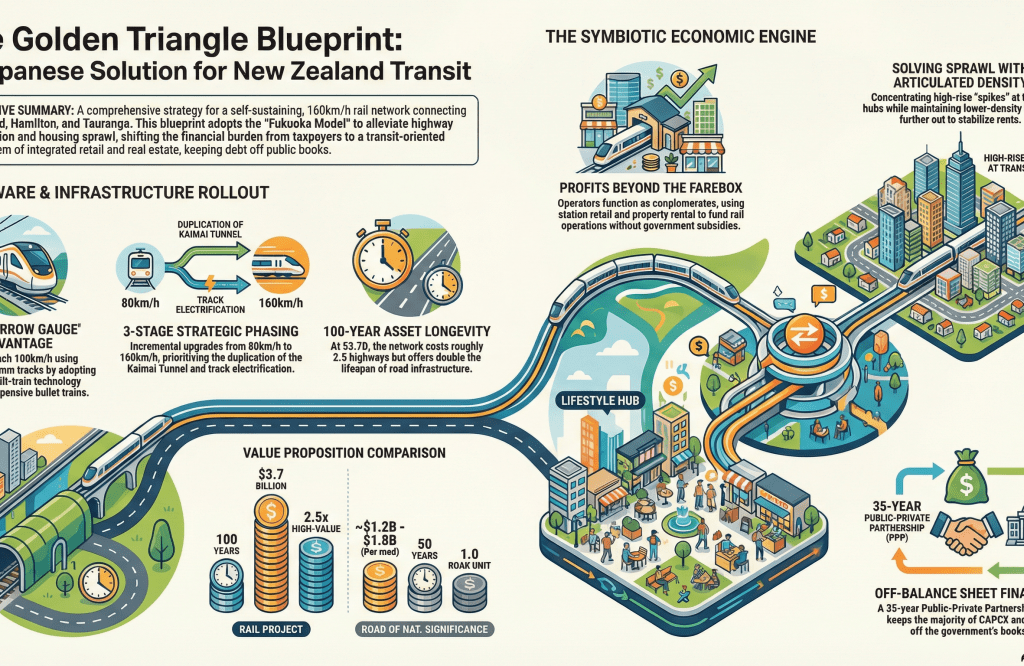
Short term, 3-year electoral thinking rather than 100-year generational thinking means we can not have nice stuff like intercity rail!
Executive Summary
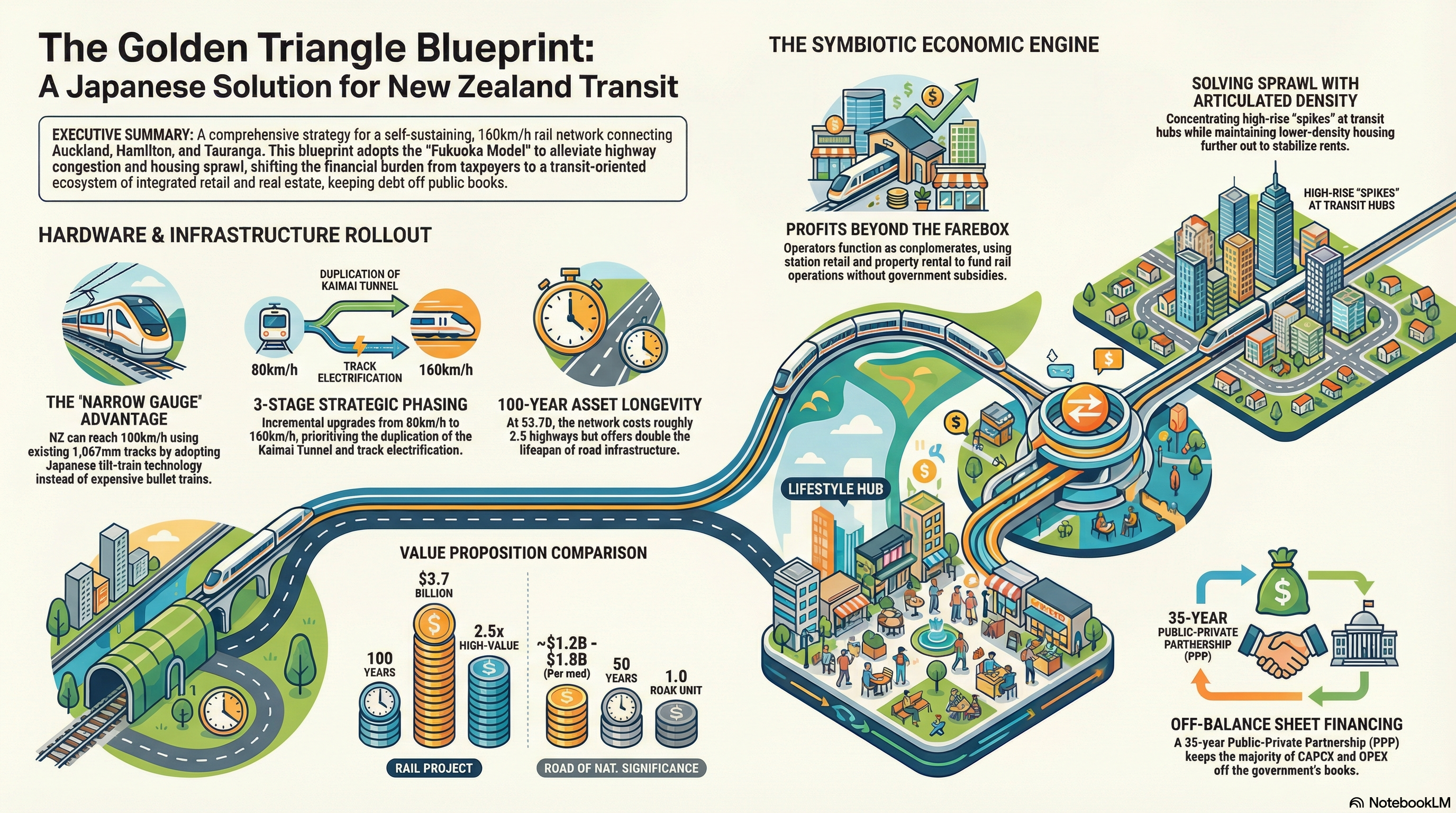
This briefing document outlines a strategic shift for Auckland and the “Golden Triangle” (Auckland, Hamilton, and Tauranga) transit networks, advocating for the adoption of a Japanese-style integrated transit and property development model. Unlike Western systems that rely heavily on government subsidies and farebox revenue, the Japanese model transforms transport operators into self-sustaining conglomerates. By leveraging Transit-Oriented Development (TOD), capturing land value, and diversifying into micro-retailing, these operators achieve financial independence while addressing critical housing shortages.
Key takeaways include:
- The Fukuoka Blueprint: Auckland should emulate its sister city, Fukuoka, focusing on relevant-scale transit and land use rather than attempting to replicate mega-cities like Tokyo.
- Financial Independence: Integrated TOD models generate massive non-fare revenue through property management and retail, allowing operators to fund capital and operational expenditures without government handouts.
- Phased Infrastructure: A three-stage plan for the “Golden Triangle” utilizes existing narrow-gauge tracks to reach speeds of 160km/h, costing an estimated $3.7 billion—high value compared to highway projects.
- Articulated Density: Moving from inefficient “carpet development” to “articulated density” focuses high-rise growth around transit hubs, stabilizing rents and accelerating housing supply.
- Strategic Partnerships: Implementing this model through multi-decade Public-Private Partnerships (PPPs) with Japanese rail experts could keep major expenditures off the public books.
The Strategic Shift: Emulating the Fukuoka Model
Rather than attempting to replicate the systems of massive mega-cities like Tokyo or Yokohama—which is characterized as a “huge mistake” for the Auckland environment—Auckland should look to the model of its sister city, Fukuoka.
- Transit-Oriented Development (TOD): Fukuoka’s approach to land use and TOD is considered highly relevant to Auckland’s growth.
- Demographic Alignment: Auckland’s growing Asian demographic (projected to reach 30% by 2021) creates a latent demand for the convenience-oriented transit lifestyles common in Asia.
- Lifestyle Integration: Moving beyond “Plain Old Transport Services” (POTS) toward an integrated lifestyle model caters to younger “Kiwi millennials” who value Japanese-style service and efficiency.
Financial Sustainability: The Non-Fare Revenue Model
A core component of the Japanese model is transforming public transport into a self-sustaining, diversified business. This reduces or eliminates the need for taxation-funded subsidies.
1. Integrated Property Development
In typical Western “rentier capitalism,” government-funded transit increases nearby property values, but independent landowners capture all the financial benefit. In the Japanese model, the transit operator:
- Owns and Manages Land: Operators buy land around, above, or below stations.
- Captures Value: The financial wealth created by the transit route is fed back into the transport system.
- Incentivized Rents: Because operators need both tenants and riders, they are incentivized to keep rents competitive rather than price-gouging.
2. Diversified Revenue Streams
- Station Micro-Retailing: Embedding convenience kiosks, vending machines linked to apps, and “trip-attractor” tenants directly into the station concourse turns passengers into shoppers.
- Shared Operational Costs: As large conglomerates, operators share overhead costs across transport, real estate, and retail divisions, reducing the financial burden on the transit side alone.
- Demand Smoothing: High-density, mixed-use centres with “morning-to-night vibrancy” attract off-peak travellers, balancing passenger volumes throughout the day.
The Golden Triangle Rail Network: A Phased Infrastructure Plan
The proposal for an inter-city rail project connecting Auckland, Hamilton, and Tauranga utilizes New Zealand’s existing 1,067mm narrow-gauge tracks, matching the standard used for Japanese inter-city services and Queensland’s Tilt Trains.
Development Stages and Speed Targets
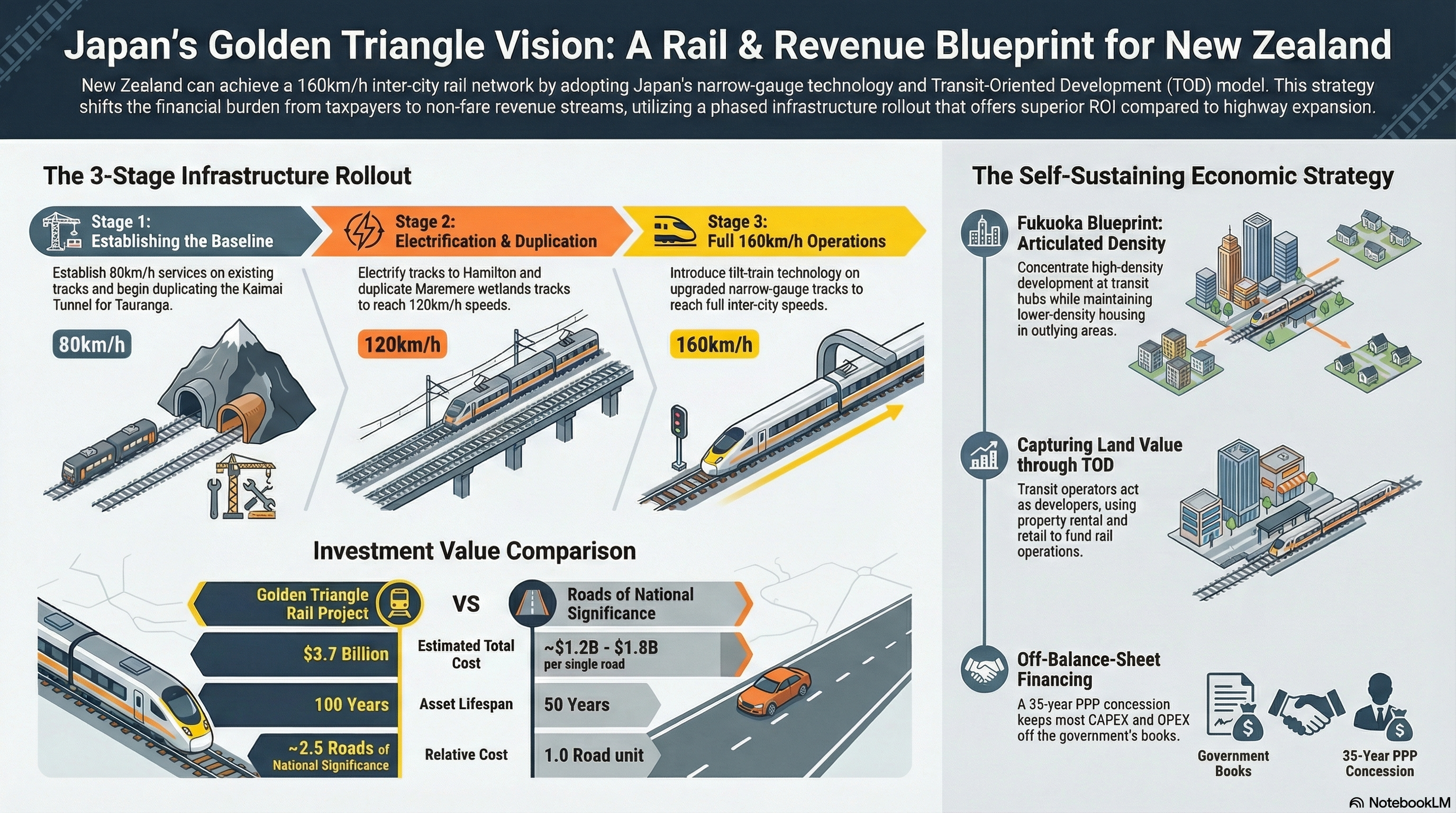
| Stage | Primary Infrastructure Actions | Speed Goal |
| Stage 1 | Establish baseline services; begin duplicating Kaimai Tunnel (Tauranga). | 80 km/h |
| Stage 2 | Track duplication (Meremere, Ngāruawāhia); electrification (Pukekohe to Hamilton). | 120 km/h |
| Stage 3 | Full implementation of tilt train technology on upgraded tracks. | 160 km/h |
Cost Analysis and Value
The total estimated cost for the Auckland-Hamilton-Tauranga network is $3.7 billion.
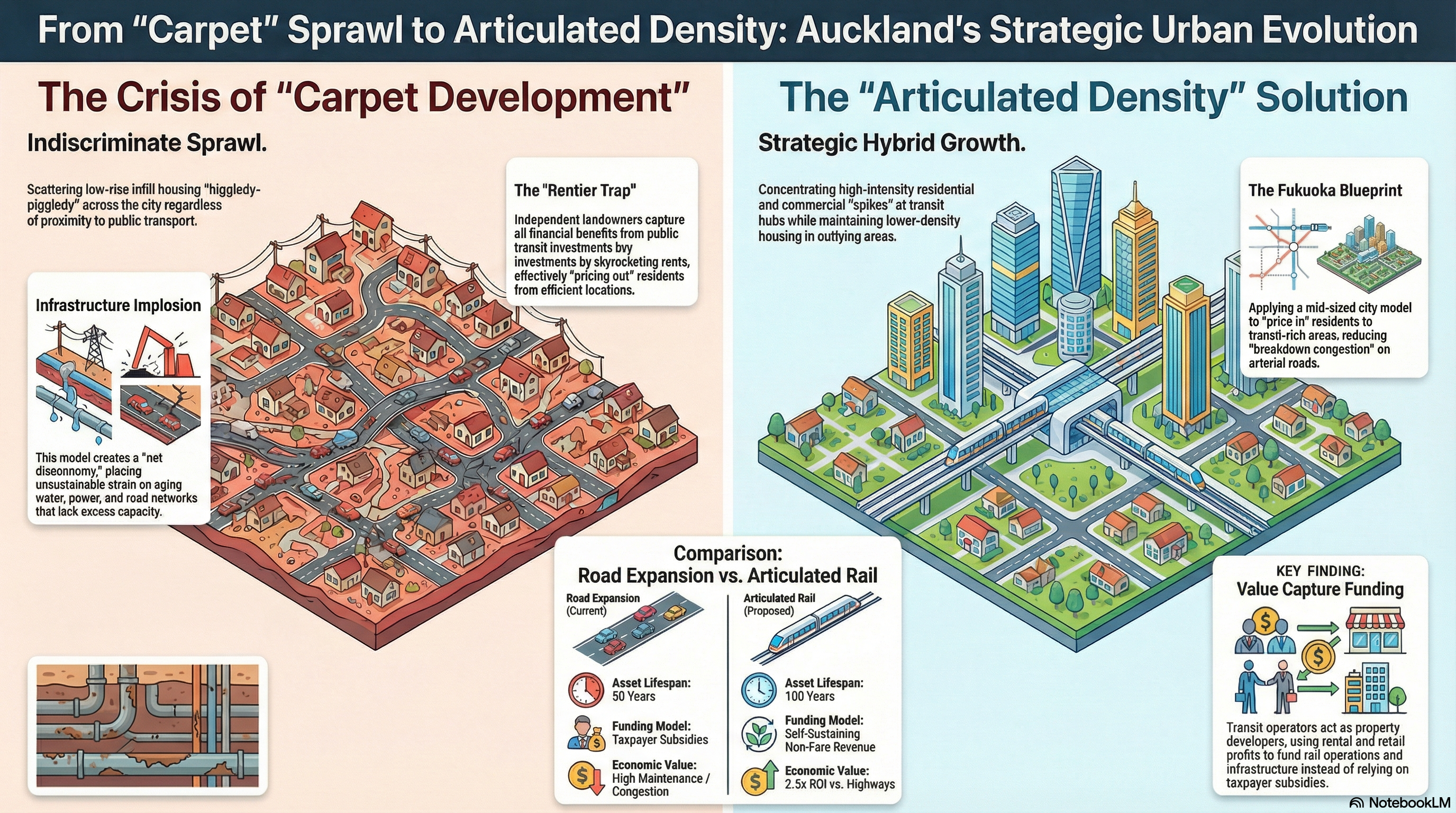
- High ROI: This represents extraordinary value for a 100-year asset timeframe compared to four-lane highways (50-year timeframe).
- Relative Cost: The total project cost is equivalent to approximately 2.5 of the government’s proposed “Roads of National Significance.”
- Auckland to Hamilton Focus: Bringing stations up to scratch, duplicating bridges, and rolling stock for hourly services between these two cities is estimated at $1.243 billion.
Urban Reform through Articulated Density
The Japanese TOD model offers a solution to Auckland’s “imploding” planning approach, which currently relies on inefficient “carpet development” (scattered low-rise infill).
- Articulated Density Concept: A hybrid model featuring high-density development strictly around transit hubs while maintaining lower-density housing elsewhere.
- Breaking Land Monopolies: Transit operators owning the surrounding sites prevents independent landowners from absorbing the value created by public investment.
- Accelerating Supply: While Western housing stock turnover is extremely slow, the competitive Japanese TOD environment results in a turnover cycle of under 40 years, ensuring responsive supply.
- Greenfield TODs: Building new “alternative CBDs” on greenfield sites without height limits or NIMBYism can discipline the inflated rent expectations of the current CBD.
Implementation via Public-Private Partnerships (PPP)
Due to New Zealand’s historical struggles with large infrastructure delivery, the sources advocate for bringing in Japanese rail experts to manage the network.
- Multi-Decade Concessions: Suggesting a 35-year concession where a Japanese firm would design, build, own, and operate the service.
- Off-Book Financing: Under this PPP model, the vast majority of capital expenditure (CAPEX) and operational expenditure (OPEX) can be kept off the government’s books.
- Freight Synergy: Infrastructure upgrades—particularly the duplication of the Kaimai Tunnel and track electrification—provide significant spillover benefits for KiwiRail’s freight operations.
Conclusion
Adopting the Japanese integrated model represents a transition from viewing transit as a social cost to viewing it as a commercial opportunity. By focusing on non-fare revenue, articulated density, and phased infrastructure upgrades compatible with existing rail gauges, New Zealand can develop a financially independent and efficient transit network that supports long-term regional growth.

 Talking Southern Auckland