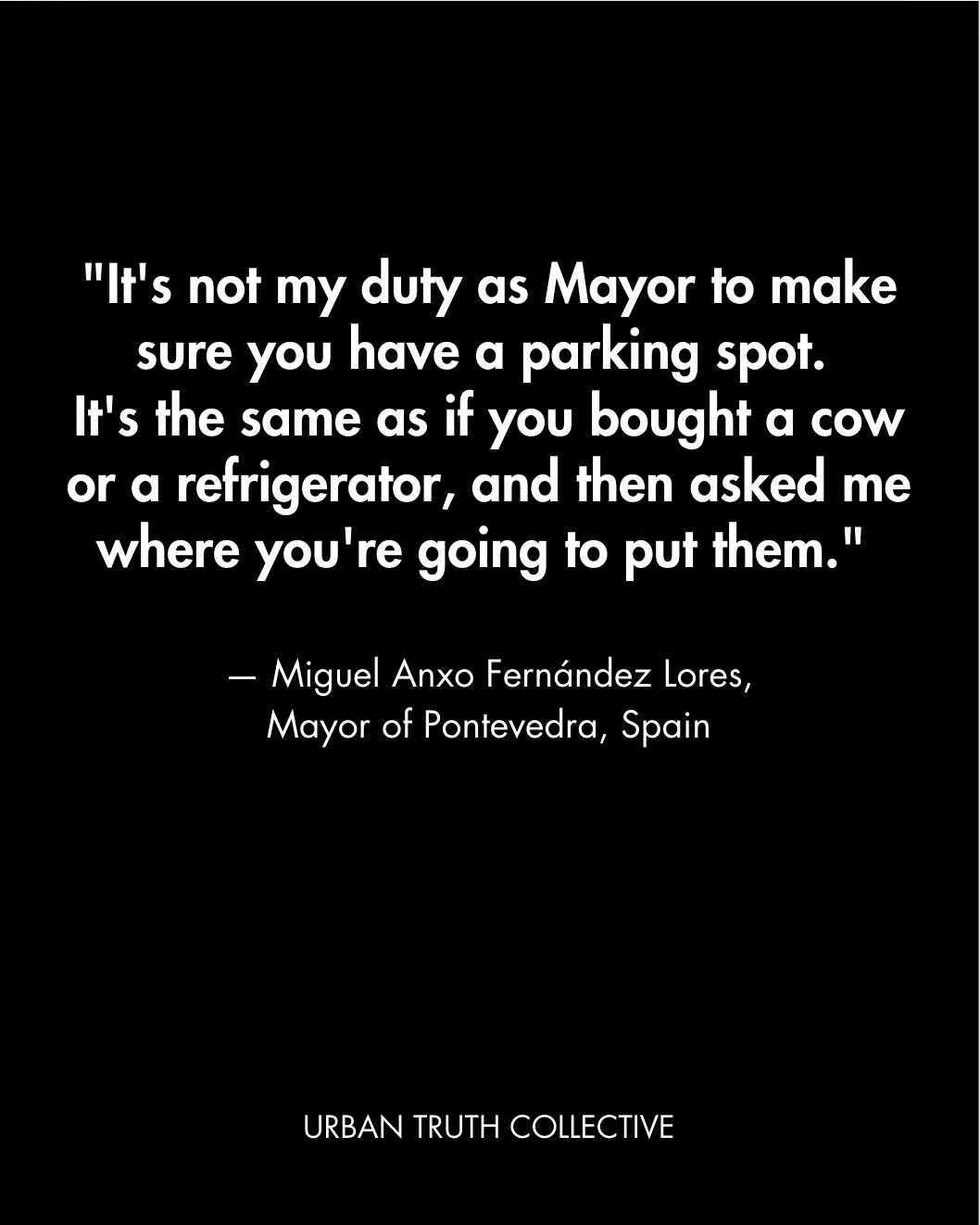
Provision of Parking is a Private not Public Responsibility
Never waste a good crisis to push through reforms. And given parking has come back up as a debate topic in Auckland even while the price of 91 accelerates over the $3/litre market, it is a good reminder that Minimum Parking Requirements before they were banned in 2020 led us to the current situation some have gotten the wrong end of the stick with in regards to intensification. So, let’s take a look at parking again how Japan handles the situation. As we are not banning cars, just rather shifting the responsibility BACK to private owners where it belongs.
Rather timely.
How Japan and even Auckland Transport looks at parking
1. How Japan Manages On-Street Parking
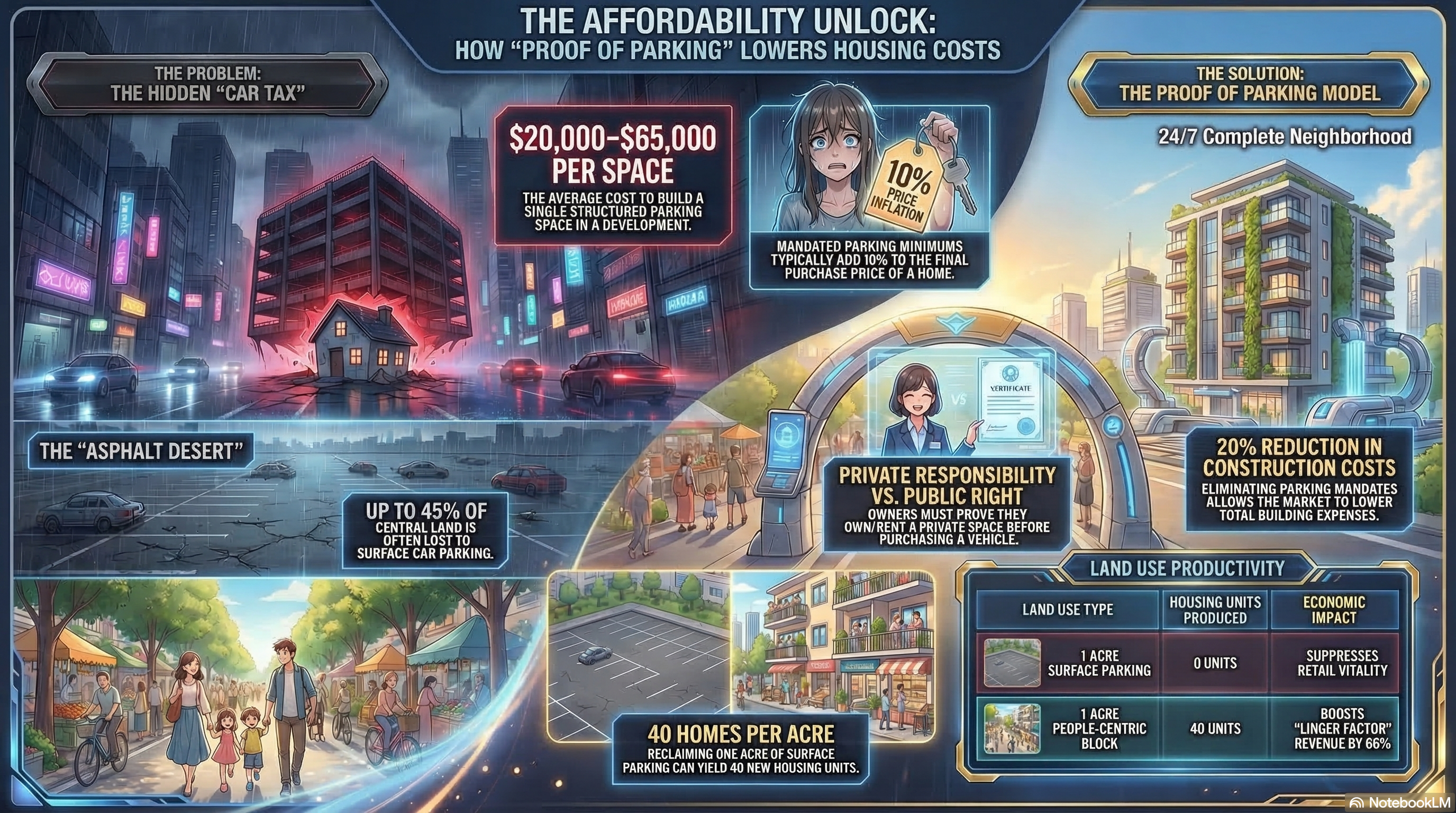
Japan manages on-street parking by fundamentally treating vehicle storage as a private responsibility rather than a publicly subsidized right. Under the “Tokyo Model,” Japan enforces a strict “proof of parking” policy. Before a resident is permitted to purchase a vehicle, they must legally demonstrate that they either own or rent a private parking space. This approach keeps public streets clear of parked vehicles, shifting the physical footprint of car storage into private facilities. Consequently, it eliminates the need for city-mandated parking minimums on new developments, freeing up incredibly valuable urban land for housing, commerce, and green spaces.
2. The Impact of “Proof of Parking” on Housing Affordability
The “proof of parking” policy directly and significantly improves housing affordability by allowing cities to eliminate mandatory parking minimums. Traditional parking rules function as a hidden “car storage tax” that artificially inflates the cost of building homes. Constructing a single structured parking space costs between $20,000 and $65,000, which adds approximately 10% to the final purchase price of a house. By abolishing these mandates and allowing the market to dictate parking demand, developers can lower overall construction costs by up to 20%.
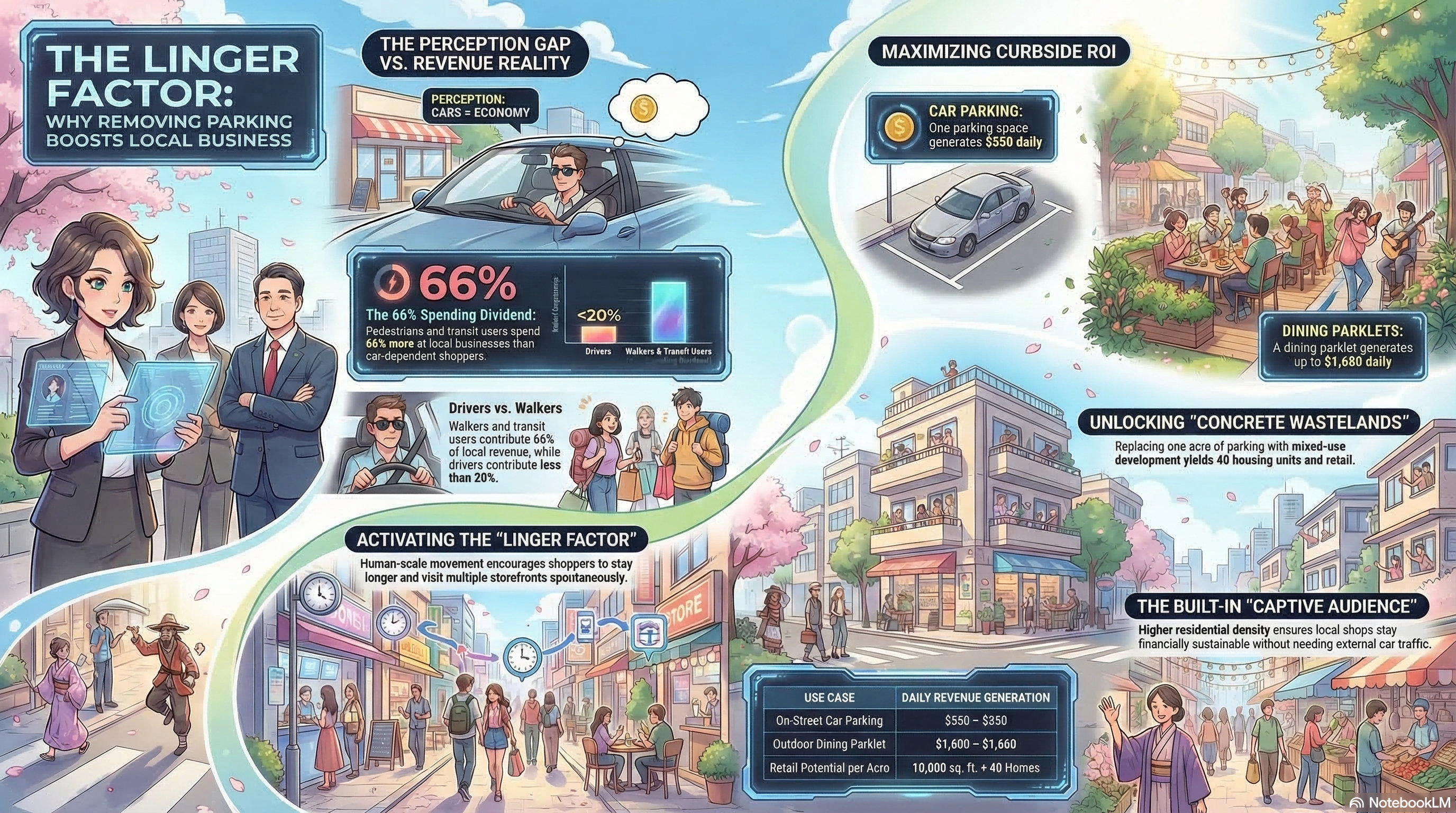
Furthermore, this policy unlocks massive amounts of land for higher-density development. While one acre of surface parking yields zero housing units, that exact same acre can support 40 housing units alongside retail space when parking mandates are removed. By spreading land and construction costs across a greater number of housing units, developers significantly lower the financial barrier to entry for residents.
3. Applying Japan’s Parking Model to New Zealand Cities
Applying Japan’s “Tokyo Model” to New Zealand cities is a core strategy proposed to transform regions from car-centric sprawl into people-centric environments. Under the frameworks associated with the Aotearoa Planning Bill 2025, integrating this model involves several key interventions:
- Eliminating Parking Minimums: Removing the hidden “car tax” that forces developers to build unneeded parking, enabling flexible, market-led development.
- Unlocking “Concrete Wastelands”: In areas like Manukau City Centre, 33% to 45% of central land is currently lost to surface car parking, creating isolated “urban islands”. The Japanese model allows this land to be reclaimed for high-value housing and mixed-use development.
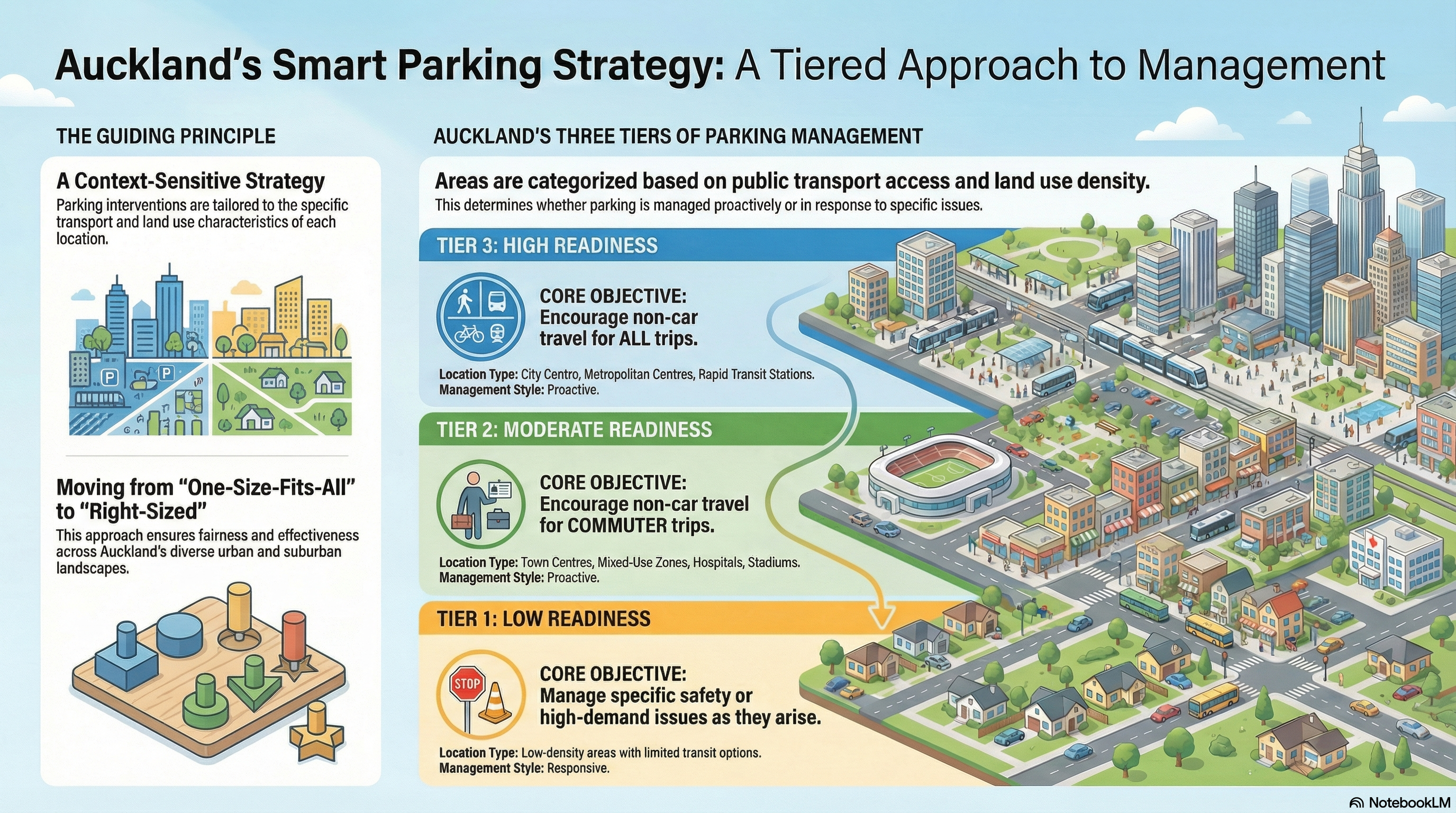
- Creating “Park-Once-and-Walk” Districts: Cities can implement a Tier 3 Parking Plan (as created by Auckland Transport), which proactively removes and prices on-street parking to manage demand. Remaining parking is consolidated into shared facilities, and the freed-up road space is repurposed for dedicated bus lanes—which move over 4 times more people per hour than a general traffic lane—and wider footpaths.
4. The Effect of Removing On-Street Parking on Local Business Revenue
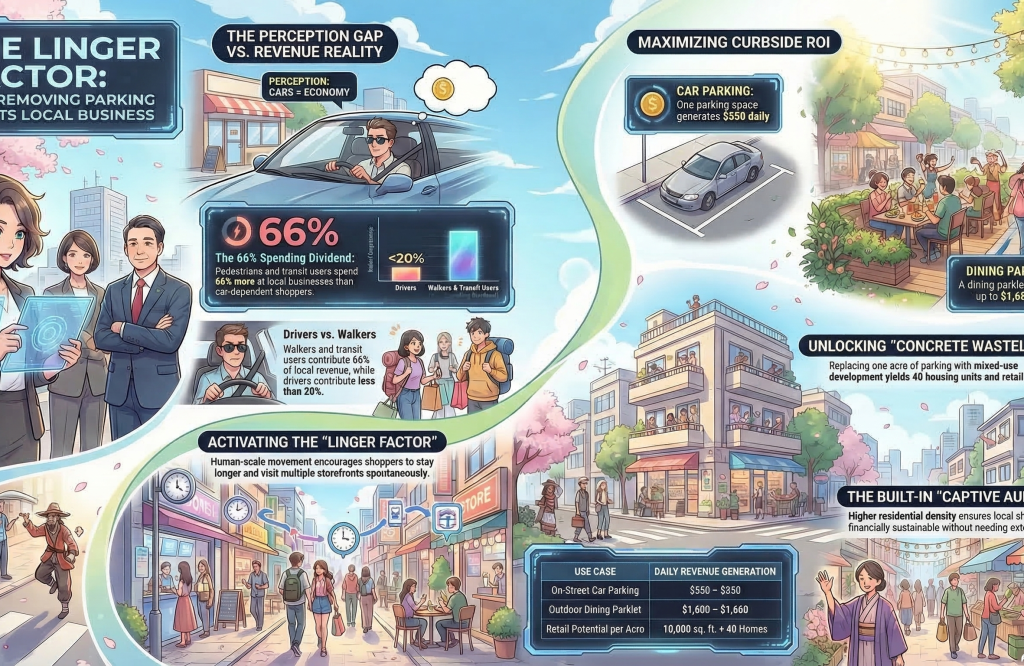
Removing on-street parking to prioritize pedestrian-friendly infrastructure (such as wider footpaths, cycleways, and outdoor dining) directly boosts local business revenue. This shift overcomes the “Perception Gap”; while it is commonly assumed that drivers drive the local economy, data reveals that walkers and transit users actually contribute up to 66% of local retail and hospitality revenue, whereas drivers contribute less than 20%.
This economic boost is primarily driven by the “Linger Factor”. Pedestrians and cyclists move at a human pace and spontaneously interact with multiple storefronts, spending approximately 66% more than car-dependent shoppers who tend to “trip-chain” (drive to one destination, make a transaction, and leave immediately). Additionally, repurposing curb side space maximizes urban profitability; converting a single car parking space into an outdoor dining parklet can increase its daily economic generation from $550–$950 up to $1,600–$1,660 per day. Finally, replacing surface parking with mixed-use buildings provides local businesses with a built-in, captive customer base that sustains a 24/7 economy.
The video summaries the Tokyo Model in regards to parking policy.

 Talking Southern Auckland