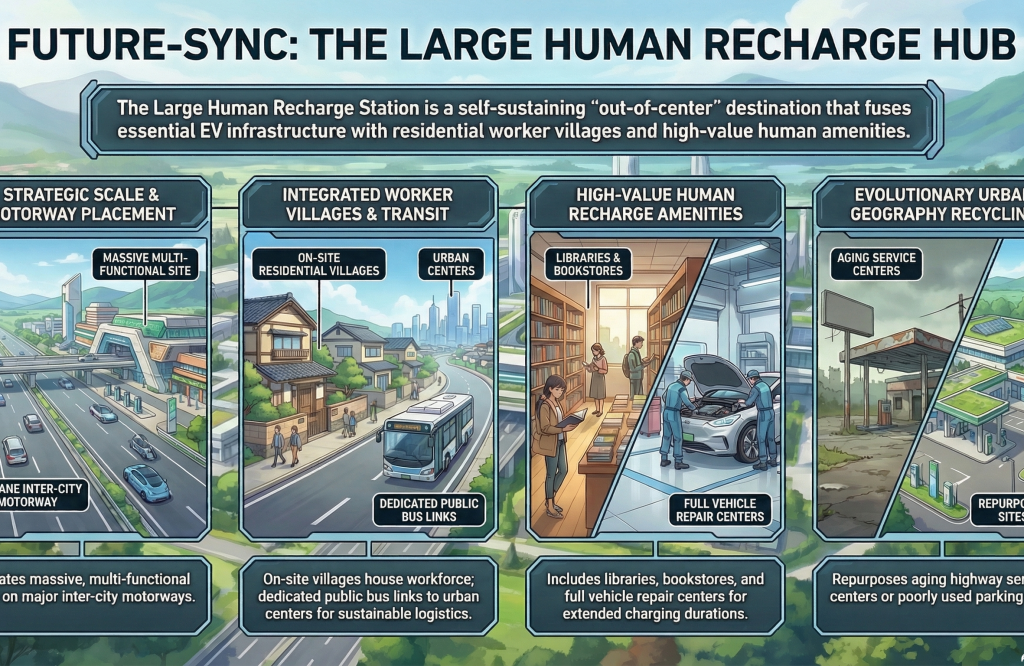
A look into the largest of the Human Recharge Stations
Time to take look at the Large version of the three classes of Human Recharge Stations. The focus around Large Human Recharge Hubs (or Stations) is because the Large Human Recharge Hub caters to inter-city and inter-regional trips not only for cars and passengers but our trucks and freight as well. Trucks and freight that have compulsory down time after so many hours of driving. What also makes the LHRH unique is that it has a supporting workers village nearby to cut down on commutes especially in these oil crisis times of 2026!
So let’s take a look at the Large Human Recharge Hub
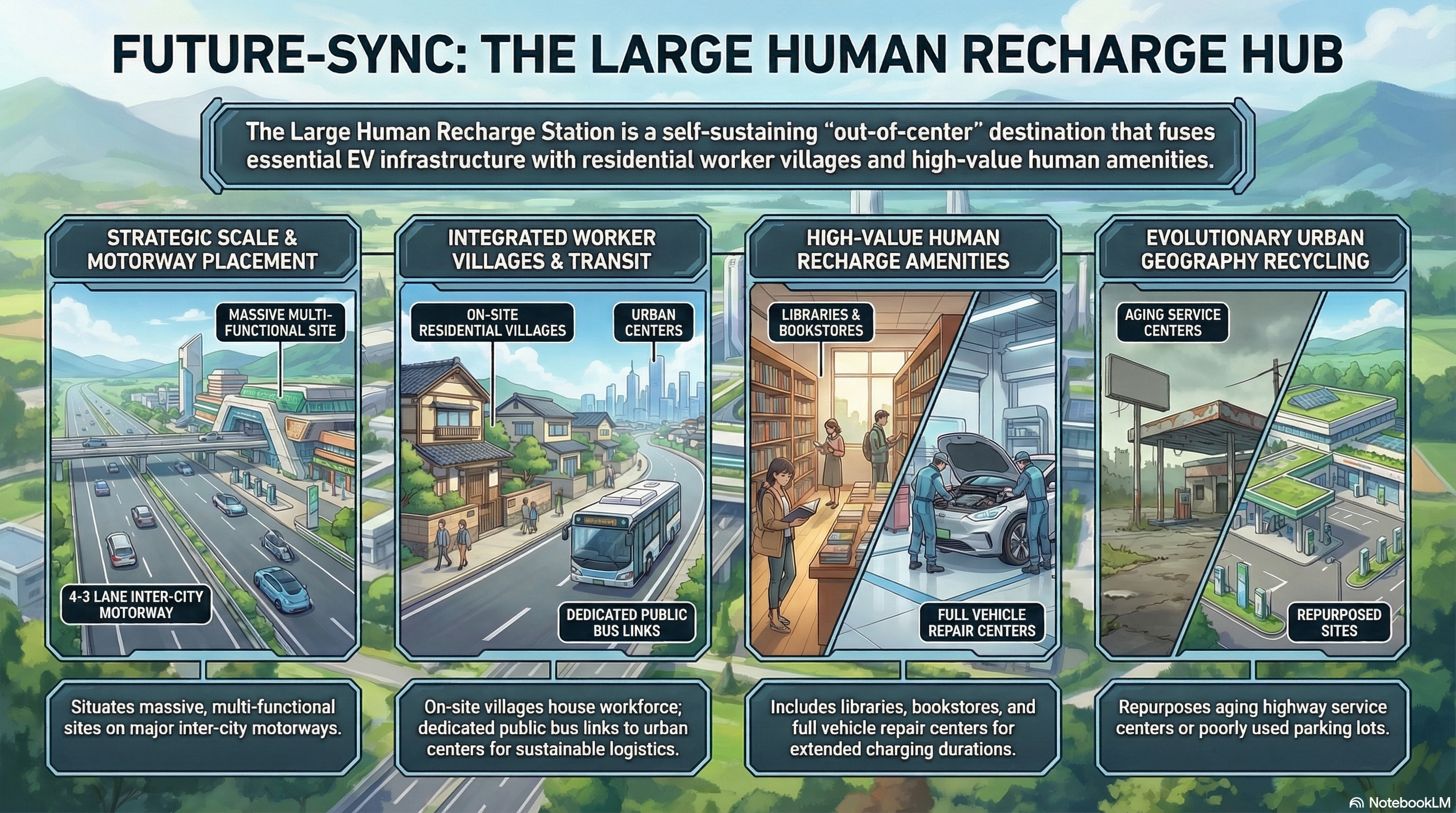
1. Executive Vision: The Evolution of Transit Infrastructure
The global transition to Electric Vehicles (EVs) necessitates a fundamental reassessment of transit infrastructure architecture. The traditional “pit stop” model, designed for the rapid refuelling of internal combustion engines, is becoming obsolete. As fast-charging protocols currently mandate a minimum seven-minute downtime—often extending significantly during peak demand or inclement weather—we must shift from utilitarian stops to “human experience places.” Inspired by successful Danish infrastructure benchmarks, this blueprint redefines the charging interval as an opportunity for high-value human utility.
A core Strategic Mandate of this blueprint is “Urban Geography Recycling.” This philosophy prioritizes the adaptive reuse of underutilized land—such as poorly used parking lots or declining highway service centres—to prevent these sites from becoming “stranded assets” as the fossil fuel era wanes. By applying evolutionary urban planning rather than high-cost revolutionary construction, we leverage existing spatial syntax to meet modern technological needs.
The primary objectives of a Large Human Recharge Station (LHRS) are defined as follows:
- Massive Scale Integration: Aggregating transit, retail, and community functions into a single, comprehensive “all-in-one” site footprint.
- Human-Centric Comfort Standards: Prioritizing hygiene, recreation, and mental well-being to mitigate the psychological fatigue of charging downtime.
- Strategic Asset Preservation: Repurposing traditional gas station footprints into modern hubs to prevent urban decay and maintain land value.
- Operational Self-Sufficiency: Incorporating onsite workforce housing and dedicated transit links to ensure long-term commercial and logistical viability.
This blueprint transforms these hubs into regional destinations rather than mere transit nodes, dictated by the rigorous geographic requirements of high-volume corridors.
2. Strategic Site Selection and Spatial Requirements
The viability of a Large Human Recharge Station is intrinsically linked to its geographic positioning. Given the massive land area required to integrate vehicle maintenance, retail strips, and residential quarters, site selection must prioritize high-visibility corridors that can support a “destination” status.
To ensure maximum utility for both inter-city travellers and regional commuters, site selection must adhere to the following checklist:
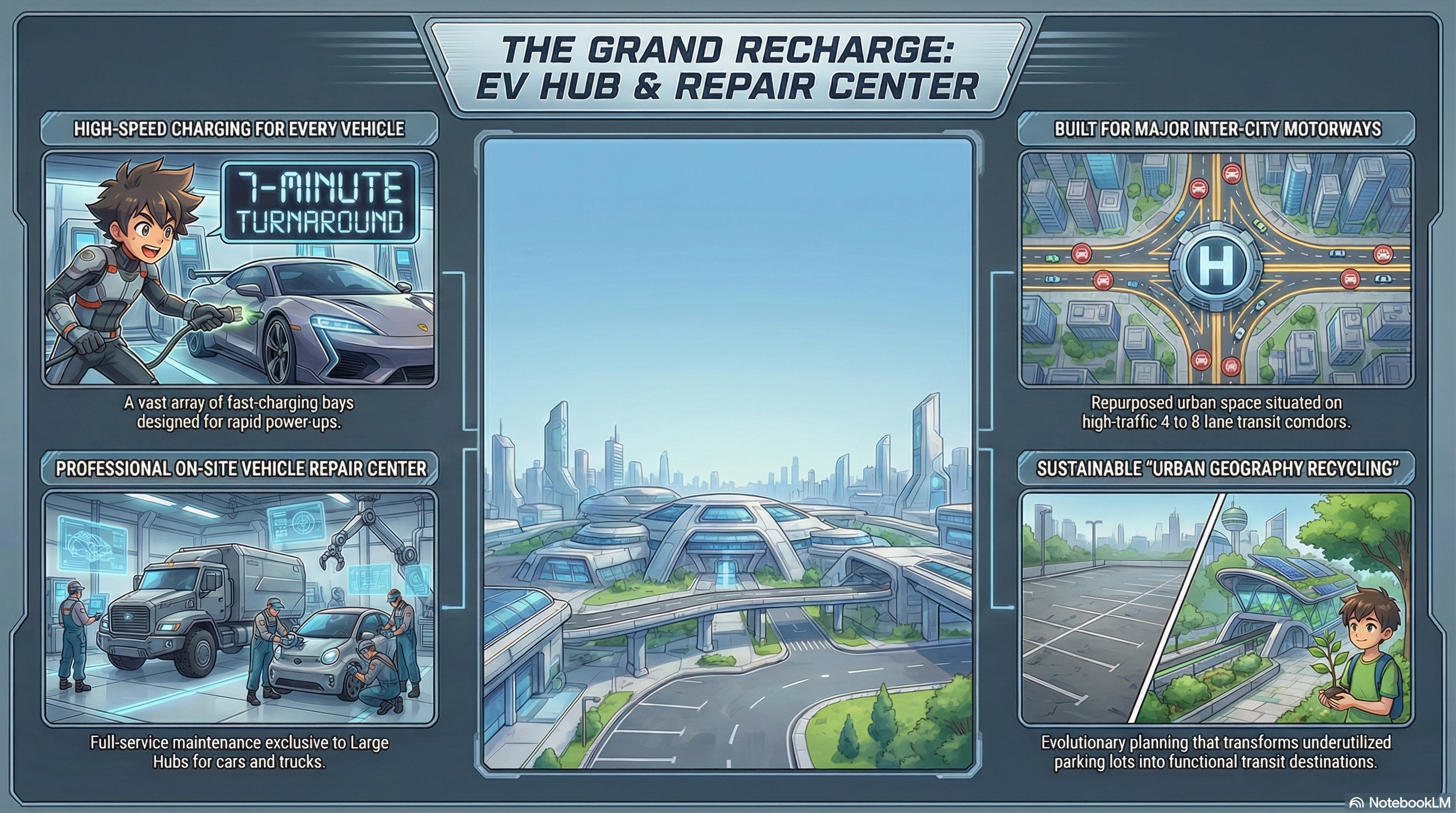
- Primary Motorway Placement: Immediate adjacency to major four- to eight-lane inter-city motorways.
- High-Capacity Urban Arterials: Sites situated on eight-lane urban avenues within city limits.
- Spatial Capacity for Integration: A footprint capable of supporting “everything rolled into one,” including a residential worker village.
- Regional Accessibility: Locations defined as “out-of-centre,” typically situated approximately 45 minutes from the primary urban core.
These “out-of-centre” locations are the only geographic zones capable of supporting the multi-functional infrastructure required for a Large-scale hub. This spatial freedom allows for the seamless transition from high-velocity vehicle movement to the stationary, high-utility environments required for the charging core.
3. Integrated Vehicle Maintenance and Energy Infrastructure
Managing the transition from fossil fuels to electric mobility requires a multi-modal energy approach. While the Hub is optimized for the future of EVs, the Large-scale model is unique in its retention of legacy services, ensuring it remains a comprehensive resource for all vehicle types currently in operation.
The operational pace of the hub is dictated by the seven-minute fast-charging benchmark. Infrastructure must be deployed to monetize this downtime effectively.
EV and Maintenance Infrastructure Standards
| Infrastructure Component | Specification | Strategic Purpose |
| Fast-Charging Bays | High-output DC stations | Primary refuelling; manages the core 7-min downtime. |
| Standard Charging Bays | Integrated low-voltage points | Designed for extended stays, retail visits, and workforce use. |
| Legacy Fuel Services | Multi-fuel pumps (Gas/Diesel) | Exclusive to LHRS: Facilitates the transition and prevents stranded asset syndrome. |
| On-Site Repair Centres | Full-service mechanical bays | Exclusive to LHRS: Addresses vehicle health during extended downtime. |
Unlike Small or Medium stations, the Large Human Recharge Hub serves as a final-stop resource, offering mechanical support that transforms mandatory vehicle maintenance into a period of high-value human productivity.
4. The Human-Centric Amenity Ecosystem
Traveler satisfaction during charging intervals is maintained through a diverse ecosystem of amenities designed to “recharge” the passenger. In a Large-scale hub, these amenities are not auxiliary; they are the primary drivers of site value.
Human Recharge Components
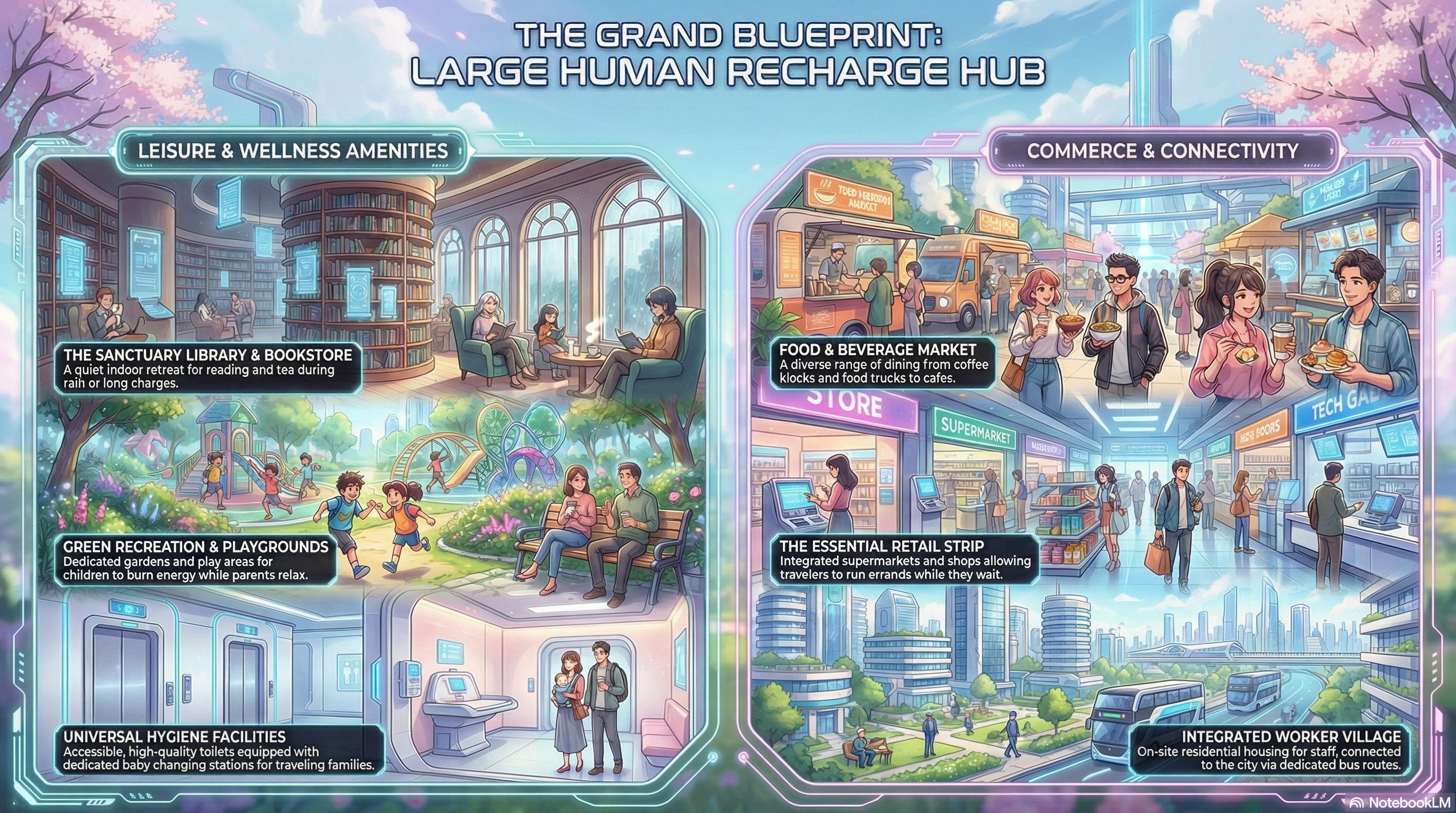
- High-Value Hygiene: Facilities must provide premium, accessible toilets and dedicated baby changing stations. This is a non-negotiable standard for maintaining the “human experience” brand.
- Diverse Food & Beverage Market: Culinary options scale from rapid-service coffee kiosks and food trucks to full-scale sit-down restaurants (e.g., McDonald’s) and cafes, catering to both the time-sensitive traveller and the leisurely visitor.
- Recreational Integration: To mitigate the “kids rioting in the back seat” syndrome, the LHRS incorporates dedicated gardens, sitting areas, and playgrounds. These green spaces allow for energy expenditure and mental decompression.
The Library and Bookstore: The Large-Scale Differentiator
A signature feature exclusive to the large station is the dedicated library or bookstore. This amenity is strategically deployed to manage extended waits, particularly when it is “hosing with rain” or when a vehicle requires intensive repair services. It provides a quiet, climate-controlled environment for travellers to decompress with a book and tea, elevating the hub from a service station to a community asset.
The operational complexity of managing such an expansive amenity ecosystem necessitates a localized human capital strategy to ensure 24/7 service standards.
5. Residential Integration and Workforce Logistics
The “Worker Village” is a critical sustainability component of the LHRS, providing a localized solution for staffing a massive, out-of-centre transit hub. By housing the workforce on-site, the hub reduces its total carbon footprint and ensures operational resilience.
Residential Worker Village Infrastructure
Immediately adjacent to the station, a high-density residential village is constructed to house retail, maintenance, and hospitality staff. This village utilizes high-density residential assets—inspired by models like McLennan Park and 340 Onehunga—to create a self-sustaining ecosystem. This village is physically integrated with the hub, allowing staff to reside within walking distance of the station’s retail and maintenance strips.
Transit Link Connectivity
To prevent worker isolation and ensure regional mobility, the village is connected to the primary urban centre via a dedicated public bus route, such as the Manukau Trans-Link. This service provides a reliable, sustainable transport link for staff, connecting the hub back to the city centre (typically a 45-minute drive). This integration ensures that the LHRS functions not as an isolated outpost, but as a well-connected extension of the broader urban fabric.
6. Implementation Methodology: Evolutionary Urban Planning
The methodology for deploying Large Human Recharge Stations favours “Evolutionary” over “Revolutionary” planning. This approach utilizes “Advanced Urban Simulation modelling” to evaluate the integration of diverse assets before ground is broken, ensuring optimal flow and utility.
The “Lotting” Technique
Implementation is achieved through “Lotting”—a strategic assembly process where existing, off-the-shelf assets (retail modules, energy points, housing units) are packaged into a single, functional site plan. This reduces bespoke construction costs and accelerates time-to-market by recycling the proven “spatial logic” of existing urban elements.
Strategic Summary: The “So What?” Layer
The evolutionary “Lotting” of Large Human Recharge Hubs addresses several critical urban planning challenges:
- Stranded Asset Mitigation: It recycles traditional gas stations and underutilized parking lots before they succumb to urban decay.
- Technological Alignment: It provides the mandatory infrastructure for the EV transition while acknowledging the current reality of charging durations.
- Public Amenity Provision: It delivers parks, libraries, and hygiene facilities to areas that are often underserved by traditional municipal planning.
The Large Human Recharge Station is the definitive blueprint for the future of sustainable, human-prioritized inter-city travel, ensuring that our infrastructure evolves alongside our mobility technology.

 Talking Southern Auckland