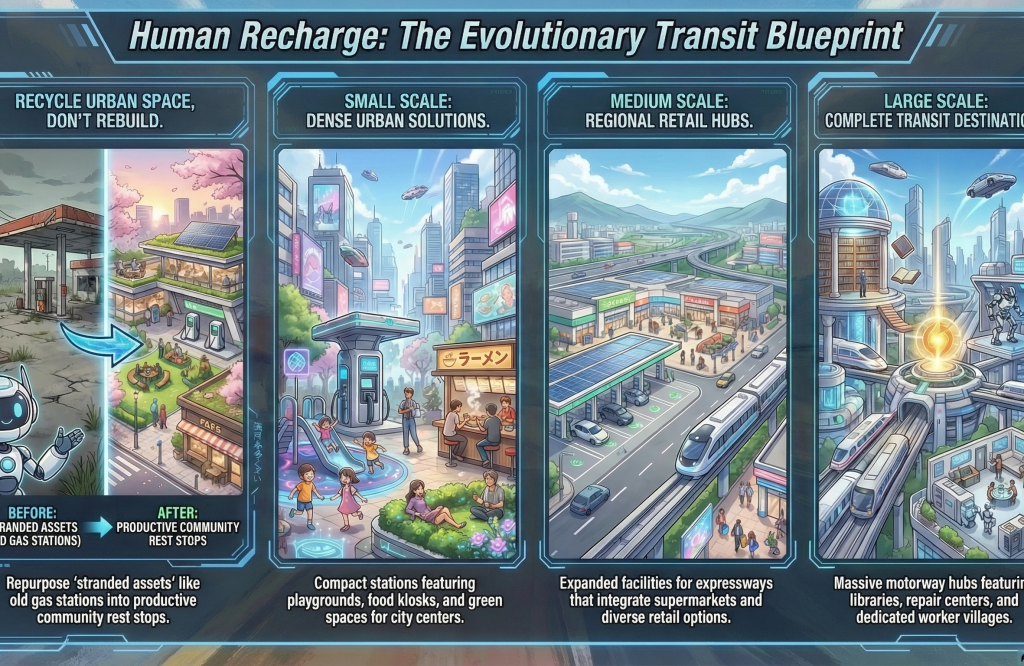
Selecting the right Human Recharge Station for the right site in its geographical context
As the oil crisis continues on, and Aotearoa suddenly realises we might be very well out of diesel by mid May, those EV cars and trucks sure look mighty fine by now (if not already). But even if we did a Norway and went full EV tomorrow we do not have the infrastructure in place to both support EV cars and trucks being recharged, and recharging the humans in them. But not all Human Recharge Stations are the same, nor is their respective geographic contexts for which they might sit in. Or rather which Human Recharge Station does the Planner pick for this location over there and why might it be different then over here. Let’s take a look.
1. Strategic Framework: The Evolutionary Transit Paradigm
The global transition to sustainable transportation mandates an operational shift from the traditional “filling station” to the Human Recharge Station (HRS) model. Drawing from Danish infrastructure benchmarks, the HRS serves as the direct successor to the conventional gas station, specifically engineered to manage the “seven-minute” EV charging window. Unlike the rapid refuelling of internal combustion engines, electric vehicle (EV) downtime creates a stationary period that must be strategically monetized and managed. The HRS model converts this logistical constraint into a high-value human experience, prioritizing passenger throughput, and psychological comfort over mere vehicle utility.
Central to this framework is the mandate for “Urban Geography Recycling.” This strategy identifies aging gas stations and underutilized land—potential “stranded assets” in a decarbonizing economy—and repurposes them through evolutionary rather than revolutionary planning. By utilizing existing footprints, municipalities can bypass the prohibitive costs of ground-up construction while preventing the emergence of urban blight. This methodology ensures that transit infrastructure evolves in lockstep with technological shifts without disrupting the existing urban fabric.
| Pillar | Strategic Mandate | Operational Execution |
| Human-Centricity | Dwell-Time Optimization | Prioritizing rest, hygiene, and recreation to occupy the mandatory 7-minute charging window. |
| Utilitarian Assembly | Asset Integration | Utilizing “off-the-shelf,” tried-and-tested components to assemble functional hubs without bespoke architectural costs. |
| Sustainable Integration | Geography Recycling | Repurposing underutilized lots and stranded fossil fuel assets to minimize waste and accelerate deployment. |
Successful implementation of the HRS model requires a rigorous adherence to tiered site selection criteria to ensure geographical relevance and economic viability.
2. Site Selection and Urban Geography Classification
In the model of Evolutionary Urban Planning, site placement is a non-negotiable directive dictated by topography and existing transit density. Strategic scale-matching ensures that each station serves the specific needs of its corridor, preventing the financial risk of over-capitalization or infrastructure redundancy.
Tiered Classification of Ideal Locations:
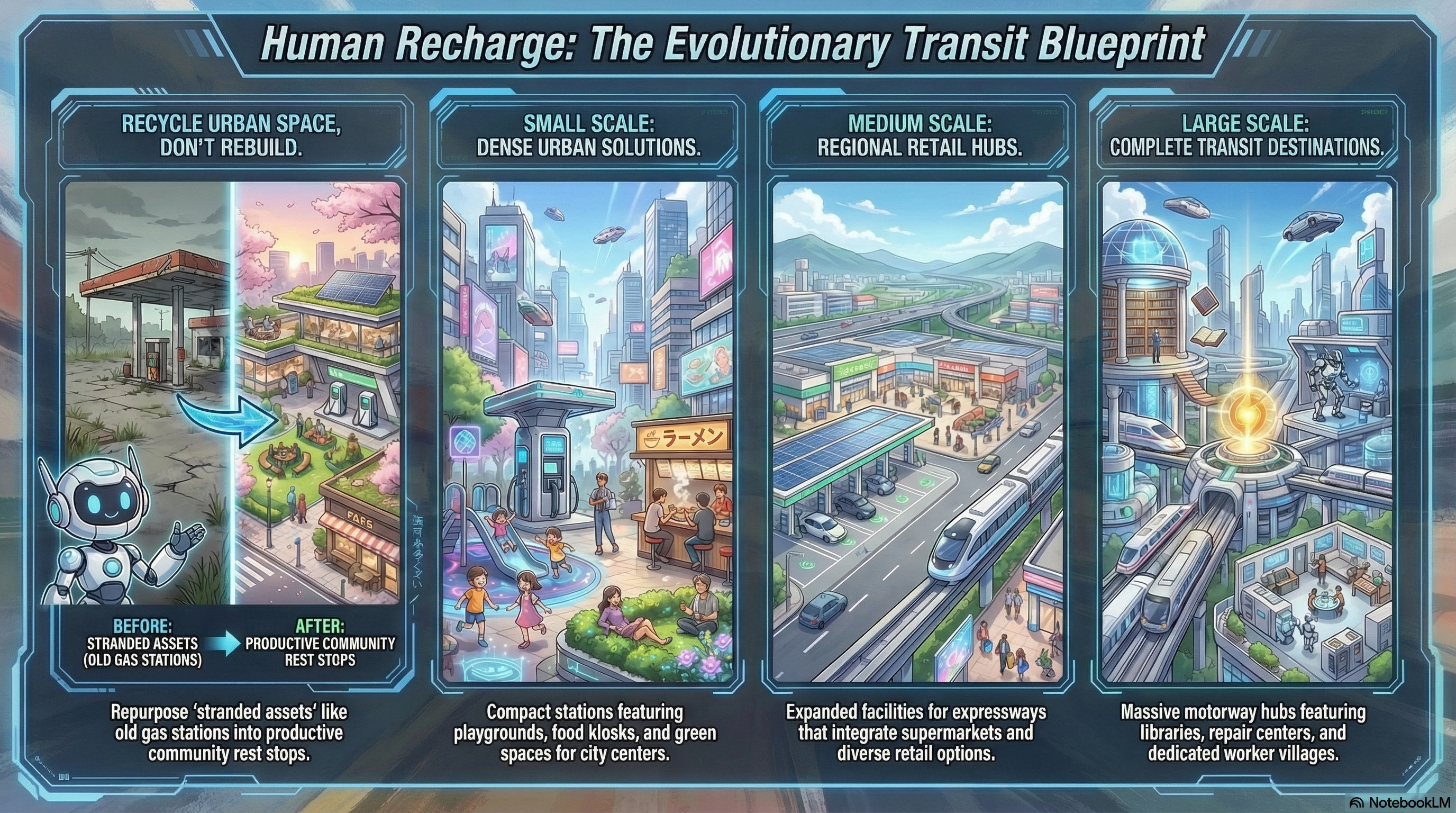
- Small Stations:
- High-Density Urban Zones: Specialized for space-constrained environments where footprint efficiency is paramount.
- Two-Lane National Highways: Calibrated for routes where high-volume facilities are unnecessary.
- Medium Stations:
- Lower-Density Urban Areas: Targeted at zones with less land pressure.
- Strategic Corridors: Ideal for two-lane national highways and four-lane expressways requiring expanded service capacity.
- Large Stations (Regional Hubs):
- Inter-City Motorways: Out-of-centre hubs serving 4-8 lane transit arteries.
- Urban Arteries: Situated on primary 8-lane avenues within city limits to serve massive transit volumes.
The “So What?” of site selection lies in asset protection. By precisely recycling underutilized parking lots or high-risk conventional gas stations, planners mitigate the threat of stranded assets becoming urban liabilities. Correct placement maximizes the utility of existing road infrastructure, ensuring that charging bays are positioned exactly where transit demand is currently underserved. This precision in placement is the primary safeguard against station redundancy and ensures optimal infrastructure throughput.
3. Tiered Infrastructure & Amenity Specifications
The HRS model is designed for scalability, evolving from essential transit support to comprehensive community destinations. While hygiene and basic recreation are universal mandates, commercial and maintenance amenities scale according to the station’s tier and land footprint.
| Feature/Amenity | Small (High-Density/Rural) | Medium (Lower-Density) | Large (Inter-City Hub) |
| Charging Infrastructure | Standard & Fast-charging arrays | Multiple Fast-charging bays | Massive High-Output Charging Arrays |
| Hygiene Services | Accessible Toilets & Baby Changing | Accessible Toilets & Baby Changing | Accessible Toilets & Baby Changing |
| Recreation | Gardens & Playgrounds | Gardens & Playgrounds | Gardens & Playgrounds |
| Food & Beverage | Kiosks & Food Trucks | Cafes & Fast-Food Outlets | Full-Service Restaurants & Cafes |
| Retail Integration | Excluded | Supermarkets & Shops | Out-of-Centre Retail Strip |
| Vehicle Services | Excluded | Excluded | Repair Centres & Legacy Fuelling |
| Dwell-Time Mitigation | Basic Green Sitting Areas | Expanded Outdoor Seating | Exclusive: Library & Bookstore |
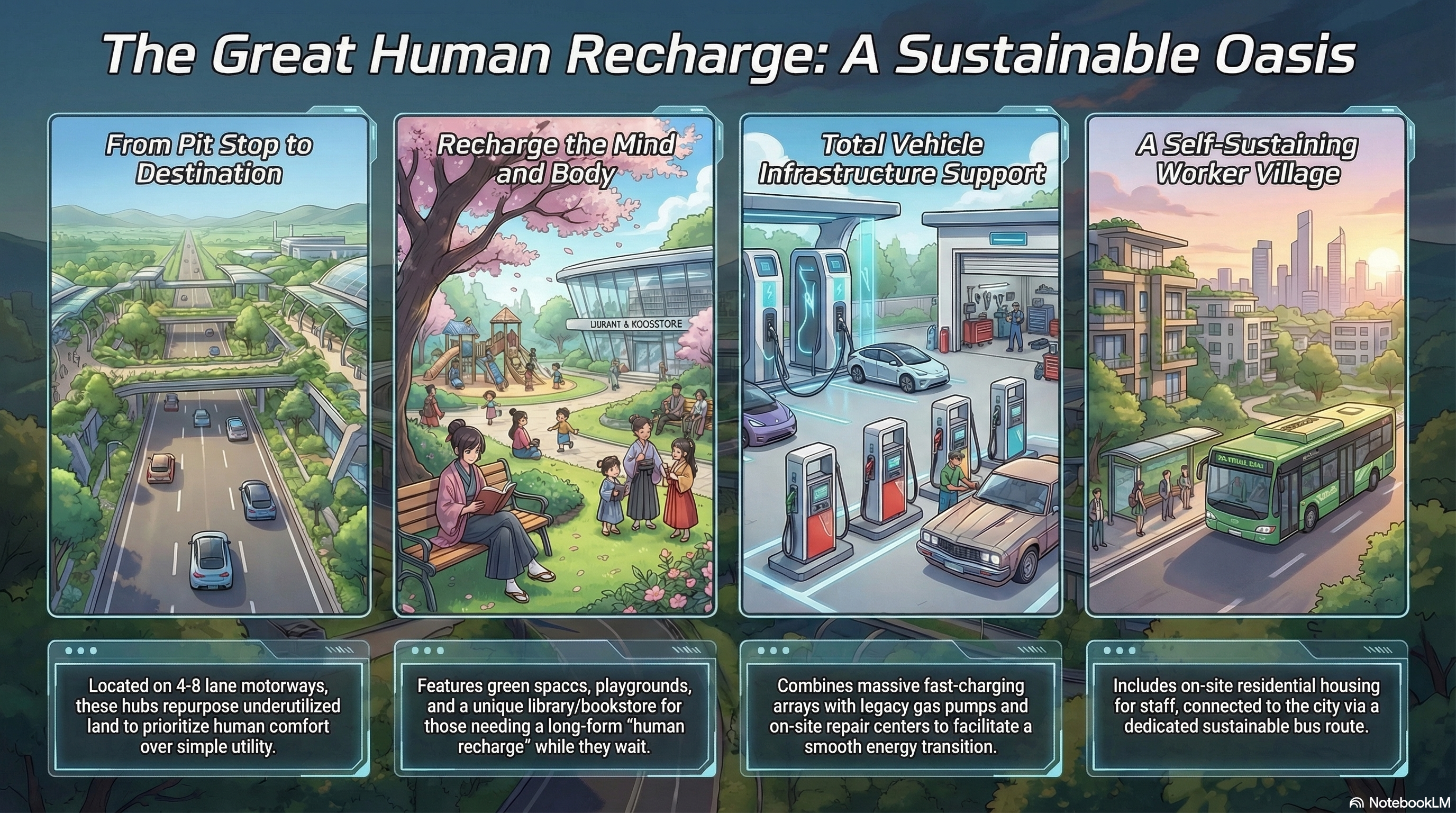
Strategic Analysis of Large-Tier Exclusives: The inclusion of the Library/Bookstore and Vehicle Repair Centres in Large Hubs is a technical “Dwell Time Mitigation Strategy.” These features address extended stationary periods caused by inclement weather or required vehicle maintenance. Providing a “tea and book” environment acknowledges the human requirement for quiet, climate-controlled comfort, transforming a maintenance delay into a destination experience. Furthermore, the retention of legacy gas pumps at Large Hubs is a calculated transition strategy to support the phased obsolescence of internal combustion engines.
4. Large-Scale Hub Integration: Worker Villages and Transit Links
The operational complexity of a Large HRS Hub requires a dedicated workforce management strategy. Because these stations function as massive, out-of-centre retail and maintenance destinations, sustainable staff retention is a primary operational requirement.
Worker Village Specifications: Every Large Hub is mandated to include a Worker Village—a dedicated residential development built in immediate proximity to the station. This village provides essential housing for the large volume of retail, hospitality, and maintenance staff required to operate the site 24/7. This proximity ensures high operational uptime and reduces the logistical burden of staff recruitment in remote or highway-adjacent locations.
Mandatory Transit Link: To prevent staff car-dependency and integrate the hub into the regional fabric, a Transit Link is required.
- Benchmark Model: A dedicated public bus route connecting the Worker Village to the primary urban centre (e.g., the 45-minute Manukau Trans-Link model).
- Strategic Objective: This link provides reliable, sustainable transport for employees, reducing the hub’s overall carbon footprint and ensuring the village remains a viable residential extension of the city rather than an isolated enclave.
5. Deployment Methodology: The “Lotting” Philosophy
The physical assembly of an HRS follows the “Lotting” methodology—a core tenet of Urban Geography Recycling. This framework treats the city as an existing library of assets to be reconfigured rather than a blank canvas for expensive, revolutionary intervention.
The BLaM Procurement Framework:
- Builders: Create bespoke assets (Minimal use in the HRS model).
- Lotters (The Recyclers): The primary role in HRS deployment. Lotters assemble existing, “off-the-shelf” components—standard retail units, prefabricated kiosks, and existing green space assets—into a functional site package.
- Modders: Innovate and adapt core systems (Reserved for specialized tech integration).
The Utilitarian Assembly Directive:
- Identify Stranded Assets: Prioritize at-risk gas stations and underperforming parking lots for immediate recycling.
- Bypass the “Innovation Trap”: Avoid high-cost, unproven “revolutionary” architecture in favour of evolutionary reliability.
- Deploy Off-The-Shelf Assets: Utilize existing materials and proven commercial structures to fill infrastructure gaps rapidly.
This “Lotting” approach represents an efficiency-first procurement model. It is significantly more cost-effective and faster to implement than traditional infrastructure overhauls. By prioritizing evolutionary reliability over revolutionary risk, the Human Recharge Station model secures the global transition to electric transit by directly prioritizing human throughput, utility, and comfort.

 Talking Southern Auckland