
A Planning Framework to Support Urban, Rural and Transport Sectors in Post Oil-Crisis World
As the oil shocks continue, one has to wonder if limping on with the status quo of fossil-fuel influenced auto-centric planning is the smart way to go through the rest of the 21st Century. For me we shouldn’t continue to limp on and hope that we might be able to return to pre oil-shock way of life only for the next one to rock on up as fast as the last one did. This yo-yoing is not exactly great for a nation, its people, nor eithers’ mental health. Hence why I have been writing on push and pull methods on moving away from this dying era and into a more resilient era. Methods including investment in transit, Human Recharge Stations, pricing such as Time of Use Charging and so on.
However, but also ironic we need to change the core fundamental to enable the transition away from an oil-shock world into a more resilient and sustainable world. That core fundamental being our Planning regime that impacts land use, spatial form and behaviours.
The irony is that my submission to the Planning Bill was designed to transition us away from our fossil-fuelled and auto centric past. It just did not know that the current Oil-Crisis would precipitate an urgency to get the transition going now! And most aspects of Planning are covered including: urban, suburban, transport, infrastructure, industry and rural. All part as a massive jigsaw puzzle as Planning is and Planners try to put together constantly.
So, lets take a recap back on my submission to the Planning Bill and how it can transition us forward in a post Oil-Crisis world!

Executive Summary
The Aotearoa Planning Bill 2025 represents a fundamental “system transplant” for New Zealand’s urban and rural operating systems. Transitioning from the subjective, fragmented “Grey Inertia” of the legacy Resource Management Act (RMA), the Bill introduces a standardized, objective codebase inspired by the 1974 Japanese Land-Use Law. The core objective is to replace a “Culture of Permission”—characterized by 1,175+ local zones and significant “Regulatory Debt”—with a “Culture of Adherence” based on ~20 National Standardised Zones (NSZs) and mathematical building envelopes.
Critical takeaways include:
- The Hydraulic City Model: Utilizing “Urbanisation Promoting Areas” (UPA) as serviced reservoirs for growth and “Urbanisation Control Areas” (UCA) as dam walls to stop unserviced sprawl.
- Infrastructure Determinism: Legally tethering building density to transit capacity (“Density Follows Frequency”), mandating minimum heights of six storeys near rapid transit spines.
- The Green Utility Mandate: Hardcoding biological health through the “3-30-300 Rule,” treating nature as high-performing infrastructure rather than an aesthetic luxury.
- The Newcomer Principle: Protecting “Economic Engines” (ports, heavy industry, farms) by requiring the agent of change—the developer—to fund all environmental mitigation.
- Complete Neighbourhoods: Prioritizing “Gentle Density” and “As-of-Right” mixed-use zoning to foster walkable, 24/7 productive ecosystems.
1. The Strategic Pivot: From Grey Inertia to Standardised Code
The Bill seeks to liquidate “Administrative Debt” by moving from subjective, project-level negotiations to a performance-based framework. By “flashing the BIOS” of the planning system, it replaces a chaotic “Postcode Lottery” with a universal language.
Comparison: Legacy RMA vs. Planning Bill 2025 Codebase
| Parameter | Legacy Resource Management Act (RMA) | Planning Bill 2025 Codebase |
| Decision Basis | Subjective; often derailed by individual objections. | Objective; based on clear, numerical standards. |
| Zoning Complexity | Chaotic “Postcode Lottery” (1,175+ local zones). | Standardized “Universal Language” (~20 NSZs). |
| Development Status | “Culture of Permission” (Reactive/Restrictive). | “Culture of Adherence” (Rules-based/Enabling). |
| Primary Driver | Property Rights Supreme. | Public Welfare Supreme. |
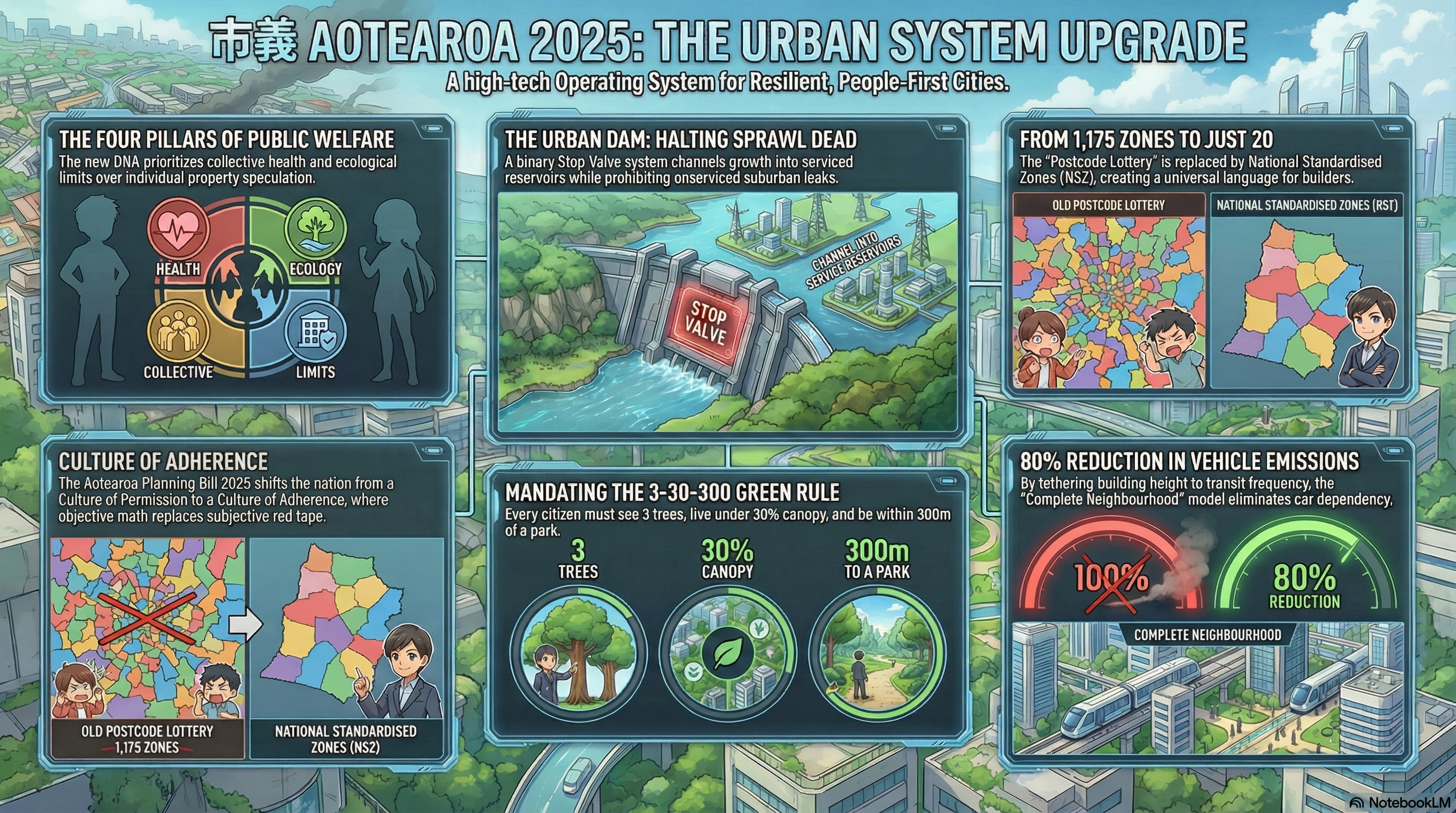
The Four Pillars of Public Welfare
The Bill is anchored by four ethical “Source Code” principles adopted from Japanese law:
- Public Welfare: Collective health and functionality take precedence over individual property preferences.
- Natural Resource Preservation: Establishes non-negotiable ecological limits and protects productive soils.
- Healthy and Cultural Living: Mandates environments that support mental and physical well-being via biophilic design.
- Balanced Development: Synchronizes growth with infrastructure (“Pipes before People”).
2. The Hydraulic City: Managing Growth Pressures
To stabilize land values and prevent the “leak” of sprawl, the Bill utilizes a binary spatial containment system known as the “Urban Dam.”
- Urbanisation Promoting Area (UPA) – The Reservoir: A 10-year serviced horizon where public capital is concentrated. Development is “infrastructure-led,” ensuring roads, sewage, and transit are in the ground before vertical construction begins.
- Urbanisation Control Area (UCA) – The Dam Wall: A “Stop Valve” where urbanization is prohibited in principle. By deprioritizing infrastructure here, the system removes the speculative premium from non-urban land and protects the rural fringe.
“Displacement is a mechanical certainty of success. We must engineer containment to stop the leak of chaotic development.”
3. National Standardised Zones (NSZ): The Universal Rulebook
The reduction of zoning complexity allows for “As-of-Right” status for compliant projects, moving decision-making “upstream” to the National and Regional Spatial Plan phases.
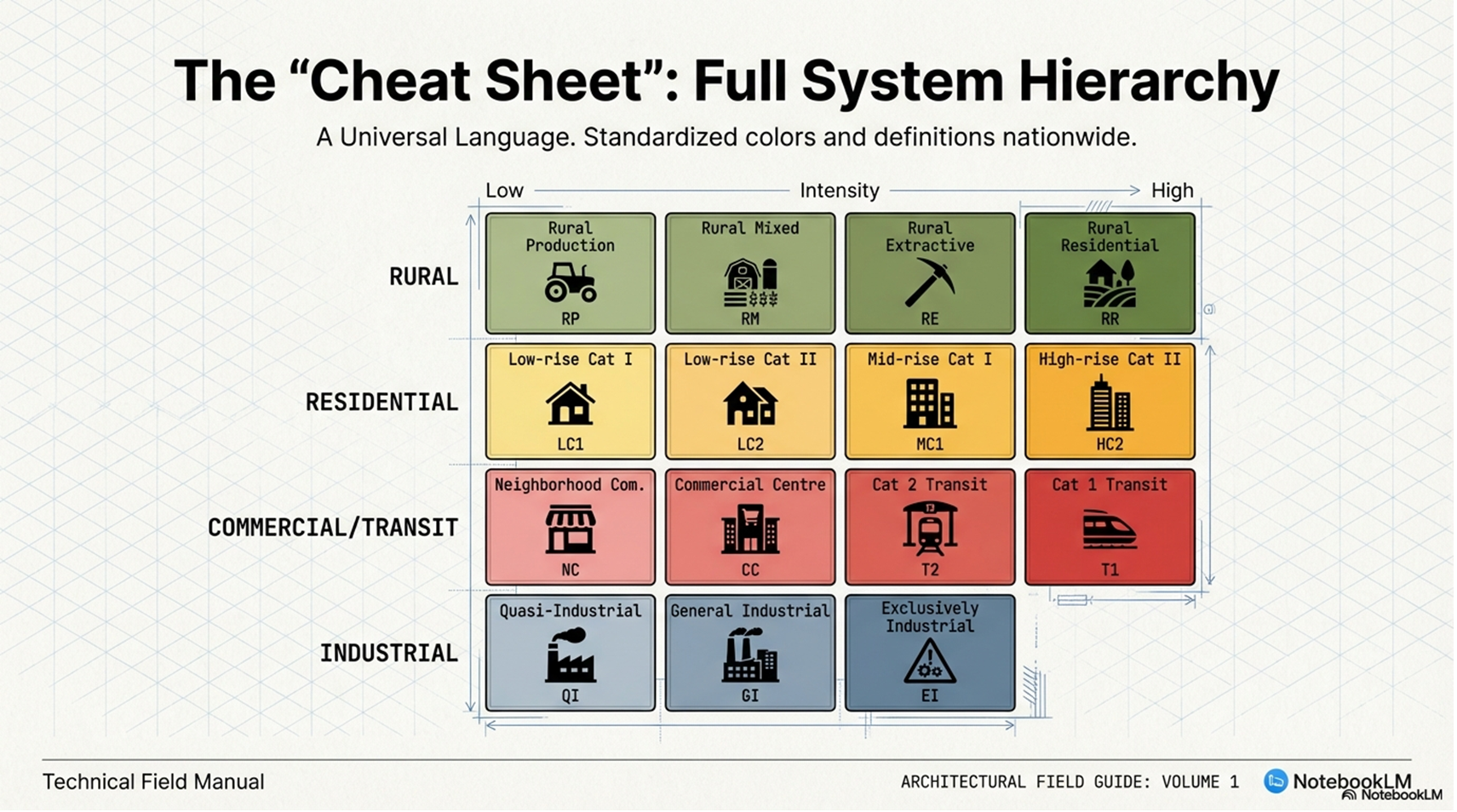
3.1 The Transit Spines (High-Intensity Urban)
Building height is legally tethered to transit pipe capacity under the “Density Follows Frequency” principle.
- Category 1 (Spine) Transit Corridor: Within 800m–1,200m of rapid transit (rail/busway). Mandatory minimum of 6 storeys.
- Category 2 (Primary) Transit Corridor: Within 400m–600m of frequent bus routes. Mandatory minimum of 3 storeys.
3.2 Residential and Inclusive Living
The Bill promotes “Inclusive Zoning” (the Russian Doll model), where higher intensity zones automatically permit uses allowed in lower zones.
- Low-Rise Residential (Cat II): Permits dairies, cafes, and salons “As-of-Right” on corner sites (up to 150m²).
- Mid/High-Rise Residential: Managed via Floor-Space Ratio (FSR) and Diagonal Line Limitations to ensure sunlight access to the “public canyon” (the street).
3.3 Industrial and Rural Economic Engines
- Exclusively Industrial Zone: A “Hard Limit” that prohibits residential, schools, and hospitals to protect the noise rights and 24/7 operations of ports, rail, and heavy industry.
- Rural-Production Zone: Reserved for large-scale farming. Extractive industries (mining/quarrying) are excluded here to protect soil quality.
- Rural-Mixed Zone: Enables smaller-scale farming, rural services, and tourism; lifestyle blocks are explicitly discouraged.
4. The Architecture of the Complete Neighbourhood
The “Complete Neighbourhood” model aims to eliminate the “Negative Productivity” of car-dependency by fostering density that sustains local life.
The Math of Viability
- 8 DU/AC (Dwelling Units per Acre): Minimum for basic community cohesion.
- 15 DU/AC: The “tipping point” for viable local commerce (corner stores, bakeries) and frequent transit.
The “Missing Middle” Housing Spectrum
“Gentle Density” is achieved through house-scaled buildings that house multiple families:
- Cottage Courts: Clusters of small homes around a shared “Green Heart” to combat loneliness.
- Plexes (Duplex to Eightplex): Buildings that maintain a residential street scale while increasing density.
- Townhouses: Attached units with individual street entrances to create “eyes on the street.”
The “Linger Factor”
Walkable proximity is an economic engine. Pedestrians spend 66% more at local businesses than drivers. Activating “As-of-Right” mixed-use on corner sites transforms dormant intersections into “community heartbeats.”
5. Green Utility and Mandatory Resilience
Nature is redefined as “Biological Utility”—a statutory right and critical health infrastructure.
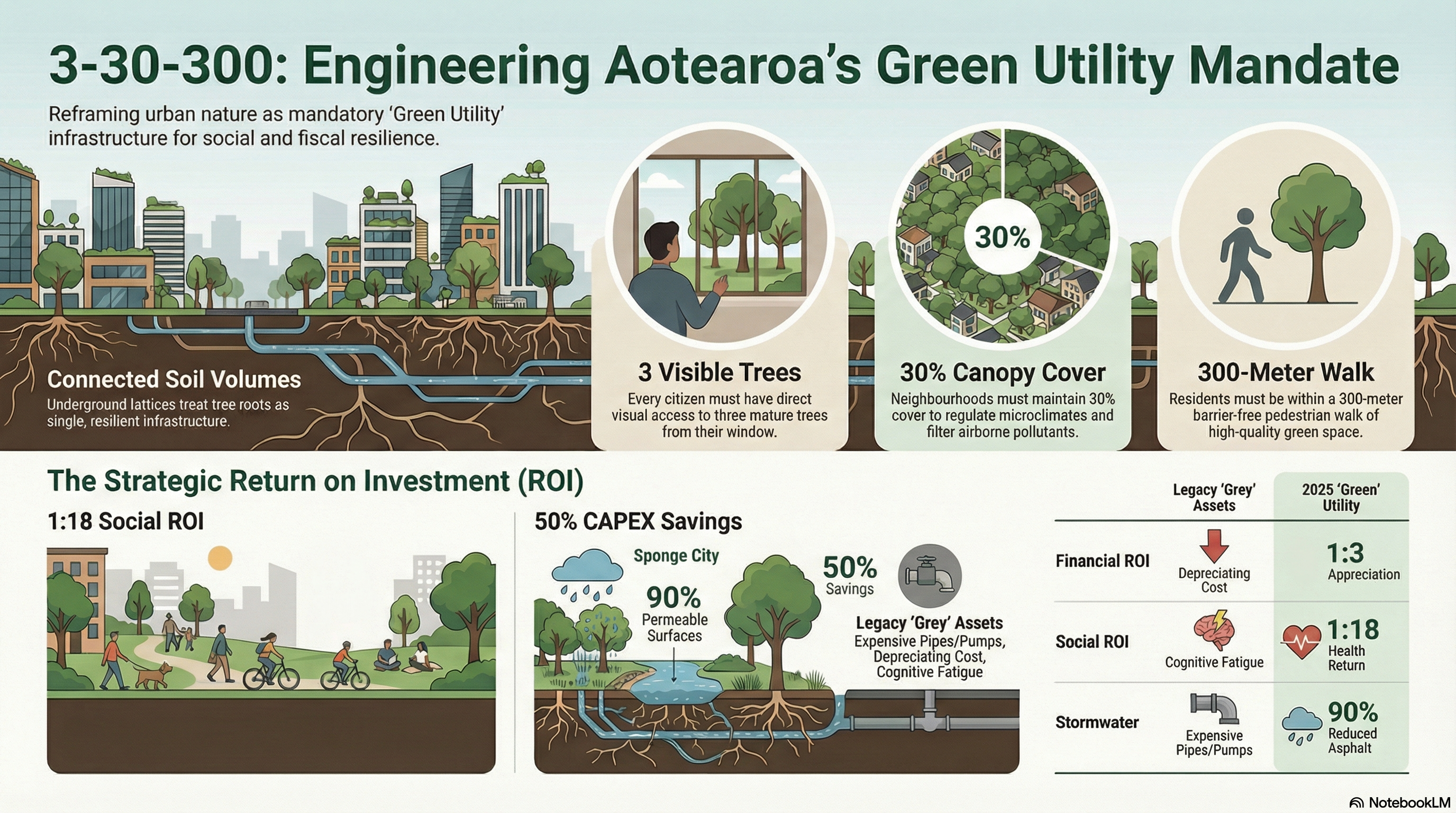
The 3-30-300 Technical Mandate
- 3 Trees: Every occupant must see 3 mature trees from their window (cognitive recovery).
- 30% Canopy Cover: Mandatory neighbourhood-level cover to mitigate “Urban Heat Island” effects.
- 300 Meters: Maximum barrier-free walk to a high-quality green space (0.5–1.0 hectare).
Sponge City Engineering
The system utilizes “Connected Soil Volumes”—underground structural trenches—to allow trees to reach full maturity. This manages stormwater at the source, yielding 50% savings on traditional “grey” infrastructure (pipes and pumps).
The Red Line Policy (Hazard Avoidance)
Strategic asset management is governed by a 100-year climate horizon (Year 2126).
- Feasibility Hard-Stop: Development is strictly prohibited in the “Top-Left Risk Quadrant” (High Likelihood + Catastrophic Consequences).
- Residual Risk Modelling: Planners must model for the failure of existing defences (e.g., 500-year events breaching 100-year walls).
6. Legal Mechanisms of the New Operating System
The shift to an objective system is supported by specific legal “teeth” that protect the integrity of the plan.
- The Newcomer Principle (First in Time, First in Right): The agent introducing change (the developer) bears 100% of mitigation costs. For example, residential projects near rail must install acoustic glazing and mechanical ventilation. This removes the “right to complain” about established industrial or rural effects.
- Section 14 Mandate: Planners are legally instructed to ignore subjective complaints out of scope, including:
- Impacts on private views.
- Subjective “character” or visual amenity.
- Social status of future residents.
- Hard Shell / Soft Core Design: Mandatory for transit spines; the building’s exterior acts as an acoustic shield for a quiet internal sanctuary (courtyard), enabling high-density living in active 24/7 corridors.
Financial and Social ROI
| Metric | Grey Infrastructure (Legacy) | Green Utility (Resilient) |
| Financial ROI | High maintenance liability. | 1:3 ROI (Trees as appreciating assets). |
| Social ROI | Negative (medical/travel costs). | 1:18 ROI (Health/Cohesion). |
| Infrastructure | Depreciating pipes/pumps. | Sponge City biological systems. |
“The city of tomorrow must be as resilient as it is green, moving from a system of speculative sprawl to systematic, infrastructure-led growth.”

 Talking Southern Auckland