Auckland and its Growing Pains The Herald this morning is running four (sorry not five as I earlier stated in an another post) on Auckland, our rural communities, … Continue reading Growing Up
The Politics behind the issue or of the day
Auckland and its Growing Pains The Herald this morning is running four (sorry not five as I earlier stated in an another post) on Auckland, our rural communities, … Continue reading Growing Up
From One Extreme To The Other With The Clunker? While most commentary and interaction with The Unitary Plan (The Clunker) continues as May 31 approaches at a more … Continue reading This and That

The Challenge is Laid Who Will Step Up From the Opposition? Answer Thus Far – NO ONE! This morning I threw down a challenge to the oppositional … Continue reading Challenge Laid Down To Oppositional Councillors

From The Liberal Side of Urban Development Councillor Dick Quax last night posted on Facebook a link to a New Geography article on how Houston (known for its sprawl) … Continue reading A Houston Perspective
I have a copy of that letter the Herald article “Compact city rulebook hits wall” talks about. You can read it in the embed below and post your reactions accordingly. BR:AKL is of the belief that this is going too fast – the Unitary Plan consultation rounds, but I do disagree with Central Government and delaying the Clunker by three years. One extra year should be adequate enough at the ABSOLUTE MAXIMUM before it gets drawn out beyond a joke.
Other reactions from me with The Unitary Plan can be found else where on this blog
After returning from the Papakura Unitary Plan feedback session this morning which was highly informative as I went one on two with Council Officers. I even learnt that Browns Bay on the North Shore who think they are in for 6-8 storey buildings are only in for four storey buildings looking at The Clunker in-depth. However, more on The Clunker later.
After my dialogue on The Unitary plan I had a discussion with Angela Dalton of Manurewa Local Board and two Papakura Local Board members (who I will look up their names shortly). The discussion came to the Glenora Road Rail Station at Addison, Takanini; 5-minutes from where I live. I was told that Auckland Transport are not doing Glenora Road Station AT ALL because of the $35 million cost for the station. $6 million for platforms, shelters, park and ride, kiss and ride and bus interchange (so a fully fledged station minus people manning it); $29 million for the grade-separation at Walters Road 50 metres south. AT forecasts the patronage figures at 952 daily using Glenora Road which I called Bollocks on straight away as a justification in not building the station.
I will also write a separate post on the Glenora Road situation and call AT on this as I know that station will attract at minimum five times that amount (952) as a conservative figure as the area grows (regardless of Takanini closing down or not).
But the 952 gives light to a mega-embarrassing situation that has not been aired yet on the Auckland laundry line. That is our honestly shameful rail utilisation figures which on average over 363 days a year (there are no passenger trains on Good Friday and Christmas Day) stands at 27,000 a day or 20.5% of potential patronage if we ran every train on average 67% full day in day out (see explanation at bottom of post).
Let me run the numbers with you:
On existing services (there are 325 a day average according to the Fare Evasion Modelling) AT expects around 30,000 passengers a day. That means 92 passengers a service and our current diesel fleet holds anywhere between 350 to 750 depending on the train class (safe loading – not crush loadings). So 92 passengers means the train is anywhere between 12% full to 26% full AS AN AVERAGE as I know some trains are packed out.
Using 10 million as the rolling annual target we are at 27,000 passengers a day which gives an actual utilisation AVERAGE (weekends are in here) of 10-23% and we need around 40,000,000 rail passenger trips annually using the existing diesel fleet if the utilisation was at 67% (rather than 100% – see explanation below)
If we take the averages across the fleet (which with out diesels it does not make this easy as we have a heterogeneous fleet currently) then followed by the new EMU fleet all running at the maximum 6-car – top and tail config (two EMU-3s put together) this happens:
If the average diesel train holds 507 passengers average and 67% puts it at 339 passengers required, multiply that out by 325 services means you need Monday to Thursday 110,099 passengers a day to get ANY WHERE near turn over rates mentioned above. And yes I know the ADL-2 and ADK-4 can not hold 507 passengers – but this is averages here made out from the SA/SD 6 car sets holding 750 passengers.
67% means 502 passengers and across the existing 325 services means you need: 163,150 passengers DAILY to make this viable, while AT is playing around with 30,000 a day or 92 passengers per train service. This means for an EMU-6-car running at an average of 12% full.
As a grand total figure we need with the EMU’s all running on just the existing provisions moving about 60 million rail passenger trips a year (this is at the 67% average utilisation rate) (so 6 time more than now) and we have not even stepped up the services yet to well over 400/day Monday to Friday at the minimum as planned.
This is mega embarrassing folks to have our existing rail utilisation at any where between 10-26% (92 passengers average for every single service – and depending on train type) per service which means Auckland is at no more than 18% of rail utilisation compared to its minimum viable capacity which stands at 67% of total maximum capacity – if we were carrying the 30,000 AT is modelling for at the moment. However remember as I mentioned above only 27,000 approximate people on average use the trains a day (10 million divided by 363 days) which means knock another 2% off the utilisation rates.
I did say mega embarrassing now didn’t I? To be honest as an Aucklander I would be deeply embarrassed at the situation before us right now with our heavy rail. We have seen growth to above 10 million only for it to slip back below that milestone in February this year. But we seem to be stuck in a rut in getting the figures where it should be. AT forecasted the annual rail passenger trips near the 12,500,000 mark which means around 34,500 a day or a utilisation rate of around 23%, but that has slipped to 10.5 million so the figures fall back to around 30,000 a day.
We have a long way to go folks to get near 60 million annual rail passenger trips (might as well use EMU figures now with them coming on-stream soon) (60 million at 67% average utilisation across ALL 325 existing services) – which means the theoretical capacity stands at 90 million.
Still 9,996,066 annual rail passenger tips for the existing diesels and we need 40,000,000 for it to be viable, 60,000,000 when the EMU’s are all on stream. Remember this total average utilisation figure rises if you run more services. For example say the CRL is complete and all EMUs are running as 6-car sets holding a maximum capacity of 750 passengers and we go to 410 services average a day, 363 days a year. That means at 67% utilisation across the services one would need 74,500,000 annual trips approximate for the entire operation to be viable. The Auckland Plan calls for by 2041, 140 million trips to be made a year by public transport – all modes…
Note: my figures are expressed as a percentage of 67% average utilisation or carrying numbers (which is 67% of the total maximum capacity) – not the actual total maximum capacity numbers (which would be 100% utilisation or carrying numbers). 67% was derived from the theoretical minimum all services would have to carry as an average for the Auckland Metro Rail system to be viable, and takes into account the system will be:
never at 100% utilisation across all services
balances out across the services where are individual services are at 95-105% utilisation and others are around the 10% currently and also projected. It basically allows for a generous spread and average from varying patronage numbers per individual service.
So with this very embarrassing situation that makes me deeply embarrassed as an Aucklander to be confronted by this
I await Auckland Transport’s reply
Auckland Vs. Wellington Thanks to the kindness of Metro Magazine this thoughtful Editorial piece from Simon Wilson was able to be read while I was in Sydney and Brisbane … Continue reading Metro Mag Opinion
And so it happened, an accident on the southbound lanes of the Southern Motorway (State Highway One) on the Newmarket Viaduct causing absolute gridlock for hours on end – and it even delayed the start of the Breakers game to boot.
You can see (what is most likely to have been caused by hopeless driving Auckland is known for) the accident and its absolute chaos from the NZ Herald along with a bonus video
From the NZH:
How one crash caused gridlock chaos
By Amelia Wade
5:30 AM Friday Mar 8, 2013
Inner-city Auckland traffic was brought to a virtual standstill last night after a motorway crash – gridlock that the Automobile Association described as the worst it had seen.
A van crashed into the back of a truck in the southbound fast lane on the Southern Motorway at Newmarket at 3.50pm, seriously injuring a man.
More than two hours later, traffic on almost all of the city’s arterial routes was gridlocked, with buses backed up in city streets and motorists reporting speeds of less than 10km/h.
Journeys that normally took 15 minutes were taking more than an hour.
Automobile Association traffic spokesman Phil Allen said he had never seen traffic so bad in central Auckland.
Are you sick of Auckland’s traffic problems? Send us your commuting tales of woe and any ideas you have on how to fix Auckland’s traffic jams here.
The association launched traffic-mapping technology on its site 18 months ago. Routes marked in black show where traffic is moving at under 25 per cent of the speed limit.
…
You can read the rest and watch the video over at the NZH.
I was fortunate enough to have returned from the success at the Strategy and Finance Committee ahead of that traffic disaster yesterday however it is going to highlight a rather sore point?
Would of the much vaunted four lane Eastern Highway expressway coupled with cycle-ways and even the Botany (heavy rail) Line alleviate some (not all but some) of the chaos yesterday by giving a viable bypass for those heading south out of the CBD. Those coming from the north would have used the Western Ring Route (State Highways 16 and 20) if it had been completed by now as an extra backup.
The Eastern Highway and Botany Line basically followed this trajectory before its mothballing in 2004
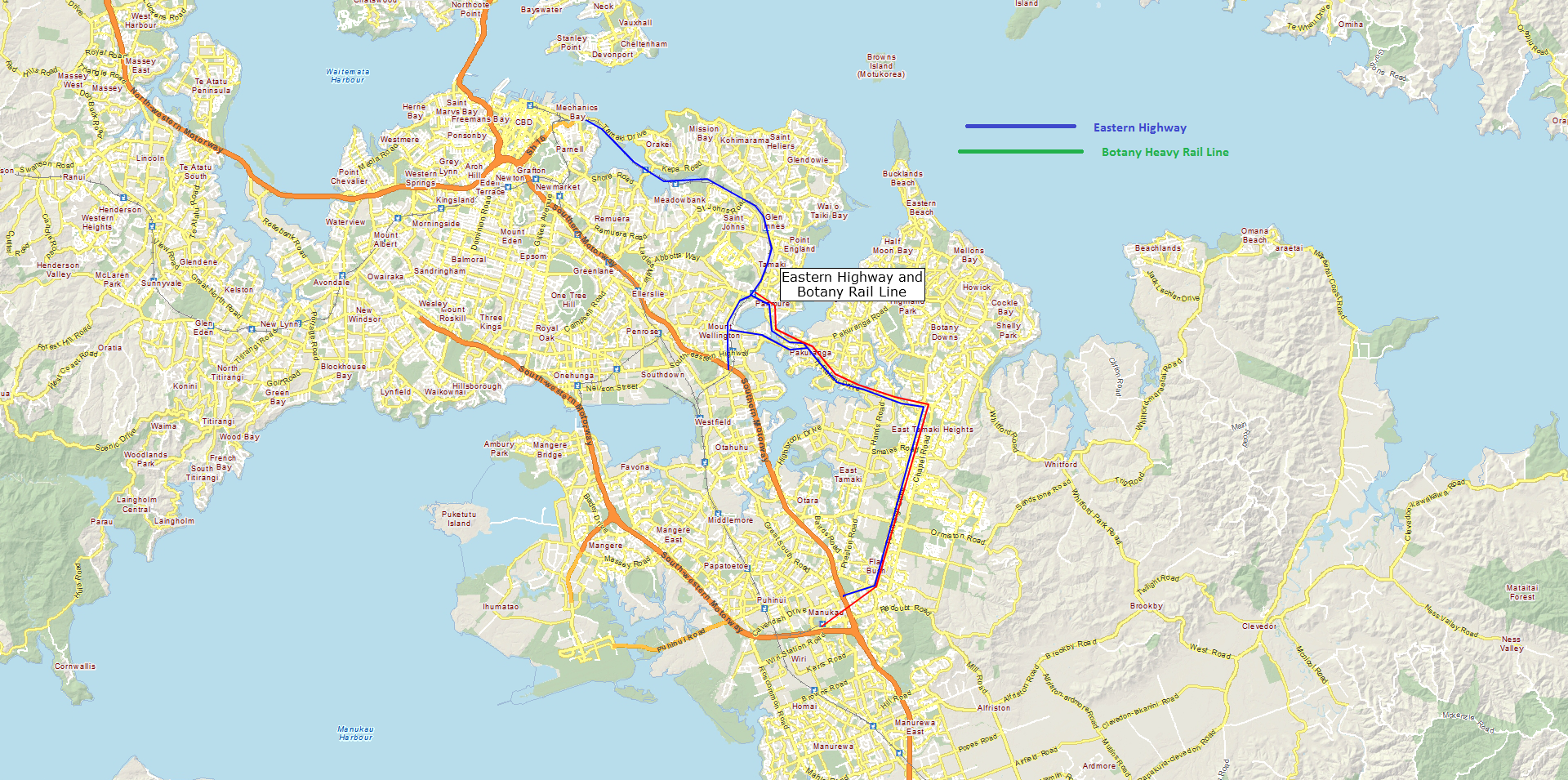
Click for full resolution
I have the original EASTDOR report into the four options available for the Eastern Highway and will get them uploaded when I return from Australia.
But for now just ponder to yourself; The Eastern Highway – that critical back up for the CBD we now miss.
Of course I am waiting for the fringe brigades from both the pro road, and pro public transport and nothing else to pipe up and basically kill the debate before it starts…
Just remember folks – the Eastern Highway provided an absolute full suite of actual integrated transport options such as: road, freight way, bus priorities, cycle ways and even heavy rail to a part of Auckland not served by rail as of current. I suppose I could have the last laugh after the project was mothballed in 2004 and how (as it would have been completed by now) it could have made a pure crap day just that slightly bit better for those stuck last night…
Actual Alternative to Betterment Taxes Proposed by Council? Recently I had written a post on basically what is a new round of taxes better known in slang as Betterment … Continue reading It is all about the MUD
I love Brisbane and am going back there for a holiday in the middle of March. Brisbane is my second home and where I lived for two years as part of my err “gap-year.” Brisbane is also similar in some respects to Auckland in regards to its civic structure, urban fabric, transportation systems, and political stupidity in investing in the wrong project.
Now I did just say political stupidity – and why is that? Check these two pieces from NZ and Brisbane on Public Private Partnerships (PPPs) not delivering as they were meant to:
Stephen King: PPPs need better ways to handle risk
5:30 AM Tuesday Feb 26, 2013
As another toll road in Australia fails, what is the future for public-private partnerships?
Instead of taking traffic off congested suburban roads, high tolls may mean too few cars use the toll road. Photo / APNIs there a future for privately funded toll roads? BrisConnections has been placed into administration only seven months after opening the Brisbane Airport Link toll road/tunnel. It has not had sufficient users to make the project viable. So what does this mean for future public-private partnerships (PPPs)?
In the short term, it will mean very little. The citizens of Brisbane have a great tunnel that (from my experience) cuts significant time off a trip to the airport. The investors have done their dough. And there may be various lawsuits about who misled whom.
However, this is the fourth in a series of PPP toll road failures, including Sydney’s Lane Cove and Cross City tunnels, and Brisbane’s Clem7. If PPPs are to have a future, we need better ways to handle the project risk.
The risk associated with large infrastructure projects can be significant. For toll roads, the viability of a project depends on projections of future traffic flows. But these flows may be highly variable, depending on a range of choices by the government and car users
…
You can read the rest over at the Herald website
Now what Mr King was referring to in regards to PPP failure and by virtual extension political stupidity in Brisbane is this Brisbane Times piece I Facebooked not so long ago:
From Brisbane Times:
Airport Link in administration
- Date February 19, 2013 Bridie Jabour
Brisbane’s Airport Link tunnel has gone into voluntary administration. Photo: Harrison Saragossi
UPDATED
The $4.8 billion Airport Link tunnel has been placed into voluntary administration.
In an announcement to ASX, tunnel’s operator BrisConnections said the company had decided to place the tunnel into administration citing low traffic levels and debts worth more than the tunnel.
The board of BrisConnections entered negotiations in November to restructure the tunnel’s debt but on Monday night, the board was told lenders were not prepared to support any of the restructure proposals.
The latest traffic figures show an average of 47,802 vehicles using the 6.7 kilometre Airport Link each day, about half of the original forecasts which had daily traffic of 90,000 vehicles.BrisConnection conceded in the ASX statement that an extensive marketing and phased-in toll regime had failed to attract enough traffic but Non-Executive Chairman Trevor Rowe was still positive about the future of the tunnel.
‘‘It’s disappointing that the board has to reach this decision,’’ he said.
‘‘The AiportlinkM7 is unquestionably a world class piece of transport infrastructure that will continue to support Brisbane’s growth into the decades ahead.’’
BrisConnections was placed into a trading halt in November and two board directors resigned after a dismal report to the ASX on Airport Link.
In the report, the company admitted for the first time the tunnel’s debt might be more than its value and a research analyst said at the time the most likely option for the Airport Link was to put it up for sale.
The tunnel had a toll free period which ended in October last year with traffic forecasts falling tens of thousands of vehicles short even when the ride was free.
The costs of building Airport Link blew out so much for construction company Leighton Holdings that it contributed to them posting a yearly loss of more than $200 million which has been turned around to a $450 million profit since it handed over the tunnel and its other high profile troubled project, the Victorian desalination plant.
Airport Link was opened in July 2012 and connects Brisbane’s northern suburbs with Brisbane’s CBD and the airport, the Clem7 and the Inner City Bypass.
The tunnel will remain open and available to users as normal.
Airport Link is the second Brisbane tunnel to financially collapse with the operator of Clem7, RiverCity Motorway Group, going into receivorship in November with $1.3 billion worth of debts.
News of Airport Link’s collapse forced Brisbane Lord Mayor Graham Quirk to defend Brisbane City Council‘s decision to push ahead with the city’s third toll tunnel, the $1.5 billion Legacy Way tunnel
The Brisbane saga should sound a warning to both Central Government who are ploughing on with the Wellington Transmission Gully Motorway – which is a PPP (the Herald article above mentions the risks of that as well) and our Auckland Council if we consider PPPs for some of our larger projects including the City Rail Link.
I have called for a PPP with the City Rail Link with our public authorities handing the tunnel construction and maintenance, while having private companies operate the stations for say 50 years providing they get the rights for urban development (including sky rights) in the immediate vicinity of stations as part of a wider investment program. Now I know in Tokyo’s railway has stations that are built and run by companies basically on behalf of the rail metro line and in the same token have developed often impressive complexes of residential, commercial office and commercial services (retail, malls, hotels) above and around the said station.
These impressive complexes allow the Tokyo authorities to share some of the costs of rail metro line station building with private companies in return for pretty much guaranteed patronage due to the urban complexes built above and around the stations.
So there are cases where PPPs for in this case with Tokyo – rail can work. This could be a very good example for Auckland to follow-up on when the CRL is being built. However the Brisbane and Transmission Gully Wellington Road PPP projects (go figure – I said roads) are also examples on what NOT to do with PPPs.
So Auckland (including AT and Council) still have a long and hard road ahead in plausible financial planning for some of our larger mega-projects like the much needed City Rail Link. On one side it could go extremely wrong and bankrupt the city, on the other we get an golden opportunity for a needed transit link and some actual world class urban renewal in our grey and drab CBD!
Food for thought
 Talking Southern Auckland