MIT, Manukau Station, Davis Avenue Boulevard looking good I was in Manukau City Centre this afternoon tending to some business. After that and in despite of our miserable weather … Continue reading Manukau Projects Nearing Completion
We all know about housing affordability. It is literally shoved in our face by Central and Local Governments, the media, and social media. How do we address the issue of housing affordability is as vexed whether the chicken or egg came first. Below is an extract from ‘The Planning Report’ and its Housing Affordability post by Bill Witte.
From The Planning Report:
Bill Witte on Housing Affordability: A Supply and Demand Problem
“You have a coastal California with a relatively expensive housing market, but you also have a significant percentage of the population whose incomes are below middle class, and with job growth concentrated either in ‘knowledge economy’ jobs that pay very well, or lower paying service jobs. There is a disconnect.” –Bill Witte
Bill, a recent study by Trulia found, after examining the range of affordability for a typical middle class home against median household income, that home ownership was increasingly out of reach of the middle class along the coasts, and specifically in Los Angeles County. Please share your thoughts on the meaning and significance of that finding.
Bill Witte: First of all, I think one of the reasons that’s true is that Los Angeles County has a very high percentage of low and very-low-income households. You have both a supply and a demand problem. You have a relatively expensive housing market and an often lengthy and expensive approval process for new development,
In the Bay Area, which might even be less affordable, housing prices are even more astronomic but incomes are generally higher. That’s fundamentally not the case in Los Angeles.
What are the implications of this phenomenon?
First of all, it is worth considering the context in LA County for middle class residential options, which is related to a whole basket of issues, including quality of schools and other quality of life concerns. A lot of the working and middle class moved out of inner city neighborhoods to distant suburban areas in the ‘90s where housing is more affordable. So, an obvious problem arises from commuting—the time, the effect on families, and transportation costs, which have risen as gas prices have risen. That’s one problem. Another problem is the City and the County find it increasingly difficulty to support or attract the middle class, and that impacts a city’s economic base. The net result: middle class jobs may be less likely to locate in urban LA and LA County.
Penrith’s sleepy country town feel is changing fast. A hands-on Council and several exciting developments are transforming its character, breaking old stereotypes and looking to a new future.
Walking down High Street, locals stop to chat with each other and people are comfortable window shopping, spending time in the arcades or watching the footy in the local pub. This is Penrith.
What’s new in the area is the growing number of innovative projects and fresh spaces within the city centre. Penrith is now home to pop-up parks, mobile playvans and even a European-style water canal.
It’s enough to challenge other hip initiatives happening elsewhere in Sydney, but like many other places, Penrith’s vibrancy differs greatly depending on what side of the tracks you find yourself.
The southern side of the train station and traditional city heart has long been a centre of activity, while the northern side has traditionally been associated with farming, recreational and defence land. This too is changing, however, with several new developments to the north bringing people and rejuvenating place.
One such development is Thornton, a new suburb directly north of the Penrith train station that includes approximately 1000 dwellings, commercial and retail uses, two hectares of industrial land and seven hectares of open space. The diversity of land uses provided in the masterplan and its focus on walkable human scale promise to improve experiences on the ground and permeability into the Penrith CBD.
What is happening in Penrith seems similar to what is happening in our own Wynyard Quarter. That said I hope the Penrith project is not eye watering expensive thus attracting flak as its Wynyard Quarter cousin currently is.
Next time I go over to Sydney (next year hopefully) I might go check out Penrith and see how it going.
City Centre has one, now time to get our two Super Metropolitan Centres one I consider this more of a place holder for myself with my next project … Continue reading Manukau City Centre Master Plan
For those like me who missed the Janette Sadik-khan Presentation last week you can see the video (the presentation in itself is 90mins long) here: Janette Sadik-khan Presentation
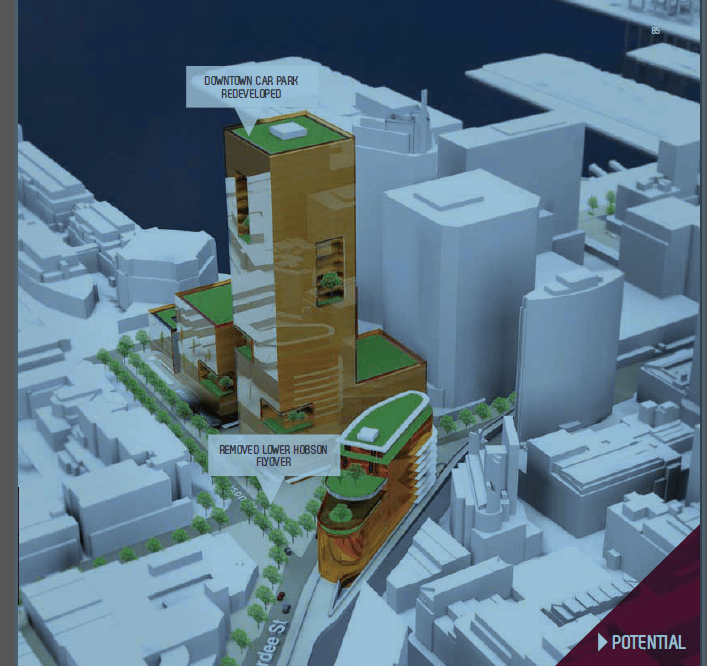
The Auckland Conversations page also contains two PDF supplementary files from both Sadik-khan and Ludo Campbell-Reid’s respective presentations. As the files are both 136MB and 56MB respectively I will embed them below so as not to blow your bandwidth (especially those on mobile) out of the water.
And before any one comments about the amount of time and resource being poured into the City Centre trust me I am aware. A post about that particular concern will be written up over the course of this and next week.




 Talking Southern Auckland
