Tag: Auckland Transport

AT HOP Roll Out Complete

Congratulations are in order
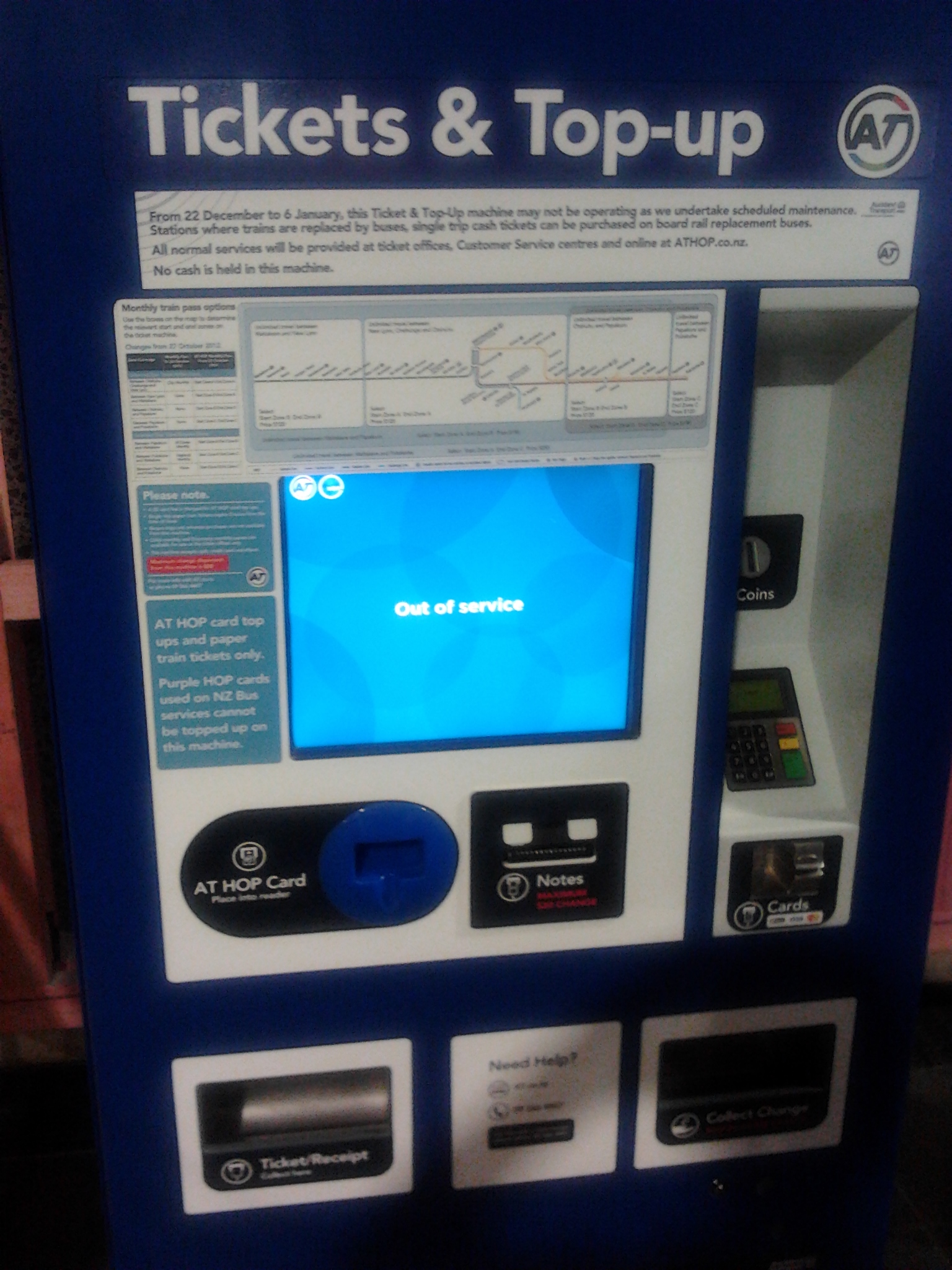
 

Yes the sole machine was out of order, however tech support had been notified 10mins earlier


Like Transport Blog (Celebration time, HOP Rollout Complete) congratulate and note the completion of the AT HOP roll out that is now completed. The journey has been very bumpy with all sorts of set backs and stories running around all over the place. In a sense of irony Talking Auckland (through its first inception View of Auckland) was partially founded in reaction to the AT-HOP and Snapper disasters at the time back in 2011. But today a moment to reflect, note, congratulate and celebrate that this roll out of this “universal” Public Transport smart card is complete.

From Voxy

Auckland Transport completes AT HOP rollout

Auckland Transport has completed the rollout of AT HOP, its reusable pre-pay smart card for travel on trains, ferries and buses.

There are currently more than 250,000 AT HOP cards being regularly used by customers around the region.

AT HOP allows customers to use one travel card on different modes of transport and public transport operators.

The card was first introduced on the region’s rail network in October 2012 and has been progressively rolled out since then.

Auckland Transport chairman, Dr Lester Levy, says it is significant for further developing public transport in New Zealand’s largest city. He says the rate at which public transport users have taken to the new system so far bodes well for on-going patronage growth.

“Other transformational projects such as the fleet of new electric trains, improved reliability of all services and a major focus on customer needs and satisfaction levels are other vital elements in delivering a world class public transport system,” he says.

Auckland mayor Len Brown is a regular user of public transport and also acknowledges what a significant milestone completion of the AT HOP rollout is. “The transformation of Auckland’s public transport system is well and truly underway, and the completion of the AT HOP rollout is a critical part of that,” he says.

“I want to congratulate Auckland Transport for delivering this project in such an effective and timely way.”

The project has been delivered in partnership with the New Zealand Transport Agency (NZTA).

Dave Brash, the New Zealand Transport Agency’s group manager of Planning and Investment, congratulates the Auckland Transport-led team on the successful introduction of integrated ticketing into Auckland.

“Making public transport easier and more attractive for people is a key priority for NZTA. So, after seven years of development, and a $73 million investment from the national land transport fund, we’re pleased with the resulting sophisticated platform, underpinned by a national ticketing standard that could support integrated ticketing systems across the country.”

—-ends—-

Source: http://www.voxy.co.nz/national/auckland-transport-completes-hop-rollout/5/185637

I use my HOP card when ever I travel on the train, bus or ferry and I personally enjoy using it with little issue. I detest carrying cash in the 21st Century so AT HOP just makes my life that much more easier when using the public transport system. Integrated Fares are on the way as Auckland Transport works through that and the service tenders (Rail starts next month) will no doubt have Integrated Fare provisions included for our public transport operators. If AT extends the HOP card to their parking buildings as a form of payment as well as one day maybe their Park-n-Rides that would be an extra one up for me (I know they can not start with using AT-HOP for parking yet until the IRD changes its treatment with HOP post June 2015, but we might as well get the ball rolling now in planning).  Further more we also have the roll out of the new South Auckland Bus Network starting next year in which all-in-all makes public transport just that much more attractive.


We still have a long way to go with things like the City Rail Link, the Manukau South Link, Pukekohe Electrification, more bus-ways, ridding us of paper tickets for something more robust like Sydney’s card tickets and so on. But lets put that to one side today, this week and take a moment, a reflection of the fact Auckland now has a universal public transport smart card.


I tip my hat and give congratulations to Dr Lester Levy and Auckland Transport with AT-HOP as an integrated ticketing scheme now fully complete.



Slowly Getting with Cycling

Bit by Bit with our Active Transport Network


Yesterday there was a large presentation followed by substantial debate on the roll of active transport (this case cycling) in Auckland. The presentation was given by Generation Zero and the Cycling Action Network (in which I’ll ask for the presentation later today) about our lagging state of the cycling network. The material in the agenda (embedded further down) further outlines the state of our cycling network:

From page 8 and 9 of the Infrastructure Agenda

  • Auckland is one of the most car-dominated cities in the world, with approximately 80 percent of all journeys made by car (Mees and Dodson 2007). Around two thirds of all car journeys in New Zealand are of less than six kilometres, with one third of all car journeys less than two kilometres (Tin Tin, Woodward et al. 2009; Turner, Hughes et al. 2010). Many of these shorter journeys could be undertaken on foot or by bicycle.
  • Auckland was ranked third most liveable city for quality of living in the 2012 Mercer rankings. However, ranked 43rd in relation to infrastructure, which includes a measure of transportation infrastructure.
  • The ACN currently consists of approximately 283 km of cycle ways, consisting of 95 km of cycle metros, 130 km of cycle connectors and 57 km of feeder routes that comprise of varying levels of service and cycle infrastructure provision. Parts of the existing network require cyclists to use bus/bike lanes and consist of short sections of unconnected cycle lanes, which advocacy groups do not consider to be an optimal solution in terms of safety.
  • Cycle monitoring is undertaken annually in Auckland and shows the success of providing high quality, connected cycle routes such as the segregated North-Western cycle way (linking western suburbs with the city centre) and the cycle lanes along Tamaki Drive (along the waterfront) that facilitate commuter and recreational cyclists of all ages and abilities.
  • On an average weekday Aucklanders take around 29,000 trips by cycle (approximately 0.6 percent of all trips). Monthly monitoring data reported to the Auckland Transport Board shows an annual increase in cycling of 10 percent compared with previous 12 months (based on data taken from nine automatic monitoring sites).
  • Safety is a barrier (perceived and actual) to people cycling in Auckland. Research undertaken on behalf of Auckland Transport by Ipsos in 2013 shows that 59 percent of respondents indicated that safety concerns are a barrier to them cycling more, with 79 percent agreeing more should be done to promote safe cycling in Auckland.
  • In 2012, crashes involving cyclists accounted for 5 percent (1 fatality and 18 serious) of all reported serious and fatal crashes across the Auckland local road network. This is disproportional to the mode share of cycling in Auckland that is approximately 1.2 percent of morning peak time journeys to work (based on 2013 census data).
  • Providing continuous separated dedicated cycle lanes and other types of cycle infrastructure to link the cycle network with transport interchanges and local services is one of the key priorities of the cycle infrastructure programme. This was confirmed in a 2013 Auckland Cycle research survey where 55 percent of people identified the provision of separated cycle facilities as a key priority.
  • The feedback from cycle advocacy groups such as Cycle Action Auckland and Generation Zero is that we should be focusing on segregated cycle lanes (preferably off road) and providing a connected network. This is aimed at improving safety and connectivity.
  • It is important that high quality cycle connector routes are provided to encourage interneighbourhood and shorter trips to schools and local services. These connector routes are also significant as they provide linkages to the wider cycle network.
  • Research also suggests that there is a strong demand for cycling in Auckland, with about one in four people owning a bike. Survey results indicate that 18 percent of respondents who are not currently cycling are primed and ready to cycle given the provision of high quality cycle facilities.
  • Auckland Transport runs campaigns during spring, summer and winter, as well as year round cycle training and “share the road” safety campaigns. During the 2012/13 financial year, Auckland Transport delivered cycle training to around 10,000 people from school children to businesses and community groups,

The Herald picked up further on the cycling situation in their “Paths full, say cyclists” in which even now pedestrians are getting cranky with cycling provisions.

From the NZ Herald:

Council told of pedestrian anger at surge in bike use of shared facilities. Cyclists are starting to feel the heat from pedestrians rebelling against having to share paths with them, Auckland Council members were warned yesterday.

In delivering her warning, Cycle Action Auckland chairwoman Barbara Cuthbert reminded the council’s infrastructure committee that pedestrians were “at the top of the hierarchy” of an active transport network.

“You may be hearing – we certainly are – that pedestrians across Auckland don’t want more shared paths,” Mrs Cuthbert said.

“Because now cycling numbers are getting up so high that those shared paths are not pleasant for pedestrians – pedestrians and cyclists deserve their own facilities.”

But Mrs Cuthbert was glowing in her praise of a council staff report recommending a greater financial commitment to cycling while warning that only 40 per cent to 50 per cent of a 900km network of bikeways will be in place by 2020 on current funding.

That compares with about 30 per cent now in place – much of which her group says is disjointed and in poor condition – and an Auckland Plan target of 70 per cent by 2020.

Committee deputy chairman Chris Darby, a cyclist, said other comparative cities around the world but particularly on the Pacific Rim were well ahead of Auckland in developing bikeways which raised public transport patronage by widening the catchment of buses, trains and ferries.

“We have been failing Auckland miserably – cycling is a badge of a smart city and we really need to have that badge on our lapel.”

His comments followed a presentation by Generation Zero youth organisation and TransportBlog representatives, who cited efforts by United States cities to attract young talent by providing safe cycling opportunities.

You can read the rest of the article over at the Herald site


Essentially the argument can be nutted down to this:

That is true to a point. Our heavier arterials should have dedicated and separated cycle ways but our smaller streets should be in a position to take cyclists automatically. This might be dropping local roads down to 30km/h and where possible flipping them over to shared spaces to remove the car as absolute priority from the road space.

For more on cycling by Talking Auckland check these related posts:


If someone asks for quick wins in getting some quality cycle and active transport infrastructure up before hitting the big stuff (long distance cycleways) I can think of two places to start:

  • Within 1km of a school
  • All Metropolitan Centres


Finally some pictures of either cycle infrastructure, some ideas, and/or places for a quick win

This slideshow requires JavaScript.


I will get the resolutions up from the Infrastructure Committee when they come through – most likely Monday if not Tuesday


Infrastructure Committee Agenda


A Look at the new EMU’s

The Middle Carriage


For those who do not have Twitter this is what the middle carriage looks like when boarding from a typical station platform

Auckland Transport ‏@AklTransport 11m
New electric trains aren’t far away! The middle carriage has platform-level boarding for wheelchairs, prams & bikes. pic.twitter.com/kG6HHdyjz6

Source: Auckland Transport ‏@AklTransport  11m

New electric trains aren’t far away! The middle carriage has platform-level boarding for wheelchairs, prams & bikes. pic.twitter.com/kG6HHdyjz6

No doubt AT will have more pictures coming soon