Tag: Public Transport

First Step in Improving Auckland’s Public Transport

Treat Humans as Humans


Not as numbers, not as dollar signs, not as a total pain in the ass that should be treated begrudgingly.


While I have been running commentary on things like Rail Efficiency Programs and operational models post City Rail Link to boost patronage via infrastructure and operations, another blogger raised a very fine point on something that is very well hammering our public transport patronage statistics – our customer service.


Before I highlight the said post from the other blogger, a quick reminder: Auckland Transport asked for submissions to its Regional Public Transport Program (RPTP) of which the hearings are next month (and that I am attending). One of the main focuses Auckland Transport was looking for in submissions to the RPTP was the “Customer Service Portal” – in other words the quality and level of customer service in our public transport system from front line staff right through to AT bureaucrats in Henderson.

This post is by virtue of an extension to my submission on the RPTP as well as replicating a point made at another blog.


So lets take a look at Customer Service on Auckland’s Public Transport System

This is from Auckland Transport Blog:


By Guest Post, on January 7th, 2013

This is a guest post by John P

The Ministry of Transport, bless ‘em, actually have a lot of interesting information on their website if you know where to look. One of the things they do is carry out a Household Travel Survey, which surveys 4,600 households in various parts of New Zealand each year. There’s plenty to look at, and you can check out various results at their transport survey, but for today I’ll look at a summary they put together on public transport use – taken from here.

The thing that stands out to me is a table showing the percentage of people who use public transport in NZ’s major cities. From this, 53% of Aucklanders surveyed hadn’t used PT at all in the last year. This put us on par with Christchurch and Dunedin, both of which are significantly smaller, neither of which have rail, and neither of which are particularly PT-oriented cities. We’re well behind Wellington, where only 27% of people hadn’t hopped on a train or bus at least once. Remember that (greater) Wellington is around the same size as Christchurch, and both cities are less than a third the size of Auckland.

Wow, that’s not a good start. How about people who haven’t used PT in the last month, but have in the last year? 17% of Aucklanders fell into this camp, in line with the other cities except for Wellington.

So, by this point, we can see that only 30% of Aucklanders had used public transport in the month before they were surveyed. We were in between Dunedin (26%) and Christchurch (34%), and well
behind Wellington where 46% of the people had used it at least once.

The last few lines of the table below are asking people how many days in the last month they had used public transport. I won’t dwell on it except to point out that half the Aucklanders who used PT in the last month hadn’t used it very often. Only 14% used it on 5 days or more, ahead of Dunedin (11%) but behind Christchurch (16%) and Wellington (27%).

Wellington is leaps and bounds ahead of Auckland, but I think we all knew that. I think these results are a pretty telling scorecard, and, to put it mildly, Auckland doesn’t look too flash. The majority of Aucklanders never use public transport at all, and most of those who do don’t use it very often. Two basic questions come out of this:

  1. Why don’t Aucklanders use PT very often?
  2. How do we improve PT usage in Auckland?

Questions that are answered in a number of different posts in this blog! A redesign of the network, and rail electrification, should help boost patronage over the next few years. But the thing is, we should really be aiming to get to where Wellington is now in the short to medium term. Anything less is short-changing ourselves in my opinion.


You can read the full article over at the Transport Blog site.

However the two questions in red are the points being raised and I answered over there. My answer was:

John (P) while a great post I think (from experience) the obvious is missing to give our flagging P/T patronage especially our rail patronage good kick until the infrastructure comes on cue over the next 10-30 years.

I take note here:

  1. Why don’t Aucklanders use PT very often?
  2. How do we improve PT usage in Auckland?

Questions that are answered in a number of different posts in this blog! A redesign of the network, and rail electrification, should help boost patronage over the next few years. But the thing is, we should really be aiming to get to where Wellington is now in the short to medium term. Anything less is short-changing ourselves in my opinion.”

Those are the two questions we are all seeking to actually answer and the reason why (to my personal disagreement as well as Councillor Mike Lee not being amused either) AT are about to embark on spending our money on “professional experts” ( http://www.nzherald.co.nz/nz/news/article.cfm?c_id=1&objectid=10855436 ) in finding “fixes” to our rail slump,


However again Councillor Mike Lee has hit the nail on the head right here with this comment from another article: http://www.nzherald.co.nz/nz/news/article.cfm?c_id=1&objectid=10857062

“Mayor Len Brown says the arrival of the trains will be “a huge step on the path towards the kind of integrated transport system an international city like Auckland needs”.

He believes the electric units – which will have greater acceleration and braking power than the existing diesel fleet – will make rail patronage “rocket” and create even more pressure for a 3.5km underground rail extension from Britomart to Mt Eden.

But council transport chairman and veteran electrification campaigner Mike Lee believes the new trains will not be enough to boost flagging patronage unless they are supported by general service improvements, notably far better punctuality and extended weekend timetables, without prohibitive fare rises.

“I would not bank on electric trains in themselves fixing chronic underlying human management problems,” he said.”


Basically cutting it short why don’t Aucklanders use P/T much and how do we improve our P/T usage in Auckland? Well the infrastructure part of the answer is being dealt with so to me it is rather irrelevant in this point in time. The actual answer came from Dr Lester Levy – Chair of AT:

Dr Levy said he agreed there was a need for “critical measures” to be adopted and Auckland Transport needed to be far more customer-led in creating a demand for its services.

And there is the answer right there and there – he said it himself: ” Auckland Transport needed to be far more customer-led in creating a demand for its services”

THAT TO ME IS (and excuse the caps) PRIORITY NUMBER ONE above else at the moment.

2013 is going to be long and interesting year getting the patronage back round again. However (and in my opinion (what ever that is worth these days)) we (by we I mean AT, Council, the p/t user, you guys here at the blog, myself, and others who give a damn about our city) can do this – slowly but surely. :D


Now I am going to extend the “situation” from another Transport Blog commenter emphasising the point:

George D

But council transport chairman and veteran electrification campaigner Mike Lee believes the new trains will not be enough to boost flagging patronage unless they are supported by general service improvements, notably far better punctuality and extended weekend timetables, without prohibitive fare rises.

He’s right. It doesn’t matter how fast and shiny the trains are if they’re still late and unreliable, and riding them costs more than ever. Every time fares rise, demand decreases – we’ve actually reached the point now where we’ve passed an equilibrium and ridership is decreasing towards a new equilibrium with those who are prepared to pay for a particular level of service.


Now since then a few more comments from Transport Blog have come up however I can’t specifically address those issues at the moment.

But as for my point and George D’s point, the writing for Auckland Transport is literally on the (virtual) wall. Improve customer service FIRST (and restore affordability to fares while at it) or all this multi-billion investment in our public transport system is going to be an utter waste if Auckland Transport can not get the basic human to human interaction right. People (both front line staff and passengers) just want to be treated like humans and be able to at least have a pleasant experience on our public transport network – even in times of disruptions. It can be done, it has been done and it is straight forward if the culture (and tools) are there.


There will be more said on this matter next month when I front up in front of members of the Auckland Transport Board next month for my RPTP hearing. However 5-minutes doesn’t quite seem long enough to hammer on about the “Customer Service Portal” at this current rate of dissatisfaction out there.



Alternative City Planning/Building

What I Do in my Downtime


From time to time in my downtime I go an embark on some “alternative” city planning and building. That being off to play a round of Cities XL 2012 for a couple of hours busy planning, building, rebuilding and managing the city/town/village. Currently on the “planet” I have 6 cities or villages under way, each specialising on a specific task at hand. Whether that be a farming town to supply food to the other cities, or a holiday town for people to get a way and relax, or a big hulking industrial and commerce centre as a central point of interactions.

At the moment I am busy focusing on Delta City, a city that will be a large hulking industrial and manufacturing centre coupled to an extensive port to “export” and “import” all the trade of the other five cities.

Delta City is at 202,000 and growing surely but steadily as it becomes the manufacturing hub on the “region.”


Here are a couple of teaser shots of Delta City:

This slideshow requires JavaScript.


For all the current 212 shots you can visit the Delta City Slideshow HERE!


Now one wonders how I get thus far with such a large city? Well this next shot does help:

Photobucket


These snapshots which I take an overview shot of the city then doodle lines on them happen when I am embarking on major transport and/or urban development projects. In this case I am planning for major road thoroughfares and bypasses to move the bulk of the cars, trucks and buses around as Delta City continues to sprawl outwards.


Now for our public transport junkies (or mass transit as said in North America) there is no mass transit currently in Delta City. However extensive tram tracks as well as the Operation Centres for buses and trams has been built. The next step is to build the bus and tram depots, then the tram/bus stops, then the actual routes themselves for the citizens to use. This of course takes a bit of time to do as your money is limited and citizens always moaning about something else along the way…


However this “retail” version of a city and transport simulations is a good way to pass the downtime and home in some skills gained in real life city living and planning. I might post some more up from the other cities as well over time.

Chicken or The Egg

What First with Transport


And


Do We Hold The Key to Better Transport?


The Herald ran a rather academic story on transport this morning and its relationship with the human body. To be honest the article is rather heavy for this time of year and looks like something err geeky from the blog next door. You can see the Herald article in the link below:

We hold the key to better transport

Some forms of getting from A to B are badly affecting the health of humans.

Incorporating the human body into transport design and planning could save millions.


We demand and expect our transport systems to get us where we want, when we want to be there, and as fast as possible. We are, however, human beings. And as with any other built system, we have to ask whether our fast and efficient modes of travel are necessarily always good for us.

And it goes on…


However when it came to solutions, yes they are under way but with Auckland‘s case it has a long way to go:

From the same article


For all the human health impacts of the modern transport system, there are obviously substantial benefits in the form of greater economic productivity, vastly increased spatial access and mobility, and even health gains, such as increased ability to get preventive and other medical care.

All technology imposes health risks of some sort. So a purely negative focus on these is unhelpful. Nonetheless, it’s useful to ask whether our transport technologies, policies and investments are good for us. If not, we need to adjust and redesign our transport accordingly.

Positive changes, many of which are currently underway, include:

  • A greater focus on redesigning congested urban spaces to encourage walking and social interaction and to lower automobile use and speeds. This could achieve many health and safety outcomes simultaneously.
  • Traffic calming – a range of techniques ranging from speed humps to pedestrian malls which create attractive active transport environments.
  • Road pricing and increasing parking fees, or eliminating parking altogether to encourage public transport use and walking.
  • The expansion of bike-share schemes, where public bicycles can be rented and dropped off from multiple locations.
  • Further safety improvements to automobile safety design for new car models.
  • Prioritising action on “black spots” on roads and highway “geometrics”, which includes improving lines of sight at intersections and around curves.

These reforms need not involve costly or radical overhaul. Road safety used to be a neglected policy; small but significant changes there have saved millions of lives. A broader incorporation of the human body into transport design and planning could save millions more.


Urban design and continued evolution of vehicle mechanics will go someway in addressing a more integrated system where transport and urban design are interwoven rather than treated separately as they are now. However the chicken and egg analogy comes up for the point I highlighted in bold: Road pricing and increasing parking fees, or eliminating parking altogether to encourage public transport use and walking. 

It is a case of do we slap on road pricing and increased parking fee measurements to build an adequate mass transit system that people would take as first choice rather than a forced choice (as of current), or do we build the mass transit system and get that running up first before slapping in the road pricing measures. It is actually a tough question and one who would have to provide a very good justification to the tax paying public no matter which of the two options they take.


But sadly Auckland seems to be in a bit of bother at the moment with is road and (in this particular case) mass transit systems. Take this article piece from the Herald (the post I have on it is sitting on ice at the moment):

Experts called in to fix rail slump

By Mathew Dearnaley

5:30 AM Friday Dec 21, 2012

Auckland Transport is resorting to professional help for a strategy on how to stop losing patronage from trains and buses. Chief operations officer Greg Edmonds has promised to provide his board with a plan early next year on how to staunch bleeding which saw a 17.2 per cent decline in train boardings last month compared with the previous November. That followed concern raised by Auckland Council transport leader Mike Lee, which was acknowledged by new board chairman Lester Levy, about a need to lift service performance. Mr Lee said patronage, which was boosted last year by the Rugby World Cup, started “flat-lining” in March and the organisation was starting to see a distinctive downward trajectory. “I don’t think this is sustainable without Auckland Transport intervening in a decisive way,” he said. “One of the measures of quality is punctuality or train performance and, while the price of our services is high, quality tends to be poor consistently.”

Mr Lee said the board, on which he is a council appointee, had been assured a new timetable would improve rail performance and that the rollout of the new Hop transport card on trains would combat fare evasion. But the board heard that train punctuality deteriorated last month to 84.1 per cent of services running to schedule, compared with 87.1 per cent in October, and he said rail staff were having difficulties stopping free-riding passengers. He had been told of fare evasion as some people were presenting their Hop cards to train staff to avoid paying their way. This did not apply to Britomart or Newmarket, which have become gated stations. “Busy, harassed train managers trying to collect fares are shown a Hop card and they move on,” he said. “The person may have paid $5 [in a since-expired half-price opening deal] for a card and, according to rail staff, they are using it to evade fares. “There are electronic checkers but they are slow and cumbersome and there’s not enough of them.” Dr Levy said he agreed there was a need for “critical measures” to be adopted and Auckland Transport needed to be far more customer-led in creating a demand for its services. “From the board’s point of view, this won’t go away – it’s the number one issue,” he said.


I think at this rate Auckland will be some way off before coming to the Chicken and Egg question on new infrastructure (which is where the point in bold above comes in) when we can’t even get the basics right on existing infrastructure.


Hopefully our transport planners and politicians will have some time to think over the summer holidays and have a solution, however as my iced post would stipulate; that might be asking for Mission Impossible. So in that case “WE” might be very well holding the key to better transport!


The Achilles Heel of C&R

Is Communities and Residents (C&R) Actually Unified?


&


Does C&R comprehend Public Good and see beyond the pure monetary side in a Public Good?


When the CRL debate popped up thanks to Bernard Orsman AND THAT POLL, I decided to go ask a nice simple question to Auckland’s centre-right local body organisation ‘Communities and Residents’ (C&R) in both Facebook and Twitter. This was the answer from Twitter:

By the way, has @CandRAuckland passed a resolution or motion yet on either supporting or being FULLY against the Auckland City Rail Link?

7hC&RTiny Klout Flag20C&R ‏@CandRAuckland

@BenRoss_AKL C&R supports CRL designation, but wants an effective funding options/value/timing discussion with all key parties


Same answer I got in the THE CRL AND THAT POLL CTD thread from Orakei Local Board Deputy Chair Mark Thomas. So that is all fine and a policy statement I would be inclined to follow providing the CRL started construction around 2018 (rather than 2015 as the mayor is pushing). However move to another rail project like the recently announced Pukekohe Electrification business case and that unification from C&R seems to fall apart rather quickly. To make things more interesting, it seems I might have exposed an Achilles heel from C&R in regards to public transport in Auckland and the cost/benefit situation:


I have asked C&R for their view-point on Pukekohe Electrification to which I will post as soon as I get it. But now check this Facebook thread in regards to the electrification extension:

  • Another pipe dream from Mayor Brown and his supporters. We can’t keep putting things on the tab. Interested to hear from my colleagues Dick Quax and Cameron Brewer.

    Pukekohe train plan

    http://www.stuff.co.nz

    Electric trains could run to Pukekohe if Auckland Council approves a $102 million upgrade to electrify the line past Papakura.
    • Bob Murphy Don’t worry about your colleagues, worry about your constituents George Wood!!!!
    • George Wood OK Robert Bob Murphy, point taken. Just thought that Dick and Cameron could add their views.
    • Ben Ross I would be very careful going into opposition over the Pukekohe electrification extension. The project has a BCR of 2.1 which is higher than probably just about all (bar one) of National’s Roads of National Significance projects COMBINED.

      Further more the project which needs $80m can easily be covered with targeted rates and development levies over 15 years to cover the loan. 

      And last I looked Papakura and Franklin Wards (to which Pukekohe resides) are both under Centre Right councillors (even though Cllr Des Morrison has “quit” C&R). Those two Councillors would be fast backing the electrification projects unless they wanted to willing feel the wraith of their constituents to the point being tipped out by a Centre Left candidate who supports the electrification extension project
    • Bob Murphy When are we going to get the North Shore rail connection?
    • Daniel Sloan We should electrify the road. Why give rail a monopoly?
      • Ben Ross fried pedestrian – toasty 😛:P
    • George Wood Can’t see this happening too soon. Saw a metro system that was struggling in Kaohsiung, Taiwan. This is a city of 2.6 million and they badly overestimated the patronage they would achieve. Auckland is only getting 10 million on the rail per annum.
      • Ben Ross And as Campaign for Better Transport shows time and time again we under-estimate ours often badly. Onehunga being one – although Manukau was the reverse that can be easily fixed with The South Link
    • George Wood Can you see rail breaking even financially any-time in the future Ben Ross?
      • Ben Ross Dual question. Freight rail yes I can if Mainfreight and Fontera could run their own freight train services on the rail lines. As for passenger rail, I do not expect it to monetary wise as it is a public good that provides greater profits in the social and economic front than the pure monetary front – something Public Bodies and representatives miss
    • Scott Bovaird I’ve given up arguing against George it must break even philosophy
    • George Wood Why is that Scott Bovaird. Can’t we have fair and balanced debate?
    • Scott Bovaird Hahahah I think we sit on complete opposite sides of the fence. Also feels like you won’t acknowledge that there is more to public transport beyond will it pay for itself. Also you don’t need to convince me to tick your name next year
      • Ben Ross yet 😉;-)
      • Scott Bovaird you’ll never convince me to live on the shore ben,
      • Bob Murphy If George stands for mayor you will get your chance Scott.
      • Scott Bovaird well if ya look below if george aligns himself with people like dick I’ll be doing everything to help other candidates
      • Ben Ross Sorry not running for mayor next year – value my sanity too much while I am still young :p:p
    • Dick Quax George I get accused of being anti PT which I’m not – use it quite a bit – however do get grumpy when I see how much public money just keeps on being poured into a 19th century technology – rail – to solve a 21st century transport problem.

      Scott Bovaird Im yet to see a reasonably legitimate alternative proposed dick. Until someone presents a business case that actually looks better than improving out rail system and then encouraging people to live near it your always going to be seen as anti PT
    • Dick Quax “Encourage people to live near rail” – just how do you do that – deal with reality not some fantasy planet which no one inhabits.
    • Scott Bovaird Ahhhh insulting my intelligence instead of actually dealing with the issues. … glad to see you’re a respectable representative of our community. Congratulations Dick you have reaffirmed my belief in why I would never vote cnr and will encourage everyone I possibly can to vote against you as well.
      • Ben Ross Not affiliated – just saying 😮:o
      • Scott Bovaird hahaha I would be distancing myself as much as possible ben cause I’m now in a very motivated place
      • Ben Ross An Independent Average Ratepayers’ View Shinning The Light at Issues in Auckland into the 2013 Local Government Elections
        Auckland YOUR CITY YOUR CALL

        Emphasis on independent 😮:o
    • Kane Glass It goes by the name of Planet Planet Rail
    • Scott Bovaird Also this is probably why you Franklin member of cnr quit because you don’t give a hoot about south of Manukau
    • Millie Liang Gentlemen.. Maybe I aren’t thinking straight..If everyone is worried about overcrowding and having to demolish 50-80k of houses in the city in the near future to accommodate everyone why do they want to spend large amounts of money on rail tracks from say Pukekohe/Helensville into the cbd….It just I remember the disaster that has unfolded at the Newmarket station square when all the pr 4-5yrs ago said there was going to be within 5-10yrs, 17,000 train passengers using the station everyday with trains capable of arriving every three mins….At the time I thought this must only be pr purposes to get funding as there was no way there that many people going to get off in Newmarket unless a city was going to be built at the end of a line, and then why head into the city any way…just my thoughts.


The dis-unity within C&R could very well extend from this article published in the Herald a couple of days ago:

Councillor quits ‘too urban’ C&R

By Bernard Orsman

Auckland councillor Des Morrison has resigned from Communities & Residents, saying the right-leaning ticket is too urban-centric and he wants to focus on rural issues before retiring at next year’s local elections.

“I’m not as close to C&R as I was,” said Mr Morrison, the Franklin councillor and chairman of the rural advisory panel.

He said he was still working with C&R but wanted to use his last year to focus on key issues for the rural sector.

The resignation of Mr Morrison, a popular figure on the council, is a blow for C&R, which has struggled since the first Super City elections, winning only five seats on the 20-strong Auckland Council.

The resignation of Mr Morrison highlights the failure of C&R to work with right-leaning independents, such as Cameron Brewer, Calum Penrose and Sharon Stewart, to build a united opposition against Mayor Len Brown’s left-leaning majority.


Hmm problems behind the scenes? Again check my THE CRL AND THAT POLL CTD thread as Bernard and I probe C&R on the CRL for responses and history.


However the Achilles Heel of C&R was exposed in the Facebook thread which I placed in bold:

  • George Wood Can you see rail breaking even financially any-time in the future Ben Ross?
    • Ben Ross Dual question. Freight rail yes I can if Mainfreight and Fontera could run their own freight train services on the rail lines. As for passenger rail, I do not expect it to monetary wise as it is a public good that provides greater profits in the social and economic front than the pure monetary front – something Public Bodies and representatives miss
  • Scott Bovaird I’ve given up arguing against George it must break even philosophy


Okay there is a difference between flushing money down the loo and subsidising a public good such as public transport – especially as I mentioned the wider economic and social benefits often outstrip the pure monetary cost!


Electrification to Pukekohe, the Manukau South Link and the City Rail Link are three public transport projects that provide wider and larger economic and social benefits in comparison to pure monetary cost (often expressed in capital to build and then the operating cost to run the thing). While the central government’s Roads of National Significance defy basically everything including monetary cost.


So the question ratepayers must ask to Council and Local Board candidates next year when it comes to projects that will crop up in the debate: While a program loses on the pure monetary front (such as public transport), does the program’s economic and social benefits outweigh that monetary loss?


There is more to programs than dollars and cents folks, and C&R could be exposed on that front especially if Pukekohe Electrification is anything to go by!


Now I wonder if C&R will respond to this? I’ll wait and see :O

Papakura Station – Refurbished

Opening of Papakura Station Platform Three


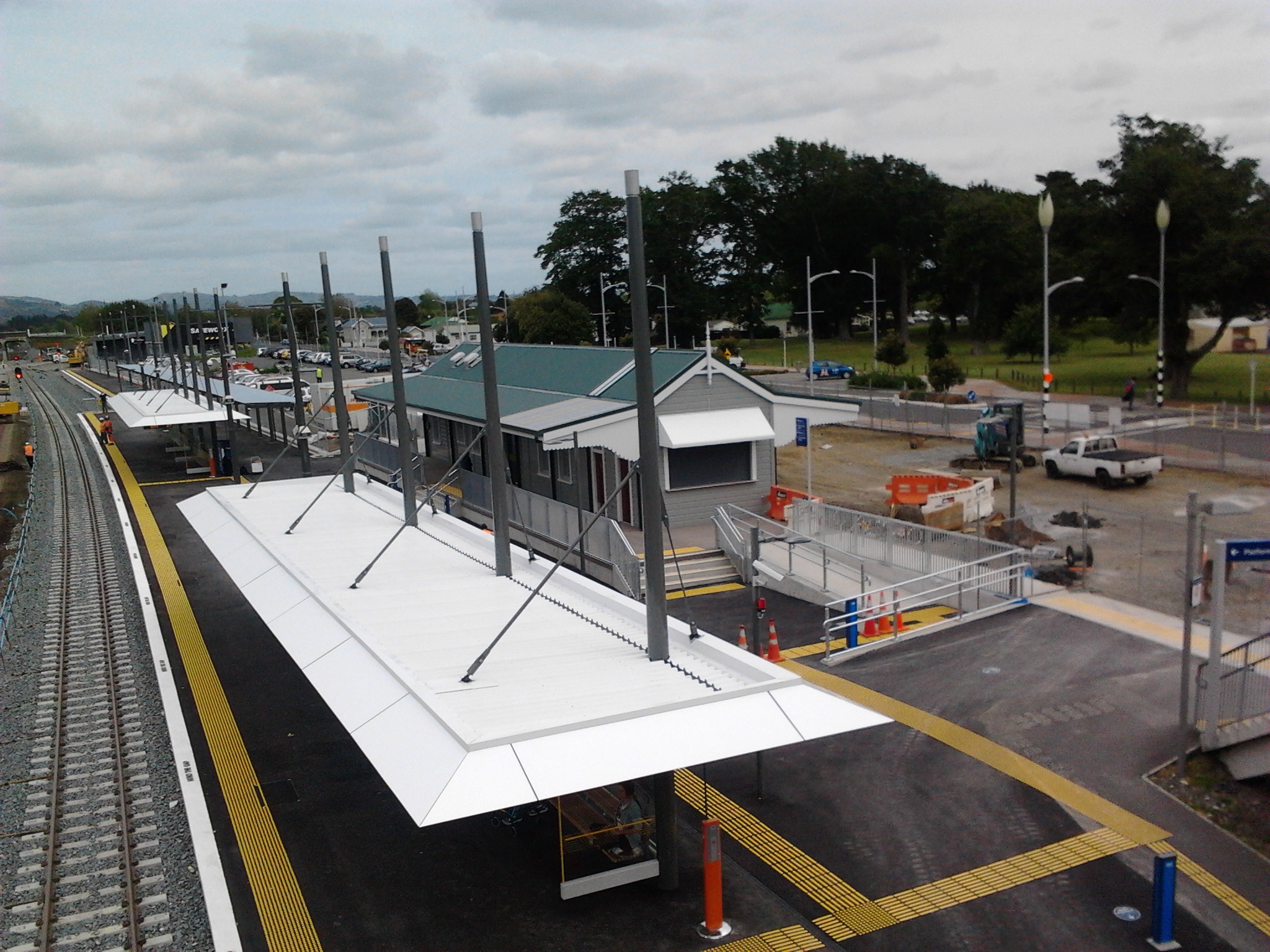
Over the weekend rail Block of Lines, the rail engineers had “commissioned” platform three at Papakura Station after an extensive revamp. This revamp included moving the old heritage Papakura Station Building and Signal Panel to the Platform Three location and sprucing the building up for a new lease of life. Platform Four at Papakura Station should have also been commissioned but will not be in use until the Electric’s start running from late next year.


I have some photos of Papakura Station taken from the over-bridge this afternoon. It is of note I was one of the first passengers out of platform three this  morning on the 5:05am service from Papakura to Britomart via The Eastern Line. I must say on first looks the new platform and refurbished building were looking very good. But I shall let you judge:


I will try endeavour to get close-ups and some shots inside the refurbished station building later on this week when I have time off.

For those looking for the station building moving shots from earlier this year, refer to my PAPAKURA STATION BUILDING ON THE MOVE post.

Wheels of Motion are Turning

Fighting for the South Manukau Link


Continuing to advocate and lobby hard for that South Link to be built – FOR YOU, the residents of South (and Counties) Auckland! As you deserve better!


Last month I had posted on someone deciding to place a nice big concrete pad in the middle of the path for the Manukau Rail Southern Link. You can see the post (SOUTH AUCKLAND GETS SHAFTED – YET AGAIN) by clicking on the link.

Well after some advocating and lobbying, Councillor George Wood who is a member of the Council Transport Committee got a Notice of Motion placed into November’s agenda about the South Link. The Notice of Motion is:

Requests Auckland Transport to give a high priority to the installation of a south facing rail link between the Manukau Spur Line and the North Island Main Trunk Line at Wiri so that this connection can be in place by the time
that electrification of the Auckland Metro rail systems occurs. 

You can see the Notice of Motion in the November Transport Committee Agenda at the bottom of this post.


Naturally I am supporting this motion after kicking up the initial fuss in the first place when I first spotted the concrete pad in the middle of the South Link’s path.

I had this to say in my material forwarded to Councillor Wood as well as my submission to the Regional Public Transport Plan:

The link to the original New Zealand Herald article: http://www.nzherald.co.nz/nz/news/article.cfm?c_id=1&objectid=10799107


As I said above, the Herald and I had commented on the missing link in April. Now some seven months later it seems apparent the link is a no-go or basically dead. Without the link; Manurewa, Papakura and Pukekohe are virtually isolated in easy access to Manukau by rail. This flies directly in the face of the idea around a Rapid Service that should allow very easy access with minimum fuss or transfers to a primary service centre for South Auckland.

The current proposal using trains which incur a transfer penalty at Puhinui or the bus trundling along the Great South Road (which takes more than double the time a train does) from Papakura to Manukau (and skipping Homai on the way) to me in my opinion is substandard for the people in these locales, and basically reinforces the isolation factor/feeling these residents have from a major service, employment and leisure centre!

Operational Proposal for Manukau to Papakura Link

With the Manukau to Papakura Link (The South Link) built for around $3.8m, the next question is what kind of services do you run. The answer is both straight forward for both the existing diesel passenger train fleet and the upcoming new electric passenger train fleet. The estimate length of journey from Papakura to Manukau Station via The South link is around 19 minutes (plus a seven minute walk from the Manukau Station to the Westfield Manukau Mall), compared to 30 mins using the Waka Pacific 471 and 472 bus according to the www.at.co.nz Journey Planner.

Thus allowing for turnaround at Manukau and Papakura Stations and knowing what rolling stock availability there is available pre-EMU’s; I recommend using one ADL-2 class DMU to run a single service backwards and forwards between Manukau and Papakura every one hour  in a single direction from 6:00am until around 10:19pm – seven days a week. That means for example your Papakura to Manukau via The South Link would start at Papakura at 6:30am and arrives in Manukau at 6:49am; then leave Manukau at 7:00am to make its return run to Papakura via the South Link.

An example of how a proposed Papakura-Manukau via The South Link Timetable would work (for brevity I have not included the afternoon services)

From Papakura Arrive at Manukau From Manukau Arrive at Papakura
    6:00am (first service) 6:19am
6:30am (first service) 6:49am 7:00am 7:19am
7:30am 7:49am 8:00am 8:19am
8:30am 8:49am 9:00am 9:19am
9:30am 09:49am 10:00am 10:19am
10:30am 10:49am 11:00am 11:19am
11:30am 11:49am 12:00pm 12:19pm
9:30pm (last service) 9:49pm 10:00pm (last service) 10:19pm


When the new electric trains are fully on-stream replacing the diesel fleet between Papakura and Swanson, the frequencies can be increased to every 30 minutes at the minimum, or 20 minutes for optimum service delivery until either the Botany or Airport Line (via Puhinui Station) is open and a new operating model would be in place (subject to EMU fleet availability).

In concluding this section of my RPTP; I highly recommend Auckland Transport remedy the situation and get that link for $3.8m built by 2016 at the absolute latest. Once the link is built, operating services would begin on an hourly timetable, stepping up to 20 minute frequencies once the new EMU fleet is fully online. To do otherwise is not an option unless you endorse isolating a major part of the community from its main service centre!


Now what I did not mention is the fact that we will have 10 ADL-class DMU’s available when all the EMU’s are online 2016. With ADL DMU’s already by then doing the Papakura – Pukekohe shuttle runs until the main line is electrified from Papakura to Pukekohe, those DMU’s can be extended to do a full Pukekohe – Papakura – Manukau via the Southern Link shuttle service until such a time Pukekohe is electrified and the EMU’s fully take over. So with upwards of 10 DMU’s, you can pretty much obtain 15-20 minute frequencies on Pukekohe – Manukau shuttles until those EMU’s can do the runs in place of the DMU’s (most likely 2020).


So here I am pitching for the residents and communities of: Homai, Manurewa, Takanini, Mahia, Papakura, Drury and (in-part) Pukekohe to get the missing link built for a frequent and rapid service to Manukau – the primary service and employment hub of South and Counties (former Franklin District) Auckland. Manukau has more connections to South Auckland residents than the CBD ever will, and as a result South Auckland should be able to access Manukau easily and efficiently which building The South Link will provide. To not provide the link and roll out the services utilising the link in my opinion as a Papakura resident and ratepayer, an insult to my fellow South Auckland neighbours and communities.


Thus I will continue to advocate and lobby hard for that South Link to be built – FOR YOU, the residents of South (and Counties) Auckland! As you deserve better!


BEN ROSS : AUCKLAND

Shining The Light – To a Better Papakura (OUR home)
AND
To a Better Auckland – (OUR City)

Auckland 2013: YOUR CITY – YOUR CALL


The Agenda