Tag: transportation

A Direct Message to Auckland Transport

Yes I am Talking to You


Yesterday I posted about the 2011 and 2012 rail patronage statistics coming through via a Local Government Official Information and Meetings Act request. In the same post down at the bottom a “direct” message was also written “to” Auckland Transport.


I am going to repost the message to AT here after the “irony” alarms were set off this morning in Twitter. No sooner than I had tweeted that: “Awaits to see if anyone from @AkTransportBlog has another “moment” on the buses or trains this morning #whyohwhy #basicsfirst” – a comment came up from one of their regular readers saying: “My 8:05am 839 outbound Shore bus started 13min late due to Transpower & @AklTransport closing Fanshawe bus lane. You closed the wrong lane!

Face-palm right there. Last I checked the Transpower works on Franshawe Street continue until March when “March-Madness” occurs (that being schools, universities and all businesses are back and transport systems face a large surge). So if problems are coming up now down at Franshawe then Lord help those in February and March if it does go to custard down there.


So here it is again – my message to Auckland Transport


I am not your enemy and I don’t want to be your enemy.

Your goal is the same as my goal (I think after a head scratch) and that is: to build and maintain (and this includes in the customer service satisfaction and confidence in using our public transport) a world-class public transport system that is: easy to access, easy to use, easy to understand, and most of all it is affordable to all – for our most liveable City.

However something has gone horribly wrong your direction and we are now seeing a sustained and systemic patronage slip in our rail network – a backbone (but not the sole back bone) to keeping the citizens and visitors of this city moving. I have no interest in attacking you Auckland Transport as that is counter-productive.

But your experiences that I have had with you both good but more hostility does not (and with absolute respect) leave me with much confidence in you nor your abilities in achieving the goal – it just simply does not. What is not also helping in my confidence towards you is the feedback I hear from infrequent and frequent passengers – customers of Auckland Transport on the public transport system which I am sorry as much as I want positives, I only see overtly negative feedback on experiences.

Your goal is my goal and all I want to do – am trying to do is as a ratepayer (your master, your employer – not the other way around) is “do my bit in” making our transport system better. Whether that be through praise in what you do right, constructive criticism to overcome the weaknesses, or offer alternatives and ideas others might not have thought of in getting our transport system moving forwards – not backwards as we are seeing; this is my way in doing my part in achieving the goal so that our transport system  is: easy to access, easy to use, easy to understand, and most of all it is affordable to all – for our most Liveable City.

You would have now doubt read my “FIRST STEP IN IMPROVING AUCKLAND’S PUBLIC TRANSPORT” post that sums up the current feelings towards you – Auckland Transport on the customer service and experience of the current system; and if you haven’t then I recommend strongly in reading it.

So what say you Auckland Transport – I am pitching with everything I have (skills, experience, knowledge, ideas, and pure passion and enthusiasm (my former co-workers can vouch for those two) to you – to make our transport system a better place in partnership with you. You know where to find me, you know where to contact me.

I await your reply. 


-Message End-


2011-2012 Rail Patronage Stats – And a Direct Message to AT

2011-2012 Rail Patronage Stats – For Auckland


Direct Message to Auckland Transport also included


While undertaking my normal cruising through blogs and social media that I keep an eye on, someone had filed a Local Government Official Meetings and Information Act (LGOIMA) request into the 2011 and 2012 Auckland rail patronage statistics – in which the numbers have been released by Auckland Transport.


You can see the patronage information HERE on page two or in the embed below

Accordingly the disclaimer from Auckland Transport applies: “The following sets out the observations of train passenger boardings by station following a single weekday sample during the month of May. The data is representative of a “typical” weekday usage but is subject to daily/seasonal variances. Auckland Transport does not warrant the accuracy of the counts.”

Source: Auckland Transport

It is of also to note that it is mentioned by Auckland Transport that there were service disruptions (I am trying to remember them) in 2011 and 2012 which “could have” affected “normal” patronage demand on the network.


So in other words the statistics are pretty next to worthless as you need an uninterrupted day to gauge “normal” patronage demand properly.


The Request and Stats

Source: Auckland Transport

Disclaimer: [as above]


What can I get out of these stats?

  • Papakura is still the third busiest station
  • Increase on patronage on the Western Line but slump on the Southern and Eastern Lines (again there were disruptions on those life which WILL affect numbers)
  • Onehunga is underwhelming – which means those passengers are getting on at Ellersile making the Onehunga trains appear busy in the peaks
  • Manukau. The comment from my Facebook will be more apt in describing this one:
    • As for Manukau, well George you and I have been down this road with Manukau. With the station 700 metres short to where it short and an observation on that concrete post, it was the entire reason behind my urgency to you and Mike Lee to see that South Link be built in order to get that patronage up


Now arguably these measurements were done in May when (looking at the Auckland Transport rolling 12-month patronage statistics) there was still growth, however since August 2012 there has been what is now a systemic and noticeable decline kicking the patronage levels back to July-August 2011 levels (so a full total back slide rendering efforts and good work gone in – useless). You can see my views on this backsliding over at my “FIRST STEP IN IMPROVING AUCKLAND’S PUBLIC TRANSPORT” post.


To which I have this message to Auckland Transport:


I am not your enemy and I don’t want to be your enemy.

Your goal is the same as my goal (I think after a head scratch) and that is: to build and maintain (and this includes in the customer service satisfaction and confidence in using our public transport) a world-class public transport system that is: easy to access, easy to use, easy to understand, and most of all it is affordable to all – for our most liveable City.

However something has gone horribly wrong your direction and we are now seeing a sustained and systemic patronage slip in our rail network – a backbone (but not the sole back bone) to keeping the citizens and visitors of this city moving. I have no interest in attacking you Auckland Transport as that is counter-productive.

But your experiences that I have had with you both good but more hostility does not (and with absolute respect) leave me with much confidence in you nor your abilities in achieving the goal – it just simply does not. What is not also helping in my confidence towards you is the feedback I hear from infrequent and frequent passengers – customers of Auckland Transport on the public transport system which I am sorry as much as I want positives, I only see overtly negative feedback on experiences.

Your goal is my goal and all I want to do – am trying to do is as a ratepayer (your master, your employer – not the other way around) is do my bit in making our transport system better. Whether that be through praise in what you do right, constructive criticism to overcome the weaknesses, or offer alternatives and ideas others might not have thought of in getting our transport system moving forwards – not backwards as we are seeing; this is my way in doing my part in achieving the goal so that our transport system  is: easy to access, easy to use, easy to understand, and most of all it is affordable to all – for our most Liveable City.

You would have now doubt read my “FIRST STEP IN IMPROVING AUCKLAND’S PUBLIC TRANSPORT” post that sums up the current feelings towards you – Auckland Transport on the customer service and experience of the current system; and if you haven’t then I recommend strongly in reading it.

So what say you Auckland Transport – I am pitching with everything I have (skills, experience, knowledge, ideas, and pure passion and enthusiasm (my former co-workers can vouch for those two) to you – to make our transport system a better place in partnership with you. You know where to find me, you know where to contact me.

I await your reply. 


AT COO Interviewed – On Auckland’s Transport

Chief Operating Officer Talks About Auckland’s Transport – Yet Still Misses the Basics?


On Friday; Auckland Transport posted up on its website an interview with their Number Three – Chief Operation Officer Greg Edmonds with TV9’s Asia Focus.

From Auckland Transport:

Transport in 2013: Greg Edmonds interview

Last reviewed: 11/01/2013 2:46 p.m.

​Watch this interview on AsiaFocus by TV9 with Greg Edmonds, Chief Operating Officer of Auckland Transport.

Mr Edmonds answers questions about integrated ticketing (HOP), its benefits and the rollout to buses that will begin in April.

He also speaks about measures Auckland Transport is taking to continue to grow public transport patronage. These include integrated ticketing, electrification of the rail network and electric trains and the redesign of bus networks to better integrate them with the rail network.

Watch the recording of the interview on TV9.co.nz. Length: 20:25


And so I watched the interview and took some notes on the following aspects (with some help of other keen eyes and ears):

Noted from Interview with AT-CCO Greg Edmonds


1.52min
“Looking for a population of 2-2.5 million people in 10yrs”

Where are the people coming? 2030 was when Auckland was due to hit the 2-million mark so is there something statisticians not telling us?

2.39min
“Current Dual HOP card system”

Why couldn’t AT get it right in the first place? It’s not that Auckland is the first place ever to use such a system. However I have covered this since my alternative to Snapper in February Last Year)

4.55min
“Rail patronage dropping since RWC – How to fix public transport patronage:

  1. Integrated train/bus/ferry timetables
  2. $600million electrification
  3. 10min a train will turn up (all day every day, 7 days a week)
  4. 15min a bus will turn up (all day every day, 7 days a week)
  5. City Rail Link post 2022 (or rather 2025)”

My Reply: From observations and experiences: trains/buses running around just about/or empty all the time outside peak hrs. However will another million people in the city in 10yrs and an aging population use their free travel passes their might be a bit more usage. But doubling usage by another 70 million in 10 years is somewhat overly optimistic given the current situation. I have also touched on AT not getting the basics rights with Customer Service in the FIRST STEP IN IMPROVING AUCKLAND’S PUBLIC TRANSPORT post which basically states all the investment in infrastructure means squat if the customer service experience is least to be currently desired. More on this again later)

7.21min
“Greg Edmonds stating passenger numbers not dropping”

Someone asked me: “I wish someone would confirm whether they dropping or rising and all officials/bureaucrats stick to the same story line.” The answer to that lies in the patronage stats from Auckland Transport which is currently stating there is overall growth in public transport patronage, but declines in Northern Busway patronage and a rather disturbing 14-15% drop in rail patronage which shows no sign of currently slowing down.

8.00min
Greg Edmonds not concerned about overall public transport use trends.”

Someone said this to me (so not my own words): “Naturally he’s not… he’s selling the fear factor of 2-2.5 million people being in Auckland and the place turning into chaos.” In saying that, however I might go an explore Edmonds comment around that remark. His role clearly dictates that he must be concerned around overall public transport trends for if they either:  fall through the floor in patronage, or the Customer Service situation does not improve – then his head might be on Councillor Mike Lee’s PLATE!)

9.25min
“Real time information system not accurate…”

I cannot comment on the Passenger Real Time Information Display System (RAPID) currently due to previous employment however a reader did ask this: (Question) “Why couldn’t AT implement a system that would work right in the first place? It’s not as though Auckland has the first system in the world. How much did this mistake cost ratepayers and who has been held accountable for it?”

10.51min
“We have patronage “Targets” – by 2020 achieve 140 million based on investments being made”

Observation: It means an extra 70 million rides in seven years, that’s an increase of 10 million per year which with the current problems AT are facing with public transport – it could be a case of “barrow” and “uphill”.  The slide in rail patronage which is becoming entrenched and systemic needs to be reversed. The question is: “how is Auckland Transport going to honestly reverse that slide?”

A remark from a reader: “Looking forward to reading what the honest and true figures are this time next year while hoping all AT staff are made to ride the buses for a year to see first-hand what really goes on in our public transport network”


15.18min
(This was noted by me and from feedback by readers as well): “No plans for the North Shore Rail Line despite apparently according to Greg Edmonds: NZTA starting the second harbour crossing around the 2015-2016 mark. Now last I looked NZTA were in the building of that tunnel crossing, going to include I believe a heavy rail line that can be joined to the City Rail Link on the CBD side while extending along the Northern Busway – replacing it.”

To me this is a rather flippant attitude of Greg Edmonds in regards to the North Shore Line and could be very well contradicting both the Mayor’s and NZTA’s plans for the eventual North Shore Line. Auckland Transport should be very well making plans for the Busway to be replaced by the North Shore Line (Heavy Rail) as was “planned” when the busway was built. Heavy Rail (The North Shore Line) can carry upwards of 900% more passengers at full capacity than the busway ever could at full capacity, while allowing a seamless train trip from the North Shore to either: the CBD, New Lynn, Sylvia Park, Newmarket, Manukau, Onehunga, THE AIRPORT, Papakura, Botany, or even Pukekohe. The North Shore Line would connect a relatively isolated part of Auckland back to the main isthmus and allow for growth on the Shore that would be better catered for.
I shall let readers making their own call on the Greg Edmonds interview but those were my thoughts (as well as some others who gave feedback).


For the benefit of Auckland Transport’s Chief Operating Officer – Greg Edmonds, I shall re-stick the Customer Service post here below for him to go and read – as I don’t quite think he has quite joined the dots to our dismal public transport performance (including that of the CCO as well):

FIRST STEP IN IMPROVING AUCKLAND’S PUBLIC TRANSPORT


Posted by BR:AKL_Admin01 on January 10, 2013 · 


Treat Humans as Humans


Not as numbers, not as dollar signs, not as a total pain in the ass that should be treated begrudgingly.


While I have been running commentary on things like Rail Efficiency Programs and operational models post City Rail Link to boost patronage via infrastructure and operations, another blogger raised a very fine point on something that is very well hammering our public transport patronage statistics – our customer service.


Before I highlight the said post from the other blogger, a quick reminder: Auckland Transport asked for submissions to its Regional Public Transport Program (RPTP) of which the hearings are next month (and that I am attending). One of the main focuses Auckland Transport was looking for in submissions to the RPTP was the “Customer Service Portal” – in other words the quality and level of customer service in our public transport system from front line staff right through to AT bureaucrats in Henderson.

This post is by virtue of an extension to my submission on the RPTP as well as replicating a point made at another blog.


So lets take a look at Customer Service on Auckland’s Public Transport System

This is from Auckland Transport Blog:


By Guest Post, on January 7th, 2013

This is a guest post by John P

The Ministry of Transport, bless ‘em, actually have a lot of interesting information on their website if you know where to look. One of the things they do is carry out a Household Travel Survey, which surveys 4,600 households in various parts of New Zealand each year. There’s plenty to look at, and you can check out various results at their transport survey, but for today I’ll look at a summary they put together on public transport use – taken from here.

The thing that stands out to me is a table showing the percentage of people who use public transport in NZ’s major cities. From this, 53% of Aucklanders surveyed hadn’t used PT at all in the last year. This put us on par with Christchurch and Dunedin, both of which are significantly smaller, neither of which have rail, and neither of which are particularly PT-oriented cities. We’re well behind Wellington, where only 27% of people hadn’t hopped on a train or bus at least once. Remember that (greater) Wellington is around the same size as Christchurch, and both cities are less than a third the size of Auckland.

Wow, that’s not a good start. How about people who haven’t used PT in the last month, but have in the last year? 17% of Aucklanders fell into this camp, in line with the other cities except for Wellington.

So, by this point, we can see that only 30% of Aucklanders had used public transport in the month before they were surveyed. We were in between Dunedin (26%) and Christchurch (34%), and well
behind Wellington where 46% of the people had used it at least once.

The last few lines of the table below are asking people how many days in the last month they had used public transport. I won’t dwell on it except to point out that half the Aucklanders who used PT in the last month hadn’t used it very often. Only 14% used it on 5 days or more, ahead of Dunedin (11%) but behind Christchurch (16%) and Wellington (27%).

Wellington is leaps and bounds ahead of Auckland, but I think we all knew that. I think these results are a pretty telling scorecard, and, to put it mildly, Auckland doesn’t look too flash. The majority of Aucklanders never use public transport at all, and most of those who do don’t use it very often. Two basic questions come out of this:

  1. Why don’t Aucklanders use PT very often?
  2. How do we improve PT usage in Auckland?

Questions that are answered in a number of different posts in this blog! A redesign of the network, and rail electrification, should help boost patronage over the next few years. But the thing is, we should really be aiming to get to where Wellington is now in the short to medium term. Anything less is short-changing ourselves in my opinion.


You can read the full article over at the Transport Blog site.

However the two questions in red are the points being raised and I answered over there. My answer was:

John (P) while a great post I think (from experience) the obvious is missing to give our flagging P/T patronage especially our rail patronage good kick until the infrastructure comes on cue over the next 10-30 years.

I take note here:

  1. Why don’t Aucklanders use PT very often?
  2. How do we improve PT usage in Auckland?

Questions that are answered in a number of different posts in this blog! A redesign of the network, and rail electrification, should help boost patronage over the next few years. But the thing is, we should really be aiming to get to where Wellington is now in the short to medium term. Anything less is short-changing ourselves in my opinion.”

Those are the two questions we are all seeking to actually answer and the reason why (to my personal disagreement as well as Councillor Mike Lee not being amused either) AT are about to embark on spending our money on “professional experts” ( http://www.nzherald.co.nz/nz/news/article.cfm?c_id=1&objectid=10855436 ) in finding “fixes” to our rail slump,


However again Councillor Mike Lee has hit the nail on the head right here with this comment from another article: http://www.nzherald.co.nz/nz/news/article.cfm?c_id=1&objectid=10857062

“Mayor Len Brown says the arrival of the trains will be “a huge step on the path towards the kind of integrated transport system an international city like Auckland needs”.

He believes the electric units – which will have greater acceleration and braking power than the existing diesel fleet – will make rail patronage “rocket” and create even more pressure for a 3.5km underground rail extension from Britomart to Mt Eden.

But council transport chairman and veteran electrification campaigner Mike Lee believes the new trains will not be enough to boost flagging patronage unless they are supported by general service improvements, notably far better punctuality and extended weekend timetables, without prohibitive fare rises.

“I would not bank on electric trains in themselves fixing chronic underlying human management problems,” he said.”


Basically cutting it short why don’t Aucklanders use P/T much and how do we improve our P/T usage in Auckland? Well the infrastructure part of the answer is being dealt with so to me it is rather irrelevant in this point in time. The actual answer came from Dr Lester Levy – Chair of AT:

Dr Levy said he agreed there was a need for “critical measures” to be adopted and Auckland Transport needed to be far more customer-led in creating a demand for its services.

And there is the answer right there and there – he said it himself: ” Auckland Transport needed to be far more customer-led in creating a demand for its services”

THAT TO ME IS (and excuse the caps) PRIORITY NUMBER ONE above else at the moment.

2013 is going to be long and interesting year getting the patronage back round again. However (and in my opinion (what ever that is worth these days)) we (by we I mean AT, Council, the p/t user, you guys here at the blog, myself, and others who give a damn about our city) can do this – slowly but surely. :D


Now I am going to extend the “situation” from another Transport Blog commenter emphasising the point:

George D

But council transport chairman and veteran electrification campaigner Mike Lee believes the new trains will not be enough to boost flagging patronage unless they are supported by general service improvements, notably far better punctuality and extended weekend timetables, without prohibitive fare rises.

He’s right. It doesn’t matter how fast and shiny the trains are if they’re still late and unreliable, and riding them costs more than ever. Every time fares rise, demand decreases – we’ve actually reached the point now where we’ve passed an equilibrium and ridership is decreasing towards a new equilibrium with those who are prepared to pay for a particular level of service.


Now since then a few more comments from Transport Blog have come up however I can’t specifically address those issues at the moment.

But as for my point and George D’s point, the writing for Auckland Transport is literally on the (virtual) wall. Improve customer service FIRST (and restore affordability to fares while at it) or all this multi-billion investment in our public transport system is going to be an utter waste if Auckland Transport can not get the basic human to human interaction right. People (both front line staff and passengers) just want to be treated like humans and be able to at least have a pleasant experience on our public transport network – even in times of disruptions. It can be done, it has been done and it is straight forward if the culture (and tools) are there.


There will be more said on this matter next month when I front up in front of members of the Auckland Transport Board next month for my RPTP hearing. However 5-minutes doesn’t quite seem long enough to hammer on about the “Customer Service Portal” at this current rate of dissatisfaction out there.


As I said: “There will be more said on this matter next month when I front up in front of members of the Auckland Transport Board next month for my RPTP hearing. However 5-minutes doesn’t quite seem long enough to hammer on about the “Customer Service Portal” at this current rate of dissatisfaction out there.”


Long way to go folks, long way to go.


A Letter from A Councillor

Councillor George Wood Writes to Manukau Courier


While checking my Facebook feed in the morning (as you do) I noticed a comment from former Manurewa Local Board Chair:


That got me looking and I discovered this:


Basically Councillor George Wood spelling it out as it is with public transport issues down here in South Auckland – especially with buses (an area admittedly I am not paying much issue to but should very well be).

I agree with the entire letter from the Councillor to the point I will be throwing more resources or rather effort here at BR:AKL on our bus issues and getting them sorted.


However Newman was “fuming” because the Southern Initiative got mentioned and the bad onus around that. Yes the Southern Initiative has had its rather ugly moments in either rough-shodding over the Local Boards or budget re-routing away from Local Boards to Southern Initiative projects that are overseen by the main governing body.

The focus from the letter should be on our transport here in South Auckland, not dragging the Southern Initiative into this as that is another debate along with the Sale and Supply of Alcohol Act.

Also I have seen no oppositional Councillor nor mayoral candidate state they would overthrow the Southern Initiative after the 2013 elections and put in place an alternative. I believe it is the case of we are lugged with it – let’s try and make this work best we can – as rough-shodding by Council Officers, CCOs, and the Governing Body happens right across the spectrum – not just the Southern Initiative.

My comment to Newman makes somewhat that point:

Ben Ross

Burnt from the Budget (which burnt the entire city any how) I still see.

That aside – well something must being going on as 2012 was a mixed year for success and failures in dealing with the Governing Body from personal experience (that is the Governing Body not the CCOs).

Failures: The Auckland Plan in part but more so the Long Term Plan. The new Rubbish Policy.

Successes: Irony would have it this has been down the transport division:- Manukau South Link, Pukekohe Electrification Extension, cant comment with the RPTP yet as the hearing is still coming up, slow progress with the bus situation down south – but least its moving.

Next Challenge: Again transport, however Alcohol Policies with the new Act in position

So “bringing them to the Governing Body” has had its moments of success and failures -( for a scrappy little ratepayer  ) – but that is to be expected. 2013 is going to bring?…


A case of win-some, you lose-some. But you continue to battle on in pushing or lobbying for what you want to see to make Auckland a better place – the purpose behind this blog from day one.


BEN ROSS : AUCKLAND

Shining The Light – To a Better Papakura (OUR home)
AND
To a Better Auckland – (OUR City)

Auckland 2013: YOUR CITY – YOUR CALL


First Step in Improving Auckland’s Public Transport

Treat Humans as Humans


Not as numbers, not as dollar signs, not as a total pain in the ass that should be treated begrudgingly.


While I have been running commentary on things like Rail Efficiency Programs and operational models post City Rail Link to boost patronage via infrastructure and operations, another blogger raised a very fine point on something that is very well hammering our public transport patronage statistics – our customer service.


Before I highlight the said post from the other blogger, a quick reminder: Auckland Transport asked for submissions to its Regional Public Transport Program (RPTP) of which the hearings are next month (and that I am attending). One of the main focuses Auckland Transport was looking for in submissions to the RPTP was the “Customer Service Portal” – in other words the quality and level of customer service in our public transport system from front line staff right through to AT bureaucrats in Henderson.

This post is by virtue of an extension to my submission on the RPTP as well as replicating a point made at another blog.


So lets take a look at Customer Service on Auckland’s Public Transport System

This is from Auckland Transport Blog:


By Guest Post, on January 7th, 2013

This is a guest post by John P

The Ministry of Transport, bless ‘em, actually have a lot of interesting information on their website if you know where to look. One of the things they do is carry out a Household Travel Survey, which surveys 4,600 households in various parts of New Zealand each year. There’s plenty to look at, and you can check out various results at their transport survey, but for today I’ll look at a summary they put together on public transport use – taken from here.

The thing that stands out to me is a table showing the percentage of people who use public transport in NZ’s major cities. From this, 53% of Aucklanders surveyed hadn’t used PT at all in the last year. This put us on par with Christchurch and Dunedin, both of which are significantly smaller, neither of which have rail, and neither of which are particularly PT-oriented cities. We’re well behind Wellington, where only 27% of people hadn’t hopped on a train or bus at least once. Remember that (greater) Wellington is around the same size as Christchurch, and both cities are less than a third the size of Auckland.

Wow, that’s not a good start. How about people who haven’t used PT in the last month, but have in the last year? 17% of Aucklanders fell into this camp, in line with the other cities except for Wellington.

So, by this point, we can see that only 30% of Aucklanders had used public transport in the month before they were surveyed. We were in between Dunedin (26%) and Christchurch (34%), and well
behind Wellington where 46% of the people had used it at least once.

The last few lines of the table below are asking people how many days in the last month they had used public transport. I won’t dwell on it except to point out that half the Aucklanders who used PT in the last month hadn’t used it very often. Only 14% used it on 5 days or more, ahead of Dunedin (11%) but behind Christchurch (16%) and Wellington (27%).

Wellington is leaps and bounds ahead of Auckland, but I think we all knew that. I think these results are a pretty telling scorecard, and, to put it mildly, Auckland doesn’t look too flash. The majority of Aucklanders never use public transport at all, and most of those who do don’t use it very often. Two basic questions come out of this:

  1. Why don’t Aucklanders use PT very often?
  2. How do we improve PT usage in Auckland?

Questions that are answered in a number of different posts in this blog! A redesign of the network, and rail electrification, should help boost patronage over the next few years. But the thing is, we should really be aiming to get to where Wellington is now in the short to medium term. Anything less is short-changing ourselves in my opinion.


You can read the full article over at the Transport Blog site.

However the two questions in red are the points being raised and I answered over there. My answer was:

John (P) while a great post I think (from experience) the obvious is missing to give our flagging P/T patronage especially our rail patronage good kick until the infrastructure comes on cue over the next 10-30 years.

I take note here:

  1. Why don’t Aucklanders use PT very often?
  2. How do we improve PT usage in Auckland?

Questions that are answered in a number of different posts in this blog! A redesign of the network, and rail electrification, should help boost patronage over the next few years. But the thing is, we should really be aiming to get to where Wellington is now in the short to medium term. Anything less is short-changing ourselves in my opinion.”

Those are the two questions we are all seeking to actually answer and the reason why (to my personal disagreement as well as Councillor Mike Lee not being amused either) AT are about to embark on spending our money on “professional experts” ( http://www.nzherald.co.nz/nz/news/article.cfm?c_id=1&objectid=10855436 ) in finding “fixes” to our rail slump,


However again Councillor Mike Lee has hit the nail on the head right here with this comment from another article: http://www.nzherald.co.nz/nz/news/article.cfm?c_id=1&objectid=10857062

“Mayor Len Brown says the arrival of the trains will be “a huge step on the path towards the kind of integrated transport system an international city like Auckland needs”.

He believes the electric units – which will have greater acceleration and braking power than the existing diesel fleet – will make rail patronage “rocket” and create even more pressure for a 3.5km underground rail extension from Britomart to Mt Eden.

But council transport chairman and veteran electrification campaigner Mike Lee believes the new trains will not be enough to boost flagging patronage unless they are supported by general service improvements, notably far better punctuality and extended weekend timetables, without prohibitive fare rises.

“I would not bank on electric trains in themselves fixing chronic underlying human management problems,” he said.”


Basically cutting it short why don’t Aucklanders use P/T much and how do we improve our P/T usage in Auckland? Well the infrastructure part of the answer is being dealt with so to me it is rather irrelevant in this point in time. The actual answer came from Dr Lester Levy – Chair of AT:

Dr Levy said he agreed there was a need for “critical measures” to be adopted and Auckland Transport needed to be far more customer-led in creating a demand for its services.

And there is the answer right there and there – he said it himself: ” Auckland Transport needed to be far more customer-led in creating a demand for its services”

THAT TO ME IS (and excuse the caps) PRIORITY NUMBER ONE above else at the moment.

2013 is going to be long and interesting year getting the patronage back round again. However (and in my opinion (what ever that is worth these days)) we (by we I mean AT, Council, the p/t user, you guys here at the blog, myself, and others who give a damn about our city) can do this – slowly but surely. :D


Now I am going to extend the “situation” from another Transport Blog commenter emphasising the point:

George D

But council transport chairman and veteran electrification campaigner Mike Lee believes the new trains will not be enough to boost flagging patronage unless they are supported by general service improvements, notably far better punctuality and extended weekend timetables, without prohibitive fare rises.

He’s right. It doesn’t matter how fast and shiny the trains are if they’re still late and unreliable, and riding them costs more than ever. Every time fares rise, demand decreases – we’ve actually reached the point now where we’ve passed an equilibrium and ridership is decreasing towards a new equilibrium with those who are prepared to pay for a particular level of service.


Now since then a few more comments from Transport Blog have come up however I can’t specifically address those issues at the moment.

But as for my point and George D’s point, the writing for Auckland Transport is literally on the (virtual) wall. Improve customer service FIRST (and restore affordability to fares while at it) or all this multi-billion investment in our public transport system is going to be an utter waste if Auckland Transport can not get the basic human to human interaction right. People (both front line staff and passengers) just want to be treated like humans and be able to at least have a pleasant experience on our public transport network – even in times of disruptions. It can be done, it has been done and it is straight forward if the culture (and tools) are there.


There will be more said on this matter next month when I front up in front of members of the Auckland Transport Board next month for my RPTP hearing. However 5-minutes doesn’t quite seem long enough to hammer on about the “Customer Service Portal” at this current rate of dissatisfaction out there.


THE RAIL EFFICIENCY PROGRAM #4

How to get Better Resilience out of the Rail Network


A Rail Efficiency Program Series


THE ALL-ENCOMPASSING RAIL EFFICIENCY PROGRAM – PART TWO


Westfield Junction Fly-Over


Those who travel by train on the Southern and Eastern Lines to their destination and pass through the Westfield Junction can know the delays that happen in that section of track due to another train “crossing over.”

This picture would explain better what I mean:

Westfield Junction jpeg overview mode


Click for full resolution (1920×955)

As you can fathom, there is a lot of conflicting routes at Westfield junction from both passenger and freight trains – all which can cause delays to our passenger services (and they do) at just about any given time.


Now with passenger train frequencies to increase to initially 6 trains per hour (one every 10 minutes)(and that could easily mean one train every 5 minutes on the lines between Westfield Junction and Papakura Station as well) once the electrics are fully on-stream (2016), plus the inevitable increase of Metro-Port freight train frequencies to and from their Southdown Metro-Port base; delays and conflicting movement risks are just going to increase no matter how good the signalling is.

So as an idea (this is not an original one but builds upon those ideas from others) is to build a Westfield Junction Fly-Over to allow trains heading to Britomart via Glen Innes (Eastern Line) from the south to “fly-over” Westfield Junction and reconnect with the Eastern Line on the other side of the junction. The Fly-Over would stop the city-bound Eastern-Line trains conflicting with south-bound trains from Newmarket thus improving the efficiency of travel for those respective services (as they often get held up the most). However the Fly-Over does not assist in dealing with conflicts if a Metro-Port train decides to enter or leave Metro-Port Facility to/from the main-line.


Knowing that Metro-Port trains are long and are either accelerating (so departing the base) or decelerating (entering the base) they take time to complete their movements and have the high potential to foul passenger train movements (which they do on a more regular basis than they should) in the area. Now I am not one for telling the Metro-Port services to bugger off as they are a revenue spinner for Kiwi Rail as well as doing a great service in their part in keeping trucks off our highways between Auckland and Tauranga. So the next extension as part of the Westfield Fly-Over phase is to build approaches and/or passing loops in the Westfield Junction to Otahuhu area to allow more efficient Metro Port freight train and Auckland passenger train movements that will not conflict each other.


Now the idea for these approaches for the Metro Port services comes from the current Third Main being built between Middlemore and Otahuhu which allows freight trains to enter or leave the Westfield yard more quickly than they do now (they have a dedicated road to power up to speed or slow down from speed without conflicting other passenger trains in the area – as trains take a long time to speed up or slow down). By virtue of extension and in anticipation of a full Third Main being fully built from Otahuhu to Papakura within the next 10-years (fingers crossed) – and currently there is plans for the Third Main to go all the way to Port of Auckland; basically what is happening is that the Third Main is being extended to Westfield Junction from Otahuhu with a “Fourth-Main” also being built from near Sylvia Park on the “south bound” side, around Westfield Junction and through to Otahuhu Station connecting back up to the current Main-Lines.


The following graphics and pictures hopefully might explain better:


This picture gives a basic outline of the work proposed at the Junction:

New junction 1 png mode


Click for Full Resolution


This next picture show the extent of the works for the Westfield Junction, the “Fourth Main” and the approaches from Middlemore Station (with the Third Main in place between Otahuhu and Middlemore):

Overview of new junction png mode


Again click for full resolution


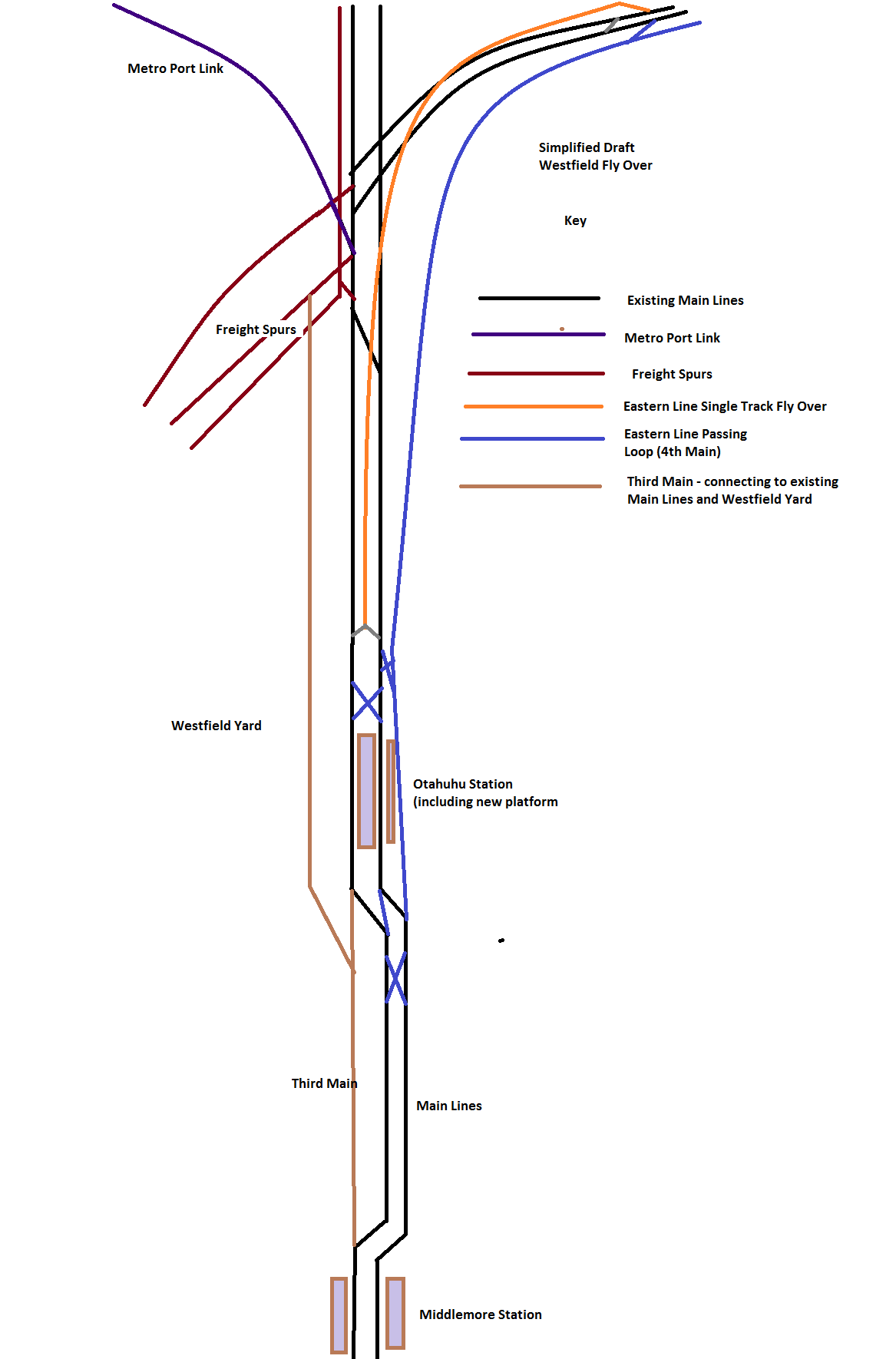
And this last one is a crude draft graphic on a simplified version of the Junction and approaches (note I have not added all the cross overs in):

Diagram of Junction Flyover


Click for full resolution


Now this idea takes into account the following:

  • Westfield Station is closed (it is actually slated for close by Auckland Transport anyhow)
  • Accepting that if a Metro Port train comes out from its base at the same time a south bound Southern Line service heading to Papakura from Britomart is also in the area moving, any city bound Southern Line trains will be waiting at the north end of Otahuhu Station for the conflicting movement to clear
  • The Metro Port train uses the Third Main all the way until Middlemore before entering the existing main line (or vice versa if heading to the Metro Port base)
  • The new EMU’s can take the gradient of the Fly-Over as it would be slightly less than the CRL gradient to which the EMU’s are designed too

So while not perfect and still likely to get delays from some conflicting movements in the Otahuhu-Westfield Junction area, those are likely to be caused by a freight train rather than another passenger service wanting to go the other way. And so this is where the junction pays it dividends: allowing Eastern Line trains to cross over the Southern Line trains without conflict of movement at the Junction. The third platform at Otahuhu Station allows the Fourth Main to come from the Eastern Line near Sylvia Park, all the way to the main interchange station (Otahuhu) and then enter the existing Main Lines heading south minimising congestion between Otahuhu and the Junction if the existing Otahuhu Platform One (City Bound) is occupied by a passing Metro Port train and Otahuhu Platform Two (existing South Bound) is occupied by a city bound train.


Cost

Cost of such a project taking into account retrofitting of the electrification system including signals, a bridge, retrofitting existing tracks with new crossovers, building the Fourth Main, building new electrification systems for the Fly-Over and Fourth Main, new Platform at Otahuhu (which could tie in with a Park and Ride plus Bus Park Facility), and future proofing the Eastern Line to allow a direct link between Sylvia Park and Penrose would come at at I would say $110 million (so same as extending electrification to Pukekohe and building two new stations).


Disruption potential and Time of Completion?

Maximum potential for maximum disruption due to the electrification system now in position and the subsequent refit that would be required.

Completion would be 18 months that includes two Christmas Close Downs and as well as Block of Lines on all non special event weekends which means…


Likelihood of this Happening?

With our current civic leadership: NONE – not with what has happened with Electrification now…

Could of it happened? Yes when the Electrification Project started.


So why did I write this then if all it will do is gather metaphorical virtual dust? To illustrate what could have been with proper planning and foresight by our leaders and engineers. However we are relegated to constant bottlenecks and delays at Westfield Junction when our passenger service frequencies increase – along with the increases of freight train frequencies from the Metro Port base.


However I am still open to surprises – and if this part of the All Encompassing-Rail Efficiency Program gets dusted off, shoulder-tapped and built; then heck someone did have vision for Auckland!

Alternative City Planning/Building

What I Do in my Downtime


From time to time in my downtime I go an embark on some “alternative” city planning and building. That being off to play a round of Cities XL 2012 for a couple of hours busy planning, building, rebuilding and managing the city/town/village. Currently on the “planet” I have 6 cities or villages under way, each specialising on a specific task at hand. Whether that be a farming town to supply food to the other cities, or a holiday town for people to get a way and relax, or a big hulking industrial and commerce centre as a central point of interactions.

At the moment I am busy focusing on Delta City, a city that will be a large hulking industrial and manufacturing centre coupled to an extensive port to “export” and “import” all the trade of the other five cities.

Delta City is at 202,000 and growing surely but steadily as it becomes the manufacturing hub on the “region.”


Here are a couple of teaser shots of Delta City:

This slideshow requires JavaScript.


For all the current 212 shots you can visit the Delta City Slideshow HERE!


Now one wonders how I get thus far with such a large city? Well this next shot does help:

Photobucket


These snapshots which I take an overview shot of the city then doodle lines on them happen when I am embarking on major transport and/or urban development projects. In this case I am planning for major road thoroughfares and bypasses to move the bulk of the cars, trucks and buses around as Delta City continues to sprawl outwards.


Now for our public transport junkies (or mass transit as said in North America) there is no mass transit currently in Delta City. However extensive tram tracks as well as the Operation Centres for buses and trams has been built. The next step is to build the bus and tram depots, then the tram/bus stops, then the actual routes themselves for the citizens to use. This of course takes a bit of time to do as your money is limited and citizens always moaning about something else along the way…


However this “retail” version of a city and transport simulations is a good way to pass the downtime and home in some skills gained in real life city living and planning. I might post some more up from the other cities as well over time.

THE RAIL EFFICIENCY PROGRAM #3

How to get Better Resilience out of the Rail Network


A Rail Efficiency Program Series


THE ALL-ENCOMPASSING RAIL EFFICIENCY PROGRAM – PART ONE


New or rebuilt cross overs at major stations


So how can we get better resilience out of the Auckland (Metro) Rail Network? For starters we give our passenger trains extra flexibility in being more able to “run-around” a problem section on the rail network. Those who travel on Auckland’s rail network (whether frequently or infrequently) would have somewhere along the line being stuck on a train due to another one breaking down somewhere or just plain getting in the road usually to being late. Unlike buses however who have somewhat more flexibility to go or run-around the a road situation (breakdown or accident), trains are confined to the double piece of parallel steel they run on (as well as rail operating procedures dictating setting a train backwards or other non-normal movement) and can not per-se run-around a broken down train that easy.

Why? Because our rail network does not have enough of what is called “cross-overs” spread throughout the network to enable trains to run-around a section of track that has an issue on it in a relatively easy manner. A cross-over being a set of “points” that allow a train to change from one set of parallel running tracks to another (and possibly back again) while still going in the same direction. The current North Island Main Trunk Line, North Auckland Line, and the Manukau Line all have “double track/mains” and crossovers spread across them rather sparsely. Currently the main cross-overs are at the following places (starting from the south ): Papakura, Wiri-Puhinui, Otahuhu, Westfield, Tamaki, Auckland-Britomart-Parnell-Newmarket section, Penrose-Southdown, Onehunga (actually a single line with a passing loop), Grafton, Morningside, Avondale, New Lynn, Henderson and Swanson. Now in saying that, not all cross-overs are “dual” cross-overs which means one’s crossing over options are limited – especially if long distances are in effect or the fact the cross-overs are not even commissioned (New Lynn) yet. The diagram below might shed some light on things a bit better:


Cross Over Diagram

Cross Over Diagram

Click to enlarge (1745 x 1016 resolution)


As I said earlier, not all our cross-overs currently are dual cross-overs which basically means the Auckland Rail Network is compounded by long distances before a train can “cross-over” and “run-around” something like a disable train (passenger or freight – it doesn’t matter as both are a pain). Now from experience, those long distances between cross-overs and even longer distances between dual-crossovers (No# 8-13) mean when a train is disabled on the main line here come long delays and cancellations owing to the lack of resilience in our rail network for trains to run around the disabled train.

With frequencies looking to step up to 6-trains per hour (so once every ten minutes) and the signalling system able to go right up to 12-trains per hour (every five minutes) both pre and post-City Rail Link, if the current existing infrastructure stays as is (including the limited third main being built which is for freight trains anyhow) then the problems on the rail network are going to really compound if something happens like a disabled train blocking a section of track. And if my Post-CRL Operational Proposal was ever decided to be used by Auckland Transport which had train frequencies stepping up to 18-trains per hour (every 3:20 minutes) in some sections without the extra resilience built-in – well you can think of delays and cancellations if a disabled train blocked a section of track.

So what first in investing in our current existing rail infrastructure to get extra resilience out of it pre-City Rail Link. Well that would be: New or rebuilt cross overs at major stations (basically all stations that act as Fare Boundary stations on the rail network)


So that basically means building new or rebuilding existing and subsequently using dual cross-overs (#10 and #11 for the purpose of this exercise) at all fare-boundary stations. The rail map below shows where the first run of dual cross overs will be:

auckland_rail_network_map fare boundary cross overs

Click for full resolution.


As you can see there is a bit of work to do in part one (crossovers at major stations) in either building or rebuilding cross-overs to #8-#13 specification to allow more resilience in the train network for when something goes wrong. You can also see (and if comparing to Google Maps) that the distances between the Cross-Overs once even built is still some distance in some parts of the network. Manurewa to Papakura is 9-minutes both ways and it is about the same if not slightly longer for New Lynn to Henderson, while Glen Innes to Westfield is 11-minutes regardless of the Tamaki Loop between Panmure and Glen Innes. However getting these cross-overs in at the major stations plus any rebuilds (Blue X’s) will offer much more resilience than currently available.


Cost

Now to build a new set or rebuild an existing set of cross-overs for Part One of the All-Encompassing Rail Efficiency Program (AE-REP), re-wire the overhead wires, and change the signalling (which includes changing what train drivers call a Signal and Interlocking Diagram that they have with them (now if I got that diagram’s name wrong let me know sooner rather than later and I shall correct it)) would most likely require a budget of $2-3m per crossover package (now I will go ask someone in the know to get a definitive figure and post back here ASAP). So at $3m times (not including Swanson, Britomart, the Tamaki Loop, Grafton or Papakura) 19 equals a conservative cost of around $57 million which for rail is a significant investment (but chump change for a road or motorway).


Justification for $57m?

The extra resilience allowing better reliability and punctuality of existing and future services when we eventually step up to 6-TPH (10 minute frequencies) – especially when a train disablement (passenger or freight) happens out on the Auckland rail network.


What Next?

For starters asking someone in the know on the cost of building crossovers as mentioned in this so I can run some numbers. Once the number have been ran a few times then I will draw up a “rolling” proposal (so a proposal that will have various versions as the AE-REP is worked on and written) and begin the advocacy process to the Auckland Council Transport Committee and by virtue of extension – Auckland Transport and Kiwi Rail.

However despite the advocacy nothing is a given until the cheque is physically signed (even then that is a certainty with Kiwi Rail and Newmarket junction being an example) – but advocate we must if we wish to continue to push for a Better Auckland Transport (System).

The Rail Efficiency Program #2

How to get Better Resilience out of the Rail Network


A Rail Efficiency Program Series


The All-Encompassing Rail Efficiency Program – A New Introduction


August last year I kicked off (then it stalled owing to circumstances until now) the Rail Efficiency Series – How to get better resilience out of our existing rail network:

THE RAIL EFFICIENCY PROGRAM


HOW TO GET BETTER RESILIENCE OUT OF THE RAIL NETWORK


A RAIL EFFICIENCY PROGRAM SERIES


AN INTRODUCTION TO THE REP

In this new series, I be running posts on how we can get more resilience thus punctuality and reliability in the existing Auckland Rail Network prior to the City Rail Link opening. In this post I will give a an introduction to the Rail Efficiency Program which was briefly mentioned in my submission to The Auckland Plan.

Those who travel on Auckland’s passenger rail network as I do on a regular basis know the frustration when your train is delayed or even worse cancelled due either some kind of fault, breakdown, accident, pesky freight train in the way, congestion at pinch-points (such as Puhinui, Otahuhu-Westfield, or Newmarket), and/or the effects of an earlier disruption still snowballing through the network affecting the train you are on. Now there are some things either happening or in the pipeline that will help reduce the frustrations and disruptions such as:

You can read the rest of that particular post through clicking on the respective link.


Now in that introduction series I had listed six technical proposals in getting more resilience out of the existing rail INFRASTRUCTURE:

This is the Five Step – Rail Efficiency Program that I will dedicate a post to each of the five steps (including graphics) before giving a final sum up and final submission ready for Auckland Transport and Council.

THE FIVE STEP – RAIL EFFICIENCY PROGRAM (TO BE COMPLETED BY 2018 (PRIORITY ONE IN MY AUCKLAND PLAN SUBMISSION))

  1. New or rebuilt cross overs at major stations (basically all stations that act as Fare Boundary stations on the rail network)
  2. Westfield Junction Flyover
  3. Relocation or adding of new stations on the rail network
  4. Cross-overs at all stations between Papakura and Swanson
  5. Third Main from Westfield to Papakura

Now there is a sixth step in my REP, that is remove level crossings on the rail network between Papakura and Swanson. However I have placed step over a 15 year program due to the resources and planning required to grade separate some of our level crossings.


Now the above still stands and will be “advocated” for where possible. However since then (as things do) other things come along and crop us – such as the  accompanying posts: TO BETTER (AUCKLAND’S) TRANSPORTELECTRICS NEARLY THERE, and a post by another blog on existing infrastructure; THE VIRTUES OF INVESTING IN TRANSPORTATION. And especially in light of remarks from Councillor Mike Lee – Chairman of the Council Transport Committee which were:

But council transport chairman and veteran electrification campaigner Mike Lee believes the new trains will not be enough to boost flagging patronage unless they are supported by general service improvements, notably far better punctuality and extended weekend timetables, without prohibitive fare rises.

I would not bank on electric trains in themselves fixing chronic underlying human management problems,” he said.

Although he was preparing to pop champagne corks last year in expectation of overtaking Wellington’s annual rail patronage of 11.3 million passenger trips, he is bitterly disappointed by a fall from a record 10.98 million trips in Auckland for the 12 months to April – a figure boosted by the 2011 Rugby World Cup – to little over 10 million by November

I thought it might be time to go ‘all-encompassing’ in the Rail Efficiency Program to build a strong proposal to submit to Council and Auckland Transport so that the flagging rail patronage is reversed and going where it should be – UP – again.


So here I go in giving it a shot in outlining the ‘All-Encompassing – Rail Efficiency Program (AE-REP):


THE TEN STEP – All-ENCOMPASSING RAIL EFFICIENCY PROGRAM (TO BE COMPLETED BY 2018 (PRIORITY ONE IN MY AUCKLAND PLAN SUBMISSION) (with additions as of 2013))

  1. New or rebuilt cross overs at major stations (basically all stations that act as Fare Boundary stations on the rail network)
  2. Westfield Junction Flyover
  3. Relocation or adding of new stations on the rail network (Adding Walters Road Station while closing Te Mahia Station being one idea) (extra feeder bus, kiss-and ride, and park-and-ride facilities would be helpful as well for major stations as a starter (plus a select few others like Walters Road Station))
  4. Cross-overs at all stations between Papakura and Swanson
  5. Third Main from Westfield to Papakura
  6. Manukau-South Rail Link
  7. Electrification to Pukekohe
  8. Grade Separation of Rail Level Crossings (although this would be a 15-year program)
  9. Introduction of (modified) full Zonal Fares 
  10. Stepping frequencies all lines to 15 minute frequencies at the absolute minimum between 6am – 9pm on all lines (between Papakura and Swanson) – 7 days a week with 30 min frequencies for Onehunga on weekends, then slipping back to 20-30 frequencies outside those hours. As for Pukekohe frequency could be stepped up to every 30 minutes initially Monday to Friday and hourly on Weekends. Now this is all Pre-CRL due to the restraints at Britomart, however once the CRL is opened you can move to the maximum the new signalling can handle which is 12-Trains Per Hour (every 5 mins).

Now that 10-step program does not include what is already happening on the existing network (or what will be happening in the case of the City Rail Link) but does build strongly upon it:

  • Electrification of the Rail Network allowing Auckland to run the faster electric trains
  • With the new electrics (EMU‘s), capacity is increased from larger and more rolling stock running more frequently
  • The City Rail Link opens up this latent capacity on the Rail Network and in-part removes the Newmarket pinch-point. The CRL turns Britomart into a through-station and through-stations have larger capacity than a dead-end station such as the current Britomart layout
  • The Third Main which seems to be now slowly under-construction from Westfield to hopefully Homai (and extended to Papakura eventually). The third main gives freight trains a dedicated track to run on in a congested piece of network keeping the freighters out of the road of passenger trains – especially in the peak times


I have left some more human “resource” elements out of the AE-REP as that is for a separate debate and for that debate to happen in the Auckland Council Transport Committee – not the blogs!


However the 10-step AE-REP does draw inspiration from the THE VIRTUES OF INVESTING IN TRANSPORTATION piece in the fact that if you don’t get the current infrastructure investment right, it becomes a rotting and collapsing foundation for any heavy-scale new capital infrastructure investment you place on top of it (try placing a house on a layer of cake and see what happens after a period of time).


So as I originally said in August, I will expand on the (now) 10-step AE-REP over the next few months to flesh out the ideas behind the Program.


The All-Encompassing – Rail Efficiency Program by Ben Ross; How to get Better Resilience out of the Rail Network


BEN ROSS : AUCKLAND

Shining The Light – To a Better Papakura (OUR home)
AND
To a Better Auckland – (OUR City)

Auckland 2013: YOUR CITY – YOUR CALL