Month: January 2013

Brewer and Transparency

Some Are – Some Are Not


Transparent…


One thing people like is transparency, especially if it is either their money or lives (livelihoods) being affected by the said corporation or civic institution. In my “What Do I Stand For and Believe In – For a Better Auckland” post I make mention of: “Open Governance: I believe in open governance where the public can sit in, listen and where possible discuss “matters-of-state” as much as possible with their representatives. None of this hiding behind closed doors (except for commercially sensitive material that does come up from time to time), and fessing up when you know you have stuffed up. You might find the public are more sympathetic you one acknowledges and apologies for a legitimate mistake”

By virtue of extension; Open Governance also applies to being transparent to the ratepayer as well – especially in regards to “costs” that come out of the ratepayers pocket.


Yet we have a case of a Council Controlled Organisations (CCO) (Watercare (Auckland Transport figures seems to be out but not released currently)) being transparent with the ratepayer and Councillors , but the Main Council Body not being transparent with the ratepayer and councillors (this especially from the Council Planning Department…).


From the NZ Herald:

Watercare opens up on legal costs

By Bernard Orsman BernardOrsman

5:30 AM Thursday Jan 17, 2013

CCO’s willingness to offer data lesson in transparency for council, says councillor.

Watercare Services is teaching its big brother Auckland Council a lesson in accountability and transparency by releasing details of how much it is spending with city law firms.

Auckland Council is refusing to release details of millions of dollars of spending with city law firms, saying it may prejudice future negotiations.

The only information the council’s general counsel, Wendy Brandon, is prepared to release is that the council uses a number of law firms and the five highest paid over the past two years were Brookfields, Buddle Findlay, Kensington Swan, Meredith Connell and Simpson Grierson – in alphabetical order.

Ms Brandon’s insistence to limit the details of legal costs from ratepayers is not shared by Watercare’s corporate affairs manager, David Hawkins, who has given a breakdown of 33 law firms used by the council body in the past two years and how much each was paid from total spending of $6.26 million.

The figures ranged from $522 to Rob Webber and Associates to $2,686,705 to Russell McVeagh.

The approaches are outlined in information collected by councillor Cameron Brewer into legal costs by the council and seven council-controlled organisations (CCOs).

The figures show that legal costs for Watercare and Auckland Transport increased by 34 per cent and 127 per cent respectively between 2011 and 2012, which both CCOs put down to costs for big construction projects.

Council acting chief executive and chief finance officer Andrew McKenzie said that overall the Auckland Council group had cut its legal costs by about $3.6 million, or just over 9 per cent.

Mr Brewer said Watercare’s 34 per cent rise in outside legal costs did not make good reading, but at least they did not hide behind the Local Government Official Information and Meetings Act. “Watercare didn’t see the need to protect themselves or the legal firms they use, so I can’t see why the rest of the council can’t show the same transparency.”

You can read the rest over at the Herald.


So Watercare have stumped up but the Main Council will not (while waiting on AT).


Councillor Brewer had this further to say:

From NewsTalk ZB

Councillor calls for transparency over legal costs

By: Aroha Tahau | Latest Auckland News | Friday January 18 2013 10:17

One Auckland City councillor is appalled the council won’t publicly release details on how much its paying different legal firms.The council’s total legal bill this year was 21 million dollars, but when councillor Cameron Brewer asked about a break down of where the funds were going, the council refused.

Councillor for Orakei, Cameron Brewer says Mayor Len Brown promised transparency and now he needs to publicly say what money is going to different legal firms.

“Ratepayers deserve to know where in fact council is spending its legal budget. At this stage we know that they’re spending over $21 million per annum but they refuse to tell us what legal companies are indeed benefiting.

“I’m calling for the council to come clean, to be transparent, something that the mayor campaigned on and actually come out with how much we’re paying what legal firms around Auckland.”


And from Facebook:

The council has refused to release me information about how much they are paying each of the city’s big law firms. Today I call on them to show the same transparency Watercare has shown. Going to the Ombudsman may be my only option. The council group spends over $21m a year on legal bills. Should the public know where this is going?
Watercare opens up on legal costs – National – NZ Herald News
Watercare Services is teaching its big brother Auckland Council a lesson in accountability and transparency by releasing details of how much it is spending with city law firms.
  • Alice-Margaret Midgley Absolutely agree Cameron.
  • Ben Ross Okay – what are the officers hiding now?
  • Stephen Maire How can Brown refuse??? Still another valid reason to cease paying rates imo.
    • Ben Ross By law and definition he can not refuse. Watercare I take my hat off to, yeah their Legal Bills might of been ugly per se but least they released them immediately so that I cant get double angry on the actual bills AS WELL AS stalling. Sure I might be peeved with Watercare over their legal bills, but that peeved will last around 2 seconds and all is well.

      As for the Main Council, well stalling now keeps the anger sustained much longer and will have me peering through the eventual reports with an electron microscope.

      The old saying goes: You get pulled over by a cop, you hand over your licence and answer his questions true-fully with no added lip and you walk away with a fine. Give him lip and hello he is going to do the full works including Rego, WoF, tyres, springs, rust, position of plates, lights and even maybe the horn. Not only is that time consuming for you but your risk of the dreaded pink sticker became that much higher – al because you gave lip

      Council is now in the same situation… which means – idiots
  • Gary Holmes So…. the council is more than happy to release details on the private lives of elected members via the annual declaration of interest (which i still refuse to complete) but won’t tell us how they are spending ratepayers money. The old Auckland City practice of officers thinking they control the place continues I see……..
    Mark Donnelly That’s incredible arrogance! Can’t see how they can justify not giving you the information. Can’t be private commercial, as anyone who contracts with Council knows it can become public knowledge – look at Tender information.
    Was this done at CEO level?
    btw – do senior managers maintai a “gift” register? ie corporate hosting etc etc
    • Ben Ross Umm with respect I think the idea might not be to bring attention to one’s self especially with the Annual Declaration of Interest List – the idea is not give someone an idea to go having a look through there especially with elections so close .

      However for the rest of the argument yes I agree with you there Gary 

      Hey now that Main Council is stalling while Watercare is playing ball – shall we now look at the rest of the CCOs?
    • Aaron Bhatnagar Actually, I found Auckland City officers pretty responsive to our directives to open up matters. Things under the Hubbard term was pretty bad, but the Banks Term part 2 was widely acknowledged as good for transparency and openness. A lot of stuff that was done in confidential committee work was put back into open. Stuff that was confidential was done for discussion, and then when the result was achieved, the results could be released into the open. Stopped the political leaking by both sides too.

      I do struggle to understand why the sum of council legal bills can’t be published. I can understand why the negotiations over billing levels wouldn’t be published, but that is a different thing.
    • Gary Holmes Good point Ben however its worth considering why do they council need to know who your partner or spouse works for, who you bank with, what groups you are a member of, what companies you have shares in and the list goes on. As Local Board Members, who have no decision making ability on contracts etc, it is not required, especially when the Council imposed that code of conduct on Local Boards without consultation. I have fought this one for the past two years and will continue to do so! Time for that coffee Ben
    • Ben Ross Time for that Coffee indeed – I shall reply to that in a moment (needing coffee at home right now – going to be a very long day here)
  • Stephen Maire Brown is the picture of arrogance unfortunately. He thinks its leadership style. But he is deluded and possibly mentally unfit for his position. Heart attack survivors often suffer such mental malady.
  • Gary Holmes i don’t necessarily think this is the mayor’s decision, more likely to be the CEO and his senior management.
  • Stephen Maire The buck stops with Brown. He must have full knowledge of this. If he does not, then we have a serious problem that needs immediate attention and action on behalf of the ratepayer.
  • Robyn Forryan Keep pushing Cameron you are already having an impact and the public have the right to know this information.
  • Stephen Maire And we shall also remember and be exceedingly grateful for your efforts on our collective behalf Mr. Brewer.
  • Jules Clark What’s required is some CPR … “Cease Paying Rates”!
  • David Cooper Keep pushing Cameron you will out of a job soon..
  • Wayne Davis You can bet the TOP guys are getting a GOOD shot at any fees,same as Council consultants. The Waitakere City Council had Kennsington Swann, hate to think what Auckland Council use!!


Open Governance which includes being transparent with costs and actions by your civic institutions.


My point was made above in regards to one aspect of being transparent – especially if some flak or anger might come your way:

“By law and definition he can not refuse. Watercare I take my hat off to, yeah their Legal Bills might have been ugly per se but least they released them immediately so that I can’t get double angry on the actual bills AS WELL AS stalling. Sure I might be peeved with Watercare over their legal bills, but that peeved will last around 2 seconds and all is well.

As for the Main Council, well stalling now keeps the anger sustained much longer and will have me peering through the eventual reports with an electron microscope.

The old saying goes: You get pulled over by a cop, you hand over your licence and answer his questions true-fully with no added lip and you walk away with a fine. Give him lip and hello he is going to do the full works including Rego, WoF, tyres, springs, rust, position of plates, lights and even maybe the horn. Not only is that time-consuming for you but your risk of the dreaded pink sticker became that much higher – al because you gave lip

Council is now in the same situation… which means – idiots”
This would stem from this part in the “What Do I Stand For and Believe In – For a Better Auckland:” None of this hiding behind closed doors (except for commercially sensitive material that does come up from time to time), and fessing up when you know you have stuffed up. You might find the public are more sympathetic you one acknowledges and apologies for a legitimate mistake.”

While Watercare have not stuffed up per se (still got questions on a big jump with the legal bills for last year however) at least they have made deliberate attempts to annoy Councillors or ratepayers – thank you Watercare.


As for the Council Main Body – we hiding something that we ought to know about? It is our money you know…


Groan – Who Wrote This

Seen This Post Before…


, a Consultant in urban, economic and community development who no wait that was someone else who served with Councillor Mike Lee on the former Auckland Regional Council – wrote a post over on his Cities Matter blog about the apparent flawed analysis on the City Rail Link. There are also two comments from various individuals that caught my attention and will also be “mentioned” as well.

From Cities Matter:


MONDAY, DECEMBER 17, 2012

A Flawed Case? Auckland’s City Rail Link Project


A tale of two cities
Two newspaper stories on infrastructure investment caught my eye last week. The first praised the approach undertaken by the Port of Tauranga. The Port has performed extremely well for shareholders, including 55% owners Bay of Plenty Regional Council.  This is put down to rigorous analysis of the financial impacts of any capital spending:

For years Tauranga has used its capital resources astutely to lift cargo volumes and improve efficiency to build economic value for its shareholders. …
The port has an outstanding record in kicking for the right goalposts when determining strategic capital development. ….
For Tauranga, a vital key has been to back innovation-driven capital investment with rigorous economic and financial analysis.

Contrast this with the latest addition to the grab bag of evidence assembled by Auckland Council to justify an underground central rail link (CRL) . Admittedly, Auckland Transport is not a commercial operation.  However, making the best possible use of capital is a key to the efficiency and productivity that will underlie the long-term prosperity of the city and the country.  And this project will not deliver.

Fiscal irresponsibility
I have not read the latest report in depth. But I did have a quick look to see what the financial implications of implementation might be for the ratepayers of Auckland, and how risk was assessed.  I couldn’t find any discussion of them.  And interestingly, in their absence it would be easy to use the analysis to demonstrate why we should not be risking substantial public funds on it. Yet the Mayor was quoted as saying that this report provides a strong basis for funding negotiations with the government.

The Transport Minister won’t buy into this.  He quickly responded by pointing out what the latest report demonstrates.  The project is not viable.  There is no financial analysis suggesting that this project has a life.


You can read the rest over at his blog.


Now that “latest report” McDermott is referring to that our utterly incompetent Minister of Transport responded to was the recently release City Centre Future Access Study (CCFAS) which can be found HERE. Now CCFAS I have mentioned briefly before while other blogs have covered it more in-depth.


My simple reply to the post written by McDermott for tonight (more in-depth coverage will come over the rest of the week), it is an exact replicant of what came out of Councillor Cameron Brewer’s Department which is widely believed (might as well been knowing the National Government Spin-Doctors) to have come straight out of Gerry Brownlee’s Office!

There is nothing new there McDermott and what you have said with the BCR’s has been refuted over at Transport Blog more than once – and will continue to be done so again and again and again until one basically “learns.”


As for the two comments posted, well that was heart sinking material to read it – but none the less expected!


” as it will never generate one cent of a financial return.”

LibertyScott; there is more to this world than the utter Neo-Liberal belief on “financial returns.” The London Underground at 150 years old last week shows the absolute long-term wider Economic returns to our sole World City (in my opinion) – London. And when I speak of Economic I speak of its full utter definition – that is: social, monetary, social and physical environmental, and the wider economic spin off’s out side of the pure revenue and expense which your blinkers can not look past from. Some goods in the world are subsidised (in fact roads are too for that matter) because there is more than absolute dollars and cents here – a fully integrated transport system is one of those goods.


“Let’s hope that serious advances in road-based transport will happen soon enough, fast enough, to get the public to re-think their brainwashing on the “inherent virtue” of rail. At the end of the day it’s about public buy-in and sadly they have thus far bought it.”

Andrew Atkin; mate your might as well bugger off to Brisbane mate where they are facing the consequences – and some very brutal ones at that of over investing in road-based transport and not developing a more balanced approach to their entire transport system which includes rail and ferries. Furthermore even our American cousins including such places as Houston and LA (oh look car central) have begun switching slowly over to more integrated transport systems which include – oh look rail. The Republicans in – look again TEXAS are going for a fully privately built and run rail line service and seeing where that ends up. If they make success out of it, it will blow away conceptions that rail is a socialist toy… As for public buy in; well they will keep buying in if real estate statistics are anything to go by. Guess where our hottest real estate is – why the fringe suburbs around the CBD which all sit on major road/bus and even rail corridors. The CRL will be an even bigger booster in those fringe areas when the latent rail capacity is not only opened up – but new areas that carry high density of travel also fall into extended rail catchment of the City Rail Link. I have not included the three new rail lines that can open up too because of the CRL giving the rail system even further reach into areas of Auckland not currently be served by rail. So sorry Andrew, don’t quite think the public will say to your way just yet looking at trends


And so this second post coming from me is the one I boot down the paddock.


Booting it for being an exact replicant of the crap that came out from Brownlee’s Office and that Brewer was silly enough to publish – with no actual alternative that presents even a better Benefit Cost Ratio than the CRL because there is none – Pure and Utter SIMPLE!


My take on all this

GROAN!

Auckland’s Electrics – Marked Improvement?

I Agree With Matt L’s Analysis on our new EMUs


Matt L from Auckland Transport Blog wrote up a post on his self-analysis on the speeds of our new incoming Electric passenger trains. I agree with his post and thus endorse and/or recommend his post over at Transport Blog. My sole comment on his post at the moment is that for the Southern and Eastern Lines at least, slicing upwards of 7-minutes of the total journey time from Britomart to Papakura will be a good attractor to rail passengers on the rolling stock and speed side. However we still have infrastructure and customer service aspects to work on with our rail system (and Auckland Transport as well) but separate posts and debates for those.

So from Transport Blog – an intro to Matt’s post on the EMU speeds:

Source: Auckland Transport Blog


Our EMU speeds

By Matt L, on January 16th, 2013

This year the first of our new electric trains will arrive and one of big benefits of them will be that they have faster acceleration than the clunky diesel trains we have now but the question is just how much faster they will be. For some reason it is something that Auckland Transport have been pretty reluctant to actually talk much about which I am guessing is due to them not wanting to get peoples expectations up. We however are not AT and are free to talk and speculate all we like so with that in mind, some time ago I built a model to try and work things out. I actually blogged about it back then but at the time I had only showed the western line, with this post I thought I would look at the whole network. Before I go into the results, for those that are interested, here is an explanation as to how I have worked the times out:

First I have worked out the distance between each station and for each leg of the journey I have assigned a maximum speed that the trains can travel and I have kept most of the network at 80kph with the inner sections at 60kph. When the EMUs were announced AT said that they would be able accelerate and brake at 1m/s². Based on that I then worked out how long, both in time and distance it would take to reach the top speed and slow back down again for each section of track. For those interested it takes 22 seconds and 247 metres to reach, or slow down from 80kph based on that acceleration of 1m/s². The next step was to work out how long the train would travel at top speed. To do that I subtracted the acceleration and braking distance off the distance between stations and worked long it would take. For each station I then added in a dwell time to represent how long it would spend on the platform. To be conservative i generally used 45 second however for busier stations I used 1 minute. I then added the time spent accelerating, braking, at top speed and the dwell time together. Lastly to try and be conservative I added in a multiplier of an extra 20% to account for things like slow drivers, corners and junctions which that then gave me an overall result for each station.

Here are the results verses the current times for each line, I have left out Te Mahia and Westfield as based on the draft RPTP they are likely to close, I have however added in the Parnell station. For the Western line I have added in the time allocated for the driver to change ends at Newmarket together with the travel time. You may also notice some of the times look longer than current. That is because AT obviously round the times up or down to get to an exact minute.

You can read the rest including the graphics over at his post.


Just a note on station dwell times as it has been mentioned: 30 seconds is the official Station Dwell Time (the time a train is stopped at a station to exchange passengers) set by Auckland Transport for all intermediary stations (those between the origin station and final destination station) except for Western Line services at Newmarket in which the Dwell Time is 3-minutes to allow the driver to change ends. There are also Marked Stations as well (Otahuhu, Newmarket, New Lynn and Glen Innes being examples) in which a train can not depart from that station until that marked time – it shows as a BOLD time on your paper timetables for each line.


Excellent work Matt.

A Direct Message to Auckland Transport

Yes I am Talking to You


Yesterday I posted about the 2011 and 2012 rail patronage statistics coming through via a Local Government Official Information and Meetings Act request. In the same post down at the bottom a “direct” message was also written “to” Auckland Transport.


I am going to repost the message to AT here after the “irony” alarms were set off this morning in Twitter. No sooner than I had tweeted that: “Awaits to see if anyone from @AkTransportBlog has another “moment” on the buses or trains this morning #whyohwhy #basicsfirst” – a comment came up from one of their regular readers saying: “My 8:05am 839 outbound Shore bus started 13min late due to Transpower & @AklTransport closing Fanshawe bus lane. You closed the wrong lane!

Face-palm right there. Last I checked the Transpower works on Franshawe Street continue until March when “March-Madness” occurs (that being schools, universities and all businesses are back and transport systems face a large surge). So if problems are coming up now down at Franshawe then Lord help those in February and March if it does go to custard down there.


So here it is again – my message to Auckland Transport


I am not your enemy and I don’t want to be your enemy.

Your goal is the same as my goal (I think after a head scratch) and that is: to build and maintain (and this includes in the customer service satisfaction and confidence in using our public transport) a world-class public transport system that is: easy to access, easy to use, easy to understand, and most of all it is affordable to all – for our most liveable City.

However something has gone horribly wrong your direction and we are now seeing a sustained and systemic patronage slip in our rail network – a backbone (but not the sole back bone) to keeping the citizens and visitors of this city moving. I have no interest in attacking you Auckland Transport as that is counter-productive.

But your experiences that I have had with you both good but more hostility does not (and with absolute respect) leave me with much confidence in you nor your abilities in achieving the goal – it just simply does not. What is not also helping in my confidence towards you is the feedback I hear from infrequent and frequent passengers – customers of Auckland Transport on the public transport system which I am sorry as much as I want positives, I only see overtly negative feedback on experiences.

Your goal is my goal and all I want to do – am trying to do is as a ratepayer (your master, your employer – not the other way around) is “do my bit in” making our transport system better. Whether that be through praise in what you do right, constructive criticism to overcome the weaknesses, or offer alternatives and ideas others might not have thought of in getting our transport system moving forwards – not backwards as we are seeing; this is my way in doing my part in achieving the goal so that our transport system  is: easy to access, easy to use, easy to understand, and most of all it is affordable to all – for our most Liveable City.

You would have now doubt read my “FIRST STEP IN IMPROVING AUCKLAND’S PUBLIC TRANSPORT” post that sums up the current feelings towards you – Auckland Transport on the customer service and experience of the current system; and if you haven’t then I recommend strongly in reading it.

So what say you Auckland Transport – I am pitching with everything I have (skills, experience, knowledge, ideas, and pure passion and enthusiasm (my former co-workers can vouch for those two) to you – to make our transport system a better place in partnership with you. You know where to find me, you know where to contact me.

I await your reply. 


-Message End-


2011-2012 Rail Patronage Stats – And a Direct Message to AT

2011-2012 Rail Patronage Stats – For Auckland


Direct Message to Auckland Transport also included


While undertaking my normal cruising through blogs and social media that I keep an eye on, someone had filed a Local Government Official Meetings and Information Act (LGOIMA) request into the 2011 and 2012 Auckland rail patronage statistics – in which the numbers have been released by Auckland Transport.


You can see the patronage information HERE on page two or in the embed below

Accordingly the disclaimer from Auckland Transport applies: “The following sets out the observations of train passenger boardings by station following a single weekday sample during the month of May. The data is representative of a “typical” weekday usage but is subject to daily/seasonal variances. Auckland Transport does not warrant the accuracy of the counts.”

Source: Auckland Transport

It is of also to note that it is mentioned by Auckland Transport that there were service disruptions (I am trying to remember them) in 2011 and 2012 which “could have” affected “normal” patronage demand on the network.


So in other words the statistics are pretty next to worthless as you need an uninterrupted day to gauge “normal” patronage demand properly.


The Request and Stats

Source: Auckland Transport

Disclaimer: [as above]


What can I get out of these stats?

  • Papakura is still the third busiest station
  • Increase on patronage on the Western Line but slump on the Southern and Eastern Lines (again there were disruptions on those life which WILL affect numbers)
  • Onehunga is underwhelming – which means those passengers are getting on at Ellersile making the Onehunga trains appear busy in the peaks
  • Manukau. The comment from my Facebook will be more apt in describing this one:
    • As for Manukau, well George you and I have been down this road with Manukau. With the station 700 metres short to where it short and an observation on that concrete post, it was the entire reason behind my urgency to you and Mike Lee to see that South Link be built in order to get that patronage up


Now arguably these measurements were done in May when (looking at the Auckland Transport rolling 12-month patronage statistics) there was still growth, however since August 2012 there has been what is now a systemic and noticeable decline kicking the patronage levels back to July-August 2011 levels (so a full total back slide rendering efforts and good work gone in – useless). You can see my views on this backsliding over at my “FIRST STEP IN IMPROVING AUCKLAND’S PUBLIC TRANSPORT” post.


To which I have this message to Auckland Transport:


I am not your enemy and I don’t want to be your enemy.

Your goal is the same as my goal (I think after a head scratch) and that is: to build and maintain (and this includes in the customer service satisfaction and confidence in using our public transport) a world-class public transport system that is: easy to access, easy to use, easy to understand, and most of all it is affordable to all – for our most liveable City.

However something has gone horribly wrong your direction and we are now seeing a sustained and systemic patronage slip in our rail network – a backbone (but not the sole back bone) to keeping the citizens and visitors of this city moving. I have no interest in attacking you Auckland Transport as that is counter-productive.

But your experiences that I have had with you both good but more hostility does not (and with absolute respect) leave me with much confidence in you nor your abilities in achieving the goal – it just simply does not. What is not also helping in my confidence towards you is the feedback I hear from infrequent and frequent passengers – customers of Auckland Transport on the public transport system which I am sorry as much as I want positives, I only see overtly negative feedback on experiences.

Your goal is my goal and all I want to do – am trying to do is as a ratepayer (your master, your employer – not the other way around) is do my bit in making our transport system better. Whether that be through praise in what you do right, constructive criticism to overcome the weaknesses, or offer alternatives and ideas others might not have thought of in getting our transport system moving forwards – not backwards as we are seeing; this is my way in doing my part in achieving the goal so that our transport system  is: easy to access, easy to use, easy to understand, and most of all it is affordable to all – for our most Liveable City.

You would have now doubt read my “FIRST STEP IN IMPROVING AUCKLAND’S PUBLIC TRANSPORT” post that sums up the current feelings towards you – Auckland Transport on the customer service and experience of the current system; and if you haven’t then I recommend strongly in reading it.

So what say you Auckland Transport – I am pitching with everything I have (skills, experience, knowledge, ideas, and pure passion and enthusiasm (my former co-workers can vouch for those two) to you – to make our transport system a better place in partnership with you. You know where to find me, you know where to contact me.

I await your reply. 


AT COO Interviewed – On Auckland’s Transport

Chief Operating Officer Talks About Auckland’s Transport – Yet Still Misses the Basics?


On Friday; Auckland Transport posted up on its website an interview with their Number Three – Chief Operation Officer Greg Edmonds with TV9’s Asia Focus.

From Auckland Transport:

Transport in 2013: Greg Edmonds interview

Last reviewed: 11/01/2013 2:46 p.m.

​Watch this interview on AsiaFocus by TV9 with Greg Edmonds, Chief Operating Officer of Auckland Transport.

Mr Edmonds answers questions about integrated ticketing (HOP), its benefits and the rollout to buses that will begin in April.

He also speaks about measures Auckland Transport is taking to continue to grow public transport patronage. These include integrated ticketing, electrification of the rail network and electric trains and the redesign of bus networks to better integrate them with the rail network.

Watch the recording of the interview on TV9.co.nz. Length: 20:25


And so I watched the interview and took some notes on the following aspects (with some help of other keen eyes and ears):

Noted from Interview with AT-CCO Greg Edmonds


1.52min
“Looking for a population of 2-2.5 million people in 10yrs”

Where are the people coming? 2030 was when Auckland was due to hit the 2-million mark so is there something statisticians not telling us?

2.39min
“Current Dual HOP card system”

Why couldn’t AT get it right in the first place? It’s not that Auckland is the first place ever to use such a system. However I have covered this since my alternative to Snapper in February Last Year)

4.55min
“Rail patronage dropping since RWC – How to fix public transport patronage:

  1. Integrated train/bus/ferry timetables
  2. $600million electrification
  3. 10min a train will turn up (all day every day, 7 days a week)
  4. 15min a bus will turn up (all day every day, 7 days a week)
  5. City Rail Link post 2022 (or rather 2025)”

My Reply: From observations and experiences: trains/buses running around just about/or empty all the time outside peak hrs. However will another million people in the city in 10yrs and an aging population use their free travel passes their might be a bit more usage. But doubling usage by another 70 million in 10 years is somewhat overly optimistic given the current situation. I have also touched on AT not getting the basics rights with Customer Service in the FIRST STEP IN IMPROVING AUCKLAND’S PUBLIC TRANSPORT post which basically states all the investment in infrastructure means squat if the customer service experience is least to be currently desired. More on this again later)

7.21min
“Greg Edmonds stating passenger numbers not dropping”

Someone asked me: “I wish someone would confirm whether they dropping or rising and all officials/bureaucrats stick to the same story line.” The answer to that lies in the patronage stats from Auckland Transport which is currently stating there is overall growth in public transport patronage, but declines in Northern Busway patronage and a rather disturbing 14-15% drop in rail patronage which shows no sign of currently slowing down.

8.00min
Greg Edmonds not concerned about overall public transport use trends.”

Someone said this to me (so not my own words): “Naturally he’s not… he’s selling the fear factor of 2-2.5 million people being in Auckland and the place turning into chaos.” In saying that, however I might go an explore Edmonds comment around that remark. His role clearly dictates that he must be concerned around overall public transport trends for if they either:  fall through the floor in patronage, or the Customer Service situation does not improve – then his head might be on Councillor Mike Lee’s PLATE!)

9.25min
“Real time information system not accurate…”

I cannot comment on the Passenger Real Time Information Display System (RAPID) currently due to previous employment however a reader did ask this: (Question) “Why couldn’t AT implement a system that would work right in the first place? It’s not as though Auckland has the first system in the world. How much did this mistake cost ratepayers and who has been held accountable for it?”

10.51min
“We have patronage “Targets” – by 2020 achieve 140 million based on investments being made”

Observation: It means an extra 70 million rides in seven years, that’s an increase of 10 million per year which with the current problems AT are facing with public transport – it could be a case of “barrow” and “uphill”.  The slide in rail patronage which is becoming entrenched and systemic needs to be reversed. The question is: “how is Auckland Transport going to honestly reverse that slide?”

A remark from a reader: “Looking forward to reading what the honest and true figures are this time next year while hoping all AT staff are made to ride the buses for a year to see first-hand what really goes on in our public transport network”


15.18min
(This was noted by me and from feedback by readers as well): “No plans for the North Shore Rail Line despite apparently according to Greg Edmonds: NZTA starting the second harbour crossing around the 2015-2016 mark. Now last I looked NZTA were in the building of that tunnel crossing, going to include I believe a heavy rail line that can be joined to the City Rail Link on the CBD side while extending along the Northern Busway – replacing it.”

To me this is a rather flippant attitude of Greg Edmonds in regards to the North Shore Line and could be very well contradicting both the Mayor’s and NZTA’s plans for the eventual North Shore Line. Auckland Transport should be very well making plans for the Busway to be replaced by the North Shore Line (Heavy Rail) as was “planned” when the busway was built. Heavy Rail (The North Shore Line) can carry upwards of 900% more passengers at full capacity than the busway ever could at full capacity, while allowing a seamless train trip from the North Shore to either: the CBD, New Lynn, Sylvia Park, Newmarket, Manukau, Onehunga, THE AIRPORT, Papakura, Botany, or even Pukekohe. The North Shore Line would connect a relatively isolated part of Auckland back to the main isthmus and allow for growth on the Shore that would be better catered for.
I shall let readers making their own call on the Greg Edmonds interview but those were my thoughts (as well as some others who gave feedback).


For the benefit of Auckland Transport’s Chief Operating Officer – Greg Edmonds, I shall re-stick the Customer Service post here below for him to go and read – as I don’t quite think he has quite joined the dots to our dismal public transport performance (including that of the CCO as well):

FIRST STEP IN IMPROVING AUCKLAND’S PUBLIC TRANSPORT


Posted by BR:AKL_Admin01 on January 10, 2013 · 


Treat Humans as Humans


Not as numbers, not as dollar signs, not as a total pain in the ass that should be treated begrudgingly.


While I have been running commentary on things like Rail Efficiency Programs and operational models post City Rail Link to boost patronage via infrastructure and operations, another blogger raised a very fine point on something that is very well hammering our public transport patronage statistics – our customer service.


Before I highlight the said post from the other blogger, a quick reminder: Auckland Transport asked for submissions to its Regional Public Transport Program (RPTP) of which the hearings are next month (and that I am attending). One of the main focuses Auckland Transport was looking for in submissions to the RPTP was the “Customer Service Portal” – in other words the quality and level of customer service in our public transport system from front line staff right through to AT bureaucrats in Henderson.

This post is by virtue of an extension to my submission on the RPTP as well as replicating a point made at another blog.


So lets take a look at Customer Service on Auckland’s Public Transport System

This is from Auckland Transport Blog:


By Guest Post, on January 7th, 2013

This is a guest post by John P

The Ministry of Transport, bless ‘em, actually have a lot of interesting information on their website if you know where to look. One of the things they do is carry out a Household Travel Survey, which surveys 4,600 households in various parts of New Zealand each year. There’s plenty to look at, and you can check out various results at their transport survey, but for today I’ll look at a summary they put together on public transport use – taken from here.

The thing that stands out to me is a table showing the percentage of people who use public transport in NZ’s major cities. From this, 53% of Aucklanders surveyed hadn’t used PT at all in the last year. This put us on par with Christchurch and Dunedin, both of which are significantly smaller, neither of which have rail, and neither of which are particularly PT-oriented cities. We’re well behind Wellington, where only 27% of people hadn’t hopped on a train or bus at least once. Remember that (greater) Wellington is around the same size as Christchurch, and both cities are less than a third the size of Auckland.

Wow, that’s not a good start. How about people who haven’t used PT in the last month, but have in the last year? 17% of Aucklanders fell into this camp, in line with the other cities except for Wellington.

So, by this point, we can see that only 30% of Aucklanders had used public transport in the month before they were surveyed. We were in between Dunedin (26%) and Christchurch (34%), and well
behind Wellington where 46% of the people had used it at least once.

The last few lines of the table below are asking people how many days in the last month they had used public transport. I won’t dwell on it except to point out that half the Aucklanders who used PT in the last month hadn’t used it very often. Only 14% used it on 5 days or more, ahead of Dunedin (11%) but behind Christchurch (16%) and Wellington (27%).

Wellington is leaps and bounds ahead of Auckland, but I think we all knew that. I think these results are a pretty telling scorecard, and, to put it mildly, Auckland doesn’t look too flash. The majority of Aucklanders never use public transport at all, and most of those who do don’t use it very often. Two basic questions come out of this:

  1. Why don’t Aucklanders use PT very often?
  2. How do we improve PT usage in Auckland?

Questions that are answered in a number of different posts in this blog! A redesign of the network, and rail electrification, should help boost patronage over the next few years. But the thing is, we should really be aiming to get to where Wellington is now in the short to medium term. Anything less is short-changing ourselves in my opinion.


You can read the full article over at the Transport Blog site.

However the two questions in red are the points being raised and I answered over there. My answer was:

John (P) while a great post I think (from experience) the obvious is missing to give our flagging P/T patronage especially our rail patronage good kick until the infrastructure comes on cue over the next 10-30 years.

I take note here:

  1. Why don’t Aucklanders use PT very often?
  2. How do we improve PT usage in Auckland?

Questions that are answered in a number of different posts in this blog! A redesign of the network, and rail electrification, should help boost patronage over the next few years. But the thing is, we should really be aiming to get to where Wellington is now in the short to medium term. Anything less is short-changing ourselves in my opinion.”

Those are the two questions we are all seeking to actually answer and the reason why (to my personal disagreement as well as Councillor Mike Lee not being amused either) AT are about to embark on spending our money on “professional experts” ( http://www.nzherald.co.nz/nz/news/article.cfm?c_id=1&objectid=10855436 ) in finding “fixes” to our rail slump,


However again Councillor Mike Lee has hit the nail on the head right here with this comment from another article: http://www.nzherald.co.nz/nz/news/article.cfm?c_id=1&objectid=10857062

“Mayor Len Brown says the arrival of the trains will be “a huge step on the path towards the kind of integrated transport system an international city like Auckland needs”.

He believes the electric units – which will have greater acceleration and braking power than the existing diesel fleet – will make rail patronage “rocket” and create even more pressure for a 3.5km underground rail extension from Britomart to Mt Eden.

But council transport chairman and veteran electrification campaigner Mike Lee believes the new trains will not be enough to boost flagging patronage unless they are supported by general service improvements, notably far better punctuality and extended weekend timetables, without prohibitive fare rises.

“I would not bank on electric trains in themselves fixing chronic underlying human management problems,” he said.”


Basically cutting it short why don’t Aucklanders use P/T much and how do we improve our P/T usage in Auckland? Well the infrastructure part of the answer is being dealt with so to me it is rather irrelevant in this point in time. The actual answer came from Dr Lester Levy – Chair of AT:

Dr Levy said he agreed there was a need for “critical measures” to be adopted and Auckland Transport needed to be far more customer-led in creating a demand for its services.

And there is the answer right there and there – he said it himself: ” Auckland Transport needed to be far more customer-led in creating a demand for its services”

THAT TO ME IS (and excuse the caps) PRIORITY NUMBER ONE above else at the moment.

2013 is going to be long and interesting year getting the patronage back round again. However (and in my opinion (what ever that is worth these days)) we (by we I mean AT, Council, the p/t user, you guys here at the blog, myself, and others who give a damn about our city) can do this – slowly but surely. :D


Now I am going to extend the “situation” from another Transport Blog commenter emphasising the point:

George D

But council transport chairman and veteran electrification campaigner Mike Lee believes the new trains will not be enough to boost flagging patronage unless they are supported by general service improvements, notably far better punctuality and extended weekend timetables, without prohibitive fare rises.

He’s right. It doesn’t matter how fast and shiny the trains are if they’re still late and unreliable, and riding them costs more than ever. Every time fares rise, demand decreases – we’ve actually reached the point now where we’ve passed an equilibrium and ridership is decreasing towards a new equilibrium with those who are prepared to pay for a particular level of service.


Now since then a few more comments from Transport Blog have come up however I can’t specifically address those issues at the moment.

But as for my point and George D’s point, the writing for Auckland Transport is literally on the (virtual) wall. Improve customer service FIRST (and restore affordability to fares while at it) or all this multi-billion investment in our public transport system is going to be an utter waste if Auckland Transport can not get the basic human to human interaction right. People (both front line staff and passengers) just want to be treated like humans and be able to at least have a pleasant experience on our public transport network – even in times of disruptions. It can be done, it has been done and it is straight forward if the culture (and tools) are there.


There will be more said on this matter next month when I front up in front of members of the Auckland Transport Board next month for my RPTP hearing. However 5-minutes doesn’t quite seem long enough to hammer on about the “Customer Service Portal” at this current rate of dissatisfaction out there.


As I said: “There will be more said on this matter next month when I front up in front of members of the Auckland Transport Board next month for my RPTP hearing. However 5-minutes doesn’t quite seem long enough to hammer on about the “Customer Service Portal” at this current rate of dissatisfaction out there.”


Long way to go folks, long way to go.


A Letter from A Councillor

Councillor George Wood Writes to Manukau Courier


While checking my Facebook feed in the morning (as you do) I noticed a comment from former Manurewa Local Board Chair:


That got me looking and I discovered this:


Basically Councillor George Wood spelling it out as it is with public transport issues down here in South Auckland – especially with buses (an area admittedly I am not paying much issue to but should very well be).

I agree with the entire letter from the Councillor to the point I will be throwing more resources or rather effort here at BR:AKL on our bus issues and getting them sorted.


However Newman was “fuming” because the Southern Initiative got mentioned and the bad onus around that. Yes the Southern Initiative has had its rather ugly moments in either rough-shodding over the Local Boards or budget re-routing away from Local Boards to Southern Initiative projects that are overseen by the main governing body.

The focus from the letter should be on our transport here in South Auckland, not dragging the Southern Initiative into this as that is another debate along with the Sale and Supply of Alcohol Act.

Also I have seen no oppositional Councillor nor mayoral candidate state they would overthrow the Southern Initiative after the 2013 elections and put in place an alternative. I believe it is the case of we are lugged with it – let’s try and make this work best we can – as rough-shodding by Council Officers, CCOs, and the Governing Body happens right across the spectrum – not just the Southern Initiative.

My comment to Newman makes somewhat that point:

Ben Ross

Burnt from the Budget (which burnt the entire city any how) I still see.

That aside – well something must being going on as 2012 was a mixed year for success and failures in dealing with the Governing Body from personal experience (that is the Governing Body not the CCOs).

Failures: The Auckland Plan in part but more so the Long Term Plan. The new Rubbish Policy.

Successes: Irony would have it this has been down the transport division:- Manukau South Link, Pukekohe Electrification Extension, cant comment with the RPTP yet as the hearing is still coming up, slow progress with the bus situation down south – but least its moving.

Next Challenge: Again transport, however Alcohol Policies with the new Act in position

So “bringing them to the Governing Body” has had its moments of success and failures -( for a scrappy little ratepayer  ) – but that is to be expected. 2013 is going to bring?…


A case of win-some, you lose-some. But you continue to battle on in pushing or lobbying for what you want to see to make Auckland a better place – the purpose behind this blog from day one.


BEN ROSS : AUCKLAND

Shining The Light – To a Better Papakura (OUR home)
AND
To a Better Auckland – (OUR City)

Auckland 2013: YOUR CITY – YOUR CALL


THE RAIL EFFICIENCY PROGRAM #5a

How to get Better Resilience out of the Rail Network


A Rail Efficiency Program Series


THE ALL-ENCOMPASSING RAIL EFFICIENCY PROGRAM – PART FIVE (A)


Relocation or Adding of new Stations on the (Auckland) Rail Network


With added resilience now added into the Auckland rail network through crossovers at “major” stations and the Westfield Junction Fly-Over, attention now focuses in getting rail stations into the best strategic places as possible with the best “facilities” possible to attract and sustain high patronage numbers. Again some of the ideas about to be mentioned in these posts have been mentioned before, I am so-called “reposting” them here as I personally like the ideas and the fact they just need reposting to emphasis the point!

Currently on the Auckland Passenger Rail Network the station locations and patronage levels are somewhat scatty with some stations well placed and attracting patronage, while others do more of a disservice to network and can actually put people off using the network. Meaning some of our stations are not in the best locations and need to be moved to better suit the Auckland populace. There are currently three such locations – all on the Southern and Eastern Lines where the; removal, moving or adding of stations be considered doing in better enhancing the “catchment” and attractiveness of those currently or wanting to use our rail network. So lets take a look at the Southern and Eastern Lines starting from the south and moving towards Britomart.

No need to mention the adding of the Paerata and Drury Stations (complete with Park and Rides) as that is being currently covered in an extensive report by Auckland Transport which can be seen over at my PUKEKOHE ELECTRIFICATION CASE post. So moving along to the next section of the network that needs attention – which would be between Papakura and Manurewa Rail stations on the Southern/Eastern Line.


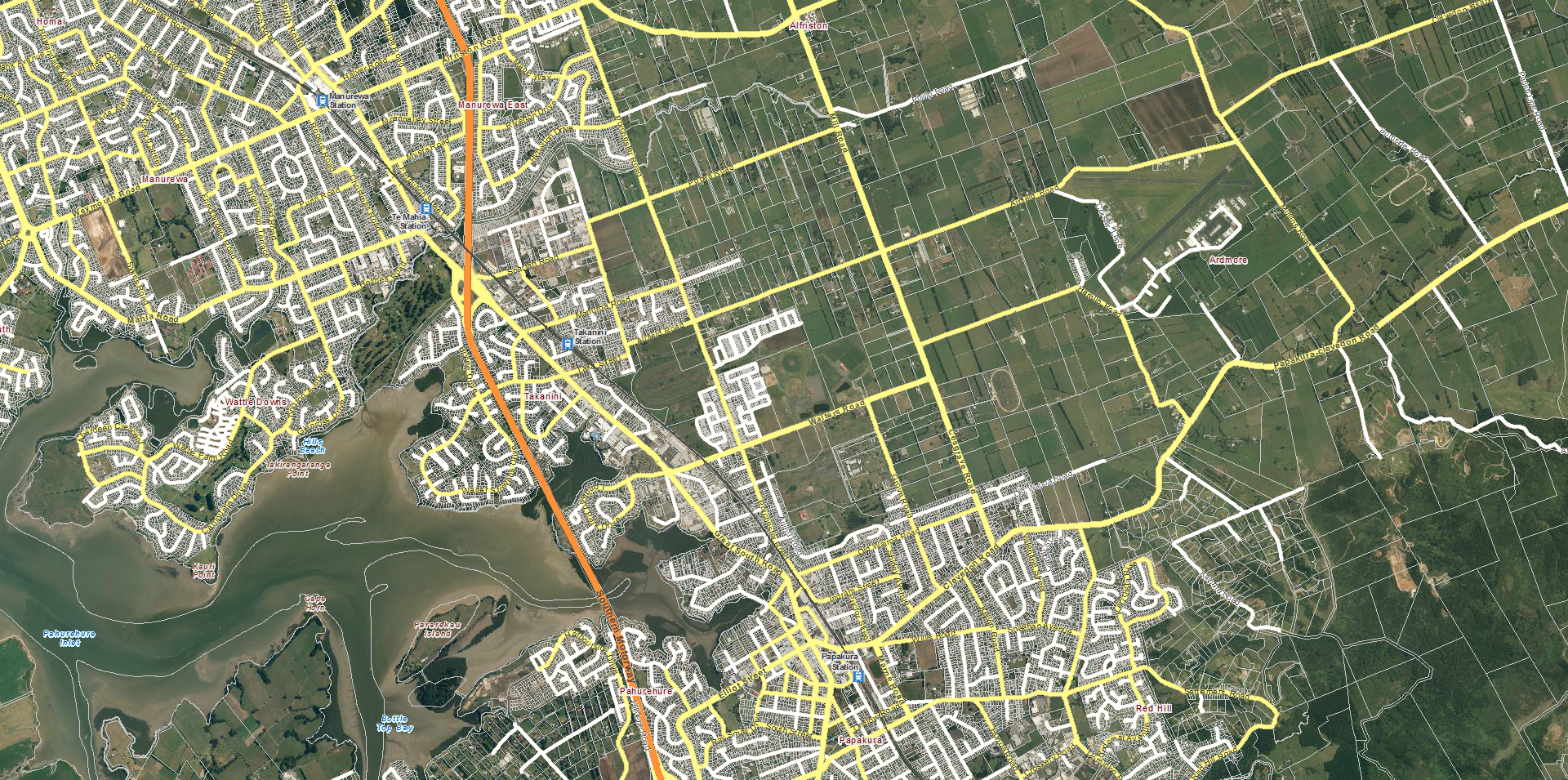
Currently between Papakura and Manurewa Stations you have Takanini and Te Mahia Stations:
Manurewa, Te Mahia, Takanini and Papakura Stations will accompanying topography


Click for full resolution


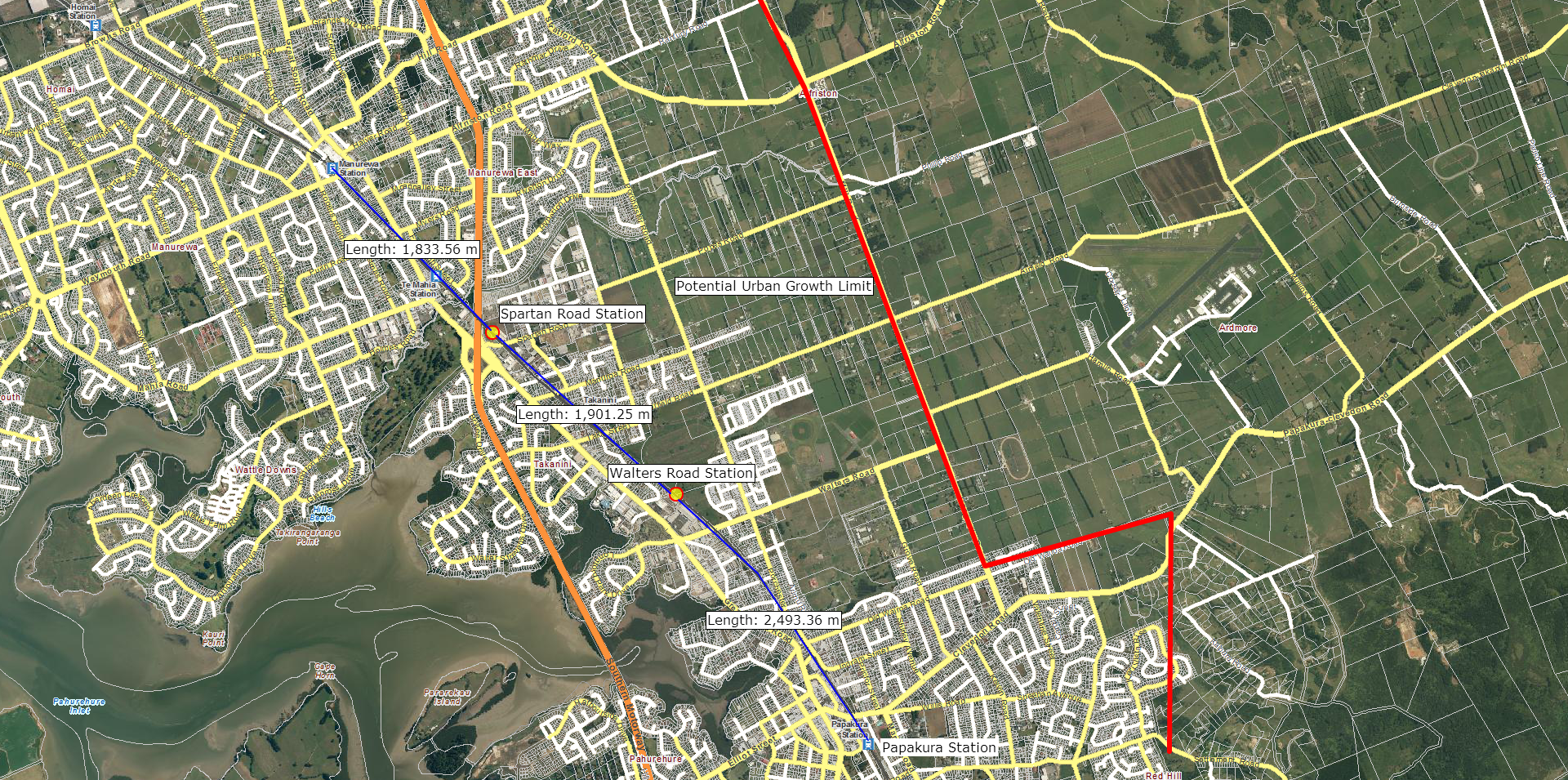
The next graphic is of impending urban development per the Auckland Plan – along with distances between stations currently:

Sth AKL stations with measurements png modes


Again Click for full resoultion


Okay some background facts on the current situation

Time to travel between stations currently:

  • Manurewa <-> Te Mahia: two minutes
  • Te Mahia <-> Takanini: three minutes
  • Takanini <-> Papakura: four Minutes

Current Facilities and nearby Amenities  at the stations currently:

  • Manurewa: Relatively new station right beside the South Mall shopping centre. The station is linked by a park and ride as well as the main bus interchange for the Manurewa area. Station has easy access by foot, bicycle, car, taxi or bus with at least two entrances to each platform. Public toilets are near by and the station is currently challenging Papakura as the third busiest station in the network after Britomart and Newmarket. Station is well-lit at night and contains the electronic Passenger Information Display system.
  • Te Mahia: An old station situated between residential on one side and basically car yards and light industry on the other. Station is linked by two narrow alley-ways at the north end with no park and ride facilities and the nearest bus stops around 300 metres away on the Great South Road. Station is poorly lit, has no electronic Passenger Information Display system, has a mix of both gravel and asphalt base for the platform, and an old concrete shelter from most likely the 1960’s. The station currently has I believe the second lowest patronage (after Westfield) and does give the feeling of being “unsafe” to both rail staff and travelling public. Catchment area due to position, lack of bus and park and ride facilities is very limited for Te Mahia Station
  • Takanini Station: Station recently had its platform extended and some new lighting to handle to new Electrics when they come on stream from next year. However it is similar to Te Mahia in respect of facilities and links despite patronage growing on that station. The station does give the impression of being “unsafe” while cars park either side along the side streets for those who drive to the station. Nearest bus stops are around 500 metres away on the Great South Road and the station has been attributed to a few accidents with train verses passenger over the last few years.
  • Papakura: Currently undergoing a large-scale revamp with the platforms being upgraded, ticket office being moved, new track infrastructure to allow train movements more easily (including a new freight train passing loop), new electronic Passenger Information Display Systems, upgraded lighting, refurbished and restored station building, and the Park and Ride facilities due for upgrades as well. Papakura Station is right next to the Papakura Town Centre and is served by easy access for walkers, cyclists, cars (two park and rides), taxis and buses (major terminus bus stop is next to the station). The station is a terminus station for most Southern and Eastern Line services and is currently the third busiest in patronage level on the Auckland Rail Network. Papakura is also a key station for train staff with a staff building and train stabling/fuelling facility located between the eastern Park and Ride and Platforms One and Two. However Papakura Station is currently constrained by lack of proper feeder buses which do have an impact on the Park and Ride being full most days of the week – limiting further passenger patronage growth. Papakura is also currently my “home station” where I catch the trains (or leave them) if I am travelling by train to some destinations

Google Maps and the Council GIS viewer currently do not show the current stations in their current form, so until I make a trip down – no pictures as of yet.


So we have the situation with Te Mahia and Takanini Stations of what and where they are, and what state they are in. Now as I have alluded to earlier South Auckland is due to undergo significant urban growth per the Auckland Plan over the next thirty-odd years. The second graphic above had a red line drawn in it that show the extent urban growth can take during the life of the Auckland Plan – which means we could be looking at well over 35,000 new residences and businesses in the area over the next twenty years at least. Now putting two and two together (and disregarding Auckland Transport is apparently going to upgrade Takanini within the next five years – which I think is for the platform only (so no Park and Ride)) you have a situation of large urban growth near the rail corridor and two dilapidated stations that have bugger all facilities, bugger all catchment area, and bugger all future with little scope of being able to fully upgrade the stations with facilities like Papakura and Manurewa. So what do I propose?


Well I propose the following


Proposal for Southern Auckland Rail Efficiency Upgrades


In short I propose the following”

  • Close Te Mahia Station (which I believe Auckland Transport are going to do)
  • Close Takanini Station
  • Build Spartan Road Station complete with full Park and Ride and Bus Interchange
  • Build Walters Road Station complete with full Park and Ride and also Bus Interchange

Why This?

  • Spartan Road and Walters Road Stations have better and large catchments for current residents and future urban growth than Te Mahia or Takanini ever could
  • Land available for the stations, park and rides, bus interchange and future upgrades
  • More uniform distance between stations from Manurewa to Papakura, thus allowing better travelling efficiency (heavy rail is most suited when stations are a reasonable distance (usually beyond 2km) between stations due to the dynamics of the rolling stock, and services it is often required to run (relatively long distance compared to light rail and buses). Basically heavy rail passenger services perform efficiently with fewer large stations with larger distances between stations compared to light rail which can handle more stations with shorter distances between them.
  • Able to start afresh in building the new stations reputations that are  safe, clean and have well-built facilities catering for large numbers of travelling passengers


These next round of graphics and annotations explain Spartan Road and Walters Road Stations

Overall View
Overall Proposal of Southern Auckland Station Investment


You can see where I have placed the new stations – close to current residents and business as well as future residents and business. Remember Te Mahia and Takanini Stations will be closed.


Close Up of Spartan Road Station Proposal
Spartan Road Station, Park and Ride and Bus Interchange


The size of land for the Station, Park and Ride, and Bus Interchange is just over 2 hectares in size. The brown lines show possible eastern shuttle bus connections for the station. A new proposed road linking Randwick and Spartan Road Station (via crossing the stream) is also placed. This new link would allow ease of access for residents to get to Spartan Road Station and possibly the industry in the surrounding area. Those living in the northern part of Conifer Grove (wedged between the Motorway, Walter Stevens Drive and Great South Road) have the choice of either Spartan Road or Walters Road Station.


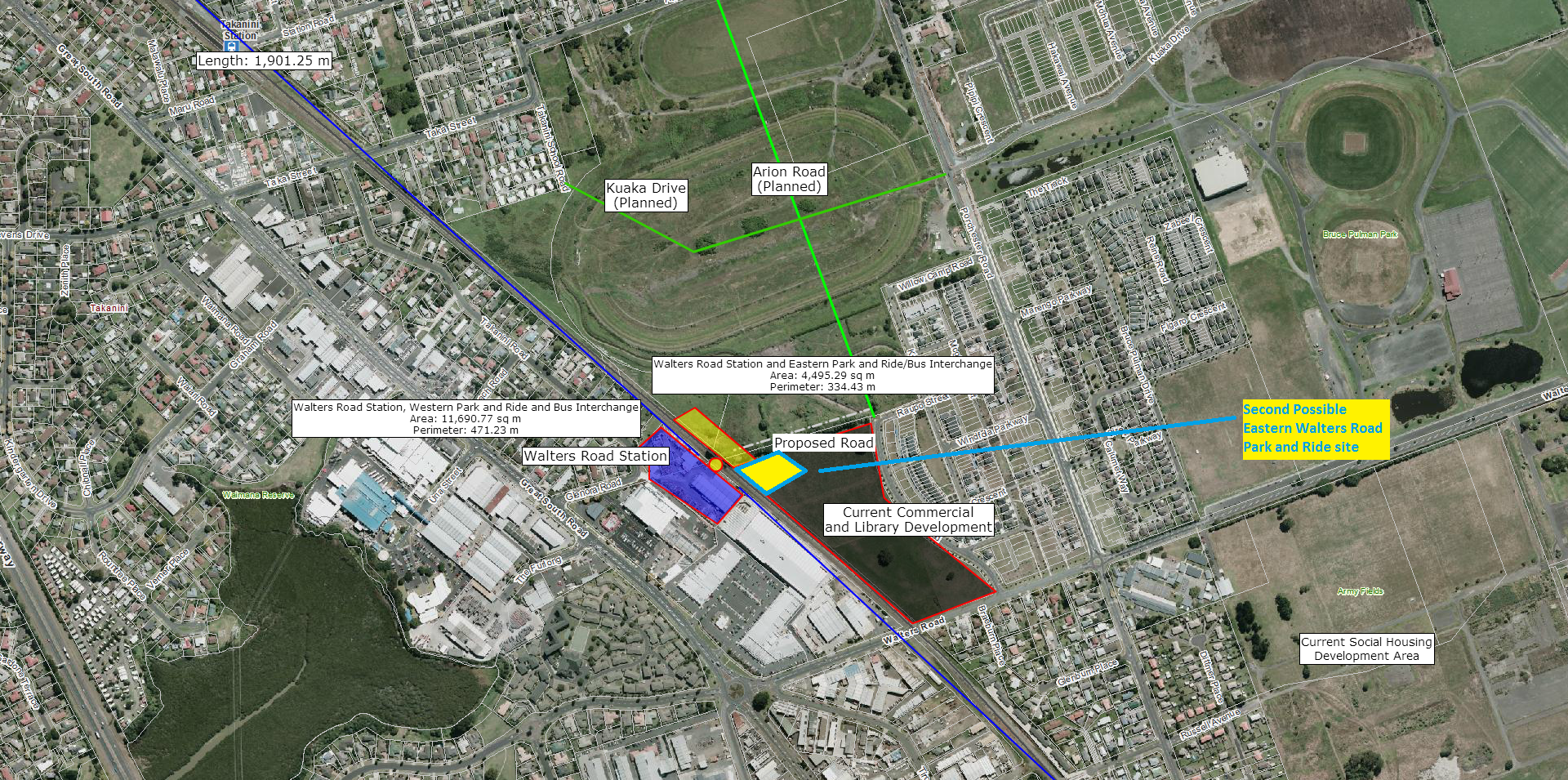
Close up of Walters Road Station Proposal
Walters Road Station, Park and Ride, and Bus Interchange


Again click for full resolution


Walters Road is bit more unique in the fact it has technically two Park and Rides, as well as two bus interchanges – one on each side of the rail line (the sizes are 1.16ha and 0.44ha respectively). This would be owing to no road level crossing being built at the station site (we are trying to reduce level crossings) nor a road bridge being built that could be justified in the cost department. If the bus interchange and/or park and ride was only built on one side, it would me a 1.5km “detour” to get to the relevant side with the park and ride and/or interchange – a rather self-defeating exercise. Furthermore you would cause bottlenecks down Walters Road by buses and cars trying access the park and ride and/or interchange if it was built on one side only. To add further weight behind building a Western and Eastern Park and Rides + Bus interchanges is the fact that Walters Road would be a station serving a fast growing area being right next to a new commercial development and within easy reach of new residential development. The Western Park and Ride + Bus Interchange would service all residents and businesses on the Great South Road side of the rail line, while the Eastern Park and Ride + Bus Interchange would service residences and businesses between the rail line Mill Road (Red Line on first graphic). Also Papakura currently has two Park and Rides (one on the western side, one on the eastern side) which are both heavily utilised – so there is a very close by success story of building two Park and Ride facilities that would be utilised well. The Eastern Park and Ride + Bus Interchange would also be my new “home-station” where I would catch my trains from to head north.

One final note having Walters Road Station with its dual Park and Rides + Bus Interchanges; the area between Manurewa and Papakura East (Red Hill) is due to undergo significant urban growth over the next three decades. You are looking at tens of thousands of new residents as well as many new businesses and civic institutions for which Papakura Station (and Takanini for that matter as well) could no simply cope if we are looking at making mass transit accessible to our new residents. Takanini is a dunga and does not have the room for a large supporting facility (Park and Ride and Bus Interchange) to make any station upgrades viable. Walters Road Station (including Park and Ride and Bus Interchange) is bang smack in the middle of a catchment area that has existing residents and businesses as well as future urban growth. Walters Road Station would be on land that can support the required large-scale support facilities (Park and Ride and Bus Interchange) as well as being connected to two access roads that run both major arterial roads that can be or already are traffic light controlled for safety reasons. So in that sense getting Walters Road Station right is absolutely critical if it is to be a key lynch-pin station that would attract existing and new people to Auckland’s fully integrated mass transit network.


Cost of these works for South Auckland?

Varies significantly and I would need to consult both an engineer and a planner to find out the true construction costs as well as the Benefit Cost Ratio (BCR) factors and the works and operational effects on these four stations are significant.


Justification

The entire post is a justification on this project. The new running times would also most likely be the following (for diesels, running times for the electrics are unknown as of yet):

  • Manurewa <-> Spartan Road: three minutes
  • Spartan Road <-> Walters Road: two Minutes
  • Walters Road <-> Papakura: four minutes

As what would happen to those who use Te Mahia and Takanini? For Takanini Station users two choices are available: car, walk, cycle, shuttle bus to either Spartan Road or Walters Road Crossing. For Te Mahia Station users they would use Manurewa or Spartan Road Stations and get there by car, shuttle bus, walk or cycle. So the alternatives are readily available and would present little disruption to existing users.


Completion Time?

To build both Spartan Road and Walters Road Stations with their supporting facilities, the new road link bridge between Randwick and Westbrook Road (connecting to Spartan Road) and demolish both Te Mahia and Takanini would be an estimate of two years as Block of Lines (closing the network in that particular section) would be required.


And so while that is the Papakura – Manurewa section of station additions and removals there is one more on the Eastern Line before reaching Britomart that could be up for a move down the line. That be moving the current Meadowbank Station closer towards the Meadowbank Tunnel and renaming it Selwyn Station. But that I shall cover in the upcoming THE RAIL EFFICIENCY PROGRAM #5B post.


But in the meantime what do you think on basically moving two stations to better locations and adding support facilities such as Park and Rides, and Bus Interchanges. Comment below


*Note: To make it clear; when I refer to Park and Rides I also mean including Kiss and Ride as well as Cycle Lockers as part of the Park and Ride Facilities.

First Step in Improving Auckland’s Public Transport

Treat Humans as Humans


Not as numbers, not as dollar signs, not as a total pain in the ass that should be treated begrudgingly.


While I have been running commentary on things like Rail Efficiency Programs and operational models post City Rail Link to boost patronage via infrastructure and operations, another blogger raised a very fine point on something that is very well hammering our public transport patronage statistics – our customer service.


Before I highlight the said post from the other blogger, a quick reminder: Auckland Transport asked for submissions to its Regional Public Transport Program (RPTP) of which the hearings are next month (and that I am attending). One of the main focuses Auckland Transport was looking for in submissions to the RPTP was the “Customer Service Portal” – in other words the quality and level of customer service in our public transport system from front line staff right through to AT bureaucrats in Henderson.

This post is by virtue of an extension to my submission on the RPTP as well as replicating a point made at another blog.


So lets take a look at Customer Service on Auckland’s Public Transport System

This is from Auckland Transport Blog:


By Guest Post, on January 7th, 2013

This is a guest post by John P

The Ministry of Transport, bless ‘em, actually have a lot of interesting information on their website if you know where to look. One of the things they do is carry out a Household Travel Survey, which surveys 4,600 households in various parts of New Zealand each year. There’s plenty to look at, and you can check out various results at their transport survey, but for today I’ll look at a summary they put together on public transport use – taken from here.

The thing that stands out to me is a table showing the percentage of people who use public transport in NZ’s major cities. From this, 53% of Aucklanders surveyed hadn’t used PT at all in the last year. This put us on par with Christchurch and Dunedin, both of which are significantly smaller, neither of which have rail, and neither of which are particularly PT-oriented cities. We’re well behind Wellington, where only 27% of people hadn’t hopped on a train or bus at least once. Remember that (greater) Wellington is around the same size as Christchurch, and both cities are less than a third the size of Auckland.

Wow, that’s not a good start. How about people who haven’t used PT in the last month, but have in the last year? 17% of Aucklanders fell into this camp, in line with the other cities except for Wellington.

So, by this point, we can see that only 30% of Aucklanders had used public transport in the month before they were surveyed. We were in between Dunedin (26%) and Christchurch (34%), and well
behind Wellington where 46% of the people had used it at least once.

The last few lines of the table below are asking people how many days in the last month they had used public transport. I won’t dwell on it except to point out that half the Aucklanders who used PT in the last month hadn’t used it very often. Only 14% used it on 5 days or more, ahead of Dunedin (11%) but behind Christchurch (16%) and Wellington (27%).

Wellington is leaps and bounds ahead of Auckland, but I think we all knew that. I think these results are a pretty telling scorecard, and, to put it mildly, Auckland doesn’t look too flash. The majority of Aucklanders never use public transport at all, and most of those who do don’t use it very often. Two basic questions come out of this:

  1. Why don’t Aucklanders use PT very often?
  2. How do we improve PT usage in Auckland?

Questions that are answered in a number of different posts in this blog! A redesign of the network, and rail electrification, should help boost patronage over the next few years. But the thing is, we should really be aiming to get to where Wellington is now in the short to medium term. Anything less is short-changing ourselves in my opinion.


You can read the full article over at the Transport Blog site.

However the two questions in red are the points being raised and I answered over there. My answer was:

John (P) while a great post I think (from experience) the obvious is missing to give our flagging P/T patronage especially our rail patronage good kick until the infrastructure comes on cue over the next 10-30 years.

I take note here:

  1. Why don’t Aucklanders use PT very often?
  2. How do we improve PT usage in Auckland?

Questions that are answered in a number of different posts in this blog! A redesign of the network, and rail electrification, should help boost patronage over the next few years. But the thing is, we should really be aiming to get to where Wellington is now in the short to medium term. Anything less is short-changing ourselves in my opinion.”

Those are the two questions we are all seeking to actually answer and the reason why (to my personal disagreement as well as Councillor Mike Lee not being amused either) AT are about to embark on spending our money on “professional experts” ( http://www.nzherald.co.nz/nz/news/article.cfm?c_id=1&objectid=10855436 ) in finding “fixes” to our rail slump,


However again Councillor Mike Lee has hit the nail on the head right here with this comment from another article: http://www.nzherald.co.nz/nz/news/article.cfm?c_id=1&objectid=10857062

“Mayor Len Brown says the arrival of the trains will be “a huge step on the path towards the kind of integrated transport system an international city like Auckland needs”.

He believes the electric units – which will have greater acceleration and braking power than the existing diesel fleet – will make rail patronage “rocket” and create even more pressure for a 3.5km underground rail extension from Britomart to Mt Eden.

But council transport chairman and veteran electrification campaigner Mike Lee believes the new trains will not be enough to boost flagging patronage unless they are supported by general service improvements, notably far better punctuality and extended weekend timetables, without prohibitive fare rises.

“I would not bank on electric trains in themselves fixing chronic underlying human management problems,” he said.”


Basically cutting it short why don’t Aucklanders use P/T much and how do we improve our P/T usage in Auckland? Well the infrastructure part of the answer is being dealt with so to me it is rather irrelevant in this point in time. The actual answer came from Dr Lester Levy – Chair of AT:

Dr Levy said he agreed there was a need for “critical measures” to be adopted and Auckland Transport needed to be far more customer-led in creating a demand for its services.

And there is the answer right there and there – he said it himself: ” Auckland Transport needed to be far more customer-led in creating a demand for its services”

THAT TO ME IS (and excuse the caps) PRIORITY NUMBER ONE above else at the moment.

2013 is going to be long and interesting year getting the patronage back round again. However (and in my opinion (what ever that is worth these days)) we (by we I mean AT, Council, the p/t user, you guys here at the blog, myself, and others who give a damn about our city) can do this – slowly but surely. :D


Now I am going to extend the “situation” from another Transport Blog commenter emphasising the point:

George D

But council transport chairman and veteran electrification campaigner Mike Lee believes the new trains will not be enough to boost flagging patronage unless they are supported by general service improvements, notably far better punctuality and extended weekend timetables, without prohibitive fare rises.

He’s right. It doesn’t matter how fast and shiny the trains are if they’re still late and unreliable, and riding them costs more than ever. Every time fares rise, demand decreases – we’ve actually reached the point now where we’ve passed an equilibrium and ridership is decreasing towards a new equilibrium with those who are prepared to pay for a particular level of service.


Now since then a few more comments from Transport Blog have come up however I can’t specifically address those issues at the moment.

But as for my point and George D’s point, the writing for Auckland Transport is literally on the (virtual) wall. Improve customer service FIRST (and restore affordability to fares while at it) or all this multi-billion investment in our public transport system is going to be an utter waste if Auckland Transport can not get the basic human to human interaction right. People (both front line staff and passengers) just want to be treated like humans and be able to at least have a pleasant experience on our public transport network – even in times of disruptions. It can be done, it has been done and it is straight forward if the culture (and tools) are there.


There will be more said on this matter next month when I front up in front of members of the Auckland Transport Board next month for my RPTP hearing. However 5-minutes doesn’t quite seem long enough to hammer on about the “Customer Service Portal” at this current rate of dissatisfaction out there.


THE RAIL EFFICIENCY PROGRAM #4

How to get Better Resilience out of the Rail Network


A Rail Efficiency Program Series


THE ALL-ENCOMPASSING RAIL EFFICIENCY PROGRAM – PART TWO


Westfield Junction Fly-Over


Those who travel by train on the Southern and Eastern Lines to their destination and pass through the Westfield Junction can know the delays that happen in that section of track due to another train “crossing over.”

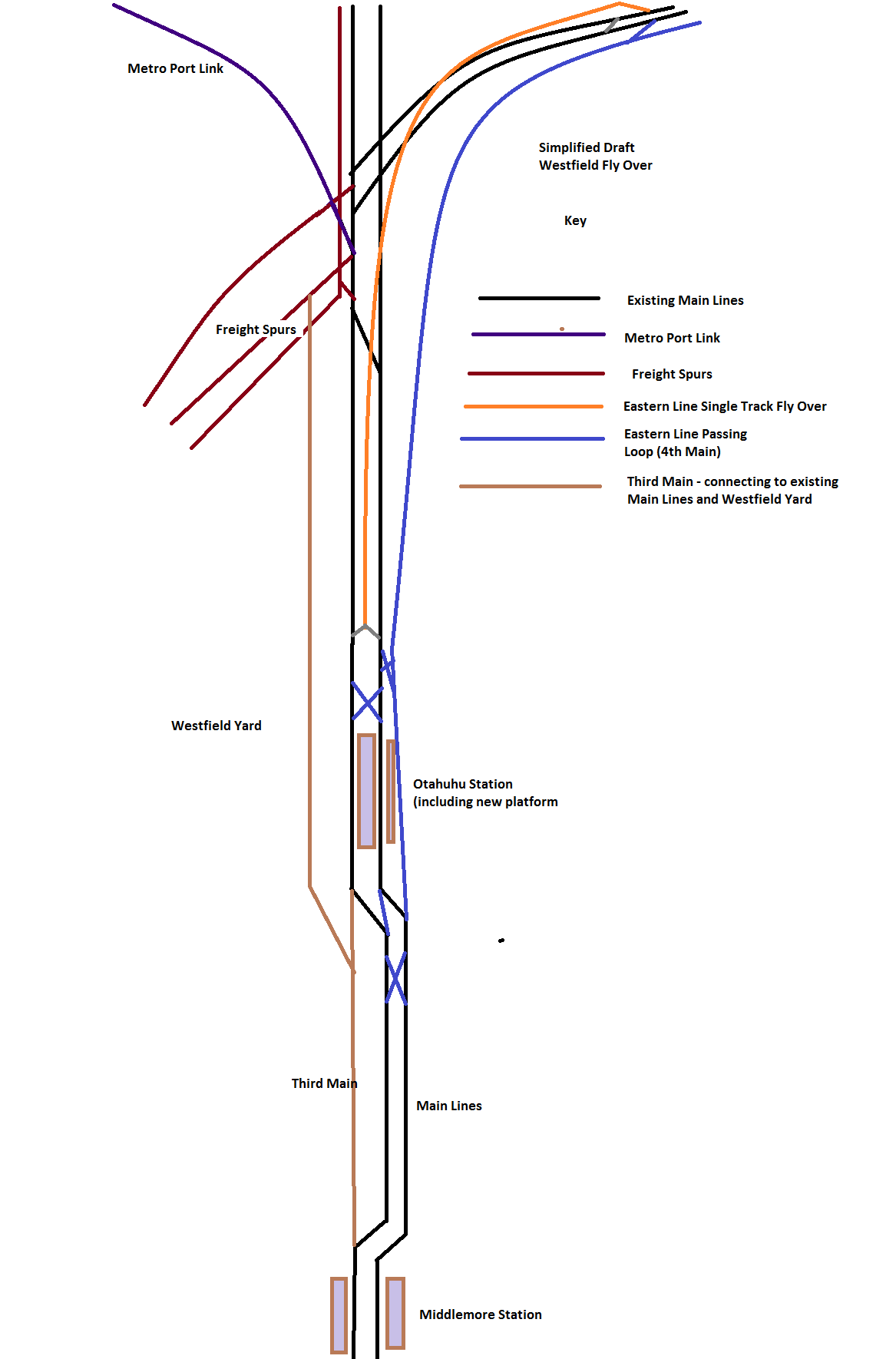
This picture would explain better what I mean:

Westfield Junction jpeg overview mode


Click for full resolution (1920×955)

As you can fathom, there is a lot of conflicting routes at Westfield junction from both passenger and freight trains – all which can cause delays to our passenger services (and they do) at just about any given time.


Now with passenger train frequencies to increase to initially 6 trains per hour (one every 10 minutes)(and that could easily mean one train every 5 minutes on the lines between Westfield Junction and Papakura Station as well) once the electrics are fully on-stream (2016), plus the inevitable increase of Metro-Port freight train frequencies to and from their Southdown Metro-Port base; delays and conflicting movement risks are just going to increase no matter how good the signalling is.

So as an idea (this is not an original one but builds upon those ideas from others) is to build a Westfield Junction Fly-Over to allow trains heading to Britomart via Glen Innes (Eastern Line) from the south to “fly-over” Westfield Junction and reconnect with the Eastern Line on the other side of the junction. The Fly-Over would stop the city-bound Eastern-Line trains conflicting with south-bound trains from Newmarket thus improving the efficiency of travel for those respective services (as they often get held up the most). However the Fly-Over does not assist in dealing with conflicts if a Metro-Port train decides to enter or leave Metro-Port Facility to/from the main-line.


Knowing that Metro-Port trains are long and are either accelerating (so departing the base) or decelerating (entering the base) they take time to complete their movements and have the high potential to foul passenger train movements (which they do on a more regular basis than they should) in the area. Now I am not one for telling the Metro-Port services to bugger off as they are a revenue spinner for Kiwi Rail as well as doing a great service in their part in keeping trucks off our highways between Auckland and Tauranga. So the next extension as part of the Westfield Fly-Over phase is to build approaches and/or passing loops in the Westfield Junction to Otahuhu area to allow more efficient Metro Port freight train and Auckland passenger train movements that will not conflict each other.


Now the idea for these approaches for the Metro Port services comes from the current Third Main being built between Middlemore and Otahuhu which allows freight trains to enter or leave the Westfield yard more quickly than they do now (they have a dedicated road to power up to speed or slow down from speed without conflicting other passenger trains in the area – as trains take a long time to speed up or slow down). By virtue of extension and in anticipation of a full Third Main being fully built from Otahuhu to Papakura within the next 10-years (fingers crossed) – and currently there is plans for the Third Main to go all the way to Port of Auckland; basically what is happening is that the Third Main is being extended to Westfield Junction from Otahuhu with a “Fourth-Main” also being built from near Sylvia Park on the “south bound” side, around Westfield Junction and through to Otahuhu Station connecting back up to the current Main-Lines.


The following graphics and pictures hopefully might explain better:


This picture gives a basic outline of the work proposed at the Junction:

New junction 1 png mode


Click for Full Resolution


This next picture show the extent of the works for the Westfield Junction, the “Fourth Main” and the approaches from Middlemore Station (with the Third Main in place between Otahuhu and Middlemore):

Overview of new junction png mode


Again click for full resolution


And this last one is a crude draft graphic on a simplified version of the Junction and approaches (note I have not added all the cross overs in):

Diagram of Junction Flyover


Click for full resolution


Now this idea takes into account the following:

  • Westfield Station is closed (it is actually slated for close by Auckland Transport anyhow)
  • Accepting that if a Metro Port train comes out from its base at the same time a south bound Southern Line service heading to Papakura from Britomart is also in the area moving, any city bound Southern Line trains will be waiting at the north end of Otahuhu Station for the conflicting movement to clear
  • The Metro Port train uses the Third Main all the way until Middlemore before entering the existing main line (or vice versa if heading to the Metro Port base)
  • The new EMU’s can take the gradient of the Fly-Over as it would be slightly less than the CRL gradient to which the EMU’s are designed too

So while not perfect and still likely to get delays from some conflicting movements in the Otahuhu-Westfield Junction area, those are likely to be caused by a freight train rather than another passenger service wanting to go the other way. And so this is where the junction pays it dividends: allowing Eastern Line trains to cross over the Southern Line trains without conflict of movement at the Junction. The third platform at Otahuhu Station allows the Fourth Main to come from the Eastern Line near Sylvia Park, all the way to the main interchange station (Otahuhu) and then enter the existing Main Lines heading south minimising congestion between Otahuhu and the Junction if the existing Otahuhu Platform One (City Bound) is occupied by a passing Metro Port train and Otahuhu Platform Two (existing South Bound) is occupied by a city bound train.


Cost

Cost of such a project taking into account retrofitting of the electrification system including signals, a bridge, retrofitting existing tracks with new crossovers, building the Fourth Main, building new electrification systems for the Fly-Over and Fourth Main, new Platform at Otahuhu (which could tie in with a Park and Ride plus Bus Park Facility), and future proofing the Eastern Line to allow a direct link between Sylvia Park and Penrose would come at at I would say $110 million (so same as extending electrification to Pukekohe and building two new stations).


Disruption potential and Time of Completion?

Maximum potential for maximum disruption due to the electrification system now in position and the subsequent refit that would be required.

Completion would be 18 months that includes two Christmas Close Downs and as well as Block of Lines on all non special event weekends which means…


Likelihood of this Happening?

With our current civic leadership: NONE – not with what has happened with Electrification now…

Could of it happened? Yes when the Electrification Project started.


So why did I write this then if all it will do is gather metaphorical virtual dust? To illustrate what could have been with proper planning and foresight by our leaders and engineers. However we are relegated to constant bottlenecks and delays at Westfield Junction when our passenger service frequencies increase – along with the increases of freight train frequencies from the Metro Port base.


However I am still open to surprises – and if this part of the All Encompassing-Rail Efficiency Program gets dusted off, shoulder-tapped and built; then heck someone did have vision for Auckland!