White, Senior (in age), Conservative and from either Central or North Auckland Had two articles I could have written on this morning. One being on Auckland Transport and the other … Continue reading Skewing of the Unitary Plan
White, Senior (in age), Conservative and from either Central or North Auckland Had two articles I could have written on this morning. One being on Auckland Transport and the other … Continue reading Skewing of the Unitary Plan
Auckland Transport has sent out a flyer alerting passengers of rail buses replaces rail services south of Otahuhu Station every Sunday to Thursday from now until to further notice. This allows Kiwi Rail continue much-needed electrification works that have fallen behind.
Here is the timetable
Lets see if Kiwi Rail can get the work done. Be a bit of a bugger if the Onehunga and Western Lines were complete but no wires in operation to the EMU depot further south in Wiri. Ooops

Get your submission in May 31 at 5pm is the cut off for you getting your feedback to the Council on the draft Unitary Plan. While I have finished … Continue reading May 31 – Final Day for Unitary Plan
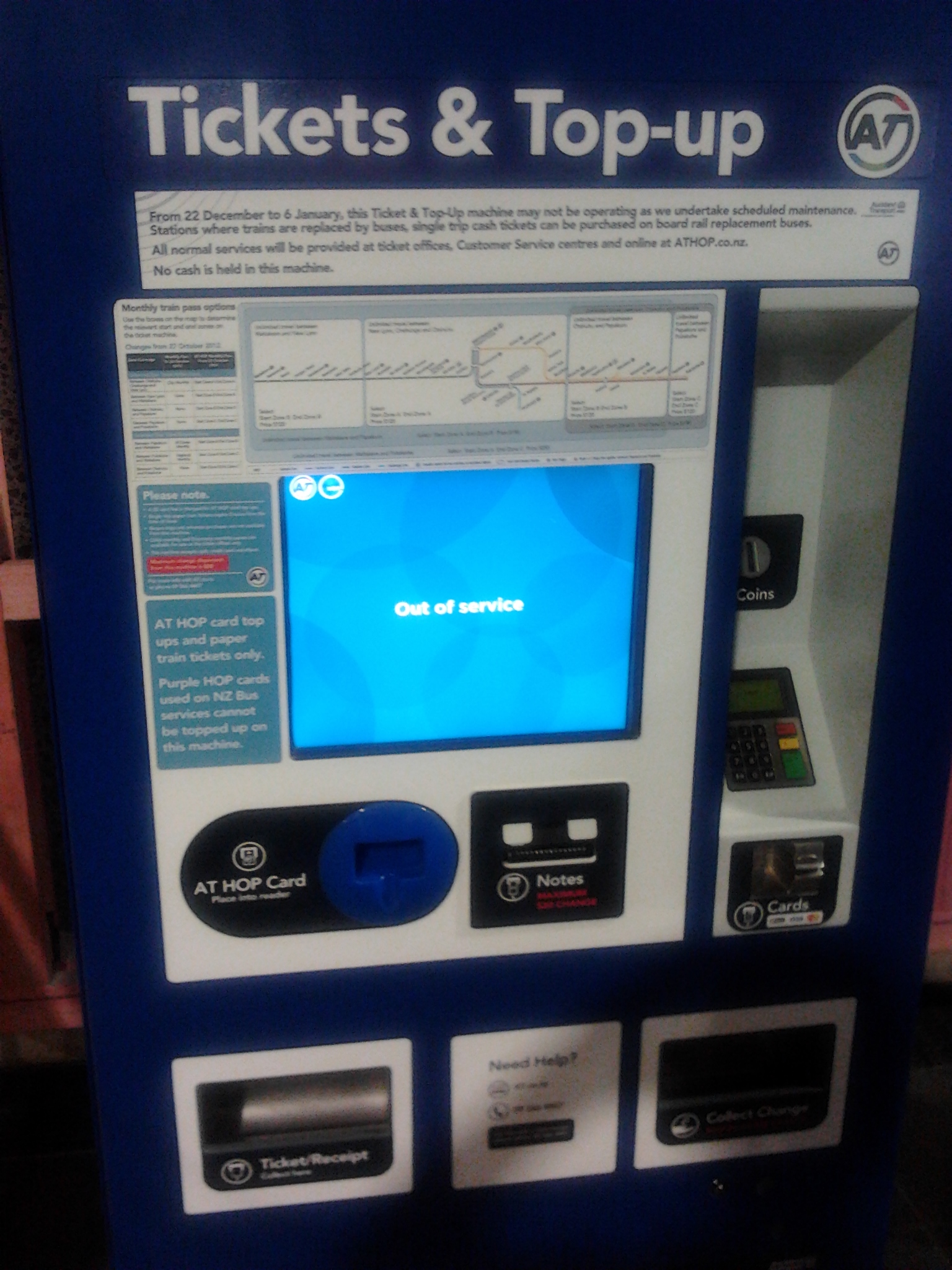
Well I managed to personally stave off a fare rise for AT-HOP care users in September last year (Fare Increase Ctd) for rail users. However, this time no such luck – you are going to be lugged with it this time around.
From the NZ Herald this morning after AT announced it last yesterday
Students bear the brunt of Auckland public transport fare rises
Auckland Transport has been accused of targeting students with public transport fare rises that will also affect thousands of Hop and multi-trip ticket buyers.
Auckland Transport – which waited until late yesterday to announce changes approved by its board two months ago – will lift cash fares for tertiary students by between 7c and 40c a trip on June 3.
Adults who use Hop cards on trains or 10-trip tickets on buses also face fare rises of 2c to 22c a ride.
Ten-trip tickets on inner harbour ferry trips such as from Devonport, Bayswater and Birkenhead to the city will also rise by up to $2, but water transport will become considerably cheaper for Hop card users.
A single trip fare for a Hop card user from Devonport to the city will fall from $5.40c to $4.10c compared with an unchanged cash price of $6, but ten-trip tickets will rise to $41.
That is to align Hop cards with multi-trip tickets, which Auckland Transport ultimately wants to scrap in favour of seamless travel across ferries, trains and buses.
Public transport operations manager Mark Lambert said close to 50,000 public transport users could be affected. The changes were required before Hop cards were rolled out to the city’s buses between June 23 and November, he said.
Auckland Council transport chairman Mike Lee asked why fares could not be aligned downward, particularly on trains.
“It seems the most loyal passengers are being targeted – students and those taking multiple trips.”
Auckland had the highest public transport fares of any Australasian city and students were “a key part of our market”, he said.
Mr Lambert said an increase in the student discount from 20 per cent to 40 per cent in 2008 proved highly effective in lifting demand and getting cars off the road, but there was a limit to ratepayer subsidies.
Auckland University Students’ Association president Daniel Haines said the fare rises appeared aimed at those who could least afford to pre-load Hop cards for multiple trips.
He said transport was the second highest cost facing students, after accommodation, and the increases would hit those who faced long trips from suburbs offering lower rents.
• For detailed information about fare changes, visit maxx.co.nz.
I remember fighting tooth and nail to retain the existing fares seen here below rather than having AT-HOP users pay a technical rise as AT were to flat line the discount rates at 10% right across the board
| Adult | Child/Accessible | Tertiary | |||||||
|---|---|---|---|---|---|---|---|---|---|
| Cash fare | HOP fare | You Save! | Cash fare | HOP fare | You Save! | Cash fare | HOP fare | You Save! | |
| 1 stage | $1.90 | $1.60 | 16% | $1.10 | $0.90 | 18% | $1.90 | $1.10 | 42% |
| 2 stage | $3.40 | $3.00 | 12% | $2.00 | $1.70 | 15% | $3.40 | $2.10 | 38% |
| 3 stage | $4.50 | $4.05 | 10% | $2.60 | $2.29 | 12% | $4.50 | $2.79 | 38% |
| 4 stage | $5.60 | $5.04 | 10% | $3.40 | $3.00 | 12% | $5.60 | $3.47 | 38% |
| 5 stage | $6.80 | $6.00 | 12% | $4.00 | $3.55 | 11% | $6.80 | $4.21 | 38% |
| 6 stage | $7.90 | $6.90 | 13% | $4.50 | $4.05 | 10% | $7.90 | $4.75 | 40% |
| 7 stage | $9.00 | $8.00 | 11% | $5.30 | $4.75 | 10% | $9.00 | $5.58 | 38% |
| 8 stage | $10.30 | $9.05 | 12% | $6.10 | $5.44 | 11% | $10.30 | $6.38 | 38% |
I believe the new fare guide is not out but reading the material from AT properly you have:
So rather than targeting the cash users and hiking the cash fares (if the actual fares did need to go up in the first place) which would move people over to AT-HOP, Auckland Transport go and hit “the little guy” who is already on AT-HOP. Ouch and nasty!
The AT-HOP fare rise also seems to be the exact opposite of the Deloitte HOP review would suggest
One wonders what the thinking was behind the latest move?
Section Four of the Unitary Plan is arguably the most important part of the entire Unitary Plan. Section Four contains all the RULES and definitions of those rules that are seen in the Unitary Plan – and also does one’s head in on the way out. One has to remember that the Unitary Plan is a document based on our Resource Management Act 1991 and subsequent amendments as they come from Wellington. What activities are permitted, controlled, restricted discretionary, discretionary, non complying and prohibited are all spelt out in the Unitary Plan and the definitions provided in the RMA.
Unfortunately the RMA is a cumbersome document (I have a copy here at home) and could be easily one of three (what I call) pieces of super legislation New Zealand have. By super legislation I mean it is beyond thick as a brick in size, has language that would baffle most people and has the greatest effect on most ordinary citizens’ lives. Of course the other two pieces of super legislation that we all love to have would be Tax Law and ACC 😛
With a cumbersome document like the RMA comes an equally as cumbersome document we know as the Unitary Plan. At what ever pages thick and language that will leave 99% of the city befuddled (paraphrasing Orakei Local Board Chair Desley Simpson) you can see why residents and business might get upset with the Unitary Plan.
Recently there was a major outcry on Mixed Housing Zones and what was entailed with them. In short as it has always been with a MHZ you can build a two storey (eight metre) house as of right – it is a permitted activity under most existing plans and the upcoming Unitary Plan. Where things get interesting is that you can build a three storey (10 metre) high house (not quite sure you can do Walk Up apartments though) providing you meeting the resource consent and urban design controls in place. This is because such an activity is classified as a Discretionary Restricted Activity per the RMA. Again this piece was already in most existing plans and is again in the upcoming Unitary Plan. So nothing different per se.
I believe what might have people “interested” is what does Restricted Discretionary Activity mean? In the Unitary Plan and as set out in the RMA it means:
4.1.4.3 Restricted discretionary activities
Resource consent is required for a restricted discretionary activity. Council may approve or decline a proposal for a restricted discretionary activity. The Unitary Plan specifies the matters over which council has restricted its discretion. Council’s consideration of the proposal, and the ability to refuse the application and impose conditions, is restricted to these matters.
The Unitary Plan uses this approach where it is possible to limit discretion to specific effects associated with an activity or development, which need to be assessed.
A permitted activity as a comparison is:
4.1.4.1 Permitted activities
Resource consent is not required for a permitted activity if it complies with all the relevant rules in the Unitary Plan. The Unitary Plan uses this approach to provide for activities to be carried out as of right, provided certain controls are met. If an activity does not comply with one or more of the relevant controls it is not a permitted activity. In those instances the activity will fall into one of the activity categories below and will require resource consent.
Existing uses
The RMA permits certain existing land uses, which were lawfully established, to continue despite contravening a rule in the Unitary Plan. These activities have existing use rights, but must satisfy the provisions outlined in s. 10 and s. 20A of the RMA.
It is the responsibility of the person claiming existing use rights to demonstrate they comply with the relevant sections of the RMA.
Certificates of Compliance (CoC)
An application can be made to council to obtain a CoC for a permitted activity. A CoC certifies that the development is fully complying. Section 139 of the RMA outlines the role of consenting authorities and environmental protection agencies in issuing CoCs. A CoC is treated as if it was a resource consent.
To provide the relevant Section Four material and what activities are what to the five residential zones I have these embeds
And the Mixed Housing Zone document which all the Councillors and Local Board members have sitting in their email boxes but have not publicly released to their communities. The document is a public document and meant to be discussed with residents and businesses
First is that I do not like Restricted Discretionary Activities as it gives a central planner too much power away from the community. Yes we have to weigh up private property rights of the individual but for activities to be lugged under the RDA class means there is going to be more than a minor impact and those in the immediate vicinity might want to be notified. You know – a no surprises policy. The Centralised Master Community Plan and Semi-Liberal Plan District methodologies I am working on would restore a more community based approach to planning and assist a no surprises policy.
Second Prong is that the language in Section Four is a total dog and will do anyone’s head in. It even does my head in and I am supposedly clued up with planning, the RMA and the Unitary Plan. If the “planners” language is confusing people on what can actually happen in a Mixed Housing Zone then I don’t blame them for their confusion.
While this might need a rewrite of the RMA itself, maybe Council could to simplify the language their end and run a traffic light system for the class of activities followed by basic plain English of each of the lights/categories. Example:
No need to mention Prohibited Activities as that is usually controlled by Central Government and often refers to things either toxic or nuclear in nature.
With a traffic light set up followed by basic plain English definitions if someone was to engage on an activity within one of the five residential zones; the citizen in question might have an easier time understand the rules and not be so confused.
I might work on simplifying and setting up a Traffic Light kind of system for the Unitary Plan but, not until after my submission is handed in by May 31.
In saying that; a well-informed citizen equipped with the knowledge and an understandable plan is a happy citizen. The opposite is a confused and angry citizen.
Maybe Council needs to work on its English in the Unitary Plan a bit better. Oh and lots of pictures – for pictures speak a thousand words (and save paper 😛 )
Talking Auckland: Blog of TotaRim Consultancy Limited
TotaRim Consultancy
Bringing Well Managed Progress to Auckland and The Unitary Plan
Auckland: 2013 – YOUR CITY, YOUR CALL

I am getting the Herald delivered free on a five-week trial thanks to the AA. You can comment on the irony of the situation later but the word free and word worm-food have relevance here.
So upon reading the A-Section of the Herald (was looking for Orsman after a menacing Facebook remark he made last night on his page) I found this about Dr Nick Smith:
I wonder what he means “lower quality developments” for Auckland and affordable housing.
Would it be the quality like my ex-army house made of treated wood and brick built in the 70’s. It is basic with basic fittings provided in the house but huge potential to upgrade as the resident saves up and upgrades the dwelling (like what we are doing with our home).
Or (and most likely) something like the quality of the Hobson Street rabbit hunches that the NIMBY‘s bark on about that leak like a sponge and are of poor quality (forcing off an expensive virtual rebuild). History (and this hurts when it spells the truth) I believe tells us those rabbit hunches were “signed off” by the C&R dominated former Auckland City Council in 2004 (while the Mayor at the time – Banks wanted a stop to it before he got chucked out because of the Eastern Highway). Oh dear I see irony abound here folks…
For further irony I need not remind Auckland that it was the then National Government of the 1990s that removed the requirement of treated wood for new houses (saving costs to the consumer apparently) and now most of them leak worse than a sponge and have rotted away to such an extent that if your repair bill was not sky-high, your house was basically condemned. As for the old Auckland City and Manukau City Councils that signed off on these disasters as well, I believe both were Centre Right dominated as well in most of that period. If you want me to drive a further boot in the situation who do our conservatives (and NIMBY’s) vote for traditionally.
And before someone sends a flaming comment right back I ask you reflect upon yourself and remember you get what you either ask/vote for or deserve (to the point my generation have to pick up the can from your mistakes).
Now the onus is on the Minister Dr Nick Smith to clearly define what he means by “lower quality development.” Because unless you plan to return to building leakers and crap like those Hobson Street apartments, then under the current situation with constructions costs artificially high building a quality basic house like mine would be near impossible for under $300k all up (including land).
Hmm with Northern Regional National Party Conference this weekend, I wonder what is being schemed or parroted in the hallways and theatre rooms…
2040 Auckland and the Character Coalition have released a statement and letter on their alternative for the Unitary Plan. Please not I am not endorsing or disagreeing (yet), just seeking YOUR thoughts on what they have to say.
From 2040 Auckland and the Character Coalition
Auckland Mayor Len Brown and Deputy Mayor Penny Hulse meet Auckland 2040 Group for
Urgent Talks about Unitary Plan
Auckland 23 May 2013
In response to mounting public outrage following Auckland 2040’s disclosure of the implications behind critical elements of the draft unitary plan, Auckland 2040 Founders Richard Burton and Guy Haddleton met this week with the Mayor, and Deputy Mayor for intensive discussions.
The meeting was constructive, with the Mayor willing to consider proposals put forward by Auckland 2040 for amendments to the plan. He also expressed a commitment to have a fair and meaningful dialogue with Auckland 2040 over the next few months, stating that the Unitary Plan would not be notified in September until 80-90% of the issues were resolved.
Following the meeting, Auckland 2040 has submitted their proposals in a letter to the Mayor and is now awaiting feedback.
Comments Richard Burton, “I look forward to the healthy public debate that will emerge from our proposal and our participation in on-going discussions with Council”
Letter to Auckland Mayor below:
22 May 2013
His Worship the Mayor
Our thanks to you and Deputy Major Ms P Hulse for taking the time to meet with Auckland 2040 and the Character Coalition yesterday. We were very pleased to read in the NZ Herald that you agreed with much of what we said.
A fundamental issue in looking at the future growth of Auckland is the extent to which Auckland is likely to grow over the next 30 years. That Auckland is growing and will continue to grow is undisputed; it is the rate and extent of growth which is at issue. Significant under or over estimation can have profound effects on future planning. We request that Auckland City:
- Be completely transparent in revealing the statistical justification for Council’s 1,000,000 population increase forecast for the next 30 years
- Reconsider the Auckland population estimate of 1,000, 000 additional population over the next 30 years to align with Statistics NZ Medium estimates. Overseas cities generally adopt the Medium estimate in planning for growth and then monitor that estimate over time, with adjustments up or down depending on actual growth. The High estimate as used by Auckland Council may overstate actual growth by as much as 50%. Overstating the population increase has serious implications on infrastructure and the need for high density intensification and or greenfields development.
The Draft Unitary Plan has been prepared on the basis of an additional 1,000,000 population over 30 years. Even if Auckland reaches such growth levels, it will not happen overnight but rather in a progressive incremental manner. It is thus logical to release land for intensification and green field’s development in a staged manner. To zone immediately 56% of Auckland’s residential areas for unrestrained, scattered apartment development is neither logical nor staged. Neither would immediate release of greenfields land sufficient for 400,000 people be logical or staged. Fortunately no-one is suggesting the latter.
We are not opposed to intensification, nor apartment development. We are opposed to scattered, un-planned, uncoordinated developments with no or inadequate consideration of urban character values, heritage values or infrastructure and no community consultation.
Certainty in an urban framework context is of fundamental importance to most people living in or buying into neighbourhoods. While alteration or addition of dwellings is largely accepted, structures introducing a different, more discordant building form are strongly opposed. Many residential areas have a mature character with established dwellings and streetscapes. Some have a dominant heritage character. Many of the most popular areas have had significant infill, but the infill is of a similar character to the existing housing so is accepted, albeit reluctantly in some quarters. Apartment buildings are a very alien building form in those streetscapes and the uncertainty of whether this form of development will occur in “my street” is what is galvanizing Aucklanders to object to Council’s proposals.
Auckland 2040 and the Character Coalition request that Council approach the Unitary Plan in a more planned and staged manner. Specifically Council should reduce the amount of land zoned for apartment development and instead have a more targeted focus providing development opportunities while preserving most of the existing residential areas.
If demand indicates more apartment zoned land is required, Council can undertake the appropriate neighbourhood or town centre studies with meaningful community involvement prior to release of more land for redevelopment. If full structure planning is required prior to release of greenfields land then why should not the same apply to intensification proposals within the existing urban area?
The following proposals should be considered in the context of the above statements. We request the Auckland Council give consideration to the following proposed amendments to the Unitary Plan:
- The introduction of a new residential Infill Zone which allows one and two storey buildings only and permits infill at a density of one unit per 350m2 net site area. This zone to be applied to the majority of the residential areas and in particular to residential areas which:
- Retain a strong residential character of 1 –2 story dwellings ,or
- Have significant heritage values, or
- Are close to sensitive environments such as the coast, lakes, volcanic cones, or
- Have been subject to considerable infill development, but which retain predominantly stand-alone housing, or
- Have topographical challenges which would tend to increase the adverse effects of apartment buildings
- The Mixed Housing Zone be restricted to areas in close proximity to town centers or selected arterial routes with good roading, public transport and infrastructure and which do not have the characteristics in (1) above.
- The Terrace House and Apartment Zone be confined to areas immediately adjoining inner city or Metropolitan Centres, plus the major town centres subject to (5) below.
- Development controls to be reconfigured to address adjoining property effects, and height limits to be restricted by full discretionary activity status, including public notification and affected party’s consents for exceeding height.
- That Metropolitan, Town Centre and neighbourhood studies be undertaken with community involvement to determine the most appropriate zoning mix after due consideration of existing urban character, heritage values, infrastructure and traffic. That Council reconsider town centre studies undertaken by previous council’s or Environment Court decisions affecting specific areas and incorporate the principal findings of those studies/decisions into the Unitary Plan.
- That should Council determine that additional intensification is warranted in the future due to increased demand, Council undertake structure planning of the areas where intensification is planned. Such structure planning should be similar in scope to that required for greenfields planning and have an aim of achieving a significant degree of community consensus.
We would welcome the opportunity to discuss these proposals in a constructive manner with Council and senior staff.
Yours sincerely,
Guy Haddleton, Auckland 2040
Richard Burton, Auckland 2040
Sally Hughes, Character Coalition
About Auckland 2040
Auckland 2040 is a newly formed grass roots organization of non political residents passionately concerned about the future planning and shape of Auckland. Its web site is www.auckland2040.org.nz
Comments and thoughts in the comment box below
24 May – 1985 – the day I came into this world.
Yes folks its my birthday day – an entire 28 years young. Still a spring chicken in the reality of things and got plenty of kick to go.
From today until Tuesday morning, blog posts will slow down as I celebrate my birthday over 4 days (Friday-Monday). It happens when you have extended family 😀
In saying that lets hope the weather holds out for most it 😀

I Believe in a Second CBD NOT Shifting the Existing One With Auckland Transport Blog stuck in their Mono Core Centric view thus a guest post from myself over … Continue reading Manukau as the Second CBD – A Clarification
Okay I am getting press releases from Auckland Council personally now as they get sent out into the public domain and press offices. Took me by surprise a bit…
Ah well might as well copy paste it into here:
From Auckland Council

Apparently looking at the Shape Auckland webpage it has been release under the Deputy Mayor’s name.
I think I need another Gin
Ah well – stranger things have happened
 Talking Southern Auckland