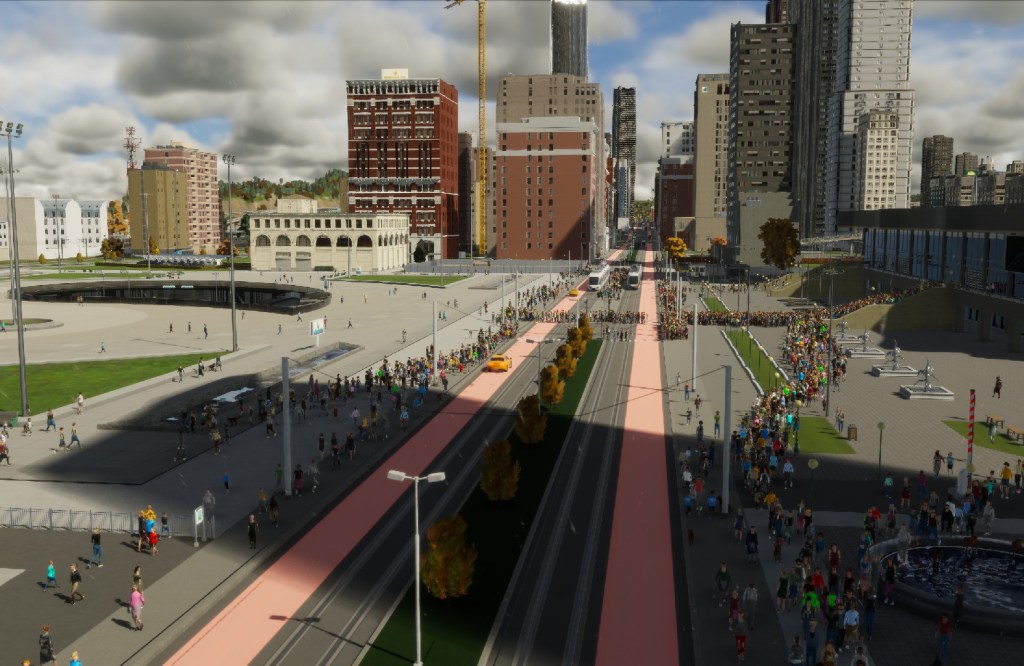
How much goes on to get to the point of residents and businesses moving in, and for visitors to part with their coin?
It takes around 12 hours in real time in preparation and planning to produce a single 51-minute video of the urban simulator letting rip (aka off pause) and watch all the urban interactions take place. Those interactions leading to the city – Manukau Ranges going from 28,000 population to 68,000 in the space of that 51-minute video.

Preparation and Planning of Manukau City Centre and its surrounds
Planning often gets hit about the time it and the Planners (I am one) takes to bring a project from an idea off the back of the napkin to fully operational. Death by endless business case aside (which is a form of predatory delay used by Government institutes like NZTA), those hits can lean towards the unfair side. City Building is not easy nor straight forward in real life, and Cities Skylines 2 demonstrates this at urban simulator level.
The videos of Manukau Ranges 3.1 and 3.2 demonstrating some of the planning and preparation of the City Centre are truncated versions of what happens “off screen” or “behind the scenes.” In 3.0 I go through some Planning theory that influences the decisions made in 3.1 and 3.2, with 3.3 being either the consequences or the proof-in-the-pudding.
But even then the planning and preparation work done in 3.x goes right back to the foundational preparations made in 1.x. Even if 1.x would focus more towards the Wiri districts, the foundations for what we see now in 3.x with the City Centre were influenced back in 1.x
With this is mind let’s look at the final preparations in bringing the City Centre, Manukau Riverside, and Manukau Way online.
Zones, boring to most but the ultimate dictator in land use, and influencer of spatial form and behaviours.
You all need somewhere to live, work, visit, and create enterprise right? Cue the Zones and local infrastructure supporting the zones that influence where it can all happen. Local infrastructure is often the front facing infrastructure taking the bulk of all behaviour interactions as a consequence of what is zoned where.
But more often than not unless there is a full scale plan review underway Zones and Local Infrastructure get taken for granted, and end up being a very dry topic of conversation.
In any case we have three districts to be brought online, a chronic housing shortage over in Wiri, and we have budding entrepreneurs wanting to set up their wares in this booming city!
You too can live in Manukau Ranges, once it is determined where, through the zones:
NEARLY THERE: The Icing on the Pudding before people and businesses move in
Nearly there you say? You mean I can get an apartment or even a house complete with the new carpet smell? Stand by caller while we process your application!
In the meantime the icing needs to be put on the pudding before we can let the new residents and businesses in. Namely the following:
- Civic Infrastructure (education, police, administration, fire, health/death care)
- Green Infrastructure (all those parks and plazas, plus some Leisure venues (which technically are Social Infrastructure))
- Communications (telecommunications, internet, and the post)
- Transit Routes (all those stops, and their respective routes)
So with Let Rip day fast approaching, lets do one last push with the final preparations:
Time to cut the ribbon: FOR SALE/RENT/LEASE: THE CITY CENTRE IS OPEN
The crowds have gathered in front of City Call, the dignitaries all give speeches that are both too long, and would put an insomniac to deep sleep, the ribbon is cut and…
You may dispense with the pleasantries commander, I am here to put you back on schedule. Darth Vader to Moff Jerjerrod on the second Death Star in Return of the Jedi.
Yeah, no pomp and ceremony here in 3.3. Just me pushing the Play button and okay we go with the population going from 28,400 to 68,000 in the space of the 51 minute video!
In 3.3 we see the developers get cracking with all the new buildings to meet the demand of the city. Meanwhile the trains, trams and buses all get to work moving the people around efficiently from Day 1 rather than day 1,444 as some cities constantly do (looking at you Auckland Transport).
Also the very definition of insanity or rather proper planning pays off with the central rail station very well utilised, and a very large stream of pedestrians going to and from a cocktail bar (of all places) enjoying those urban vibes:

Is all started here
It actually all started way back in 1.0. But in 3.0 I go through some Planning Theory to give an overview and the eventual development of the City Centre:
Interesting or ironically while Cities Skylines might operate in a vacuum per-se compared to real world cities, to bring the City Centre up to where it is in 3.3, this framework from Khaled Abdellatif on his LinkedIn post would playout if Manukau Ranges was being developed in the real world.
That framework (while related to Saudi Arabia), it translates well into any other city large, medium or small:
- 𝗣𝗼𝘀𝗶𝘁𝗶𝗼𝗻 𝗖𝘂𝗹𝘁𝘂𝗿𝗮𝗹 𝗜𝗱𝗲𝗻𝘁𝗶𝘁𝘆: Define and elevate the town’s cultural, ecological, or economic value within plans and strategies. Diplomacy begins with knowing what your place stands for.
- 𝗘𝘀𝘁𝗮𝗯𝗹𝗶𝘀𝗵 𝗜𝗻𝘀𝘁𝗶𝘁𝘂𝘁𝗶𝗼𝗻𝗮𝗹 𝗢𝘄𝗻𝗲𝗿𝘀𝗵𝗶𝗽: Assign dedicated focal points or units to embed diplomacy across planning, tourism, and investment. Without structure, diplomacy lacks depth.
- 𝗘𝗻𝗴𝗮𝗴𝗲 𝘄𝗶𝘁𝗵 𝗚𝗹𝗼𝗯𝗮𝗹 𝗡𝗲𝘁𝘄𝗼𝗿𝗸𝘀: Participation in forums like WUF, ICLEI, and UCLG-MEWA should lead to leadership, visibility, and access to global tools and partnerships.
- 𝗙𝗼𝗿𝗴𝗲 𝗦𝘁𝗿𝗮𝘁𝗲𝗴𝗶𝗰 𝗖𝗶𝘁𝘆 𝗣𝗮𝗿𝘁𝗻𝗲𝗿𝘀𝗵𝗶𝗽𝘀: Build alliances with peer cities facing shared challenges. Link them to real projects for exchange, co-development, and measurable outcomes.
- 𝗧𝗿𝗮𝗰𝗸 𝗜𝗺𝗽𝗮𝗰𝘁 𝗮𝗻𝗱 𝗙𝗲𝗲𝗱 𝗶𝘁 𝗶𝗻𝘁𝗼 𝗣𝗹𝗮𝗻𝗻𝗶𝗻𝗴: Capture results in visibility, funding, SDG progress, and policy learning — and reflect them back into plans, dashboards, and decision-making.
In further irony, the urban simulator is basically a VI (Virtual Intelligence) operating on a Mixed Reality basis. Even with the simulator going, 3.4 (under construction as of this article) will demonstrate the constant going back to the five steps as a part of a post implementation review ensuring the city is in tip top shape. Unless you want it to suddenly hollow out through everyone leaving!
Position Culture Identity, Establishing Institutional Ownership, and Tracking Impact and Feed into (new or revised) Planning was essentially done in 3.0 and is repeated post a Ride the Transit series when I go checking out what is going on at ground level!
Conclusion
3.3 might be where we get to see all the action of the residents and businesses moving in while the tourists also check out the best spots while departing with their coin along the way. But as 3.0, 3.1, and 3.2 illustrates there is a lot of work done behind the scenes to get us in a state where we can be at 3.3 and letting the simulator rip.
Even in 3.3 while the everything is in action, you are kept constantly on the go yourself tweaking, modifying and even wholescale remodeling the latest urban area in order to keep it in tip-top health, and efficiency!
3.4 I will take a look back at the City Centre post simulation to conduct the first of what will be many check-overs (much like seeing the doctor) to see how everyone is going!
Finally, the definition of insanity as seen in the three pictures below:


 Talking Southern Auckland