
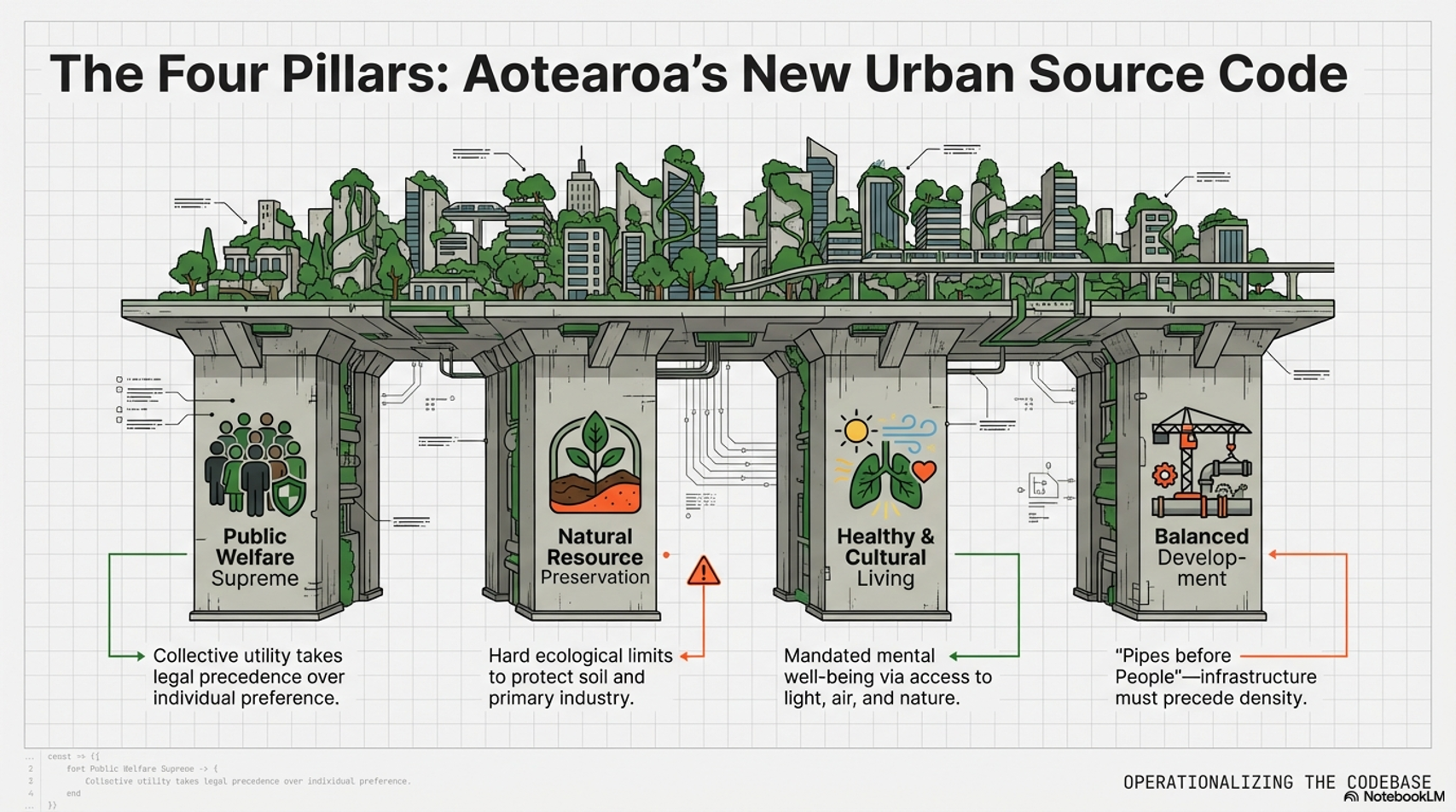
Public Welfare Supreme be the actual Planning model for New Zealand?
With the Select Committee Report on the Planning Bill due back on July 20 (subject to no more delays), I am going to provide a very high level recap on where I think our Planning system should go. Remembering what I submitted on as a proposal blends the Japanese planning system with aspects of New Zealand’s. Private Property Rights are still very much present in what I submitted on, but the overarching nature of what is called Public Welfare Supreme sits at the top of my proposed planning system.
So, lets take a look back in what I proposed. My 172-page submission is at the bottom if you want some light reading as it were.
1. The Hook: The Death of the Dormitory Suburb
For three decades, New Zealand’s urban development has been paralyzed by “Grey Inertia”—a massive regulatory debt accumulated under the Resource Management Act (RMA). This era was defined by a subjective, litigious “culture of permission” that made building anything from a terrace house to national infrastructure a process of “death by a thousand cuts.” The result? Isolated dormitory suburbs that prioritize individual property rights over the functional health of the collective.
Could we see a “System Upgrade” through the proposed Aotearoa Planning Bill? If New Zealand wanted it, this framework, championed by planner Ben Ross, seeks to pay down our regulatory debt through a 4-level Hierarchical Funnel Framework. By locking in decisions at the top—Goals and National Instruments—and flowing them down into Regional Combined Plans, we eliminate the ability to relitigate strategic growth at the final Consent stage. It is a shift from a “Property Rights Supreme” model to a Public Welfare Supreme model, moving toward an objective Culture of Adherence designed to build resilient, human-scale habitats.
2. The 3-30-300 Rule: Nature as a “Green Utility”
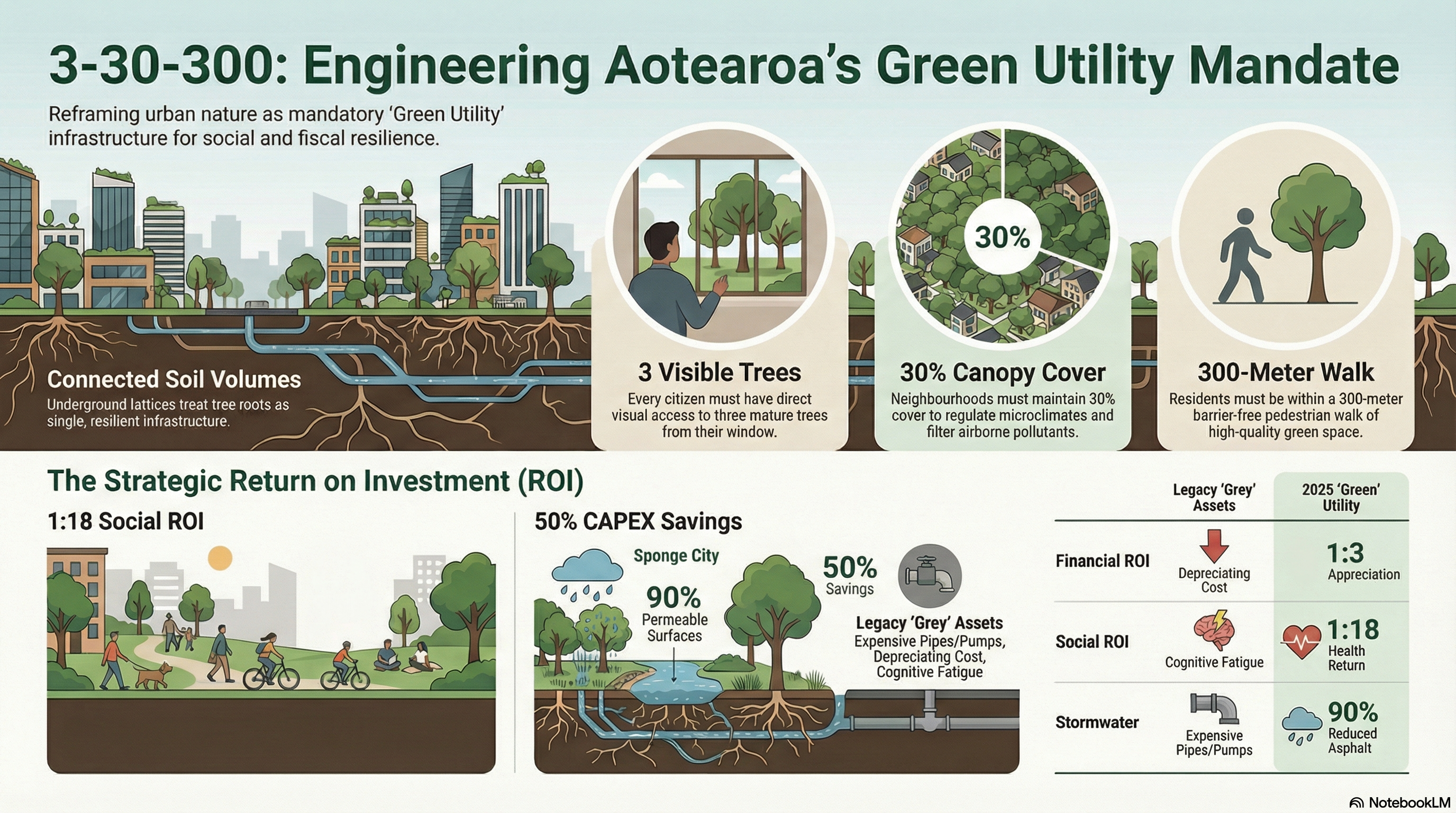
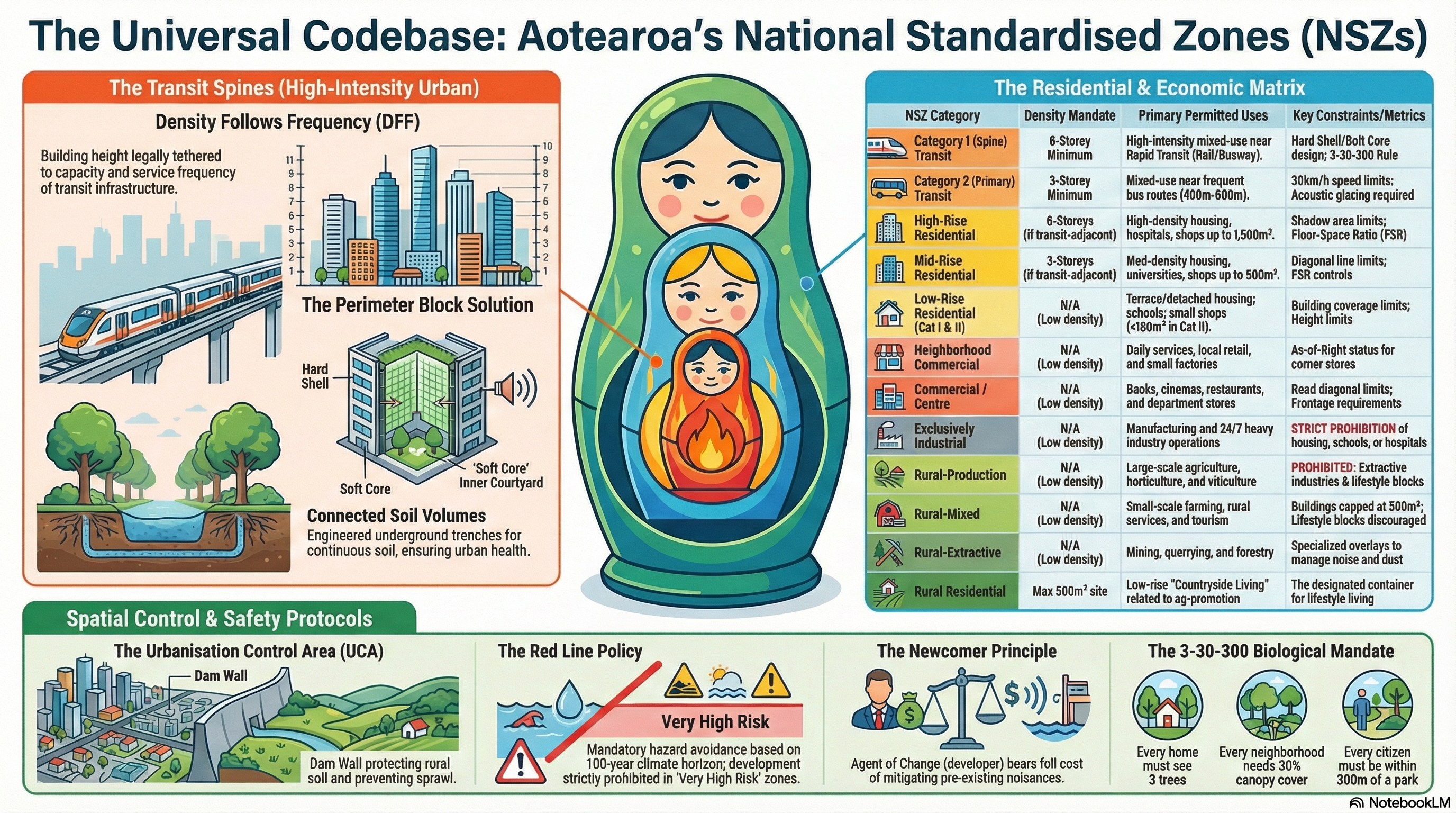
Modernist planning often treats parks and trees as aesthetic luxuries—the first items to be value-engineered out of a budget. The new framework flips this logic, hardcoding nature as a mandatory Green Utility or biological infrastructure. The 3-30-300 rule establishes three non-negotiable metrics for public health:
- 3 Visible Trees: Every resident must see at least three mature trees from their window to facilitate “cognitive restoration.”
- 30% Canopy Cover: Every neighbourhood must maintain 30% cover to regulate microclimates and mitigate the Urban Heat Island effect.
- 300-Meter Walk to Green Space: Every citizen must live within a 300-meter, barrier-free pedestrian walk of a high-quality park (0.5 to 1.0 hectares).
To ensure these trees thrive, the framework mandates Connected Soil Volumes—underground trenches that allow root systems to share nutrients. This isn’t just about “wellness”; it’s about the bottom line. By treating nature as a “Sponge City” utility, we can reduce impermeable surfaces by 90% and cut infrastructure capital expenditures by 50%.
“By utilizing these ‘Sponge City’ biological layouts… the city can generate a 1:18 Social ROI through improved public health and active travel.”
3. The Urban Dam: Managing the “Hydraulic Pressure” of Growth
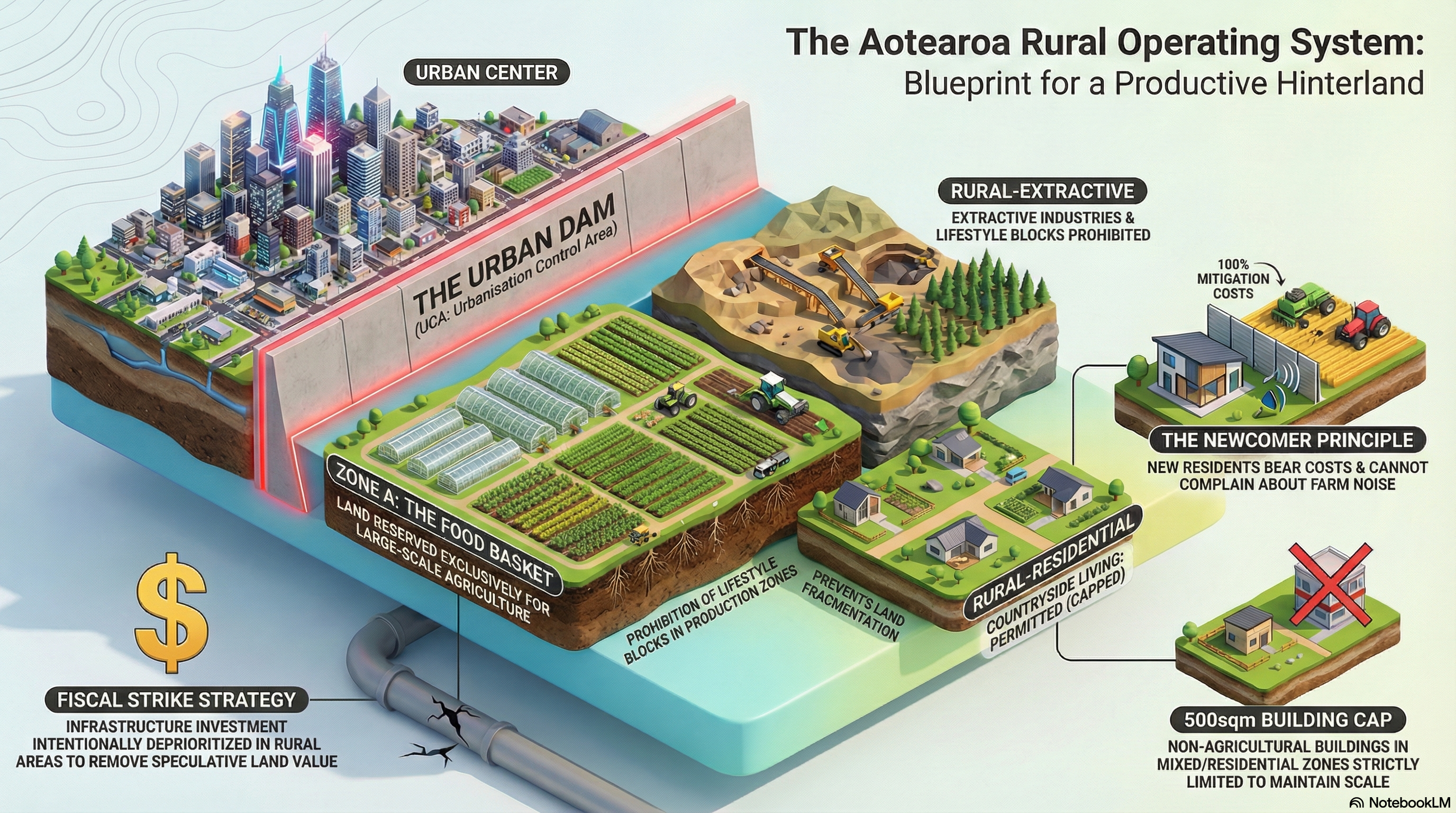
To stop the “leakage” of urban sprawl into productive farmland, the framework introduces the Urban Dam. This mechanism manages the “hydraulic pressure” of rising land values through two distinct zones:
- The Reservoir (Urbanisation Promoting Area – UPA): These are designated growth zones with a 10-year horizon. Development here is governed by an Infrastructure First mandate; the state provides the “skeleton”—sewerage, streets, and transit—and density is permitted to follow.
- The Stop Valve (Urbanisation Control Area – UCA): Outside the dam wall, urbanization is prohibited in principle. By explicitly deprioritizing infrastructure investment here, the system effectively evaporates speculative land-banking value. This protects the “Food Basket” (Rural-Production zones) from fragmentation, ensuring land is priced for what it grows, not what it could be.
4. The Video Game Sandbox: Planning in Cities Skylines
In a move that bridges the gap between theory and reality, planners are now using urban simulators like Cities Skylines as professional sandboxes. Ben Ross utilizes his virtual city project, “Waikato,” to test spatial plans without the hurdles of “political partisan pontification” or “endless business cases.”
This virtual environment allows for the implementation of Transit by Design, where functional public transportation networks are established before the first virtual resident moves in. These simulations now serve as the visualization layer for AI-generated blueprints. Ross’s submission to the Planning Bill included concepts for the Auckland Regional Combined Plan co-developed with Large Language Models (LLMs), proving that AI can draft simplified policy that functions at the street level.

5. The Newcomer Principle: The “Invisible Shield”
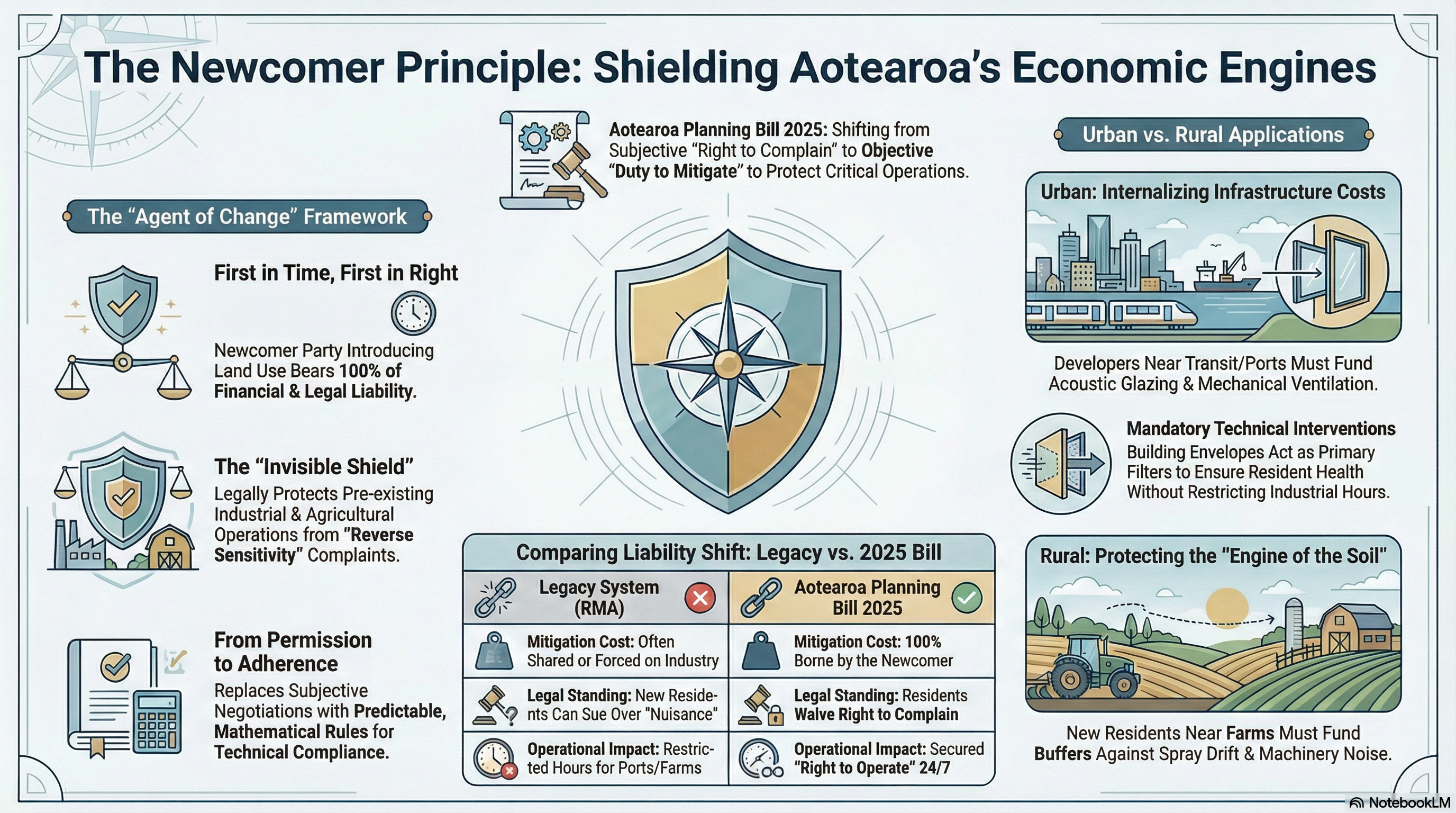
A primary barrier to high-density housing is “reverse sensitivity”—where new residents complain about the noise of existing economic engines. The framework settles this through the Newcomer Principle (also known as the Agent of Change).
Under this rule, the newcomer bears the cost of mitigation. A developer building apartments near a 24/7 port must install a Hard Shell—high-specification acoustic glazing and mechanical ventilation—to protect residents. This allows for a Soft Core—internal green courtyards—where residents find peace. This principle ensures that ports and railways can operate at peak productivity without fear of litigation.
“The Aotearoa Planning Bill 2025 represents a fundamental ‘Operating System’ upgrade… transitioning from a ‘Property Rights Supreme’ philosophy to a ‘Public Welfare Supreme’ model.”
6. Inclusive Zoning: The “Russian Doll” Model
The proposed reform replaces the current mess of 1,175 local zones with a universal codebase of 13–20 National Standardised Zones (NSZs). This model is adapted directly from the Japanese 1974 Land Use Planning Act, which treats zoning as an “Urban Operating System.”
Central to this is Inclusive Zoning, or the Russian Doll model. In this system, mixed-use activities like cafes, dairies, and salons are permitted as-of-right in residential areas. This activates the 15-minute city, creating a Linger Factor where pedestrians—who spend 66% more at local businesses than drivers—can meet their daily needs within a short walk, turning single-use housing pods into complete neighbourhoods.
7. KISS: The Power of Unapologetic Language
To ensure speed and efficiency, the framework applies the KISS (Keep It Simple, Stupid) principle to legislation. Using AI to strip away bureaucratic jargon, the Auckland Regional Combined Plan concepts utilize Unapologetic Language to create absolute clarity for developers and citizens alike.
The system moves away from subjective “character reviews”—which are often just a mask for NIMBYism—and toward Mathematical Adherence. If a project fits the defined “mathematical envelope” of the zone, it achieves “Permitted Activity” status automatically. This streamlines the administrative funnel, ensuring the planning system acts as a facilitator of growth rather than a gatekeeper of inertia.
Conclusion: The Triple ROI
The transition to a Public Welfare Supreme model delivers a strategic Triple ROI:
- Legal Certainty: Liquidation of project-level litigation through objective codes.
- Economic Scale: Universal standards that allow for industrial-scale construction pipelines.
- Long-term Resilience: Mandatory hazard avoidance and the integration of green utilities.
As we move toward 2027, we must ask: Are we willing to trade the absolute “private property rights” of the past for a guaranteed public welfare habitat that actually works for everyone?


