Category: General

Everything else

Calls for Balance on the Cultural Impact Assessments

Council calls for balance in-lieu of a public meeting by a protest group tomorrow


From Auckland Council

Cultural impact assessments: balance needed


“Protecting Auckland’s cultural heritage is a key part of Auckland Council’s job but so is making sure consent applicants don’t find themselves tied up in unnecessary red tape,“says Roger Blakeley, Auckland Council’s Chief Planning Officer.

“There is always a balance to be struck.”

Dr Blakeley was responding to public debate about the proposed Auckland Unitary Plan provisions concerning mana whenua including a public meeting tomorrow organised by the group Democracy Action.

He says the rules in the proposed Unitary Plan regarding sites of significance or value to mana whenua were brought in following feedback the council had received on the draft plan asking for more protection for cultural sites and places.

The Unitary Plan hearings process is now underway and the Independent Hearings Panel will review the rules as people have their say.

The Proposed Auckland Unitary Plan (PAUP) provides greater emphasis on the consideration of Mana Whenua values, establishing a framework for Auckland Council and Mana Whenua to work together.

It contains a range of provisions relating to Te Tiriti o Waitangi, intended to meet the council’s broad obligations under the Resource Management Act.

“In the meantime, we need to keep focusing on a balanced, workable approach. The ‘Cultural Impact Assessment’ that critics have been complaining about isn’t new – it’s been around for years.”

It is currently required in a very small number of cases where a property is near a site that is of value or significance to mana whenua and involves changes that could potentially impact those sites. This can include, for example, former burial sites or pa sites.

In the last six months, Auckland Council has processed over 6000 resource consents and less than 200 of them (3%) triggered a possible assessment. There have been 50 site visits and 12 cultural impact assessments formally requested in that time. 

“As a council we’ve worked closely with iwi to find ways to minimise the impact on landowners and have introduced a facilitation service to simplify the process.

“This involves the council contacting iwi on behalf of the applicant, and the iwi will say whether an assessment is needed. Most people are taking advantage of the facilitation service.

“There is a misconception that these assessments involve some kind of veto from iwi. They don’t. They are about iwi providing expert advice. The council takes that expertise into account, but it is the council that makes the decision.

“While we continue working towards the right balance, it’s good to remember just how important protecting our Māori heritage is to Aucklanders – including recent arrivals who really embrace this aspect of their new home. It is our point of difference in the world. Like other global cities, we want to retain our heritage, as an important part of our culture and identity.”

—-Ends—-


Quoting again: In the last six months, Auckland Council has processed over 6000 resource consents and less than 200 of them (3%) triggered a possible assessment. There have been 50 site visits and 12 cultural impact assessments formally requested in that time. 


RMA Reforms to Get Under-way – In Earnest

Reforms to tackle housing affordability?


From the Minister for the Environment – Dr Nick Smith

Reform of RMA critical to reforming housing affordability

The Resource Management Act needs to explicitly recognise the importance of New Zealanders’ access to more affordable housing if the downward trend in home ownership over the past 20 years is to be reversed, Building and Housing, and Environment Minister Dr Nick Smith said today at the Property Council New Zealand’s Residential Development Summit in Auckland.

“The Resource Management Act must safeguard our natural environment but it is also a crucial piece of planning legislation. It forms the basis for the decisions that determine what we can do on our land. So it’s important we have a system that balances environmental protection with the wider needs of New Zealanders. We need a system which ensures that important environmental standards are maintained, but that which also enables growth and development – including a strong housing supply,” Dr Smith says.

“It is the price of land and sections that has gone up so rapidly in unaffordable housing markets like Auckland, and it is the Resource Management Act and how it is implemented that is largely responsible for this cost escalation. The new law allowing Special Housing Areas is a short-term fix but we must address the fundamental problem with the Resource Management Act if we are serious about long-term housing affordability.

“The vast bulk of consent processes under the Resource Management Act are about urban development, yet they barely rate a mention in the purposes and principles of the Act. This is why the Government is determined to make changes. We need to get everybody working in the resource management area from a policy, planning and consent perspective to understand how their decisions impact on young Kiwi families who aspire to own their own home.

“I welcome the challenge working as Building and Housing, and Environment Minister. No one Minister has previously been responsible for the full regulatory framework affecting housing, from subdivisions, building consenting to occupational regulation. This presents the opportunity to streamline how we develop new housing so as to increase housing supply and affordability.”

….

Source: http://beehive.govt.nz/release/reform-rma-critical-reforming-housing-affordability#.VD2xNLdkiz0.twitter


It will be interesting to see what comes about when the draft reforms list is finally released – most likely by Christmas if the Government is going full speed on this.

Still I wonder if we would have been better served if we had a Planning Minister: Queensland Gets It Right, Auckland Continues to Dither and Get it Wrong

Also the old issue of property rights is bound to crop as well: Property Rights and the Unitary Plan


So lets see what the reforms do truly give us….


Developments from the Unitary Plan Hearings

Contention around access to resources for Community Groups


I have seen this from Local Board Chair Peter Haynes in regards to a motion Councillor Cathy Casey put forward at the Unitary Plan Committee today:

At the open meeting of the Council’s Unitary Plan Committee. Cathy Casey moved for a report to prolong the hearings process to assist community groups faced with a very unequal battle against major developers such as Eden Park. I urged the Governing Body to give serious consideration to resourcing certain community groups to engage expert witnesses. My colleague from Orakei, Desley Simpson also spoke about the difficulties the convoluted hearings process pose for such groups. Sadly, Cathy’s motion was lost on Alf Filipaina’s casting vote.

I have noted from a couple of Procedural Minutes from the Independent Hearing Panel for the Unitary Plan as well as the Committee Agenda (see: website down so will get the link when it is back up) that the Council nor the Hearings Panel are particular interested in making resources available to submitting groups so that they can front the Hearings Panel better equipped. Furthermore the Minister for the Environment has refused access to those resources as well.


It definitely seems so after my previous Unitary Plan Hearings Already Into Trouble? first pointed it out.


AMETI Part One – Walking/Cycling Day

Your Chance to Walk AMETI Part One before it opens


From Voxy

Walk or cycle Auckland’s new road and tunnel at Panmure

Auckland’s newest road is expected to take thousands of trucks a day off Panmure roads when it opens to traffic in early November.

Auckland Transport will open the 1.5km Te Horeta Rd in Panmure to traffic on Sunday 2 November. The road goes through a 220m tunnel, has new cycle lanes and a shared cycle and foot path alongside, which will all open at the same time.

A community event will be held on Saturday 1 November so people in the area can walk or cycle through the tunnel, along the road and on the shared path.

Completing the new road is the final major milestone for the $180m first stage of the Auckland Manukau Eastern Transport Initiative (AMETI). It also included building the new Panmure Station, three new bridges and new cycling and walking links.

AMETI is a group of projects aimed at giving people in the south-eastern suburbs improved transport choices and better connections to the rest of Auckland. See an aerial video and photos of the new road, station and other upgrades here: at.govt.nz/projects-roadworks/ameti/.

Auckland Transport Chairman, Dr Lester Levy says completing the first stage of AMETI will be an important milestone for transport improvements in the area.

“People in the area are beginning to realise the benefits of the longer term programme of improvements for the south east. It is also one of the first major transport infrastructure projects to be completed by Auckland Transport since the new Auckland Council was established.”

AMETI Programme Director, Peter King says the new road is expected to carry 20,000 vehicles a day, including 2400 trucks.

“Te Horeta Road will link Morrin Rd to Mt Wellington Highway to cut peak journey times between Mt Wellington and Glen Innes.The direct link will bypass the Panmure roundabout and Ellerslie-Panmure Highway, easing congestion on this route.

…..

Full details, article and source: http://www.voxy.co.nz/national/walk-or-cycle-aucklands-new-road-and-tunnel-panmure/5/204559


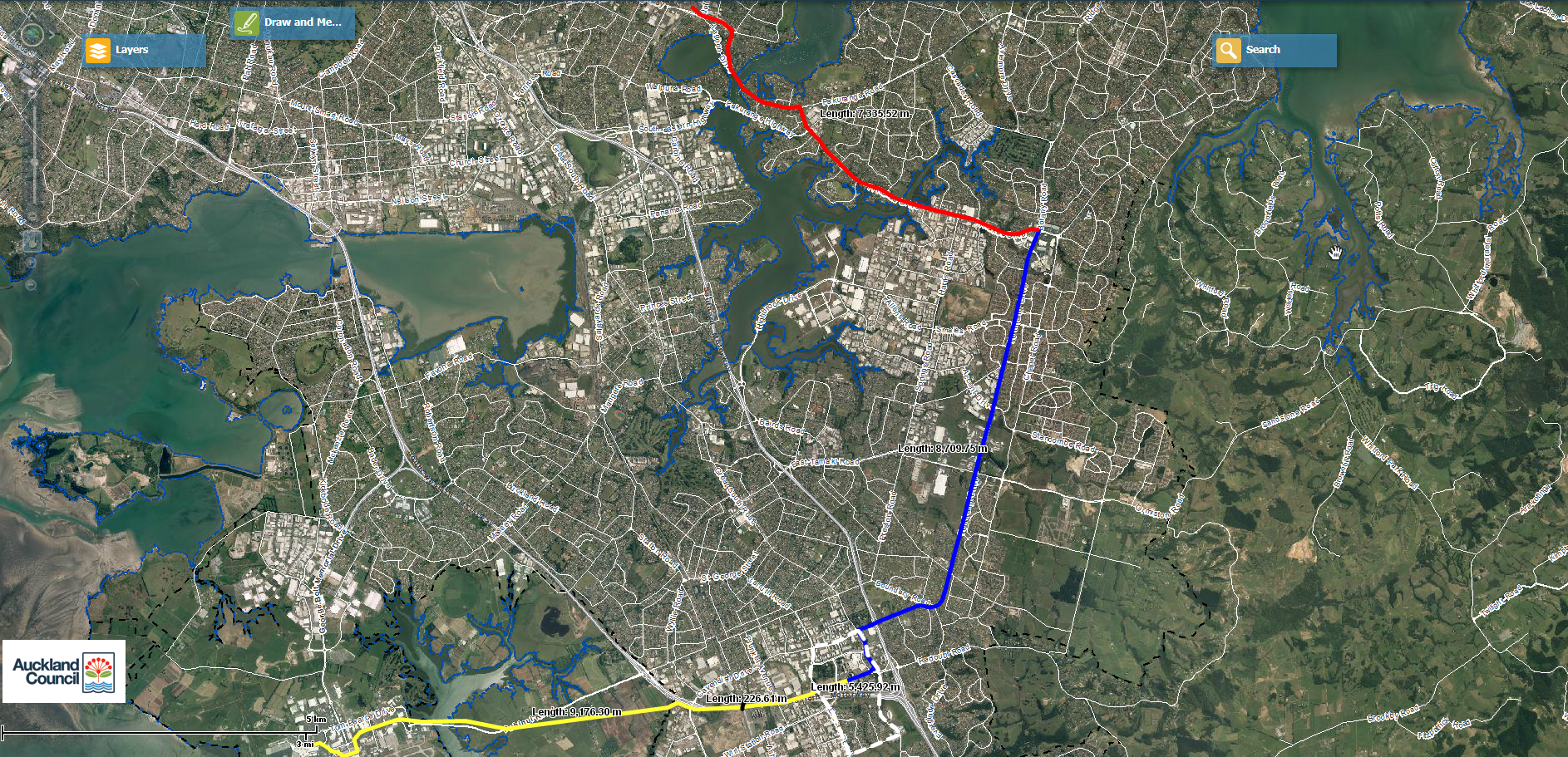
Now to get Part Two under-way. The Busway from Panmure Station to Pakuranga Town Centre. Parts Three and beyond would be extending that bus way to Botany and Manukau City Centre forming the South Eastern Bus-way. In due time it can be converted to rail to form the Botany Line (The Botany Line Sky Train)

The Botany Line Sky Train Route


Auckland Transport’s Continued Failure

Stronger Action Needed – NOW


Credit is due where credit is due as I always say. NZTA’s Auckland Division is pretty good with the Tweets on happenings around the State Highway Network, major incidents on our arterial roads, events, and from time to time even public transport even though NZTA’s main jurisdiction is the State Highways with Auckland Transport supposedly meant to be picking up the rest.

Well Auckland Transport seems to be absolutely tone-deaf to happenings around its own network including the trains while NZTA seem to be slowly filling the gap as resource and skill allows.


This morning something went wrong on the Western Line (update: Breakdown) causing delays, cancellations, and over crowded trains having to skip stations in their trip to Newmarket and Britomart thus leaving passengers behind. Now if that was not causing enough angry Tweets from commuters then this next bit would.

Reports came in pretty fast that due to an over crowded train on the Western Line, a poor passenger had collapsed and required medical treatment at Baldwin Avenue Station. Of course this is going to cause further delays but having a passenger collapse due to over crowding trains is not on by any stretch.

Now when you have disruptions on a public transport network you expect Tweets, Facebook Messages, and even phone texts to go out just like Civil Defence did in the blackouts earlier this week. This way people are alerted and can make decisions rather than standing at a station wondering when their next train would come. Social media these days allows rapid and near instant communication to the world of such situations. Of course Auckland Transport could have diverted Southern Line trains to go do some shuttling between New Lynn and Newmarket to assist and rail buses (or just alerting people to go use the bus with AT-HOP universal across the system) being dispatched would have further assisted the Western Line.

But what did we get? Until about two paragraphs ago in writing this post we got absolutely nothing from Auckland Transport across the media spectrum AT ALL. Result? The Baldwin Avenue incident which is very easily avoided.


So while this incident occurs the Auckland Transport CEO gets a pay rise, and the head of Comm’s as well as the Chief Operation Officer twiddle their thumbs.

Bit unacceptable while Auckland Transport has failed to deliver most of its targets?

Call me a bit of an old fashion person but I thought when a leader failed to deliver their targets set out it was instant dismissal. How times have changed.


And as I finish this up I just saw this:


Horse long bolted